Top 12 Benefits of CMMS Software for Schools and Universities
By jogan miller on March 17, 2026
A school district in Ohio was spending 68% of its maintenance budget on emergency repairs — broken HVAC systems mid-winter, burst pipes during exam week, electrical faults that evacuated classrooms on test days. The facilities director had a team of 14 technicians, a backlog of 340 open work orders, and no visibility into which buildings were most likely to fail next. Six months after deploying a CMMS, emergency repair spending dropped to 31% of budget. Technicians were completing 40% more work orders per week. Three buildings that had historically generated emergency calls every month went twelve months without a single unplanned breakdown. The change wasn't new staff or new equipment — it was structured information, automated scheduling, and a single system that connected every request, every asset, and every maintenance decision across the district. Oxmaint is purpose-built for educational facilities — from single schools to multi-campus universities. Book a demo to see how it works for your institution.
68%
Avg emergency repair share in schools without CMMS
40%
More work orders completed per week after CMMS deployment
$0.29
Per sq ft annual maintenance cost at world-class K–12 facilities
3.2x
Average ROI on CMMS investment within 18 months in education
See All 12 Benefits in Action at Your Institution
Oxmaint powers maintenance operations for schools, districts, and universities — from teacher request portals to automated compliance reporting.
Why Educational Facilities Need a CMMS More Than Most Industries
Educational facilities carry a maintenance burden that most industries don't face: the people inside them are children and young adults whose health, safety, and academic performance are directly affected by the condition of the building. A classroom with a malfunctioning HVAC system doesn't just inconvenience workers — it reduces cognitive performance, triggers asthma episodes, and generates parent complaints that reach school boards within hours. A campus where deferred maintenance has accumulated $4 million in unaddressed repairs is not just an operational problem — it is a liability, a compliance risk, and a student recruitment handicap. CMMS software addresses all of these dimensions simultaneously, transforming maintenance from a reactive cost centre into a proactive, data-driven operation that protects students, supports staff, and justifies its budget with documented results.
Key Insight
The average US school building is 44 years old. At that age, deferred maintenance accumulates at $0.50–$0.80 per square foot per year without structured PM programmes — a $250,000–$400,000 annual liability for a 500,000 sq ft campus that CMMS-driven maintenance prevents.
The 12 Benefits — Overview
The twelve benefits below are organised in order of financial impact for most educational institutions. Emergency repair reduction and compliance automation deliver the fastest ROI. Academic calendar scheduling and energy management deliver the largest long-term savings. Teacher request portals and student safety improvements deliver the outcomes that matter most to parents, boards, and accreditation bodies.
12 Benefits of CMMS for Schools & Universities — At a Glance
01
Emergency Repair Reduction
Preventive maintenance eliminates the reactive failures that consume 40–70% of school maintenance budgets
02
Automated Compliance Reporting
Fire safety, OSHA, ADA, and health inspections documented automatically — audit-ready at all times
03
Academic Calendar Scheduling
Major maintenance windows aligned to school breaks — zero disruption to instruction time or exam periods
04
Energy Cost Reduction
Well-maintained HVAC, lighting, and building systems reduce energy waste by 15–25% across campus
05
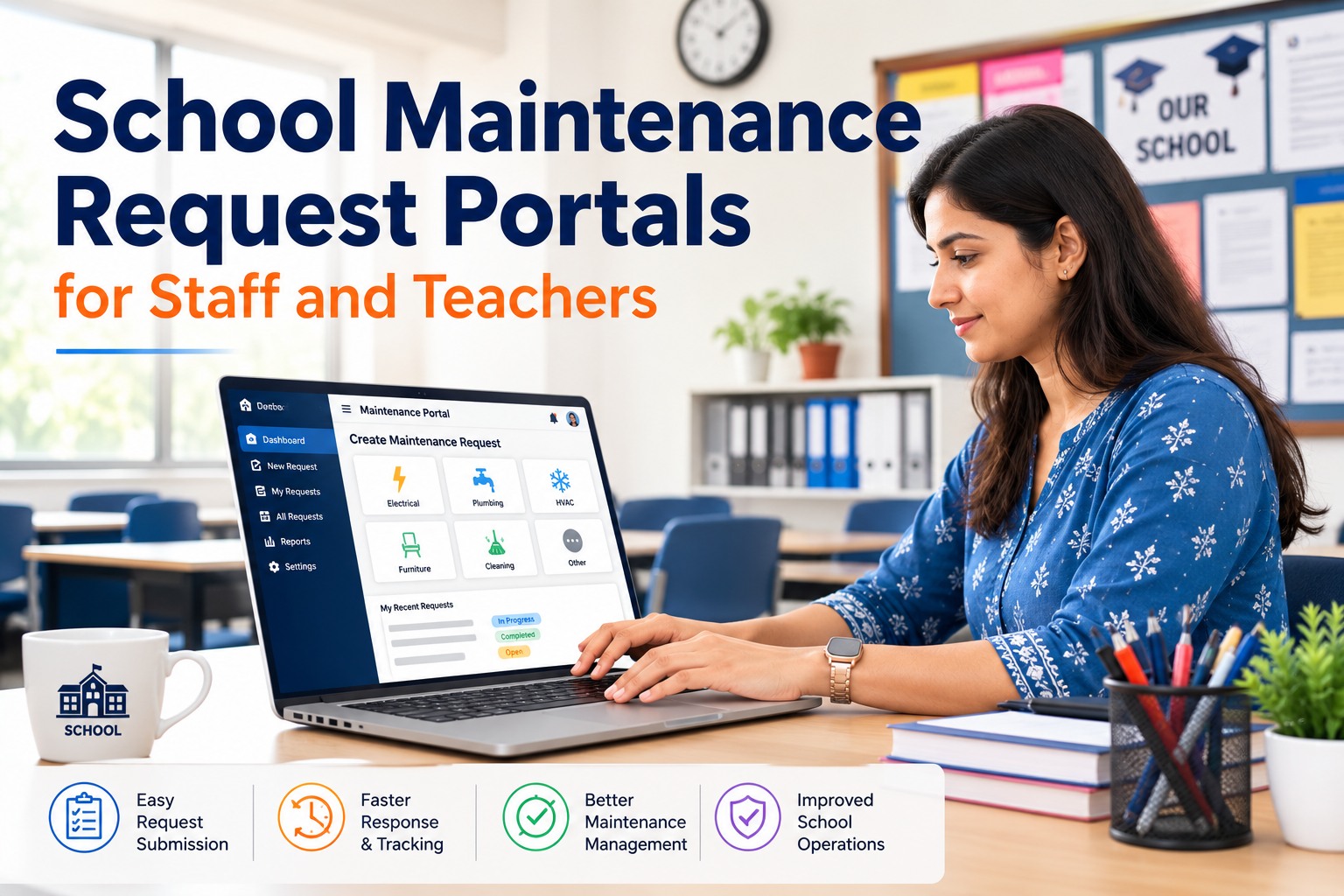
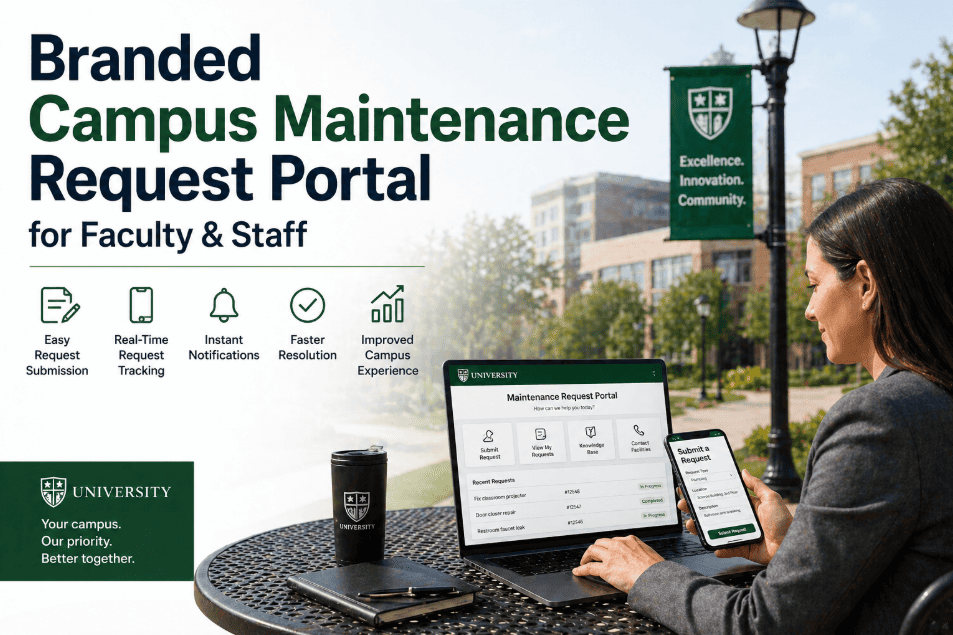
Teacher Request Portal
Staff submit maintenance requests from any device — tracked, prioritised, and closed with automatic status updates
06
Deferred Maintenance Reduction
Structured backlogs and priority scoring prevent the $4–12M deferred maintenance liability that builds invisibly at underfunded campuses
07
Student Safety Improvement
Playground equipment, fire suppression, electrical systems, and indoor air quality maintained on documented schedules — not when they fail
08
Asset Life Extension
PM programmes extend HVAC, boiler, and roof system life by 30–60% — deferring capital replacement by years
09
Multi-Site Visibility
District directors see every building's maintenance status, backlog, and compliance state from one dashboard — no more phone-around status checks
10
Budget Justification & Reporting
Labour costs, material spend, and maintenance ROI documented automatically — board presentations backed by data, not estimates
11
Contractor Management
External vendors, elevator companies, and specialist contractors managed through the same system — certificates, work orders, and invoices in one place
12
Accreditation & Inspection Readiness
Regional accreditation bodies and state inspectors receive complete maintenance documentation — digital, timestamped, and exportable in minutes
Benefit 1: Emergency Repair Reduction — The Highest-ROI Starting Point
Emergency repairs cost educational institutions 3–5x more than the same work performed on a planned schedule. A bearing replacement planned two weeks in advance costs $380 in parts and 2 hours of labour. The same bearing failing on a Friday evening before a Monday exam period costs $1,200 in emergency parts procurement, 6 hours of overtime labour, and potentially a weekend classroom shutdown that triggers parent complaints and administrator intervention. For a typical K–12 district spending $2.4 million annually on maintenance, shifting from 65% reactive to 30% reactive maintenance represents $840,000 in annual savings — without adding a single staff member.
Emergency Repair Cost Comparison — Planned vs. Reactive
Typical cost differential for common school facility maintenance tasks — planned schedule vs. emergency response
Task
Planned Cost
Emergency Cost
HVAC Bearing Replacement
$380
$1,200
Boiler Heat Exchanger Repair
$1,800
$6,400
Roof Leak Repair (minor)
$420
$2,200 + interior damage
Electrical Panel Fault
$650
$3,100 + evacuation cost
Plumbing Pipe Failure
$290
$1,800 + water damage
Fire Suppression Inspection Fail
$180 (PM catch)
$8,000 + regulatory penalty
Schools with CMMS-driven PM programmes typically achieve 60–70% planned maintenance ratios within 12 months — cutting emergency spend by $180,000–$420,000 per year for a mid-size district.
Benefit 2: Automated Compliance Reporting
Educational facilities carry one of the heaviest compliance burdens of any building type. Fire suppression systems, emergency lighting, elevator certifications, asbestos management, lead paint monitoring, playground safety inspections, food service equipment, and ADA accessibility maintenance all require documented, timestamped evidence of completion — not just completion itself. A single failed fire suppression inspection that wasn't documented costs a district $8,000–$25,000 in penalties plus the liability exposure of an undocumented system. CMMS automates the scheduling, execution reminder, technician sign-off capture, and report generation for every compliance task — so audit readiness is a permanent state, not a three-week scramble before the inspector arrives.
Key Insight
The average K–12 district manages 140–280 compliance inspection tasks per year across its building portfolio. Without CMMS, tracking these manually across spreadsheets, emails, and physical binders means 15–25% of tasks are either late or undocumented — creating regulatory exposure that typically exceeds the annual cost of the CMMS platform itself.
Compliance Categories CMMS Automates for Educational Facilities
Life Safety Systems
Annual + Monthly
Fire extinguisher inspections, sprinkler system flow tests, emergency lighting battery tests, smoke detector verification, and exit sign checks. Auto-scheduled with technician mobile sign-off and photo capture. Audit report generated in one click.
Environmental Health
Quarterly + Annual
Asbestos-containing material inspections, lead paint monitoring in pre-1978 buildings, IAQ ventilation checks, mould assessment protocols, and drinking water quality verification. Documented chains of custody for all environmental testing.
Equipment Certifications
Annual
Elevator and lift certifications, playground equipment safety inspections (ASTM F1292), kitchen equipment health department certification, boiler pressure vessel inspections, and gym equipment safety checks — all with expiry tracking and auto-renewal alerts.
Benefit 3: Academic Calendar Scheduling
Educational maintenance has a unique scheduling constraint that commercial facilities don't face: the academic calendar. Major HVAC overhauls, roof replacements, electrical upgrades, and deep cleaning cycles must fit into summer breaks, spring holidays, and teacher work days — or they disrupt instruction. Without CMMS, facilities directors plan these windows mentally, miss the optimal scheduling slots, and end up either rushing work during breaks or doing it during term time when it causes complaints. CMMS integrates academic calendar data with maintenance planning — automatically proposing windows for major work, alerting planners when high-disruption tasks are scheduled during instruction periods, and building the long-term capital maintenance plan around school calendar constraints.
Academic Calendar Maintenance Planning — Summer Break Capacity Example
Available Window = Break Days × Daily Capacity − Staffing Constraints
Worked Example: 10-School District Summer Break Planning
1
Summer break: 58 working days — 11 weeks with 3 days staff training = 55 maintenance days
2
Team capacity: 14 technicians × 8 hrs = 112 technician-hours/day available for major work
3
Prioritised backlog from CMMS: 4,840 hours of deferred and planned summer work
4
Capacity gap: 4,840 − (55 × 112) = 680 hours requiring contractor resource — identified in February, not July
Without CMMS, this capacity analysis happens in the first week of summer break when contractors are already booked. With CMMS, it happens in January — giving facilities directors time to budget, procure, and schedule contractors before the peak summer demand window.
Benefit 4: Energy Cost Reduction
Energy is the second-largest operating cost for most educational institutions after staffing — and maintenance is the single largest controllable driver of energy efficiency. A school HVAC system operating with dirty filters, misaligned dampers, degraded insulation, and uncalibrated controls consumes 18–30% more energy than the same system properly maintained. Across a 500,000 sq ft campus spending $800,000 annually on energy, that represents $144,000–$240,000 in avoidable energy cost. CMMS-driven PM programmes ensure filter changes, belt replacements, coil cleaning, and control calibration happen on schedule — converting energy savings from an aspiration into a documented, reportable outcome.
Energy Savings from CMMS-Driven PM — University Campus Example
500,000 sq ft campus — $820,000 annual energy spend — CMMS deployed Year 1
HVAC Filter & Coil PM
Monthly filter changes + semi-annual coil cleaning reduces HVAC energy draw by 12–18%
Weatherstripping, window seal, and door hardware PM reduces heat loss — 8% reduction in heating load
$24,000/yr
Lighting System PM
Ballast, sensor, and timer maintenance ensures lighting controls function as designed — 6% lighting energy reduction
$14,000/yr
Boiler & Hot Water System PM
Burner tuning, heat exchanger cleaning, and insulation maintenance — 9% efficiency recovery on heating systems
$29,000/yr
Total Annual Energy Savings
$137,000/yr
Energy savings alone typically cover 60–100% of annual CMMS platform cost for mid-size educational institutions — making the platform effectively self-funding within the first year of structured PM operation.
Benefits 5–8: Portals, Deferred Maintenance, Safety & Asset Life
The middle tier of CMMS benefits in educational settings addresses the operational experience of staff, the long-term financial health of the facility portfolio, and the safety outcomes that matter most to students, parents, and regulators. These four benefits are deeply interconnected — a working teacher request portal generates the data that prevents deferred maintenance, which directly improves student safety and extends asset life simultaneously.
Benefits 5–8: How They Connect and Compound
Benefit 5
Teacher Request Portal
Staff submit requests from any device — no phone calls, no paper forms, no "I told someone last week." Every request is logged, assigned, prioritised, and closed with a timestamped confirmation. Teachers receive automatic status updates. Principals see response time metrics. Nothing falls through the cracks.
Impact: 35% faster average request-to-resolution time. 94% staff satisfaction vs. 61% with phone/email systems.
Benefit 6
Deferred Maintenance Reduction
CMMS surfaces the backlog that spreadsheets hide. When every asset has a documented maintenance history and every incomplete task is visible in a prioritised queue, facilities directors can make data-driven arguments for budget allocation — and boards can see exactly what deferred work is accumulating before it becomes emergency spend.
Impact: Facilities with CMMS reduce deferred maintenance accumulation by 45–65% within 24 months of deployment.
Benefit 7
Student Safety Improvement
Playground equipment falls under ASTM F1292 and CPSC guidelines — routine inspections are mandatory, not optional. HVAC failures that cause CO2 build-up impair cognition. Electrical faults that go uninspected cause fires. CMMS ensures every safety-critical asset is inspected on schedule, with evidence, before failure — not after an incident triggers a review.
Impact: Schools with structured safety PM report 78% fewer safety-related incident reports tied to facility conditions.
Benefit 8
Asset Life Extension
A commercial HVAC unit has a design life of 15–20 years. In schools that run reactive maintenance, average replacement happens at 11–13 years. With structured PM, the same unit routinely reaches 18–22 years. On a campus with $4M of HVAC assets, that 5-year life extension represents $1M+ in deferred capital expenditure.
Impact: PM-maintained assets last 30–60% longer than reactively-maintained equivalents across all major school facility systems.
Ready to See What CMMS Does for Your Campus?
Get a live walkthrough of Oxmaint's education module — teacher portals, compliance automation, and academic calendar scheduling included.
The final four benefits operate at the organisational and governance level — they are the benefits that matter to district superintendents, university presidents, accreditation bodies, and school boards. Multi-site visibility, budget justification reporting, contractor management, and accreditation readiness collectively determine whether educational facilities leadership can make a defensible case for maintenance investment and demonstrate institutional accountability for the condition of every building under their management.
One dashboard shows every building's open work orders, compliance status, backlog value, and team utilisation. District directors spend 80% less time on status-gathering calls and 80% more time on decisions. Schools with the worst maintenance profiles are visible before they generate complaints.
Benefit 10: Budget Justification
Board-Level
Automated reports show cost-per-building, cost-per-sq-ft, emergency vs. planned ratio, and maintenance ROI — exactly the data school boards and university trustees need to approve maintenance budgets. Facilities directors who use CMMS data in budget presentations report 40% faster approval cycles.
Benefit 11: Contractor Management
Vendor Control
External contractors receive work orders, submit completion reports, and provide compliance certificates through the CMMS portal — eliminating the paper chase of emailed PDFs and phone confirmations. Insurance certificates, contractor performance ratings, and invoice approvals all in one system.
Benefit 12: Accreditation Readiness
Always Ready
Regional accreditation bodies (AdvancED, WASC, Middle States) require evidence of safe, well-maintained learning environments. CMMS produces a complete maintenance history — every inspection, every work order, every compliance certificate — exportable in minutes. Accreditation visits become routine, not crisis events.
CMMS ROI for Educational Institutions — The Full Picture
The combined financial impact of all twelve benefits produces a return that consistently surprises educational administrators who approach CMMS as a cost rather than an investment. For a typical mid-size school district managing 8–15 buildings with a $2–4 million annual maintenance budget, the total annual value delivered by a well-implemented CMMS ranges from $380,000 to $820,000 — against an annual platform investment of $18,000–$48,000. That is an 8–17x return, delivered across emergency savings, energy reduction, asset life extension, compliance penalty avoidance, and staff productivity.
Annual CMMS ROI — Mid-Size School District
12-building district — $3.1M annual maintenance budget — 85,000 students — CMMS Year 2 results
Emergency Repair Reduction
Reactive ratio drops from 64% to 28% — $1.98M emergency spend reduced to $868K
$312,000
Energy Savings
HVAC, boiler, envelope, and lighting PM restores 15–22% energy efficiency across campus portfolio
$137,000
Asset Life Extension
5-year average life extension on HVAC and roofing — annualised capital deferral value
$168,000
Compliance Penalty Avoidance
Zero late/missed inspections vs. 4–6 per year pre-CMMS at avg $4,200 penalty + remediation
$26,000
Staff Productivity Gain
14 technicians completing 40% more work orders — equivalent to 5.6 additional FTE capacity without new hires
$196,000
Total Annual Value Delivered
$839,000
Annual Oxmaint platform cost for a 12-building district: $22,000–$36,000. Net ROI: $803,000–$817,000. Return: 23–37x. Payback period: under 3 weeks of emergency repair savings.
Frequently Asked Questions
How long does it take to implement CMMS in a school district?
For a district of 8–15 buildings, a mobile-first CMMS like Oxmaint can be operational — with asset registry loaded, PM schedules active, and technicians using mobile apps — within 3–6 weeks. The first two weeks cover data import (asset lists, existing schedules, staff profiles). Weeks 3–4 cover technician training and first PM schedule activation. By week 6, most districts are completing their first full month of structured PM with compliance tasks tracked and teacher request portals live. Full ROI typically appears in months 3–6 as emergency repair frequency begins to decline.
Can teachers and non-maintenance staff submit requests without special training?
Yes — the teacher-facing request portal is designed for zero training. Staff access a simple web form or mobile link, describe the issue in plain language, optionally attach a photo, and submit. They receive automatic email or SMS confirmation with a reference number, and status updates as the work progresses. No login credentials required for requesters in most configurations. The simplicity of the requestor interface is specifically designed for educational environments where maintenance software adoption by non-maintenance staff is the primary implementation challenge.
How does CMMS help with state and federal compliance audits in schools?
CMMS generates a complete, timestamped maintenance history for every asset — every inspection completed, every work order closed, every compliance task signed off — exportable as PDF or Excel in minutes. When a state inspector arrives for a fire safety audit, the facilities director can produce a 12-month fire suppression inspection log covering every building in the district before the inspector finishes parking. For federal programmes like E-Rate, Title I facility compliance, and Healthy Schools Act requirements, the same documentation package covers all required evidence in one export.
What is the typical cost of CMMS for a K–12 school district?
For a district of 5–20 buildings, annual CMMS costs typically range from $12,000 to $48,000 depending on the number of buildings, technicians, and feature requirements. Oxmaint's education pricing starts at approximately $299 per month for a single-site deployment and scales to district-wide licensing at $1,800–$3,200 per month for 10–20 sites. Most districts find that energy savings alone — typically $80,000–$200,000 annually for a mid-size district — cover the full platform cost within the first two to three months of structured PM operation.
How does CMMS reduce deferred maintenance in schools?
Deferred maintenance accumulates when tasks exist but aren't tracked, prioritised, or scheduled — they stay invisible until something fails. CMMS makes the backlog visible: every incomplete task, its age, its priority, and its estimated cost appear in a structured queue that facilities directors can show to boards and budget committees. Visibility alone changes decision-making. Districts using CMMS report 45–65% reductions in deferred maintenance accumulation within 24 months — not because budgets increased, but because structured prioritisation ensures the highest-risk items are addressed before they become emergency replacements.
Built for Education
Give Your Students, Staff, and Board the Facility Operation They Deserve
Oxmaint's education CMMS combines teacher request portals, automated compliance scheduling, academic calendar planning, and real-time multi-site visibility into one mobile-first platform — built for the way school facilities teams actually work.
✓ Teacher & staff request portal — zero training required
✓ Automated compliance scheduling for 140+ task types
✓ Academic calendar-aware PM scheduling
✓ District-wide dashboard — every building, one screen