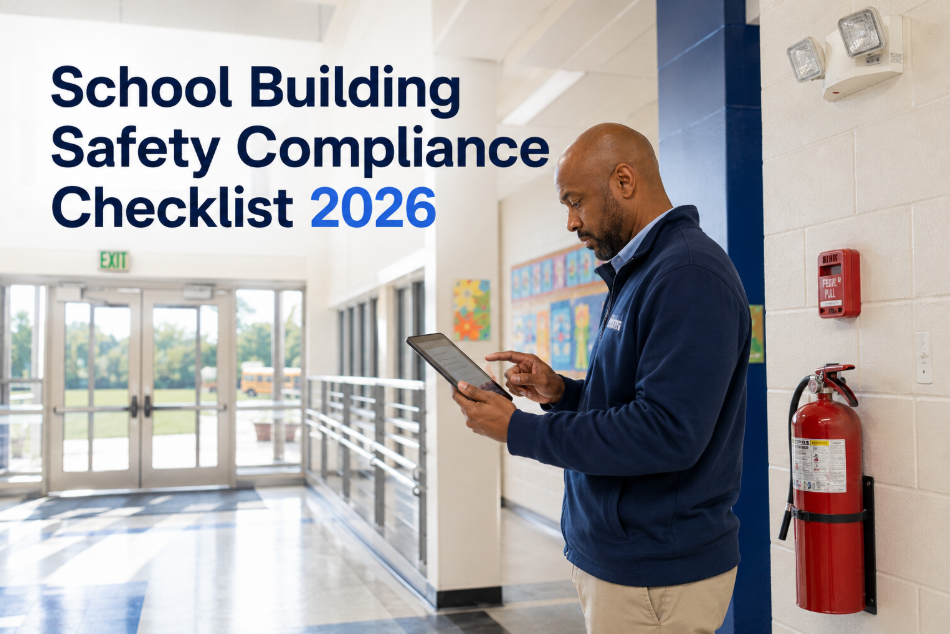
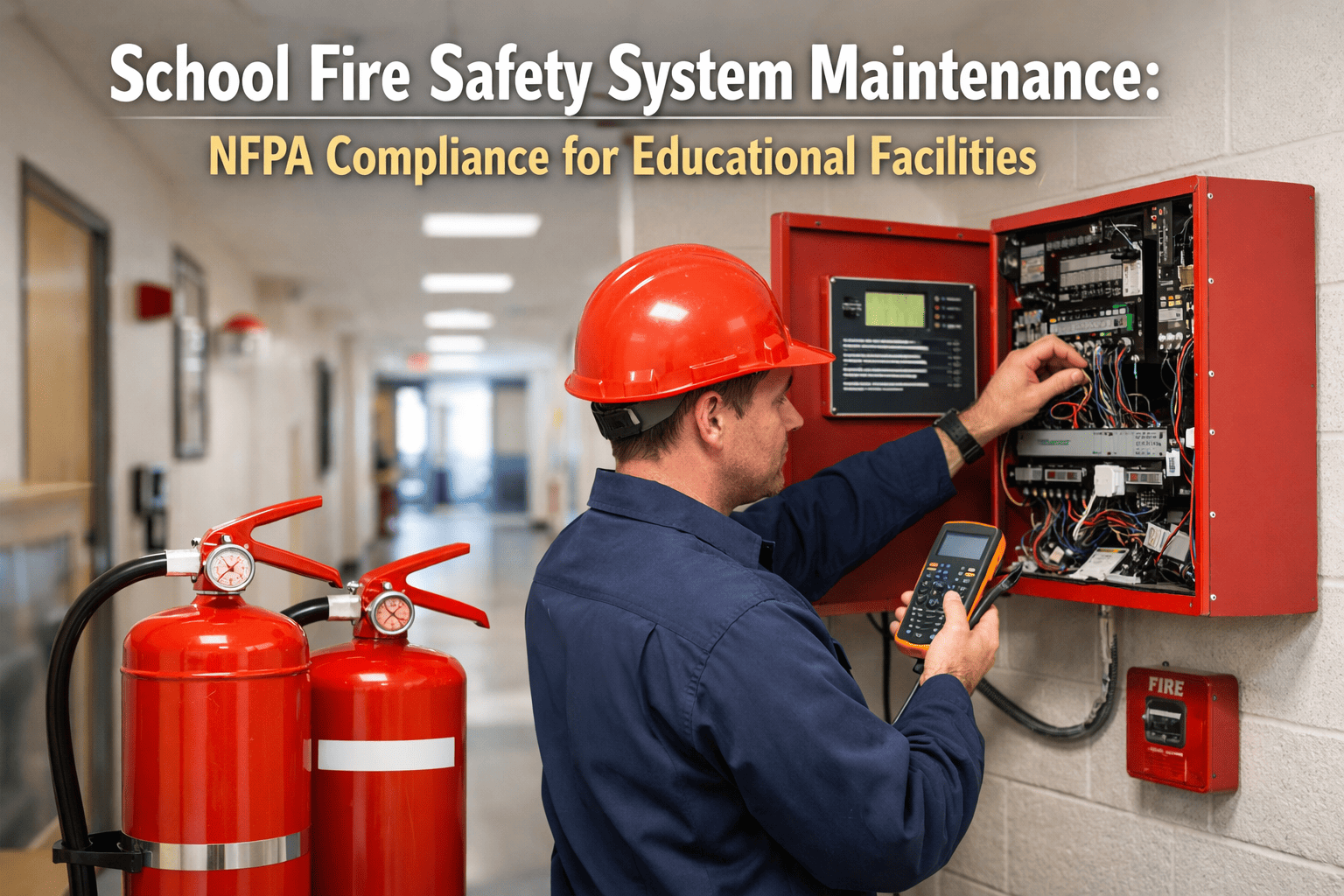
School facilities managers carry a compliance burden that most commercial property managers never face: fire alarm testing mandated by NFPA 72, accessibility equipment inspections under ADA, OSHA recordkeeping requirements, and playground safety standards — all running on overlapping schedules across dozens of buildings, with inspectors who can arrive unannounced and documentation that must be retrievable on demand. A missed inspection or an incomplete record is not just an administrative failure — it is a liability event and, in a fire emergency, a safety one. Start your free trial to automate school safety compliance in OxMaint. Book a demo to see how OxMaint handles fire, ADA, OSHA, and playground compliance for school districts.
Compliance & Audit Trail Management
Every Inspection Scheduled. Every Record Stored. Every Auditor Ready.
OxMaint automates fire alarm testing schedules, ADA equipment inspections, OSHA documentation, and playground safety checks — with timestamped sign-offs, photo evidence, and instant record retrieval for any inspector, any time.
72%
of school fire safety violations involve documentation gaps, not system failures
$15K+
average ADA non-compliance penalty per violation per day in a school facility
3x
more likely to pass unannounced inspection when compliance tasks are digitally logged
The Four Compliance Programmes Every School Facilities Team Must Run
School building safety compliance is not a single programme — it is four overlapping programmes, each with its own regulatory authority, testing intervals, and documentation requirements. The facilities team managing all four on paper, across multiple buildings, is managing four separate sources of institutional risk simultaneously.
Fire Alarm & Sprinkler
NFPA 72, NFPA 25
Missing test records, untested devices, failed device not retested
Citation + remediation order
ADA Accessibility
ADA Title II, ADAAG
Lift out of service, expired certificate, door opener force exceeded
$15K+/day per violation
OSHA Workplace Safety
OSHA General Duty, 29 CFR 1910
No LOTO procedure, missing Form 300, no annual EAP review
$16K per serious violation
Playground Safety
CPSC Handbook, ASTM F1487
No inspection record, surfacing below depth, broken equipment not closed
Civil liability exposure
Fire Alarm and Sprinkler Compliance: NFPA 72 and NFPA 25
NFPA 72 is unambiguous: devices must be tested at defined intervals, results must be documented, and records retained for a minimum of five years. The compliance failures happen not because tests are not done, but because documentation is not where it needs to be when an inspector asks for it.
Water-flow alarm devices — test and record response time to monitoring panel
Supervisory signal devices — confirm signal transmission confirmed at receiver
Control valves — confirmed open, locked, and tamper switch functional
All results documented: technician name, credentials, date, time, pass/fail per device
Every smoke detector tested individually — functional test per NFPA 72 Table 14.4.2.2
All manual pull stations operated and reset — response confirmed at control panel
Visual inspection of all sprinkler heads — no paint, corrosion, or obstructions within 18 inches
Failed devices: corrective work order raised — device flagged until retest passes
Full test report retained per device location for minimum 5 years
All heat detectors tested to rated temperature using UL-listed test equipment
Duct smoke detectors tested for airflow sensing and alarm transmission
Air sampling systems — flow rates verified, sampling ports confirmed clear
Internal inspection of sprinkler piping for MIC, tuberculation, and scale build-up
Obstruction investigation where internal inspection reveals potential blockage
All findings documented in inspection report retained for the life of the system
ADA Accessibility: Five Equipment Categories That Generate the Most Violations
ADA compliance extends beyond structural installation to the operational maintenance of every accessibility device. Equipment that exists but fails to function on the day an inspector arrives is a violation — regardless of whether it worked last week. The pattern across most ADA violations is the same: equipment was installed correctly, passed its initial inspection, and then entered a maintenance blind spot.
Inspected and maintained per OEM schedule — typically quarterly. Any out-of-service lift requires a documented repair timeline. Operating without a current inspection certificate is a violation regardless of condition.
Inspection intervalQuarterly
Certificate requiredCurrent + posted
Out-of-serviceRepair timeline required
All automatic door openers at accessible entrances tested for opening force (max 5 lbf), opening speed, and hold-open timing per ADAAG. Annual minimum — quarterly for high-traffic entrances.
Max opening force5 lbf
Hold-open timePer ADAAG 4.13.6
Test intervalAnnual minimum
Visual strobe devices in all classrooms, corridors, and restrooms must be tested alongside audible devices — confirming activation, flash rate, and candela output per NFPA 72 and ADA requirements simultaneously.
Test frequencyAnnual (NFPA 72)
Coverage requiredAll occupied spaces
Most common missRestrooms omitted
OSHA Compliance: Four Requirements That Generate the Most Violations in School Maintenance
LOTO
Lockout/Tagout — 29 CFR 1910.147
Every piece of equipment requiring maintenance must have a documented energy control procedure attached. Procedures must be accessible before each task and reviewed annually. A CMMS attaches the correct LOTO procedure to every relevant work order automatically — technicians cannot skip it, and the access is timestamped.
Form 300
Recordkeeping — 29 CFR 1904
Schools with 11+ employees must maintain OSHA Form 300 (injury log), Form 300A (annual summary posted Feb 1–Apr 30), and Form 301 (incident reports) — all retained 5 years. A CMMS captures maintenance incident data from work order close-outs automatically, eliminating the manual transcription step that causes recordkeeping gaps.
EAP
Emergency Action Plans — 29 CFR 1910.38
Emergency action plans must be reviewed annually and accessible in each building. On multi-building campuses, each building needs its own plan with correct evacuation routes, assembly points, and emergency contacts. A CMMS schedules the annual review as a recurring task, assigns it to the responsible person, and logs completion with a named reviewer signature.
ACM
Asbestos Management — AHERA / OSHA 1910.1001
Schools built before 1980 require an asbestos management plan. Any maintenance work that could disturb ACM must follow OSHA's asbestos standard — trained workers, air monitoring, and documentation. A CMMS links the asbestos inspection record and management plan to any work order touching the relevant building area, preventing untrained staff from inadvertently disturbing ACM.
Playground Safety: Three Inspection Levels That Must All Be Documented
The CPSC Handbook and ASTM F1487 govern equipment design. But the standards that drive ongoing compliance liability are the three-level inspection requirements — and most districts run only one level consistently.
Routine
Weekly (or after incidents)
Immediate hazards, broken equipment, entanglement risks, vandalism, surfacing displacement.
Record: Hazard log — defect found, action taken, reopening confirmed
Operational
Monthly
Hardware torque, wear patterns, structural connections, surfacing depth at critical fall zones.
Record: Signed checklist per piece of equipment — retained minimum 3 years
Annual CPSI
Annually — Certified Playground Safety Inspector only
Full ASTM F1487 compliance, structural integrity, surfacing impact attenuation, accessibility.
Record: Written CPSI inspection report — retained for the life of the installation
What Inspectors Ask For — and How Long It Takes Without a CMMS
Fire Marshal
Last 2 years of smoke detector test records, Building C
45–90 min — if records exist at all
<2 min
ADA Inspector
Last service record and certificate for the North Building stair lift
20–60 min — often not located
<2 min
OSHA Inspector
LOTO procedures for rooftop HVAC units + worker training records
30 min for procedure; training usually missing
<2 min
Plaintiff's Attorney
All playground inspection records, north playground, prior 24 months
3–5 days under legal discovery
<2 min
30-Day CMMS Implementation for School Safety Compliance
Week 1
Asset Registration and Compliance Mapping
Register every fire alarm device, accessibility equipment item, HVAC unit, and playground structure with make, model, location, and inspection requirements. Map each asset to its compliance programme. Typical 5-building district: 800–1,400 assets. OxMaint bulk import reduces registration to 4–8 hours total.
Week 2
Schedule Configuration and Baseline Assessment
Set inspection frequencies per compliance programme, assign tasks to technicians or contractors, and configure escalation rules for failures. Run the first inspection cycle — this baseline assessment reveals the deferred compliance backlog that currently represents institutional risk across all four programmes.
Week 3
Document Migration and Certificate Linking
Import historical inspection records, upload existing certificates — LOTO procedures, asbestos plans, elevator certificates, CPSI reports — and link each document to the relevant asset. Compliance history is complete from day one, not from the first new inspection.
Week 4
Close the Gaps and Go Live
Address the top 10 findings from the baseline assessment. Close overdue fire alarm tests, renew expired ADA certificates, complete missing playground inspection records. Go live with the full automated compliance schedule — every task timestamped, signed, and retrievable from day one.
Compliance & Audit Trail Management
Fire. ADA. OSHA. Playground. All Four Compliance Programmes. One System.
72%
of violations are documentation gaps
<2 min
to retrieve any compliance record
30 Days
to full compliance programme
Trusted by school districts and facilities teams across 40+ countries. No credit card required.
Frequently Asked Questions