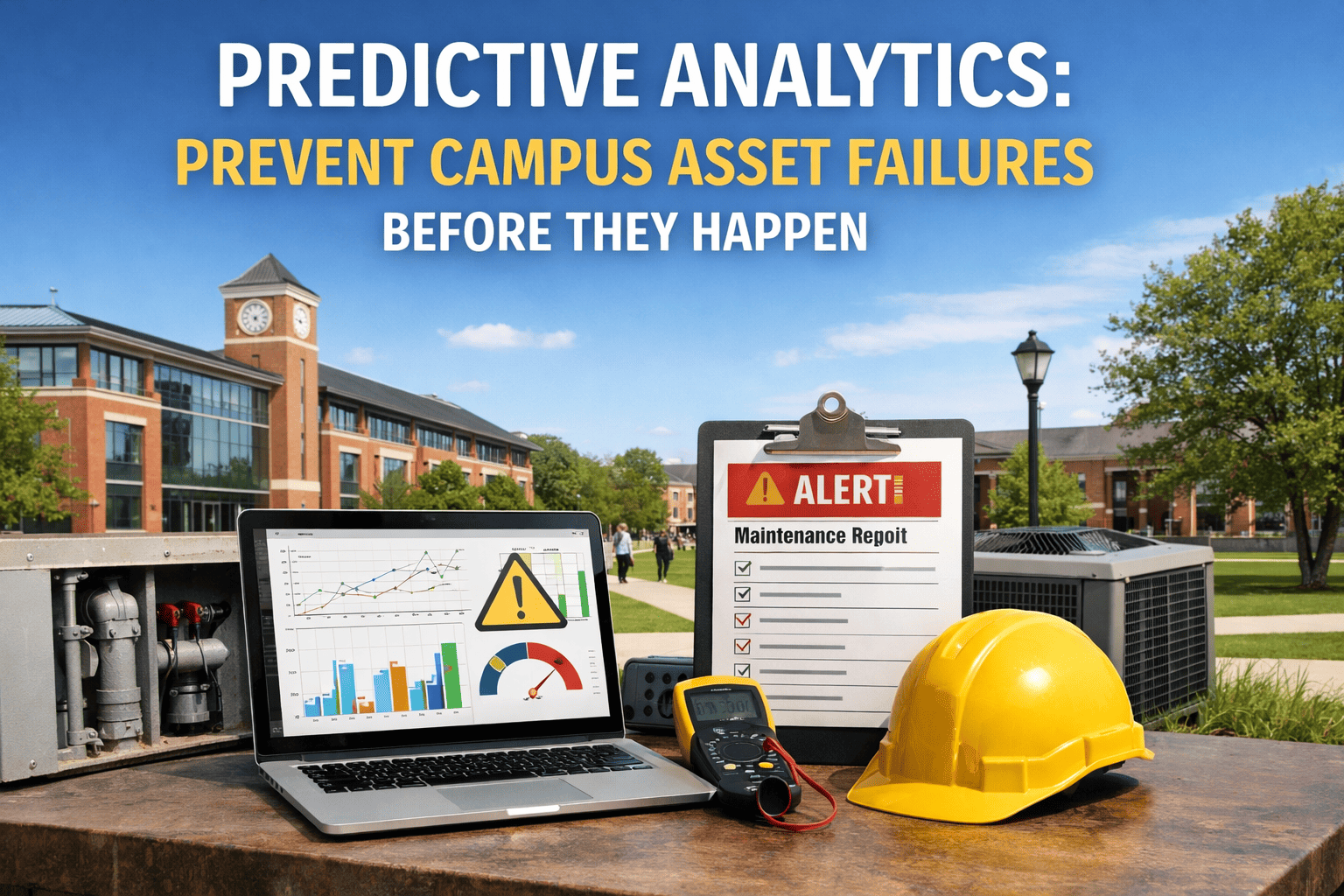
Machine learning models are preventing infrastructure failures at universities right now — predicting specific failure modes across chillers, boilers, switchgear, and elevators 2–6 weeks before they occur by correlating vibration, temperature, pressure, and energy data that no manual inspection can track at scale. Institutions running these models are documenting 65% fewer emergency failures, 30% longer asset life, and 5–8× first-year ROI. A planned repair during break costs $28,000; the same failure as an emergency during finals costs $340,000. In 2026, with enrollment cliff pressure, workforce shortages, and tightening compliance mandates converging simultaneously, the question is no longer whether AI works — it is how much longer your campus can operate without it. Schedule a demo to see ML failure prediction running on campus infrastructure data.
How Machine Learning Actually Works on Campus Infrastructure
The term "AI maintenance" has been diluted by marketing to the point where it can mean anything from a simple calendar reminder to actual neural network inference on sensor data. Understanding what machine learning does in campus facility management — specifically and technically — is essential to evaluating whether a platform delivers genuine predictive capability or just relabeled preventive scheduling.
Calendar-based preventive maintenance schedules service at fixed intervals regardless of actual asset condition. Rule-based alerts fire when a single sensor exceeds a static threshold. Neither approach learns from historical data, detects multi-variable degradation patterns, or improves accuracy over time. Calling these capabilities "AI" is misleading — they are deterministic logic, not machine learning.
Machine learning models ingest time-series data from multiple sources — vibration, temperature, pressure, energy consumption, maintenance history, weather, occupancy — and identify degradation signatures that precede specific failure modes. The models improve with every data point, every repair outcome, and every confirmed or false-positive prediction. This is statistical inference, not static rules.
Raw sensor data is ingested from building automation systems, IoT sensors, and smart meters. Feature engineering extracts meaningful signals: rate of change in vibration amplitude, deviation from baseline energy consumption, correlation between outdoor temperature and discharge pressure. These engineered features feed classification and regression models that output failure probability, estimated time to failure, and recommended intervention.
Gradient-boosted decision trees (XGBoost, LightGBM) excel at failure classification from tabular sensor data. Long Short-Term Memory (LSTM) neural networks capture temporal patterns in time-series vibration and energy data. Isolation forests and autoencoders detect anomalous operating conditions that do not match any known failure mode — catching novel failure patterns before they are cataloged.
The critical distinction is that machine learning does not require you to know what to look for. Calendar-based PM assumes you know the right service interval. Rule-based alerts assume you know the right threshold. ML models discover the patterns that predict failure from the data itself — including patterns that no human engineer has explicitly defined. That is why ML catches the failures that experienced technicians miss: not because the technicians lack skill, but because the human brain cannot simultaneously track six variables across 2,000 assets over 18 months of continuous data. Start a free trial to connect your building data and see what the models find in the first 30 days.
The Six Campus Systems Where ML Prevents the Most Expensive Failures
Not every campus asset benefits equally from machine learning. The highest ROI comes from applying predictive models to systems that are expensive to repair, critical to operations, and generate sufficient data for pattern detection. These six system categories represent 85%+ of preventable emergency spending on university campuses:
Anatomy of a Prediction: How the Model Catches What Humans Miss
To understand why ML catches failures that experienced technicians miss, consider the specific mechanics of a real prediction. The following analysis traces a failure that ML prevented — and shows why no amount of manual inspection would have caught it in time:
| Signal 1 | Bearing vibration amplitude increasing 0.003 in/sec/week — below the 0.15 in/sec alarm threshold, invisible on any single reading |
| Signal 2 | Discharge pressure rising 0.4 PSI/day — within normal operating range but trending upward against stable load conditions |
| Signal 3 | Oil analysis iron particulate increased 12% over baseline at last quarterly sample — flagged as "monitor" not "action" by the lab |
| Signal 4 | Compressor motor amperage drawing 2.3% above nameplate — attributed to "normal variation" by the operating engineer |
| Signal 5 | Condenser approach temperature widening 0.8°F over 6 weeks — masked by seasonal outdoor temperature changes |
| ML Output | Model correlates all 5 signals against 14,000 historical failure events → 94% probability of drive-end bearing failure within 18–22 days → predictive work order generated with failure mode, recommended repair, and optimal scheduling window |
No single signal in that sequence would have triggered a work order under any manual inspection protocol. The vibration was below threshold. The pressure was within range. The oil analysis said "monitor." The amperage variation was dismissed as normal. The approach temperature change was attributed to weather. It was only when all five signals were correlated simultaneously, compared against thousands of historical failure patterns, and analyzed for rate-of-change trajectories that the failure became visible. Schedule a demo to see multi-variable failure correlation running on live campus data.
ML Prediction Accuracy by Campus System
Not all predictions are equally valuable. A model that predicts failures with 95% accuracy but generates 200 false positives per month is worse than useless — it trains technicians to ignore alerts. The metrics that matter are precision (what percentage of alerts are real), recall (what percentage of actual failures are caught), and lead time (how far in advance the prediction fires):
| System Category | Precision | Recall | Avg Lead Time | Data Sources Required |
|---|---|---|---|---|
| Central Chillers | 89–94% | 91–96% | 18–28 days | BAS temps/pressures, vibration sensors, oil analysis, energy meter |
| Boiler Systems | 86–92% | 88–93% | 14–21 days | Stack temp, combustion analysis, feedwater chemistry, runtime hours |
| Electrical Switchgear | 82–88% | 85–90% | 21–42 days | Thermal imaging, power quality meters, partial discharge sensors |
| Air Handling Units | 88–93% | 90–95% | 7–14 days | BAS discharge/return temps, VFD data, filter differential pressure |
| Elevators | 84–90% | 87–92% | 10–21 days | Door cycle count, motor current, leveling data, callback history |
| Plumbing/Hydronic | 80–87% | 83–89% | 5–14 days | Flow meters, temperature differentials, pressure transducers |
Beyond Prediction: Five AI Capabilities Transforming Campus Operations
Failure prediction is the highest-value ML application, but it is not the only one. AI transforms five distinct operational workflows on campus — each one generating measurable returns independently:
AI captures repair procedures, building-specific quirks, and diagnostic approaches from every completed work order. Natural language processing extracts actionable knowledge from technician notes. When a senior technician retires, their 25 years of building knowledge remains in the system — reducing new hire ramp time from 12–18 months to under 6 months.
AI auto-classifies maintenance activities against compliance frameworks — every HVAC service is tagged to ASHRAE 62.1, every fire system inspection maps to NFPA code, every accessibility repair logs against ADA requirements. The system generates continuous compliance documentation as a byproduct of normal maintenance operations, eliminating weeks of manual compilation.
The compounding effect of these five capabilities is what generates the 5–8× ROI. Predictive failure detection reduces emergency spending. Intelligent routing amplifies the workforce. Energy anomaly detection cuts utility costs. Knowledge capture protects against turnover. Compliance automation avoids penalties. Each capability generates independent returns, but together they create a virtuous cycle where every improvement enables the next. Sign up free to deploy all five AI capabilities on your campus infrastructure.
The Data You Already Have Is Enough to Start
The most common objection to ML-powered maintenance is "we don't have enough data" or "we'd need to install sensors everywhere." Neither is true for most university campuses:
| Data Source | Already Available At | ML Application | Connection Method |
|---|---|---|---|
| Building Automation System | 90%+ of university campuses | Temperature, pressure, flow, damper position, equipment runtime — the primary data source for HVAC failure prediction | BACnet/IP, Modbus, API integration with Siemens, JCI, Honeywell, Tridium |
| Energy Meters / Smart Meters | 75%+ of campuses | Building-level and circuit-level energy consumption patterns for anomaly detection and waste identification | Utility API feeds, interval data exports, submeter network integration |
| Maintenance History | 100% of campuses (even paper) | Failure frequency, repair types, parts consumption, asset age — trains failure classification models | Legacy CMMS export, spreadsheet import, paper record digitization |
| Work Order Records | 100% of campuses | Response times, failure descriptions, technician notes — NLP extracts failure patterns from text data | CSV/Excel import, API from existing ticketing systems, direct entry |
| Weather Data | Public APIs (free) | Correlates outdoor conditions with equipment performance to normalize baselines and detect weather-masked faults | Automated weather API integration by campus zip code |
| Occupancy / Class Schedule | Student information systems | Predicts load patterns for HVAC optimization and student-impact prioritization of maintenance work | SIS API integration, academic calendar import |
For campuses that want to enhance their data infrastructure, the highest-value sensor additions are vibration monitors on central plant rotating equipment ($500–$2,000 per asset), power quality meters on main electrical switchgear ($1,000–$3,000 per panel), and indoor air quality sensors in high-occupancy spaces ($200–$500 per sensor). But for most institutions, the BAS data, energy data, and maintenance history they already have are sufficient to begin generating predictions within weeks. Schedule a demo and we will assess your existing data infrastructure during the call.
Quantified Impact: What ML-Driven Maintenance Delivers Annually
Conservative estimates for a mid-size university managing 2–3 million gross square feet across 60–100 buildings with 1,500–3,000 major maintainable assets:
Implementation: From Zero to Predictions in 90 Days
Deploying ML-powered maintenance on a university campus does not require a multi-year IT project, a data science team, or a complete sensor overhaul:
By day 90, the platform has learned your campus's unique operating patterns, generated its first round of high-confidence predictions, documented energy savings, closed compliance gaps, and produced the dashboards your CBO needs to present to the board. Start your free trial and begin the 90-day path from reactive to predictive operations.