Most universities and campus facility teams still calculate their Facility Condition Index by hand — pulling data from disconnected spreadsheets, outdated building assessments, and maintenance logs scattered across filing cabinets. The result is FCI scores that are 18-24 months stale by the time they reach the board, budget requests built on guesswork rather than evidence, and deferred maintenance backlogs that grow 6% annually while leadership debates which buildings actually need funding. The American higher education sector is sitting on $112 billion in deferred maintenance, and most of it is invisible because nobody has current, defensible condition data. Campuses that have connected their CMMS directly to FCI scoring through platforms like OxMaint report FCI scores that update in real time as work orders close, capital requests that get approved 2.4x faster because the data is board-ready, and deferred maintenance backlogs that shrink by 23% in the first year — not because budgets increased, but because spending finally targeted the right buildings.
FCI Scoring for Campus Buildings: How CMMS Data Turns Facility Condition into Board-Ready Capital Plans
A practical guide to auto-generating Facility Condition Index scores from live maintenance data — replacing manual assessments with real-time condition intelligence that wins capital funding approvals.
What Is the Facility Condition Index and Why Does It Matter?
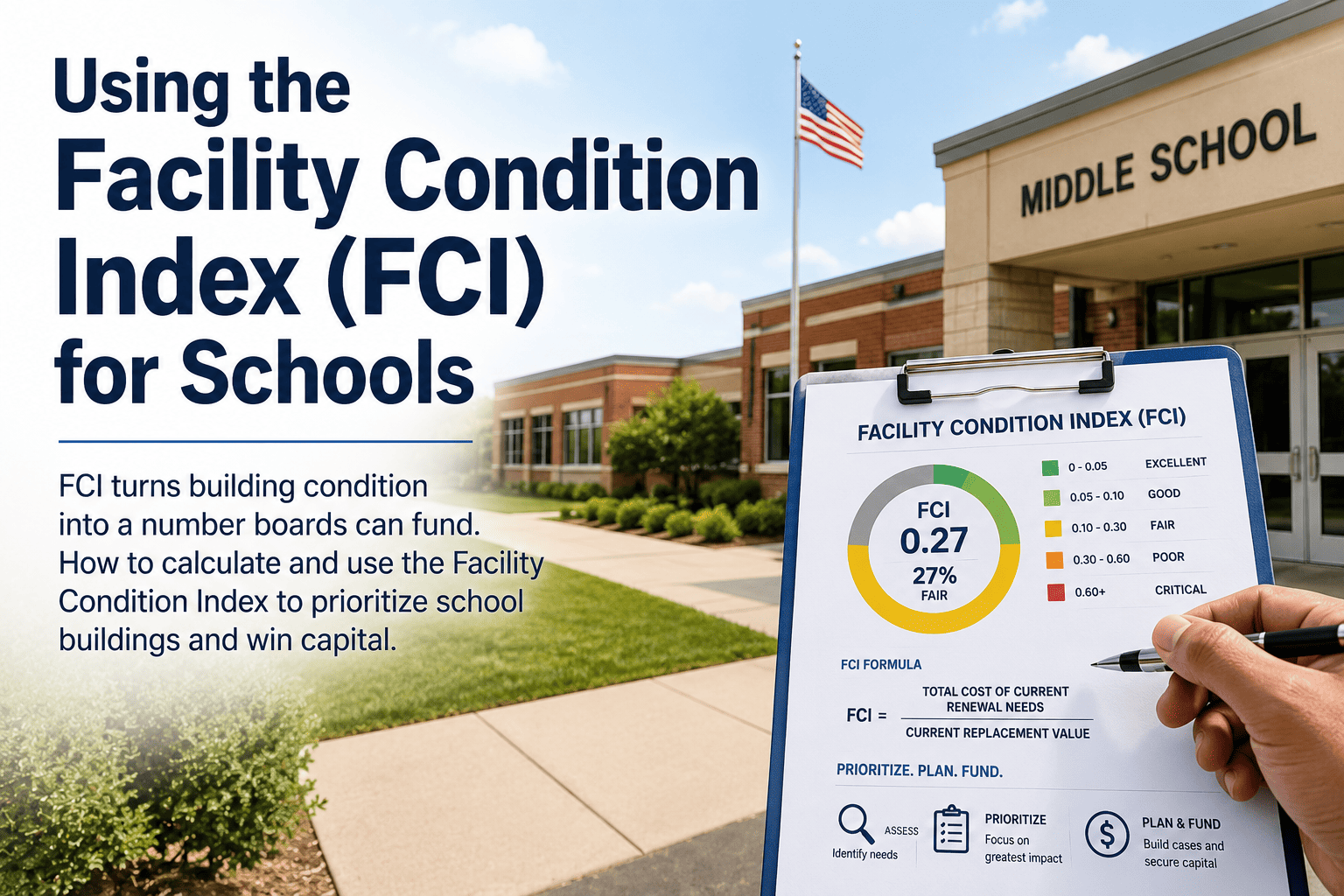
The Facility Condition Index is the single most important number in campus facility management. It is the ratio of a building's total deferred maintenance cost to its current replacement value — expressed as a decimal between 0 and 1. An FCI of 0.05 means deferred maintenance equals 5% of replacement value (APPA "Good" rating). An FCI above 0.10 signals a building entering decline. Above 0.30, renovation costs approach or exceed full replacement. The problem is not the formula — it is the data feeding it. Most campuses update FCI scores through periodic walking assessments conducted every 3-5 years by external consultants. By the time results are compiled, the data is already outdated. CMMS-generated FCI changes this entirely: every closed work order, every deferred repair, every condition note logged by a technician feeds the numerator in real time. The denominator (replacement value) updates annually from institutional records. The result is an FCI score that is always current, always defensible, and always ready for the next budget conversation. If your campus still relies on periodic assessments, see how live FCI scoring works inside a modern CMMS — start a free trial or book a demo to see it with your building data.
The APPA FCI Framework: Condition Tiers Explained
APPA (the Association of Physical Plant Administrators) defines four condition tiers based on FCI ranges. Understanding where each building falls determines whether it receives routine maintenance funding, targeted renewal investment, or full capital replacement consideration. Here is the framework every campus facility director needs to internalize — and the CMMS data that maps directly to each tier.
Building systems are functioning as designed. Deferred maintenance is minimal. Routine preventive maintenance sustains condition. Capital needs are predictable and manageable within operating budgets.
Some building systems are aging beyond useful life. Deferred maintenance is accumulating. Without targeted renewal investment, the building will cross into "Poor" within 3-5 years.
Multiple systems are failing or past useful life. Reactive maintenance dominates. Operating costs are 35-50% higher than equivalent buildings in "Good" condition. Significant capital renewal required.
Building is at or near end of useful life. Renovation costs approach or exceed full replacement value. Safety and code compliance risks are elevated. Board-level capital decisions required immediately.
Why Manual FCI Scoring Fails Campus Facility Teams
The traditional approach to FCI — hiring external assessors every 3-5 years to walk buildings and estimate deferred maintenance — was designed for an era when buildings changed slowly and budgets were generous. Neither is true today. Here are the six failure modes that manual FCI creates — and why every one of them is eliminated by CMMS-driven scoring.
A 3-year assessment cycle means FCI data is 18-36 months old when presented to the board. Conditions change faster than assessments — emergency repairs, system failures, and deferred PMs shift the real FCI continuously.
External facility condition assessments cost $0.10-$0.15 per gross square foot. For a 5-million-square-foot campus, that is $500,000-$750,000 per assessment cycle — money that could fund actual repairs instead of measuring the need for them.
Walking assessments rely on individual assessor judgment. Two assessors evaluating the same HVAC system often produce estimates that vary by 25-40%. Board members know this — and discount FCI data accordingly.
Manual FCI exists in a separate document from work orders. When a $180,000 chiller repair is completed, the FCI score does not change until the next assessment cycle — making capital tracking meaningless in real time.
When 40 buildings were assessed by different teams, in different years, using different methodologies — comparing their FCI scores is comparing apples to equations. CMMS-driven FCI uses the same formula, the same data source, updated at the same frequency for every building.
72% of campus CFOs report that maintenance capital requests lack sufficient data to prioritize against competing institutional needs. Stale FCI scores without supporting work order evidence are the primary reason capital requests are deferred — not denied, just endlessly deferred.
How OxMaint Auto-Generates FCI Scores From Live CMMS Data
OxMaint replaces periodic manual assessments with continuous, automated FCI calculation. Every work order, every asset condition note, every deferred repair logged by your technicians feeds directly into the FCI formula — producing scores that are current to the day, defensible to the dollar, and formatted for board presentation without manual compilation.
Every campus building, system, and major component entered with replacement values, installation dates, and expected useful life. OxMaint imports from existing spreadsheets or prior assessment data.
Every completed repair reduces deferred maintenance (lowers FCI). Every deferred work order increases it. Technicians log condition notes and photos that feed asset-level scoring automatically.
OxMaint runs the APPA FCI formula (Deferred Maintenance Cost / Current Replacement Value) for every building, every day. Scores update as work orders close, new deferrals are logged, and replacement values are adjusted annually.
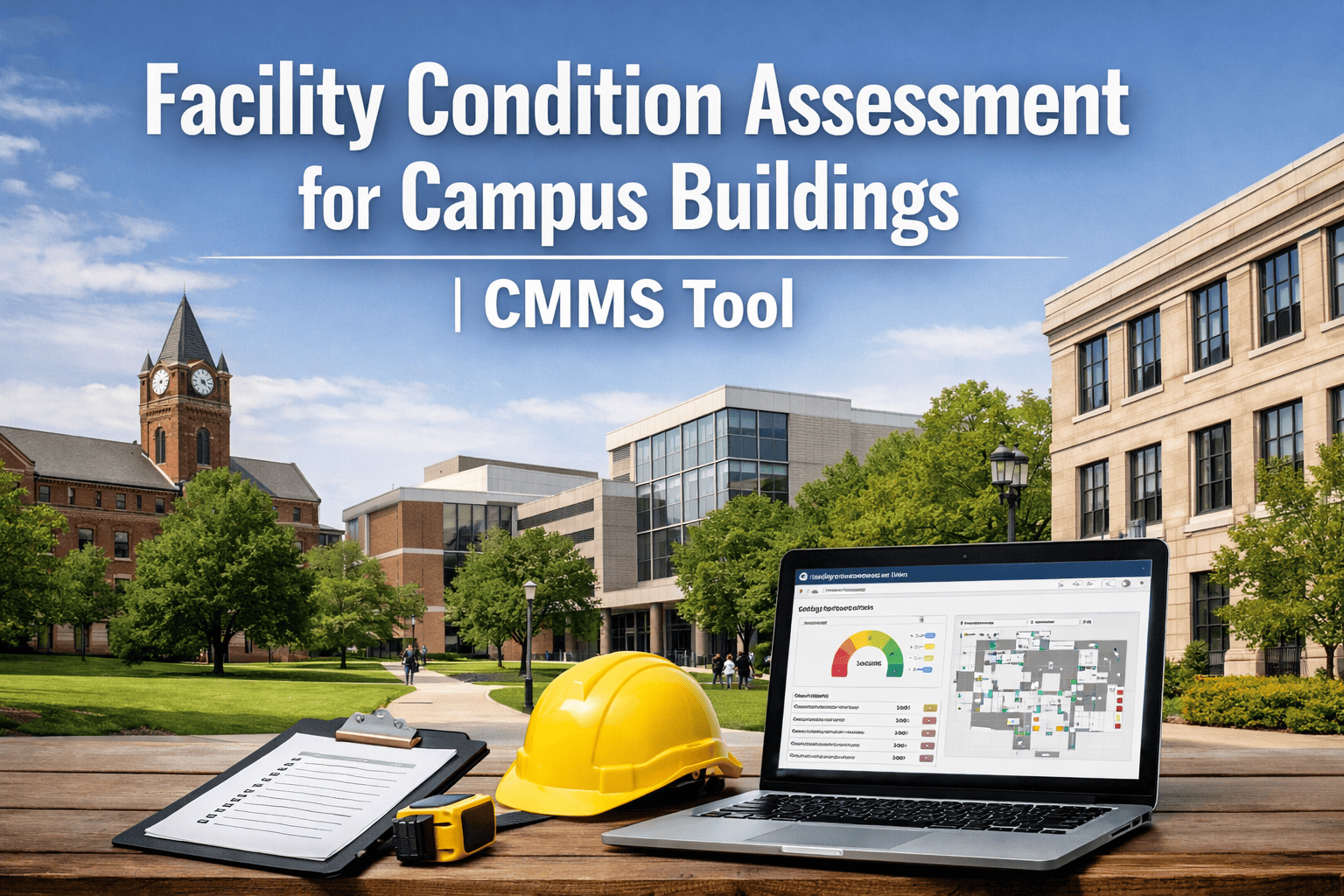
Portfolio-level FCI dashboards, building-by-building rankings, system-level drill-downs, and 5-year CapEx forecasts — all exportable in presentation format. No manual compilation. No consultant fees.
The entire pipeline runs without manual data entry beyond standard work order completion — the same work your technicians are already doing. The difference is that every wrench turn now feeds your capital planning model. See the FCI dashboard with your campus data — book a demo for a live walkthrough.
Manual Assessment vs. CMMS-Driven FCI: What Actually Changes
The shift from periodic manual assessment to continuous CMMS-driven FCI is not incremental — it fundamentally changes what facility directors can prove, how fast they can act, and how much capital they can justify.
| Dimension | Manual Assessment FCI | CMMS-Driven FCI (OxMaint) |
|---|---|---|
| Update Frequency | Every 3-5 years | Daily — updates with every closed or deferred work order |
| Data Source | Walking assessment by external consultant | Live maintenance records from technicians already doing the work |
| Cost Per Assessment | $0.10-0.15 per sq ft ($500K-$750K per cycle for large campus) | Included in CMMS subscription — no additional assessment cost |
| Subjectivity | High — assessor judgment varies 25-40% between individuals | Low — formula-driven from documented repair costs and asset records |
| Connection to Work Orders | None — FCI report lives in a separate file from maintenance ops | Direct — every work order completion or deferral adjusts the building FCI score |
| Board Credibility | Moderate — CFOs discount stale data and subjective estimates | High — real-time scores backed by timestamped repair records and cost evidence |
| CapEx Forecasting | Static snapshot — no projection capability | 5-10 year rolling CapEx models based on asset lifecycle and condition trends |
| Portfolio Comparison | Inconsistent — different assessors, years, and methodologies per building | Consistent — same formula, same data pipeline, same update frequency across all buildings |
OxMaint Features That Power Campus FCI Scoring
FCI is not a standalone feature — it is the output of a fully connected maintenance ecosystem. These are the OxMaint capabilities that feed, refine, and present FCI data across your entire campus portfolio.
Portfolio, Building, System, Asset, Component — five levels of hierarchy that map exactly to how campuses organize physical infrastructure. Every work order cost rolls up through the hierarchy to the building FCI score.
Technicians assign 1-5 condition scores during inspections. Scores weight the FCI calculation beyond raw cost data — a $50,000 chiller rated "2" signals more deferred need than cost alone would indicate.
Asset lifecycle data and condition trends project when each system will need replacement. Campus-wide CapEx forecasts show exactly how much capital is needed, when, and in which buildings.
See every building ranked by FCI score on a single screen. Drill down to system-level detail. Export board-ready presentations with one click. Filter by building type, age, or funding priority.
Technicians complete work orders, log condition notes, and attach photos from the field. Every entry feeds the FCI model automatically. No post-shift data entry. No paper forms to transcribe.
Every FCI score is backed by timestamped work orders, technician signatures, and cost records. When the board asks "how did you calculate this?" — the answer is a click, not a filing cabinet.
Every feature above is live from day one — no custom configuration, no six-month implementation project. Most campuses have their first auto-generated FCI scores within 14 days of going live. Explore the full feature set with your campus data — start a free trial and load your first building this week.
ROI: What CMMS-Driven FCI Delivers to Campus Operations
The return on CMMS-driven FCI scoring is not theoretical — it is measured in capital dollars approved, maintenance costs avoided, and deferred backlog reduced. These benchmarks are drawn from campuses that have transitioned from manual assessment to continuous CMMS-driven condition tracking.
Budget requests backed by real-time FCI scores, work order evidence, and 5-year forecasts are approved 2.4x faster than requests supported by 3-year-old walking assessments.
Visible, data-driven FCI scores redirect spending to the buildings and systems with the highest impact — reducing total campus deferred maintenance by 23% in year one.
For a 5M sq ft campus, eliminating the external assessment cycle saves $500,000-$750,000 every 3-5 years — capital that funds actual repairs instead of measuring the need for them.
Automated PM scheduling and mobile work orders push preventive maintenance completion from a campus average of 55% to 92% — directly reducing the deferred maintenance numerator in the FCI formula.
Most campuses generate their first CMMS-driven building FCI scores within 14 days of going live on OxMaint — including asset import, replacement value entry, and initial work order backlog capture.
Every building scored on the same methodology, updated at the same frequency, visible on a single dashboard. No more comparing assessments conducted by different firms in different years.
Legacy CMMS implementations take 6-12 months and still fail at adoption. OxMaint is built for campus teams that need results now — guided onboarding, bulk asset import, and auto-generated FCI scores within two weeks. No implementation project. No consultant army. Just a working system with real data.
Frequently Asked Questions
How accurate is CMMS-driven FCI compared to traditional walking assessments?
CMMS-driven FCI is more accurate for ongoing condition tracking because it uses actual, documented maintenance costs rather than assessor estimates. Traditional assessments capture a snapshot with 25-40% variance between assessors. CMMS data uses real work order costs, actual parts expenditure, and documented deferrals — producing FCI scores that CFOs and board members find more credible because every data point has a timestamped work order behind it. Initial FCI accuracy improves as maintenance history accumulates — most campuses reach full confidence within 6-12 months of comprehensive work order logging.
What if we have no current replacement value data for our buildings?
Replacement values are the denominator in the FCI formula and are required for meaningful scores. Most campuses have this data in their insurance records, institutional planning office, or state system facilities database. OxMaint can import replacement values from any existing source. For buildings without documented replacement values, industry cost-per-square-foot benchmarks (RSMeans data, for example) provide defensible starting estimates that can be refined over time. The key is starting with reasonable estimates and improving accuracy annually — not waiting for perfect data that never arrives.
Can OxMaint handle a campus with 50+ buildings of different types and ages?
OxMaint is built for multi-site portfolios — campuses with 50, 100, or 200+ buildings are the core use case, not an edge case. The five-level asset hierarchy (Portfolio, Building, System, Asset, Component) scales to any campus size. FCI dashboards rank all buildings on a single screen with drill-down to system-level detail. Filtering by building type, age, occupancy status, or funding priority gives facility directors the exact view they need for each board conversation. Most multi-building campuses are fully loaded within 14 days using bulk import tools.
Does transitioning to CMMS-driven FCI mean we never need external assessments again?
Not necessarily — but the role of external assessments changes dramatically. Instead of being the primary source of condition data (expensive, infrequent, subjective), external assessments become a periodic validation layer that confirms CMMS-driven scores are tracking correctly. Many campuses reduce assessment frequency from every 3 years to every 7-10 years, and scope them as spot-check validations rather than comprehensive surveys. The savings in assessment cost alone typically exceed the annual CMMS subscription cost by 4-6x.
Your Buildings Are Telling You Their Condition Every Day. Are You Listening?
Every work order your technicians close, every repair they defer, every condition note they log — it is all FCI data. The only question is whether that data sits in disconnected spreadsheets or feeds a live scoring model that wins capital approvals. OxMaint turns the maintenance work your team already does into board-ready facility intelligence — with your first building FCI scores generated within 14 days of signup.