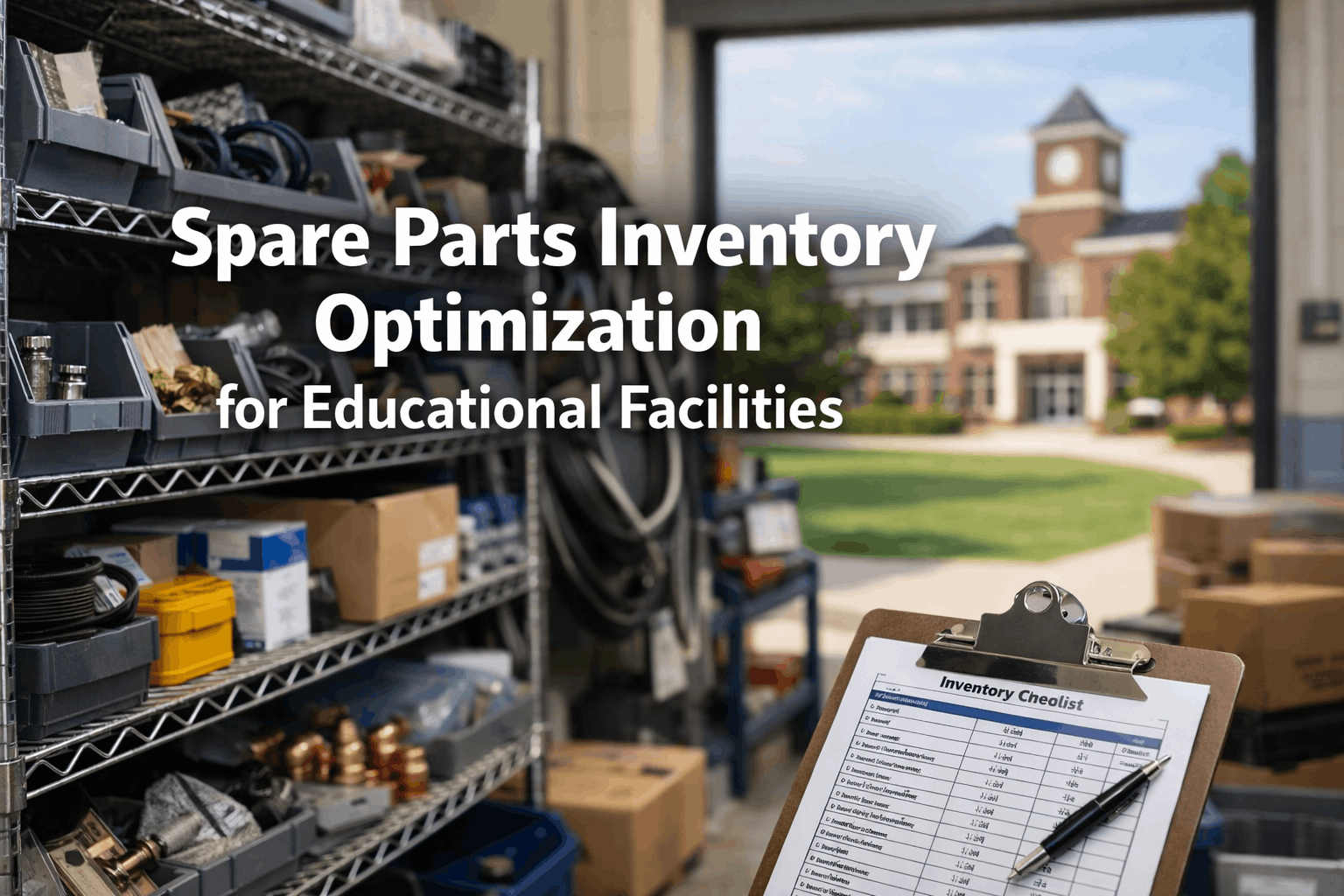
A maintenance technician walks to the storeroom to retrieve a replacement motor for a failed air handler in the science building — and finds the shelf empty. The part was last used six months ago and never reordered. The repair is delayed 72 hours while the emergency order ships. During that time, 340 students cannot access their laboratory space during finals week. This exact scenario plays out across university and K-12 campuses thousands of times every year — not because facilities teams are negligent, but because spare parts inventory managed through spreadsheets and institutional memory has no ability to predict demand, track consumption patterns, or alert when stock falls below safe levels. AI-driven inventory optimization in CMMS platforms changes this by analyzing historical work order data, seasonal demand patterns, and asset failure frequencies to predict which parts will be needed before the failure happens. Campuses using automated inventory management report 67% fewer stockout events and reduce emergency parts procurement spend by $38,000–$95,000 annually depending on portfolio size. To see how predictive inventory management works for campus maintenance, start a free trial or book a demo and see live parts management configured to your campus.
Campus Operations · Parts Management · AI Analytics
AI Spare Parts Inventory Optimization for Campus Maintenance
Predict part demand before failures occur, eliminate stockouts during term, and cut emergency procurement spend — with CMMS-driven inventory intelligence built for campus facilities teams.
67%
reduction in stockout events for campuses using automated CMMS inventory management vs manual tracking
$95K
maximum annual emergency procurement savings for mid-size campus portfolios with predictive parts management
72hrs
average repair delay caused by parts stockouts on campus — 3 days of disrupted learning and facility access
4.8x
premium cost of emergency parts order versus planned procurement — per CMMS industry benchmarks
Parts Stockouts During Term Are Avoidable — With the Right Data
Oxmaint tracks every part issued from every work order and calculates consumption rates automatically — giving your team the historical data needed to set intelligent minimum stock levels, trigger reorder alerts, and plan seasonal inventory builds before fall semester and winter break shutdowns.
Start a free trial and connect your storeroom inventory today, or
book a demo to see parts management configured for your campus scale.
Why Campus Parts Management Is Uniquely Difficult
Seasonal Demand Spikes
HVAC Parts Demand Doubles in August — Before Every Fall Semester
Campus HVAC systems that sat partially dormant through summer restart under full occupancy in September. Filter replacements, belts, bearings, and motor assemblies that saw minimal use in June fail at elevated rates in weeks 2–6 of fall semester. Without historical consumption data by season, teams consistently understock exactly when demand peaks and students are present.
Multi-Building Complexity
50+ Buildings, 400+ Asset Types, and Thousands of Part Numbers
A mid-size university campus maintains buildings ranging from 1960s classroom blocks to new LEED-certified research facilities — each with different equipment generations, manufacturers, and part specifications. Managing thousands of part numbers across one central storeroom plus satellite closets requires systematic tracking that spreadsheets structurally cannot provide.
Budget Cycle Pressure
Inventory Investment Competes Against Deferred Maintenance and Capital Projects
Campus facilities budgets are allocated annually — and spare parts inventory competes directly against visible maintenance projects and capital improvements for funding. Without consumption data proving the cost of stockouts versus inventory investment, the storeroom budget loses to projects that have visible deliverables. CMMS data makes the stockout cost visible and quantifiable.
Academic Calendar Constraints
Repairs Must Happen Faster During Term — When Disruption Affects Students
A 72-hour parts delay in July affects no students. The same delay in October blocks laboratory access during a critical research period. Campus maintenance must achieve faster MTTR during academic terms precisely when occupancy is highest — which requires parts to be on hand before demand occurs, not ordered when the failure happens.
How AI-Driven CMMS Inventory Optimization Works on Campus
1
Work Orders Capture Every Part Used
Technicians log parts consumed on every work order from mobile. Part number, quantity, asset repaired, and date are recorded automatically — building consumption history from day one without separate inventory entry.
2
Consumption Patterns Analyzed by Asset and Season
After 60–90 days of work order history, CMMS data reveals which parts are consumed at what rates, by which assets, and in which months. Seasonal demand spikes for HVAC season, plumbing freeze events, and academic year starts become quantifiable patterns — not institutional memory.
3
Minimum Stock Levels Set From Data, Not Guesswork
CMMS calculates minimum stock levels per part based on average consumption rate, lead time from supplier, and peak demand periods. Parts critical to life-safety or high-impact HVAC systems carry higher minimum thresholds — automatically, not from manual review cycles.
4
Automated Reorder Alerts Before Stock Falls Critical
When stock level falls below the calculated minimum, Oxmaint generates an automated reorder alert — notifying the facilities coordinator or purchasing team with the part number, preferred supplier, and quantity to order. No weekly storeroom audit required. No surprise stockouts.
5
Pre-Semester and Pre-Shutdown Inventory Builds Planned With Data
Before fall semester and winter break maintenance pushes, CMMS consumption data generates a pre-build parts list — showing exactly which parts will be needed in elevated quantities based on last year's work order history. Stock the storeroom with evidence, not instinct.
6
Inventory Cost Reporting for Budget Justification
CMMS tracks total inventory value, parts cost per building, emergency procurement versus planned procurement spend, and stockout event frequency. This data makes the business case for storeroom investment that every facilities director needs for budget approval — in concrete dollar terms.
Reactive Parts Management vs CMMS-Driven Optimization
Reactive Inventory Management
Stock Awareness
Unknown until technician checks physically — discovered empty at repair time, during the failure
Reorder Trigger
Manual storeroom walkthrough — done inconsistently, misses fast-moving parts between audits
Seasonal Preparation
Based on institutional memory — whoever remembers what ran short last fall semester
Emergency Procurement
4.8× standard cost — paid on 20–35% of all parts orders due to stockout-driven urgency
Repair Delay Impact
72-hour average delay per stockout event — disrupting students during academic term
Budget Visibility
Unknown parts spend by building — emergency costs buried in maintenance budget line items
CMMS Inventory Optimization
Stock Awareness
Real-time stock level per part — visible to all technicians on mobile before they travel to storeroom
Reorder Trigger
Automatic alert when stock crosses minimum threshold — calculated from consumption data, not judgment
Seasonal Preparation
CMMS generates pre-semester build list from 12-month consumption history — data-driven, not memory-based
Emergency Procurement
Reduced to under 5% of orders — 95% of parts procured on planned schedule at standard rates
Repair Delay Impact
Near-zero stockout delays — parts on hand before demand peaks, not ordered when failures occur
Budget Visibility
Full parts cost by building, by asset, by trade — emergency vs planned split tracked monthly
Critical Parts Categories for Campus Facilities
High Volume · High Risk
HVAC Consumables
Air filters (MERV 8, 11, 13 by building type), belts and bearings, motor capacitors, thermostat sensors, coil cleaning chemicals, chiller refrigerant, VAV actuators
Stockout Risk: Critical — HVAC failure affects entire building occupancy
Compliance-Critical
Life-Safety System Parts
Smoke detector batteries and sensors, emergency exit lighting batteries, fire suppression system components, AED electrode pads and batteries, exit sign LED modules
Stockout Risk: Regulatory — missed replacement creates compliance violation
High Frequency
Plumbing and Restroom
Flush valve diaphragms (Sloan, Zurn), faucet cartridges, toilet supply lines, trap primers, soap dispensers, paper towel dispensers, drain strainers
Stockout Risk: High — restroom failures create immediate hygiene and ADA complaints
Seasonal Critical
Electrical and Lighting
LED lamp replacement stock by fixture type, ballasts, photocell sensors, circuit breakers by amperage, outlet and switch covers, GFI outlet replacements, panel fuses
Stockout Risk: Medium-High — lighting failures in labs and classrooms require fast response
Lab-Specific
Research Facility Parts
Fume hood sash cables and hardware, lab gas fittings, emergency shower activation components, eyewash station seals, biosafety cabinet HEPA filters, compressed gas regulator parts
Stockout Risk: Critical — lab safety equipment failures shut research operations immediately
Grounds and Exterior
Building Envelope Parts
Door closer arms and springs, weatherstripping by door type, lock cylinders and cores, window hardware, exterior lighting heads, irrigation valve components, drainage grate replacements
Stockout Risk: Medium — exterior failures accelerate with weather; access control failures are security events
What Predictive Inventory Management Delivers — In Numbers
67%
fewer stockout events
campuses using CMMS consumption tracking vs manual storeroom management — measured over 12-month periods
$38K–$95K
emergency procurement savings annually
for campus portfolios of 500K–2M sq ft — eliminating 4.8× emergency premium across the most common failure parts
40%
reduction in MTTR
when critical spares are staged on-site and technicians can verify availability on mobile before responding — repair time drops from hours to minutes on parts retrieval
0 days
repair delay for pre-stocked parts
versus the 72-hour average delay when parts must be emergency-ordered — the difference between a disruption and a maintenance event during academic term
Frequently Asked Questions
How long before a CMMS has enough data to generate accurate parts predictions?
Most campus facilities teams see statistically reliable consumption patterns within 90–120 days of consistent work order logging. For seasonal parts like HVAC filters and belt drives, one full academic year cycle provides the most accurate baseline — after which the CMMS can generate pre-semester build lists from the previous year's consumption history. The key is consistent work order logging from day one: every part used, every work order closed, every job recorded on mobile. Starting with a partial catalog is fine — Oxmaint builds consumption history progressively as work orders accumulate. Even a 60-day history enables data-informed minimum stock levels that outperform manual guesswork.
What is the right minimum stock level for critical campus parts?
Minimum stock level = (Average daily consumption × supplier lead time in days) + safety stock. Safety stock for campus parts typically runs 20–30% above the reorder quantity for HVAC consumables and 50–100% above for life-safety components where stockouts create compliance risk. In practice: if you use 8 MERV-13 filters per month across a building cluster and your supplier delivers in 5 business days, your minimum stock level before reordering is (0.4/day × 5 days) + 30% safety stock = approximately 2.6, rounded up to 3 filter units. CMMS calculates this automatically from consumption history — your facilities team sets the lead time and safety stock percentage per supplier, and the system manages the rest.
How should campus facilities handle parts for older buildings with discontinued equipment?
Older campus buildings with legacy equipment create parts sourcing challenges that standard inventory models don't address. Best practices: First, conduct a condition assessment of all critical legacy equipment and identify the 10–15 components most likely to fail — then stock 2–3 units of each regardless of current consumption rate (one-time emergency reserve, not rolling inventory). Second, document supplier alternatives and lead times for each critical legacy part in the CMMS asset record — so technicians know sourcing options before the failure occurs. Third, use CMMS failure history to identify which legacy systems are generating disproportionate repair frequency — these are your capital replacement candidates, and the parts spend data makes that case quantitatively.
How do campus facilities teams justify storeroom inventory investment to CFOs?
The financial case for inventory investment rests on three data points that CMMS provides: (1) Emergency procurement premium — total spend on expedited/emergency orders in the past 12 months, multiplied by 0.79 to show what it would cost at standard pricing. The difference is pure waste. (2) Repair delay cost — stockout events × average repair delay × impact measure (student lab hours lost, classroom hours unavailable, residential HVAC hours offline). (3) Optimal inventory investment — calculate the carrying cost of 90 days of the most-consumed parts and compare it to the emergency premium identified in step 1. For most campuses, $8,000–$25,000 in additional inventory investment eliminates $38,000–$95,000 in annual emergency procurement costs — a 3–5× ROI that CFOs consistently approve.
Oxmaint CMMS · Campus Parts Management
Stop Discovering Stockouts at the Worst Moment. Predict Demand Before It Arrives.
Oxmaint tracks every part used on every work order — automatically building the consumption history that powers smarter inventory decisions. Reorder alerts before stock runs critical. Pre-semester build lists from last year's data. Emergency procurement spend that trends down every quarter. Connect your campus storeroom and generate your first consumption report within your first 30 days.