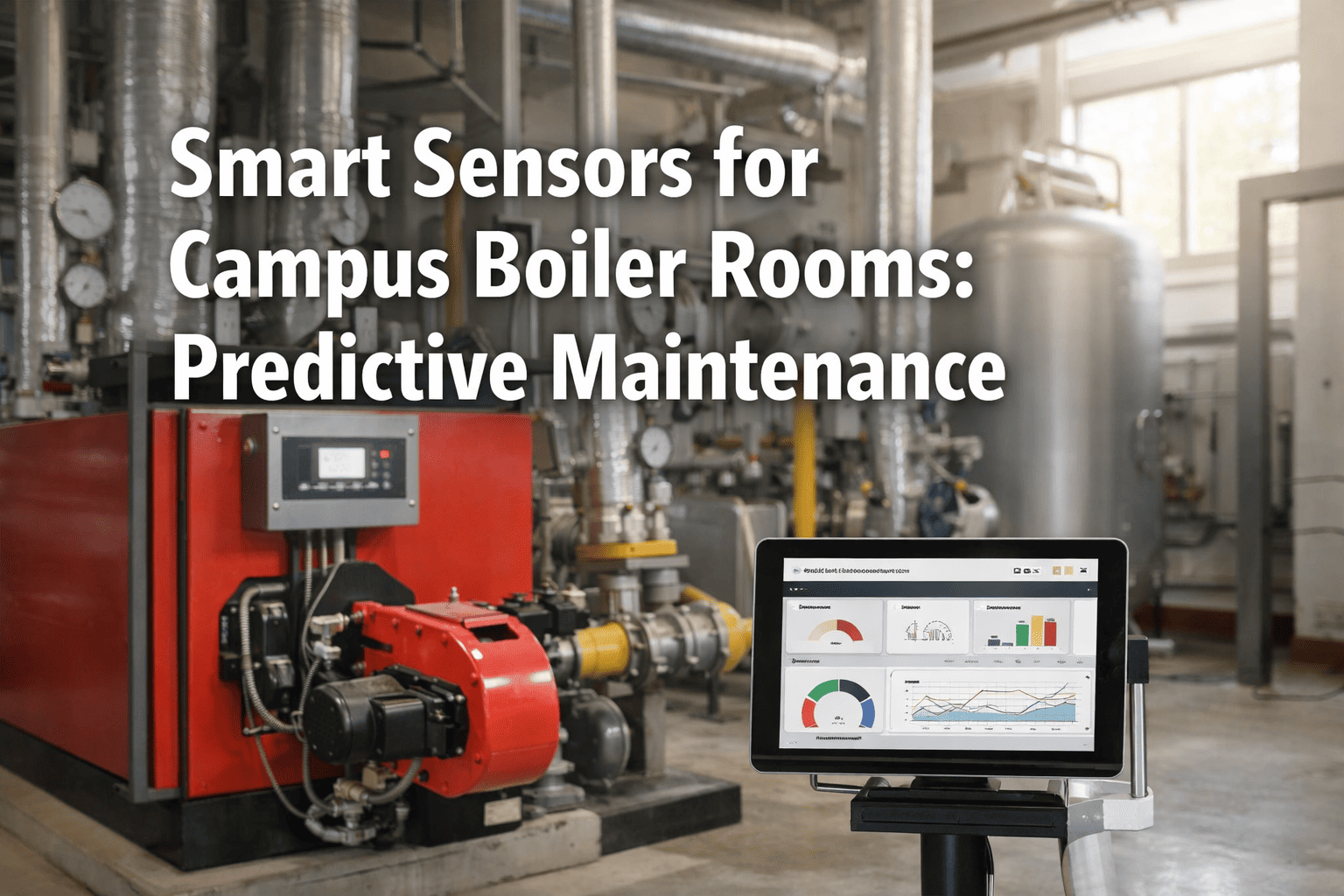
A campus boiler that fails in January does not just interrupt heating — it closes buildings, cancels classes, and triggers emergency repair costs that dwarf the entire annual maintenance budget for the system. Smart vibration, temperature, pressure, and flue gas sensors connected to Oxmaint monitor boiler health continuously — catching compressor wear, pressure drift, and heat exchanger degradation 3 to 6 weeks before failure, when a targeted intervention costs $600 instead of $40,000. See Oxmaint's boiler sensor integration for your campus — start free.
Smart Sensors for Campus Boiler Rooms: Predictive Maintenance Guide
Vibration, temperature, pressure, and flue gas sensors integrated with Oxmaint give facilities teams 3–6 weeks of advance warning before campus boiler failure — converting a $40,000 emergency into a $600 planned repair.
Oxmaint integrates with vibration, temperature, pressure, flue gas, and water chemistry sensors on campus boilers — creating a continuous health score for each unit. When any signal crosses the alert threshold, a prioritized work order is generated and dispatched to the nearest qualified technician automatically.
Why Campus Boilers Are the Highest-Risk Predictive Maintenance Target
Campus boilers operate in a uniquely unforgiving context. They run at maximum load during the coldest months — exactly when failure has the highest operational impact. A residential university that loses its central boiler plant in February cannot simply defer the problem to the next business day.
Boiler failures are also predictable. Every major boiler failure mode — heat exchanger cracking, burner degradation, pump bearing failure, pressure relief valve drift — produces measurable sensor signals weeks before the unit fails. The problem is not that these signals are invisible. It is that without continuous monitoring, no one is watching between annual inspections.
Oxmaint's sensor integration watches continuously — every 15 minutes, every day of the year — and converts developing failure signals into maintenance work orders while there is still time to intervene. Book a demo to see boiler sensor monitoring for your campus.
Boiler Sensor Coverage — What Oxmaint Monitors
Oxmaint integrates with five sensor categories covering the primary boiler failure modes on campus heating systems — each with specific thresholds and automated work order triggers. See sensor thresholds configured for your boiler plant.
| Sensor Type | Failure Mode Detected | Alert Lead Time | Planned Repair Cost |
|---|---|---|---|
| Vibration | Pump bearing wear, burner motor imbalance | 4–6 weeks | $400–$900 bearing replacement |
| Flue Gas Temp | Heat exchanger fouling, combustion inefficiency | 3–5 weeks | $600–$1,200 cleaning + tune |
| Stack O2 / CO | Burner degradation, air-fuel ratio drift | 2–4 weeks | $300–$800 burner service |
| Water Pressure | Expansion tank failure, PRV drift, leak | 1–3 weeks | $200–$600 valve/tank service |
| Water Chemistry | Scale buildup, corrosion, pH drift | 4–8 weeks | $400–$1,000 treatment + flush |
Boiler Predictive Monitoring Results — Campus Deployments
Measured outcomes at university and K-12 campuses using Oxmaint boiler sensor monitoring — 12-month post-deployment data.
Sensor-to-Work-Order Workflow — Five Steps
Oxmaint converts a boiler sensor reading into a dispatched maintenance work order in five automated steps — with no dispatcher required for standard threshold events.
Seasonal Planning — Preparing Campus Boilers Before Winter
The most valuable window for boiler predictive maintenance is September and October — before peak heating demand begins. Oxmaint's seasonal planning module automatically schedules a comprehensive pre-winter boiler inspection for every unit in the campus plant, generating work orders for each check item timed to complete before the first hard freeze date configured for the campus location.
The pre-winter package includes burner tune, heat exchanger inspection, water treatment check, all valve operability tests, pump bearing inspection, flue inspection, and combustion analysis. Completing this package in October costs $800 to $1,500 per boiler. Discovering that the same issues existed in January costs $15,000 to $45,000 per incident — and closes buildings in the worst possible conditions.
Oxmaint's seasonal alert module also tracks degree-day accumulation against boiler runtime — flagging units that are running longer than expected for the heating load, which is an early indicator of declining heat exchange efficiency. Start free to configure seasonal boiler planning for your campus.
Our Oxmaint vibration sensor flagged Boiler 3 with an elevated bearing signature in late October. We replaced the pump bearing in a planned shutdown over a weekend for $780. That same boiler had failed catastrophically the previous February — $42,000 in emergency repair, 4 days of partial building closures, and a very long conversation with our VP. The sensor paid for itself 50 times over in one catch.
Frequently Asked Questions
-74% Emergency Repairs. 8.3x ROI. 3–6 Week Failure Lead Time.
Smart boiler monitoring integrated with Oxmaint — live on your campus heating plant within 2 weeks.