Universities operate some of the most complex facility portfolios in existence — a single campus can span 200+ buildings across residential halls, research laboratories, athletic venues, central utility plants, and historic structures, totaling 5 to 15 million gross square feet. Yet APPA's 2025 State of Facilities report found that 61% of higher education institutions still operate without a fully integrated CMMS, relying instead on disconnected work order tools, departmental spreadsheets, and ERP modules never designed for maintenance management. The consequence is a national higher education deferred maintenance backlog exceeding $112 billion. Universities that have deployed purpose-built CMMS platforms like Oxmaint report 31% improvement in PM compliance, 24% reduction in emergency work orders, and the ability to generate Facility Condition Index reports for every building on demand — transforming capital budget requests from anecdotal narratives into data-driven investment cases.
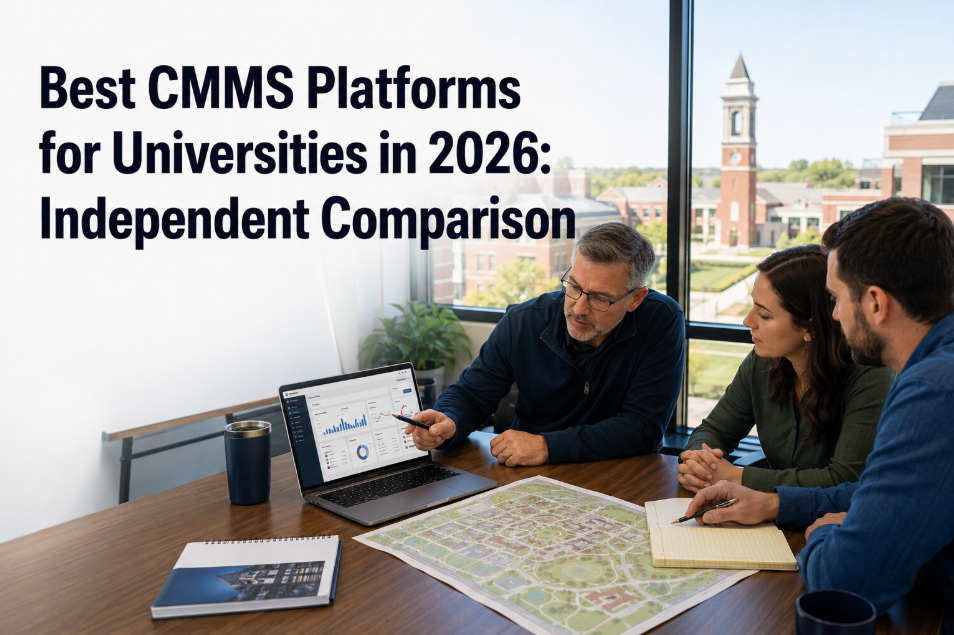
Best CMMS Platforms for Universities in 2026
Independent comparison of university CMMS platforms — evaluating multi-building hierarchy, ERP integration, sustainability tracking, mobile parity for distributed crews, and total cost of ownership for institutions with 50 to 500 buildings.
What Universities Need From a CMMS in 2026
A university CMMS is not a glorified work order tool. It must serve as the operational backbone for facilities departments managing 200+ asset categories across buildings that range from 150-year-old lecture halls to BSL-3 research labs. The eight capabilities below separate purpose-built university platforms from generic maintenance software.
Multi-campus universities need 6+ levels of asset hierarchy. Flat structures break down at 50 buildings. Oxmaint supports unlimited nesting with inherited PM templates at every level.
83% of universities run one of three major ERPs. CMMS must sync purchase requisitions, budget codes, and HR data without custom middleware costing $100K+.
76% of US universities have signed carbon neutrality pledges. CMMS must track energy-related maintenance (HVAC optimization, lighting retrofits) and tie work orders to sustainability KPIs.
Research universities maintain 500+ fume hoods and specialized lab HVAC. CMMS must generate compliance documentation for OSHA, EPA, and NIH grant requirements automatically.
Housing departments handle 15,000+ requests per year. A no-login portal with photo upload and room auto-detection reduces duplicate tickets by 34% and response time by 42%.
Board of trustees approves capital budgets based on documented building condition. CMMS must calculate FCI per building and project renewal costs across a rolling 10-year horizon.
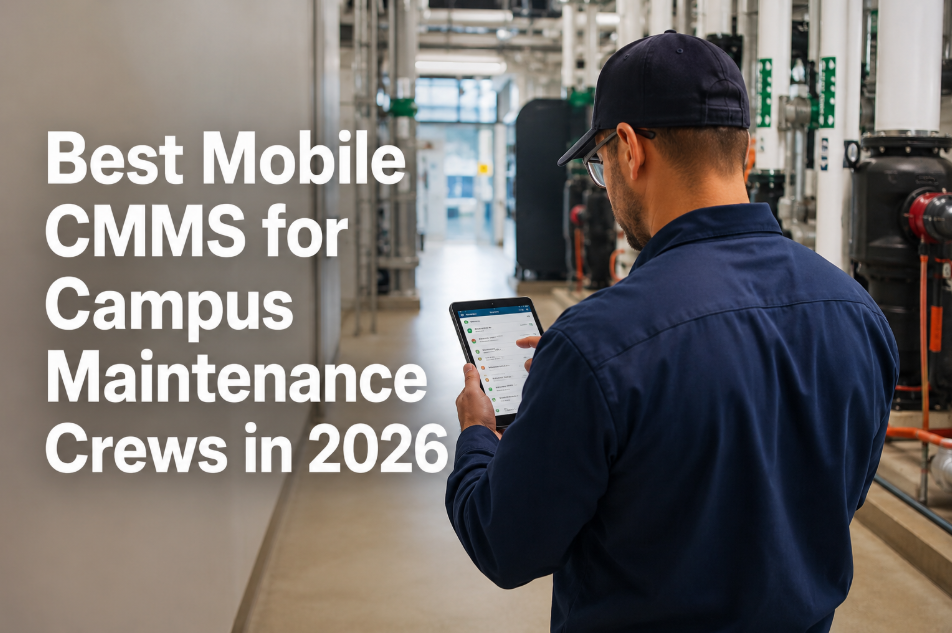
University maintenance crews walk 4–8 miles per shift. Mobile app must support offline work order completion, photo attachment, barcode scanning, and GPS check-in without returning to a desktop.
Athletic events, commencement ceremonies, and conferences generate 200+ event-related work orders annually. CMMS must integrate with event calendars for pre/post-event PM scheduling.
2026 University CMMS Platform Comparison
Evaluated against criteria most frequently cited by university facility directors during RFP processes. Data reflects publicly available platform documentation and APPA community feedback.
| Capability | Oxmaint | TMA Systems | AiM (AssetWorks) | Brightly (SchoolDude) |
|---|---|---|---|---|
| Multi-Campus Hierarchy (6+ levels) | Unlimited nesting | 5 levels | 6 levels | 3 levels |
| ERP Integration (Banner/Workday) | API — included | Custom integration | Native Banner | Limited |
| FCI / Capital Planning | Built-in 10-year model | Add-on module | Built-in | Basic reporting |
| Energy / Sustainability Tracking | Native per-building | Custom fields | Utility module | Not available |
| Mobile Offline Mode | Full offline | Partial | Partial | Online only |
| Student Housing Portal | No-login web form | Login required | Login required | QR + login |
| Implementation Timeline | 1–2 weeks | 3–6 months | 4–8 months | 2–4 weeks |
| Total First-Year Cost (200 buildings) | Under $15,000 | $50,000–$120,000 | $80,000–$200,000 | $25,000–$60,000 |
University facility directors evaluating CMMS platforms should request a campus-specific demonstration that maps their actual building hierarchy and workflow. Start a free trial and import your building list, or book a demo for a guided walkthrough with the Oxmaint higher ed team.
Common University Facility Management Pain Points
These challenges are not hypothetical — they are reported consistently across APPA surveys, NACUBO benchmarking studies, and facility director forums. Each one compounds annually when left unaddressed.
68% of facility directors report difficulty securing capital funding because they cannot present quantified building condition data. Board of trustees approves what they can see documented — not what they hear described verbally.
The average university adds $11.4 million in deferred maintenance every year. Without condition-based tracking, the backlog remains invisible until catastrophic failure — a burst steam line, a collapsed roof, a failed chiller during finals week.
NIH-funded labs require documented evidence of fume hood certification, autoclave validation, and HVAC performance. Paper logs are insufficient for federal audits — and non-compliance can freeze grant disbursements totaling millions.
Housing uses one tool, athletics uses another, central plant uses a third. The VP of Facilities has no single view of campus-wide maintenance operations — making staffing, budgeting, and priority decisions based on incomplete data.
How Oxmaint Serves University Facility Operations
Oxmaint is built for multi-site, multi-hierarchy operations — which is precisely what a university campus represents. Every feature below maps to a specific university facility challenge documented by APPA and NACUBO.
Import building lists, floor plans, and asset inventories from existing spreadsheets. Oxmaint's hierarchy supports multi-campus, multi-zone structures. A 200-building campus typically completes initial setup in under 8 hours.
Assign PM templates by building type — residential, academic, research, athletic, central plant. Each zone gets frequency schedules calibrated to its equipment density and compliance requirements.
API integration syncs purchase requisitions, budget codes, and vendor data with Banner, Workday, or PeopleSoft. No custom middleware. Maintenance costs flow into your general ledger in real time.
Condition scoring feeds directly into Facility Condition Index calculations. Present the board of trustees with per-building FCI scores and 10-year capital renewal projections — backed by documented asset data, not estimates.
Link HVAC optimization work orders, lighting retrofit projects, and BAS integration data to per-building energy intensity metrics. Report carbon reduction progress tied directly to maintenance actions.
Full-feature mobile app with offline mode, barcode scanning, GPS check-in, and photo capture. Crews complete work orders in the field — no return to shop required. Average technician saves 1.8 hours per shift in administrative overhead.
Universities that implement Oxmaint see measurable PM compliance improvement within 60 days and complete capital planning data within one semester. Ready to map your campus? Start a free trial today or book a demo for a campus-specific walkthrough.
ROI Benchmarks: Universities After CMMS Deployment
Frequently Asked Questions
Can Oxmaint handle both academic and auxiliary buildings under one platform?
Yes. Oxmaint's hierarchy supports unlimited building types under a single campus — academic, residential, athletic, research, central plant, parking, and auxiliary. Each building type can have distinct PM templates, crew assignments, and compliance requirements while rolling up to unified campus-level reporting.
How does Oxmaint handle multi-campus universities with geographically distributed sites?
Each campus operates as a top-level node in the hierarchy with its own zone structure, crew assignments, and budget tracking. Central administration sees consolidated reporting across all campuses while individual campus directors maintain operational control of their buildings. Distance between campuses is irrelevant to the software architecture.
What is the typical implementation timeline for a university with 100+ buildings?
Most universities with 100–300 buildings complete initial setup (building import, major asset registration, and first PM templates) within 1–2 weeks. Full deployment including crew training, mobile rollout, and ERP integration typically takes 4–6 weeks. This is dramatically faster than legacy platforms that require 4–8 months.
Does Oxmaint support APPA-level benchmarking and reporting?
Oxmaint tracks the core metrics required for APPA benchmarking: FCI per building, cost per gross square foot, PM completion rates, staffing ratios, and custodial service levels. Reports can be exported in formats compatible with APPA's Facilities Performance Indicators survey submission.
Your Campus Infrastructure Deserves a Platform Built for Higher Ed Scale
Legacy tools built for single-building operations cannot serve a 200-building campus. Oxmaint gives university facility directors the hierarchy, compliance tracking, capital planning, and mobile capability they need — at a fraction of the cost and implementation time of traditional higher ed CMMS platforms.