Higher education facilities directors in 2026 are managing a paradox — campus buildings are aging faster than capital budgets can address, yet the expectations for sustainability performance, regulatory compliance, and student experience quality have never been higher. The average U.S. university campus has buildings that are 42 years old, mechanical systems approaching end-of-life, and deferred maintenance backlogs growing at $7–$12 per square foot annually. In this environment, a CMMS is no longer a convenience tool for scheduling work orders — it is the operational backbone that connects capital planning to daily execution, energy management to maintenance activity, and compliance documentation to real-time field operations. Facilities directors who deploy CMMS strategically across these 9 use cases are the ones securing budget approvals, passing audits without scrambling, and demonstrating measurable operational improvement to provosts and boards. Platforms like Oxmaint are purpose-built for exactly these higher education scenarios — multi-building hierarchies, academic calendar scheduling, and portfolio-level reporting that boards actually understand. See how it works for your campus — start a free trial or book a demo with our higher ed team.
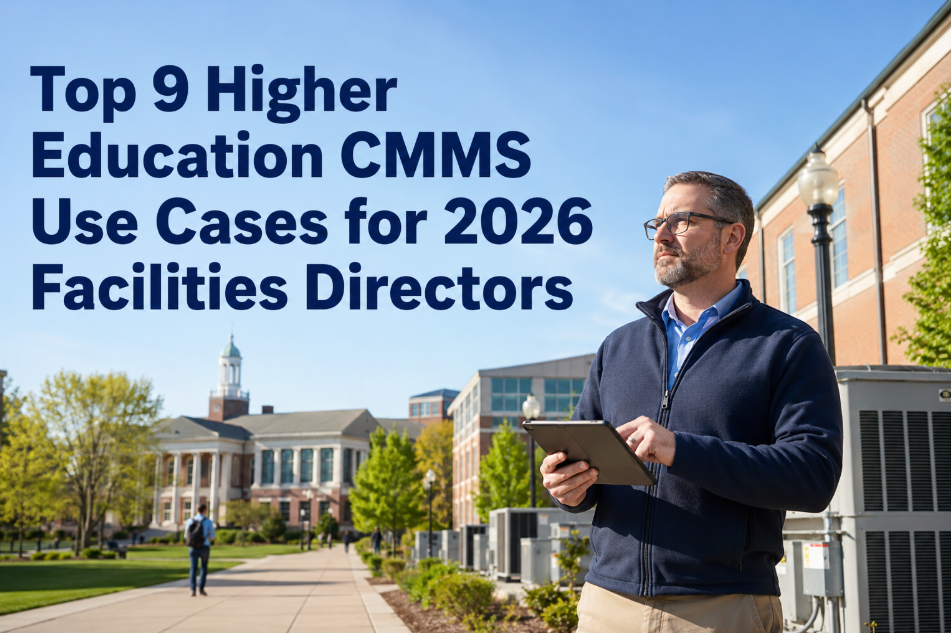
Top 9 Higher Education CMMS Use Cases for 2026 Facilities Directors
Capital plan defense, energy management, lab compliance, ESCo savings verification, mobile parity — the strategic use cases that separate reactive operations from data-driven facilities leadership.
Why These 9 Use Cases Matter in 2026
A CMMS in higher education is not just a work order ticketing system. When deployed strategically, it becomes the single source of truth that connects capital planning to daily operations, links maintenance activity to energy performance, and produces the compliance documentation that accreditors and state auditors demand. The 9 use cases below represent the operational scenarios where CMMS generates the most measurable impact — where the difference between having the system and not having it translates directly into budget approvals won, audit findings avoided, and operational costs reduced.
Each use case includes the operational problem it addresses, the specific CMMS capabilities required, and how Oxmaint delivers those capabilities for higher education environments. Whether your campus manages 15 buildings or 300, these are the scenarios where your CMMS investment pays for itself. Ready to explore how these apply to your campus? Start a free trial or book a demo to walk through your specific needs.
The 9 Strategic CMMS Use Cases for Higher Ed
From capital plan defense to lab compliance — every use case maps to a real operational challenge that facilities directors face in 2026.
Capital budget requests in higher education succeed or fail based on data quality. A facilities director who walks into a board meeting with "we need $14M for deferred maintenance" loses to one who presents "Building 7 has an FCI of 0.34, its chiller has failed 6 times in 18 months at $42,000 per event, and replacement at $280,000 eliminates $252,000 in projected annual repair costs — a 10-month payback." CMMS provides the asset-level failure history, cost attribution, and condition scoring that transforms capital requests from opinions into evidence-backed investment cases. Universities using CMMS-generated capital justification data secure 23% more in approved capital funding compared to those submitting narrative-based requests.
Energy costs represent the second largest operating expense for most universities — averaging $2.10 per square foot annually. The connection between maintenance quality and energy consumption is direct: a poorly maintained chiller runs 15–25% less efficiently, a clogged air handler increases fan energy consumption by 20%, and deferred economizer repairs eliminate free cooling hours worth $8,000–$15,000 per season. Universities that track HVAC maintenance completion alongside energy use intensity (EUI) consistently demonstrate the correlation — and use it to justify maintenance investment as an energy cost reduction strategy. CMMS-linked energy tracking gives sustainability officers the data to include in AASHE STARS submissions, carbon neutrality reports, and campus sustainability dashboards.
Research laboratories on university campuses are among the most regulated environments in higher education — governed by OSHA, EPA, NIH, state fire codes, and institutional biosafety committees. Fume hood face velocity testing, emergency shower inspections, eyewash station checks, autoclave validation, and biosafety cabinet certifications are not optional — they are compliance requirements tied to grant eligibility, institutional accreditation, and legal liability. A single missed fume hood test that correlates with a researcher exposure incident can trigger OSHA investigation, grant suspension, and institutional reputation damage. CMMS provides the automated scheduling, mandatory completion flags, and timestamped documentation trail that eliminates compliance gaps across dozens or hundreds of labs.
Energy Service Companies (ESCos) promise guaranteed energy savings through performance contracts — but verifying those savings requires independent maintenance and operational data that ESCos do not provide themselves. Universities that sign 15–20 year performance contracts without independent CMMS data to track equipment maintenance quality, operational parameters, and actual energy performance are relying entirely on the ESCo's own reporting to validate the ESCo's own claims. This is a $500M+ sector vulnerability across higher education. CMMS provides the independent maintenance record — documenting that ESCo-installed equipment is being maintained to specification, that operational parameters match contract assumptions, and that actual savings match guaranteed projections. When they do not match, the CMMS data becomes the evidence for contract remediation.
University maintenance technicians spend their day moving between buildings — basement mechanical rooms, rooftop air handling units, underground utility tunnels, and student-facing spaces. Any CMMS that requires them to return to a desktop computer to log work order completions, check asset history, or submit parts requests loses 1.5–2.5 hours of productive time per technician per day. Mobile parity — a mobile interface that provides full functionality without compromise — is the difference between a CMMS that technicians adopt voluntarily and one they resent. Offline capability matters critically in campus environments where basement mechanical rooms, parking structures, and utility tunnels have zero cellular signal. The technician must be able to complete work orders, capture photos, and log notes offline with automatic sync when connectivity returns.
The $112 billion national deferred maintenance backlog across higher education exists because most institutions cannot quantify their own share of it with precision. They know the backlog is large. They cannot say exactly how large, which buildings carry the most, which systems are most critical, or how fast it is growing. Without dollar-denominated, building-level, system-level backlog data, capital planning is guesswork and board presentations rely on estimates. CMMS that captures estimated repair cost on every open work order — and aggregates those costs by building, system type, priority, and age — transforms deferred maintenance from an abstract problem into a specific, actionable capital liability with clear prioritization and sequencing.
University campuses are not single buildings — they are portfolios of 20 to 400+ structures ranging from 100-year-old historic halls to cutting-edge research facilities, with utility plants, parking structures, athletic complexes, and residence halls all operating under one facilities department. A CMMS that treats each building as a flat list of assets fails at the portfolio scale. Higher ed requires a multi-level hierarchy: Campus > Zone > Building > Floor > Room > System > Asset > Component. This hierarchy enables roll-up reporting (FCI by zone, cost by building type, PM compliance by system), delegation (zone supervisors see only their buildings), and strategic analysis (which building class consumes 40% of maintenance spend?).
Regional accreditors (HLC, SACSCOC, MSCHE, WSCUC, NEASC, NWCCU) increasingly include facility condition and safety compliance in their institutional reviews. State fire marshals, building code officials, EPA environmental inspectors, and ADA compliance auditors all require documented evidence of maintenance activity — with dates, personnel, and outcomes traceable per asset. Institutions that compile this documentation manually spend 200–400 staff hours before each major review. Those using CMMS generate the same reports in minutes — timestamped, signed, and filterable by any combination of asset type, date range, work category, and compliance tag. The difference is not just efficiency — it is audit confidence. CMMS documentation passes scrutiny because it was captured during the work, not reconstructed afterward.
Residence halls operate 24/7, 365 days per year — they are occupied housing facilities with tenant expectations for response time, comfort, and safety that exceed any other building type on campus. A broken HVAC system in a residence hall at 2 AM on a Friday in January is an emergency with immediate student welfare implications. Summer turnover maintenance — where every room must be inspected, repaired, cleaned, and certified ready for fall move-in within a 6–8 week window — is one of the most operationally intensive maintenance events in higher education. CMMS enables resident-submitted service requests with priority auto-routing, summer turnover project management with room-level tracking, and year-round PM scheduling for the HVAC, plumbing, and fire safety systems that keep 10,000+ students safe and comfortable.
CMMS as Work Order Tool vs CMMS as Strategic Platform
Most universities have a CMMS. Few use it across all 9 use cases. The difference in outcomes is significant.
Measured Outcomes When Higher Ed Deploys CMMS Strategically
How Oxmaint Supports All 9 Use Cases From One Platform
Purpose-built for multi-building higher education environments — not retrofitted from commercial real estate or manufacturing.
Asset condition scores and repair cost data feed capital forecasting models — board-ready reports with asset-level evidence behind every line item.
HVAC PM completion rates tracked alongside energy performance — EUI improvements linked to maintenance investment for sustainability reports.
Lab safety, fire suppression, and regulatory PMs flagged mandatory — overdue alerts to director and EHS simultaneously. Audit reports on demand.
Contract-specified maintenance schedules, operational parameters, and performance data tracked independently for savings verification audits.
Complete work orders, scan barcodes, capture photos, and view asset history on mobile — offline sync for basement mechanical rooms and utility tunnels.
Portfolio > Campus > Building > System > Asset > Component. Zone-level delegation, roll-up reporting, and building-class analytics at every level.
Frequently Asked Questions
Can a university start with 2–3 use cases and expand later?
How does Oxmaint handle the unique scheduling requirements of academic calendars?
What ERP and financial systems does Oxmaint integrate with in higher education?
How do we measure CMMS ROI across multiple use cases simultaneously?
Your Campus Has 9 CMMS Use Cases. How Many Are You Using?
Every use case on this list represents budget dollars defended, compliance risks eliminated, or operational hours recovered. Oxmaint supports all 9 from a single platform — with academic calendar scheduling, multi-building hierarchy, and board-ready reporting built in. Most campus facilities teams activate their first two use cases within the first week of onboarding.