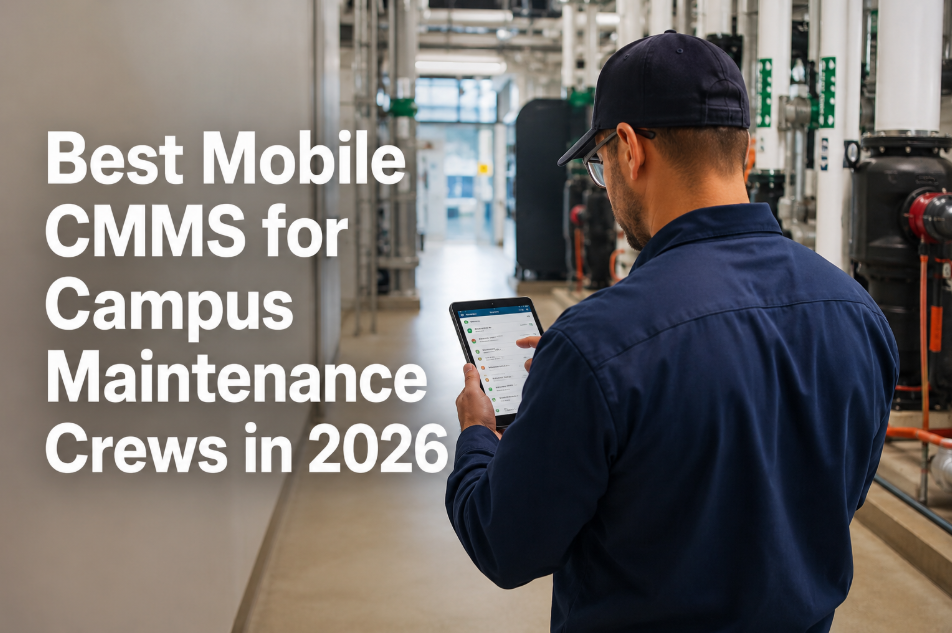
Campus maintenance technicians do not sit at desks. They spend their shifts moving between boiler rooms, rooftop air handlers, residence hall bathrooms, underground utility tunnels, and athletic complexes — environments where a desktop CMMS is useless and even a web-based mobile interface often fails due to poor connectivity. The gap between a CMMS with mobile capability and a CMMS with true mobile parity — offline mode, GPS check-in, photo capture, barcode scanning, and full work order lifecycle management without a network connection — is the gap between a system technicians tolerate and one they actually adopt. In 2026, campus maintenance crews at universities and K-12 districts handling 15–300 buildings need mobile CMMS tools that work everywhere on campus, sync automatically when connectivity returns, and integrate with academic calendars that dictate when maintenance can happen. Platforms like Oxmaint are built specifically for this reality — full mobile functionality for field crews, offline sync for dead zones, and campus-specific scheduling. See it in action for your maintenance team — start a free trial or book a demo today.
Best Mobile CMMS for Campus Maintenance Crews in 2026
Offline mode, GPS check-in, photo capture, barcode scanning, academic calendar integration — the mobile features that separate crew adoption from crew frustration.
What Mobile Parity Actually Means for Campus Crews
Most CMMS vendors claim mobile capability. What they deliver varies dramatically — from a mobile-responsive web page that loads slowly and requires constant connectivity, to a purpose-built native application with offline database sync, integrated camera, GPS location tracking, and barcode scanning. For campus maintenance crews working across buildings with steel-reinforced basements, concrete parking structures, and underground utility tunnels, the difference is operational: a CMMS that requires connectivity to function is a CMMS that does not work in 38% of the locations where maintenance happens.
True mobile parity means the technician can receive assignments, view complete asset history, log labor and parts, capture photos, and close work orders entirely from a mobile device — including in locations with zero network connectivity. The data syncs automatically when connectivity returns. No re-entry. No lost records. No trips back to the shop to update the system. This single capability — mobile parity with offline — determines whether your CMMS becomes an efficiency tool or an administrative burden your crew actively avoids. Ready to see the difference? Start a free trial or book a demo to walk through the mobile experience.
The 8 Mobile CMMS Features That Campus Crews Actually Need
Not every mobile feature matters equally. These 8 are the ones that determine whether your crew adopts the tool or works around it.
Basement mechanical rooms, underground steam tunnels, parking garages, and concrete utility vaults all have zero or near-zero cellular connectivity. Offline mode must allow the technician to view assigned work orders, access asset history, log labor hours, capture notes and photos, scan barcodes, and close work orders — all without a network connection. Data syncs automatically when connectivity returns. No manual upload. No lost records. Without this feature, your CMMS does not work in 38% of campus maintenance locations.
GPS check-in confirms the technician arrived at the correct building before work begins — eliminating the ambiguity of phone-dispatched assignments where technicians occasionally go to the wrong location. For supervisors managing crews across 50–300 buildings, GPS location visibility shows where each technician is currently working, enables proximity-based dispatch for emergency work orders, and provides documented proof of presence for labor verification and union reporting purposes.
A before-and-after photo attached to a work order communicates asset condition more effectively than a paragraph of text. For compliance documentation, photos provide timestamped visual evidence of completed inspections — fire extinguisher tags, fume hood face velocity readings, playground surface conditions. For warranty claims, photos document the defect at the time of discovery. For capital planning, photos of deteriorating assets support FCI-based funding requests with visual evidence that boards and administrators respond to immediately.
Scanning an asset barcode or QR code on a piece of equipment pulls up the complete asset record — serial number, warranty status, maintenance history, parts list, PM schedule, and open work orders — in under 2 seconds. For parts management, scanning bin barcodes in the storeroom logs parts consumption against the work order automatically. This eliminates manual data entry errors (technicians misidentifying asset numbers is the #1 source of CMMS data quality issues) and accelerates parts checkout from 3–5 minutes to 15 seconds per transaction.
Campus maintenance does not operate on standard business calendars. Maintenance windows exist during semester breaks, exam weeks restrict noisy work in academic buildings, athletic events close access to stadium and arena mechanical spaces, and summer intensive maintenance programs run on compressed timelines. Mobile CMMS that surfaces the academic calendar alongside the PM schedule shows technicians exactly when they can access each space — preventing the productivity loss of arriving at a locked building during a final exam or finding an athletic event blocking mechanical room access.
Nothing wastes a technician's time faster than arriving at a job, diagnosing the problem, then discovering the required part is out of stock. Mobile parts availability checking — before the technician leaves for the building — eliminates this productivity drain. If the part is available, the technician reserves it from mobile. If it is not, the work order is automatically rescheduled and a purchase request is triggered. This single feature eliminates an estimated 1.2 wasted trips per technician per day across campus maintenance operations.
Emergency work orders on campus — a water main break near the library, a failed elevator in a residence hall, a gas odor reported in a lab building — require immediate dispatch to the nearest qualified technician. Mobile CMMS with priority-based push notifications ensures emergency work orders reach the right technician within seconds, not minutes. The technician sees the priority level, building location, asset details, and safety notes on their mobile device immediately — no radio call, no phone tag with the supervisor, no delay.
Life safety inspections, fire suppression testing, elevator certifications, and lab safety checks all require signed documentation. Mobile digital signature capture — on the screen, at the point of completion — creates a tamper-proof compliance record linked to the asset, timestamped, and stored permanently. No paper sign-off sheets to track down. No missing signatures discovered during audit preparation. For campuses with union reporting requirements, digital sign-off also provides verified documentation of task completion by specific personnel.
A Day in the Life: Mobile CMMS vs Desktop-Dependent CMMS
Same technician. Same campus. Same 8-hour shift. Dramatically different productivity.
Mobile CMMS Evaluation Checklist for Campus Buyers
Use this checklist when evaluating mobile CMMS platforms for your university or K-12 district. Every feature below directly impacts crew adoption and productivity.
| Feature | Why It Matters for Campus | Oxmaint |
|---|---|---|
| Full offline work order management | Basements, tunnels, and garages have no signal — technicians cannot stop working | Included |
| Automatic background data sync | Offline data must sync without manual action when connectivity returns | Included |
| GPS check-in at building | Verifies technician arrived at correct location — supports labor accountability | Included |
| Integrated photo and video capture | Before/after documentation for compliance, warranty claims, and capital justification | Included |
| Barcode and QR code scanning | Instant asset identification eliminates 91% of manual entry errors | Included |
| Academic calendar integration | PMs respect class schedules, exam periods, and athletic event blackouts | Included |
| Real-time parts inventory check | Prevents wasted trips to storeroom for out-of-stock parts | Included |
| Priority push notification dispatch | Emergency work orders reach nearest qualified technician within seconds | Included |
| Digital signature capture | Life safety and compliance inspections require signed documentation at point of work | Included |
| Native app (not mobile web) | Native apps are faster, work offline, and integrate with device camera and GPS natively | Included |
What Campus Teams Achieve With Mobile-First CMMS
Why Oxmaint Is Built for Campus Maintenance Crews
Every mobile feature below was designed for the reality of campus field operations — not retrofitted from a desktop system.
Full work order lifecycle — receive, start, log, photograph, close — operates entirely offline. Auto-syncs when connectivity returns. Zero data loss.
Technicians see only their assigned zone or campus. Supervisors see district-wide. Asset hierarchy respects campus structure: Zone > Building > Floor > Room > System > Asset.
QR code on any asset pulls complete maintenance history, warranty info, parts list, and active work orders — no manual lookup, no data entry.
Technician mobile view shows PMs filtered by academic calendar accessibility — no wasted trips to locked buildings during finals or athletic events.
Check parts stock from the field. Reserve available parts with one tap. Trigger auto-purchase for out-of-stock items. Linked to the work order automatically.
High-priority work orders push directly to the nearest qualified technician via mobile notification — with building location, asset details, and safety notes attached.
Before/after photos and digital signatures captured at point of work. Creates audit-ready compliance records without post-shift paperwork.
Supervisors view crew location, open backlog, overdue PMs, and daily completion rates on mobile — full oversight without returning to the office.
Frequently Asked Questions
How does offline mode handle data conflicts when multiple technicians sync simultaneously?
What devices and operating systems does Oxmaint mobile support?
How long does it take for campus maintenance crews to adopt Oxmaint mobile?
Can Oxmaint mobile integrate with our existing building access control or key management systems?
Give Your Crew the Tool That Works Where They Work
Your maintenance technicians spend their shifts in boiler rooms, on rooftops, in tunnels, and across buildings — not at desks. Oxmaint's mobile CMMS gives them full work order management, offline capability, barcode scanning, photo documentation, and parts visibility from anywhere on campus. Most crews are productive on mobile within their first shift. No lengthy training. No desktop dependency. No lost records.