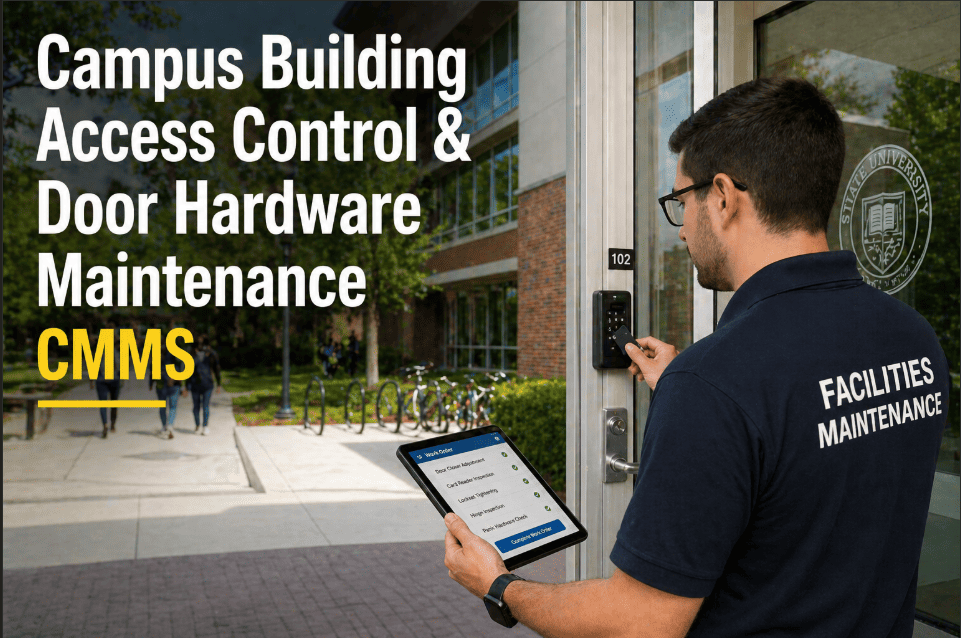
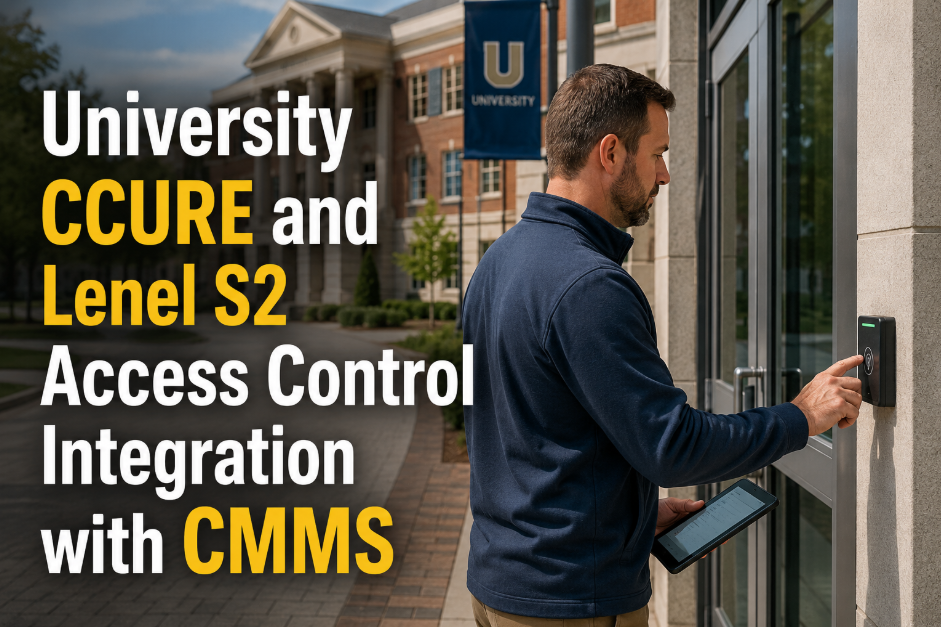
A campus card reader that fails at 11 PM on a Friday does not just inconvenience a student — it creates a security gap, a facilities emergency call, a locksmith fee, and a formal incident report. Multiply that by the 847 access control devices the average mid-size university operates across 60+ buildings, and the scale of the maintenance challenge becomes clear. Most campus access control failures are not hardware failures — they are maintenance failures. Card readers with dirty contacts, door closers with worn hydraulics, electric strikes with corroded solenoids, and magnetic locks with weakened holding force all degrade gradually and predictably. A structured PM program catches 85% of these failures before they become security incidents. Without CMMS tracking, campus security hardware lives in a maintenance blind spot — installed, commissioned, and then forgotten until something stops working. If your campus access control systems are maintained reactively, start a free trial with Oxmaint or book a demo to see how structured PM eliminates security hardware failures.
Campus Access Control Maintenance — 2026 Data
85% of Campus Access Control Failures Are Preventable With Structured CMMS-Driven PM — Yet 73% of Universities Have No Formal Hardware Maintenance Program
847
Average access devices per campus
Mid-size university — card readers, electric strikes, mag locks, door closers, and intercoms across 60+ buildings
73%
Universities with no formal PM
APPA 2025 — security hardware maintained reactively with no structured inspection schedule in CMMS
$340
Average emergency lockout cost
Including after-hours technician callout, locksmith, and security escort — versus $18 planned PM inspection cost
85%
Failures preventable with PM
Security hardware failure analysis — contact fouling, hydraulic wear, and solenoid corrosion are predictable and preventable
Purpose-Built Campus Security Hardware Maintenance
Stop Treating Security Hardware Failures as Emergencies — Start Preventing Them
Oxmaint tracks every card reader, electric strike, mag lock, and door closer as a named asset with its own PM schedule, failure history, and warranty record. Security gaps become maintenance work orders before they become incidents.
The Six Hardware Types That Make Up Campus Access Control — and What Each Needs
Campus access control is not a single system — it is six distinct hardware categories, each with different failure modes, different maintenance intervals, and different consequences when they fail. A card reader failure is an inconvenience. An electric strike failure on a residence hall stairwell door is a life-safety event. Understanding each hardware type and its specific maintenance requirements is the foundation of a program that protects both security and safety. For campuses ready to build this program systematically, start a free trial or book a demo to see how Oxmaint structures access control asset hierarchies.
Common failures: Contact fouling from dust and moisture, LED status light failure, keypad wear, weather seal degradation on exterior units
PM tasks: Contact cleaning with IPA solution, lens inspection, button test, seal condition check, firmware version verification
Failure consequence: Student lockout, security gap at monitored entry point, incident report required
Common failures: Solenoid corrosion in high-humidity locations, latch bolt misalignment from door settling, voltage drop from aging wiring, cold weather lubrication failure
PM tasks: Strike alignment check, solenoid current draw measurement, lubrication, fail-safe/fail-secure function test, wire connection torque check
Failure consequence: Life-safety egress concern, AHJ citation, emergency repair at $450–$900 per callout
Common failures: Holding force degradation (should be 600–1,200 lbs, fails at under 400 lbs), armature plate corrosion, mounting bracket loosening, power supply voltage sag
PM tasks: Holding force measurement with pull gauge, armature surface cleaning, mounting hardware torque, power supply voltage check at 12/24 VDC specification
Failure consequence: Door that appears secure but releases under moderate force — security breach without alarm trigger
Common failures: Hydraulic fluid loss reducing closing force, arm adjustment drift allowing door to slam or not latch, spring tension loss on older units, freeze-up in cold climates
PM tasks: Closing speed adjustment (2–6 second range), latching speed check, back-check function test, fluid leak inspection, mounting screw torque
Failure consequence: Door not latching = access control system bypassed entirely. Fire door not closing = life safety violation
Common failures: Speaker membrane corrosion on exterior units, camera lens fouling, microphone sensitivity loss, network connection degradation for IP-based systems
PM tasks: Two-way audio test, camera image quality check, lens cleaning, network latency measurement for IP systems, weather seal inspection
Failure consequence: Visitor management breakdown, security staff unable to verify identity before granting access
Common failures: Battery capacity degradation (SLA batteries lose 20% capacity per year), charging circuit failure, output voltage drift causing intermittent hardware faults that mimic reader failures
PM tasks: Battery load test under simulated power failure, output voltage measurement at all terminals, charging current verification, battery age tracking for 3-year replacement cycle
Failure consequence: Entire access zone goes offline during power event — every device on that supply simultaneously fails
Four Failure Patterns That Create Campus Security Gaps
01
The "Intermittent Reader" That Never Gets Fixed
A card reader on the library's east entrance starts failing one in ten attempts. Students start propping the door open. Facilities gets verbal reports but no formal work order — so no technician is dispatched. Six weeks later, the reader fails completely on a Saturday night with 200 students inside. The root cause was fouled contacts — a $12 cleaning job that became a $680 emergency repair plus a security incident report. Without CMMS failure tracking, intermittent faults accumulate invisibly.
02
Door Closers That Defeat the Access Control System
A $3.5M card access system installed across a residence hall complex is completely bypassed when door closers drift out of adjustment and doors stop latching. The card reader shows "access granted" correctly — but the door swings open to anyone who pushes it. This is the most common access control failure mode on campuses: the electronic system works perfectly while the mechanical hardware it depends on fails. Semi-annual closer adjustment checks eliminate this entirely.
03
Magnetic Lock Holding Force Below Specification
A mag lock rated at 1,200 lbs holding force that has degraded to 380 lbs looks secure. The LED is green. The access control software shows "locked." But a moderate shoulder check will open the door. Without semi-annual holding force testing with a calibrated pull gauge, degraded mag locks remain in service for years — providing the appearance of security without the reality.
04
Warranty Expiration Tracking Across 847 Devices
A campus deploys 200 card readers across a new residence hall complex. Three years later, the readers begin failing. Nobody tracked that the hardware warranty expired at year 3. OEM replacement parts are now at full cost instead of warranty replacement. Across 847 devices with staggered installation dates and 3–7 year warranty periods, untracked warranty expiration costs the average campus $45,000–$120,000 in avoidable hardware replacement costs annually.
How Oxmaint Structures Campus Access Control Maintenance
Registry
Every Device as a Named Asset
Each card reader, electric strike, mag lock, door closer, intercom, and power supply registered individually with location, installation date, model, serial number, firmware version, and warranty expiry. Asset hierarchy: Campus > Building > Floor > Door > Device Component.
847 devices tracked — none in a maintenance blind spot
PM Engine
Hardware-Specific PM Schedules
Quarterly card reader cleaning. Semi-annual mag lock holding force tests. Annual electric strike load testing. Battery replacement on 3-year cycles triggered from installation date. Each device type carries its own maintenance template with specific inspection checklist, not a generic "inspect annually" task.
PM schedules matched to each hardware failure mode
Failure Log
Intermittent Fault Pattern Detection
When the same card reader generates three service requests in 90 days, Oxmaint flags the pattern and escalates to a formal inspection work order. Intermittent faults that would otherwise accumulate until catastrophic failure are caught in the data before they become security incidents.
Recurring faults caught before they become incidents
Warranty
Warranty Expiry Alerts Across All Devices
Warranty expiration dates tracked per device. 90-day advance alerts generated when hardware approaches warranty end — giving procurement time to negotiate extended coverage or schedule replacement before costs shift from warranty to capital budget.
Zero surprise warranty expirations across 847 devices
Compliance
Life-Safety Documentation for AHJ Inspection
Fire door closer compliance, ADA-compliant door force documentation, and fail-safe/fail-secure function test records automatically generated from inspection work orders. AHJ inspection packages exportable on demand with timestamped maintenance evidence.
AHJ inspection compliance documented automatically
Mobile
Technician Mobile Inspection Workflow
Technicians complete access control inspections on mobile devices with device-specific checklists, photo capture for condition documentation, and barcode/QR scanning to identify assets instantly. Completed inspections sync automatically to the asset record.
Inspection data captured at the device, not reconstructed later
Reactive vs. CMMS-Driven Access Control Maintenance
| Dimension | Reactive Campus Approach | Oxmaint CMMS-Driven Program |
| Asset visibility |
Spreadsheet or no record of devices |
Every device registered with full history |
| Card reader PM |
When it stops working |
Quarterly cleaning on scheduled work orders |
| Mag lock holding force |
Never tested |
Semi-annual calibrated pull gauge test |
| Door closer adjustment |
When door won't latch |
Semi-annual adjustment check per device |
| Battery replacement |
When power supply fails |
3-year cycle triggered from installation date |
| Warranty tracking |
Lost or unknown |
Per-device alerts 90 days before expiry |
| Intermittent fault detection |
Not tracked |
Pattern-flagged after 3 events in 90 days |
| AHJ compliance documentation |
Manual file assembly before inspection |
Auto-generated from work order records |
Access Control Maintenance ROI — The Numbers
85%
Failures Prevented
Security hardware failures caught by structured PM before they create security gaps or lockout events
19x
Cost Difference
$18 planned PM inspection vs. $340 average emergency lockout response — same device, different maintenance model
$120K
Warranty Savings Potential
Annual avoidable hardware replacement costs eliminated by tracking warranty expiry across all 847 devices
Zero
Security Incident Reports
Target outcome for campuses running structured access control PM — maintenance failures should not become security events
Frequently Asked Questions
Can Oxmaint integrate with our existing access control management software like Lenel, Software House, or Genetec?+
Yes. Oxmaint integrates with access control management platforms via API where available — receiving door event data, alarm triggers, and hardware fault alerts to generate maintenance work orders automatically. For platforms without direct API integration, Oxmaint's manual asset registry with QR-code scanning provides the same structured PM capability without requiring software integration. The maintenance program functions effectively either way — the integration simply adds automatic fault-triggered work order generation.
Book a demo to discuss your specific access control platform.
How long does it take to register 847 access control devices in the CMMS?+
Bulk CSV import allows existing asset lists from building management systems or spreadsheets to be loaded in a single upload — typically 2–4 hours for data preparation and import for a campus-scale deployment. Campuses without existing digital asset lists can use Oxmaint's mobile QR scanning to register devices during the first inspection round — capturing location, model, and serial number at the device, building the registry as technicians walk the campus. A 60-building campus typically completes mobile registration in 3–5 days of technician time.
Who should perform access control hardware maintenance — facilities staff or security contractors?+
The optimal split: 70% of tasks to facilities staff, 30% to specialist contractors. Card reader cleaning, door closer adjustment, visual condition inspections, and battery testing are straightforward tasks within facilities technician capability with proper procedure guides. Electric strike load testing, mag lock holding force measurement, and power supply load capacity verification benefit from security hardware specialist training. Oxmaint supports both — internal technician assignments for routine PM and contractor work orders for specialist tasks, all documented in the same device record with the same audit trail.
How does CMMS access control maintenance support CLERY Act compliance?+
The Clery Act requires institutions to maintain accurate crime statistics and security infrastructure records. CMMS maintenance documentation provides evidence that access control systems were functioning and maintained — relevant when security incidents occur and legal questions arise about whether hardware was in serviceable condition. Timestamped maintenance work orders, inspection checklists with technician signatures, and failure-to-resolution documentation create a defensible record that the institution operated its security infrastructure responsibly.
Start a free trial to see how the documentation trail is built automatically.
Campus Access Control — Oxmaint
Security Hardware That Fails Is a Maintenance Problem. Solve It Before It Becomes a Security Incident.
847 access control devices across 60+ buildings cannot be maintained reactively. Each card reader, electric strike, mag lock, door closer, intercom, and power supply needs its own PM schedule, failure history, warranty record, and inspection checklist. Oxmaint provides all of it — in a single platform that turns security hardware maintenance from a blind spot into a structured, documented, and compliance-ready program.
85%
Failures prevented with structured PM
19x
Cost difference — planned vs. emergency
847
Devices tracked — none forgotten
Auto
AHJ compliance documentation