Superintendents across North America are walking into school board meetings with one of two realities: either they have the numbers — FCI scores, opening-day readiness percentages, deferred backlog in dollars — or they are walking in with estimates and hoping the board does not ask the hard questions. The gap between these two situations is not about how well a district manages its facilities. It is about whether the district has the systems in place to measure how well it manages them. K-12 facilities represent some of the most politically visible public infrastructure in any community — parents notice a leaking ceiling or broken HVAC in their child's classroom far faster than they notice a pothole on a side street. With average deferred maintenance backlogs now exceeding $200 per student in most U.S. school districts, the pressure to demonstrate data-driven stewardship of facilities budgets has never been higher. Platforms like Oxmaint's K-12 CMMS give superintendents and district facilities directors the live KPI dashboards they need to lead those conversations with confidence. Want to see how it looks for your district? Start a free trial or book a demo with our team.
Top 10 K-12 District Facility KPIs Every Superintendent Tracks in 2026
The metrics that win board approval, satisfy state auditors, protect student health, and prove your facilities team is delivering — all tracked automatically with the right CMMS.
The Case for Formal KPI Tracking in K-12 Facilities
School district facilities teams operate under a unique combination of pressures that most other public-sector organizations do not face: state facility audits, EPA environmental compliance, ESSER funding reporting requirements, union contract obligations for custodial staffing, opening-day readiness deadlines that are entirely non-negotiable, and the constant public visibility of buildings that serve children in every neighborhood.
Yet the majority of K-12 districts still manage facilities through a combination of work order spreadsheets, paper maintenance logs, and institutional memory held by long-serving staff. When those staff members retire — and the retirement wave in K-12 facilities management is significant — the institutional knowledge walks out the door with them. The 10 KPIs below are what the most effective district facilities operations track, and what Oxmaint surfaces automatically for every district that adopts the platform. Start a free trial or book a demo to see your district's data come to life.
The 10 KPIs That Define High-Performing K-12 Facilities Programs
Each of these KPIs is tracked by the districts that consistently win capital funding, pass state audits, and deliver buildings that teachers want to work in and parents feel good about sending their kids to.
FCI is the foundational metric for K-12 facility condition reporting — used by state auditors, bond rating agencies, and ESSER compliance reviewers. It divides total deferred maintenance cost by the building's current replacement value. A district with an FCI above 0.30 across its portfolio is in a difficult position to defend capital budget requests without documented remediation plans. Districts with FCI data per school can prioritize bond funding, sequence renovation projects, and demonstrate stewardship to taxpayers.
Indoor air quality is the K-12 facility KPI with the most direct link to student health outcomes and the highest regulatory exposure. EPA's IAQ Tools for Schools program, state ventilation codes, and post-COVID ESSER IAQ improvement requirements all demand documented evidence of HVAC maintenance, filter replacement schedules, and CO2 monitoring. Districts that track IAQ compliance formally can demonstrate to parents, health officials, and state auditors that buildings are safe — and can access continued ESSER funding tied to IAQ improvements.
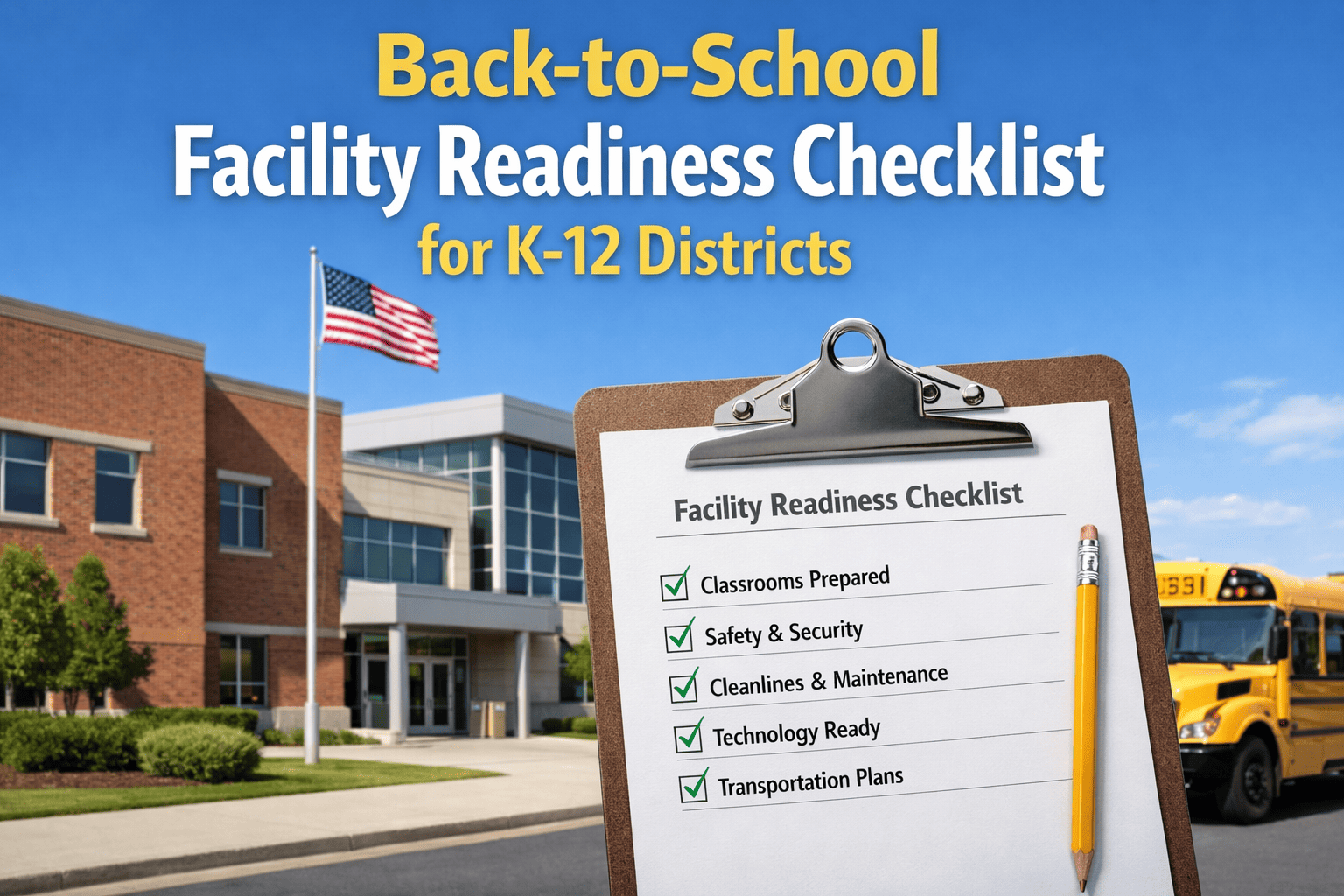
Opening-day readiness is a uniquely K-12 KPI — the percentage of school buildings that are fully operational, inspected, cleaned, and safe on the first day of school. A single school that cannot open due to a facilities failure generates immediate media coverage, parent complaints, and board scrutiny. Districts track this metric as a summer-long project KPI, with checklists for each building covering HVAC functionality, plumbing, fire safety systems, custodial readiness, and technology infrastructure. Oxmaint's digital checklists allow teams to track building-by-building readiness status in real time across the entire district.
PM compliance in K-12 settings faces unique scheduling challenges — maintenance must happen outside school hours, around athletic seasons, summer programs, and community use agreements. Districts that schedule PMs aligned to the academic calendar, with work concentrated during winter and spring breaks and summer months, consistently achieve 85%+ compliance. Those relying on paper schedules average 52%. Each point of PM compliance improvement reduces emergency call costs by approximately $1,800 per school building per year.
Dollar-denominated deferred backlog is the number that moves school boards and state legislators. Tracking deferred maintenance in work order counts — "we have 340 open tickets" — produces no urgency. Showing "$4.2M in deferred maintenance aging at 14% annually without additional investment" produces budget decisions. State facility funding formulas in many states (including Ohio, California, and Texas) require documented deferred backlog figures as part of capital project eligibility. Oxmaint's backlog report produces this number automatically, broken down by school, building system, and aging category.
Response time KPIs by priority tier are the most visible measure of facilities service quality to teachers, principals, and parents. When a toilet overflows in an elementary school bathroom, the principal does not care about your average MTTR — they care how fast someone shows up. Tracking response time by priority tier, by school, and by technician allows the director to demonstrate service consistency and identify schools or problem types that chronically underperform. It also supports contract negotiations with service unions by providing objective performance data.
Custodial staffing ratios — typically expressed as cleanable square feet per custodian — and APPA cleanliness levels are the facilities KPIs most directly perceived by students, parents, and teachers. APPA recommends 19,000–21,500 square feet per custodian for Level 2 service. Districts operating above 28,000 sq ft per custodian are delivering Level 3–4 service — visibly inadequate cleanliness that affects school climate surveys and recruitment. Tracking APPA level scores through digital inspection rounds gives facilities directors objective data to justify staffing requests.
Energy cost per student is a benchmark that speaks directly to school board members who think in per-pupil terms. U.S. public schools spend approximately $8 billion on energy annually — about $180 per student on average, though costs vary widely by climate zone, building age, and HVAC maintenance quality. Districts that document the link between PM compliance and energy cost reduction can build compelling ROI cases for maintenance investment: every $1 spent on HVAC preventive maintenance returns $4–$8 in energy and repair cost avoidance over 10 years.
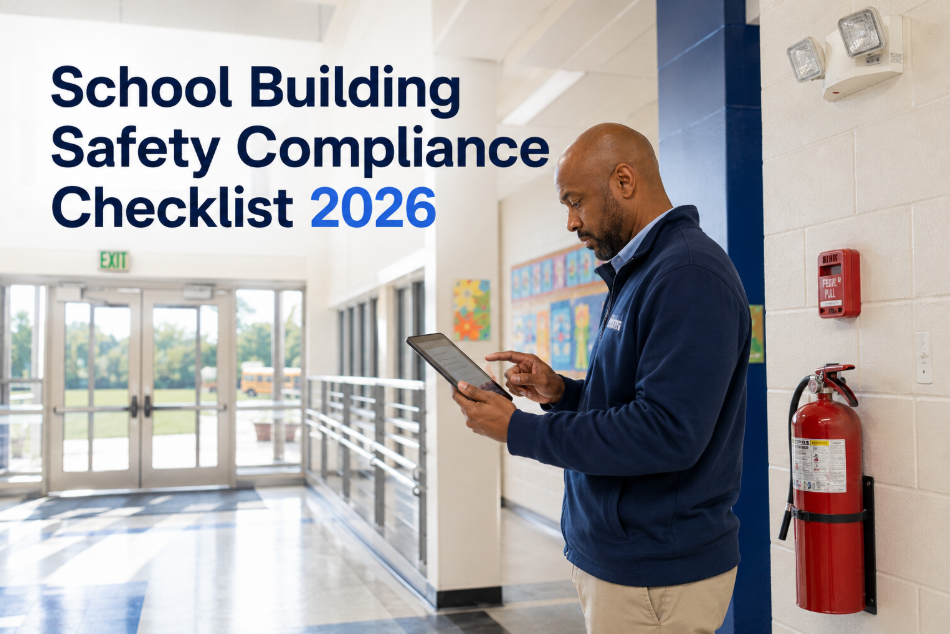
Fire suppression system inspections, emergency exit lighting tests, panic hardware checks, fire door inspections, and playground safety assessments are not negotiable — they are mandatory compliance items with potential criminal liability for the superintendent and board in cases of student injury following a documented failure. States including California, Florida, New York, and Illinois have mandatory reporting requirements for school life safety inspections. Tracking compliance through a system that generates automatic overdue alerts — rather than relying on calendar reminders — is the only reliable method at scale across a multi-school district.
ESSER (Elementary and Secondary School Emergency Relief) funds distributed post-COVID included billions for facility improvements — IAQ upgrades, HVAC replacements, ventilation improvements, and building safety measures. Documenting that ESSER-funded facility projects were completed, that work was performed as specified, and that outcomes (IAQ improvements, energy reductions) are measurable is now an active federal compliance requirement. Districts that tracked ESSER-funded work orders through their CMMS can produce compliance reports on demand. Those that managed ESSER projects through spreadsheets are facing retroactive documentation challenges as federal review processes intensify through 2026.
The KPI Board Report: What Every Superintendent Needs
This is the one-page district facilities KPI summary that high-performing superintendents present to their boards quarterly — and that Oxmaint generates automatically.
Before vs After: What KPI Tracking Changes for a K-12 District
Two districts. Same size. Same budget. Very different conversations with their school boards.
How Oxmaint Delivers All 10 KPIs for K-12 Districts
Built for multi-site school district operations — not just individual buildings. Every feature maps directly to a KPI on this list.
Every HVAC unit, boiler, elevator, generator, and roof system logged by school — with condition scores and replacement cost that feed FCI automatically.
PMs are concentrated during breaks and summer — scheduled to academic calendar constraints, not just fixed intervals. Compliance rates climb from 52% to 88%+ within one school year.
Summer readiness checklists assigned to each school — HVAC, plumbing, fire safety, custodial. Completion tracked by building in real time with photo documentation.
Life safety and IAQ PMs flagged as mandatory — automatic overdue alerts to director and superintendent. Compliance documentation generated on demand for auditors.
Work orders tagged by funding source at creation. ESSER compliance reports show project completion, cost, and outcome data in a single export for federal review.
One-click export of district-wide KPI summary — FCI by school, PM compliance, deferred backlog, life safety status, energy cost per student — formatted for board presentation.
Technicians receive, complete, and close work orders on mobile — including offline in buildings with poor signal. Response time tracked automatically from dispatch to arrival.
Asset replacement cost and condition data feeds rolling 5-year CapEx models — giving superintendents the forward-looking financial data needed for bond referendum planning.
What K-12 Districts Achieve With Oxmaint
Frequently Asked Questions
How does a small district with 5–8 schools get started with KPI tracking?
Can Oxmaint help with ESSER documentation for federal compliance reviews?
How does Oxmaint handle maintenance scheduling across multiple schools with different calendars?
What is the most common mistake K-12 districts make when trying to track facility KPIs?
Your District Already Has the Data. Now Give It a Dashboard.
FCI scores, PM compliance rates, deferred backlog dollars, opening-day readiness, ESSER documentation — the data behind every KPI on this list already exists in your district's operations. Oxmaint brings it into one live platform, updated automatically, and formatted for the board presentations, state audits, and capital planning conversations that define your success as a facilities leader. Most districts are tracking their first three KPIs within the first week.