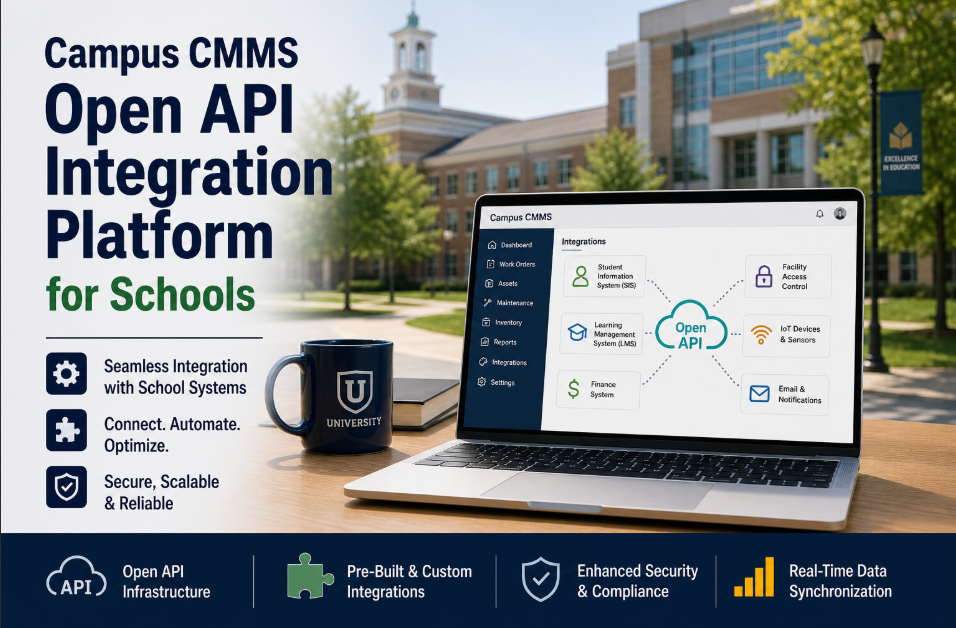
A university running Banner for student records, SAP for finance, and a Siemens BMS for building controls has three systems that should be sharing data automatically — and almost certainly are not. Maintenance teams sit at the intersection of all of them, manually re-entering work orders, copying cost codes, and generating reports that a properly integrated system should produce without human intervention. Open API CMMS integration is the difference between a facility operation that scales and one that drowns in administrative overhead. Start a free trial of OxMaint and connect your first integration in under 72 hours, or book a demo to see live API connections with the BMS, ERP, and HR platforms your campus already runs.
Campus CMMS Open API Integration: Connect Every System, Eliminate Every Silo
73% of university facilities teams operate across 5 or more disconnected platforms. An open API CMMS bridges the gap — pulling BMS alerts into work orders, pushing costs to ERP, and syncing HR rosters automatically. No custom coding. No middleware. No Monday morning reconciliation.
Your Campus Systems Should Talk to Each Other
OxMaint's open API platform connects BMS, ERP, HR, IoT, and student systems to one unified maintenance workflow. Pre-built connectors. Documented REST API. Zero implementation fees.
What Is Campus CMMS Open API Integration?
Open API integration means your CMMS can send and receive data with any campus platform using standardized interfaces — REST APIs, webhooks, and OAuth-secured endpoints — without custom development for every connection. A BMS fault alarm automatically becomes a work order. A completed work order posts labor costs to the ERP. A new hire in HR automatically gets provisioned as a technician in the CMMS. Data flows. Your team focuses on maintenance, not spreadsheets. Ready to cut integration costs and unify your campus tech stack? Start a free trial for 30 days and test the API sandbox on day one, or book a demo to walk through live integration scenarios with your specific systems.
The Campus Tech Stack That Needs to Communicate
HVAC faults, chiller alarms, and AHU anomalies trigger work orders automatically. OxMaint pulls BMS alerts via BACnet and Modbus and routes them to the right technician within 60 seconds.
Labor hours, material costs, and purchase orders flow two-way between OxMaint and your ERP. Finance sees real maintenance costs without waiting for a monthly spreadsheet or consultant export.
When a technician joins or transfers, OxMaint syncs via HR webhooks. Permissions update automatically — no IT tickets, no provisioning lag, no stale user records creating scheduling errors.
Temperature, vibration, energy, and occupancy sensors feed OxMaint via MQTT and REST. Threshold breaches create preventive work orders before failures occur — no human intervention required.
Class schedules and room bookings inform maintenance windows. OxMaint avoids scheduling disruptive PMs during high-occupancy periods by reading calendar data directly from your scheduling platform.
Utility meter data flows into OxMaint asset records, enabling energy-based maintenance triggers and sustainability reporting aligned to campus carbon commitments and ESG targets.
The Integration Pain Points Costing Campus Teams Hours Every Week
Fault notifications from Siemens, Johnson Controls, or Honeywell arrive as emails. Someone reads it, manually creates a work order — if they are at their desk. Without API routing, critical alarms wait for humans to notice, often 2 to 4 hours later.
Labor and materials tracked in the CMMS. Cost codes live in the ERP. Month-end reconciliation is a manual export-import that takes two days and still produces a 3–5% error rate requiring Q2 corrections.
A technician transfers campus — their work orders keep auto-assigning. A new hire starts Monday. They cannot access the CMMS until IT processes a ticket, usually Wednesday or Thursday, costing nearly a full week of productive work.
A facilities board report needs KPIs from the CMMS, cost data from the ERP, and headcount from HR. Without integration, assembling it takes 10 to 12 hours. With open API sync, the report runs in under 30 seconds.
How OxMaint Open API Connects Your Entire Campus Stack
Every OxMaint object — assets, work orders, PMs, parts, locations — is accessible via a documented REST endpoint. No black-box connectors. Your IT team reads the spec and builds in a day.
Work order created, completed, overdue — each event fires a webhook. BMS systems, ticketing tools, and Slack channels receive real-time status updates without polling the API constantly.
SAP, Oracle, Workday, Banner, Ellucian, ServiceNow — authenticate with OAuth 2.0, map your fields, and go live. Average activation time: 72 hours with zero custom coding required.
OxMaint pushes and pulls. A cost code added in SAP appears in OxMaint on the next sync. A completed work order posts labor costs to SAP with the correct GL account — automatically.
Every API call authenticates via OAuth 2.0. Tokens scope to specific resources. Every call is logged in the 7-year audit trail — satisfying OSHA, NHS, and most internal compliance requirements.
Connect SCADA systems or IoT sensor networks via MQTT or OPC-UA. Readings attach to asset records. Threshold breaches generate preventive work orders before failure — at the asset level.
Disconnected Stack vs OxMaint Open API: A Direct Comparison
| Integration Point | Without Open API | With OxMaint Open API |
|---|---|---|
| BMS Fault Response | Email alert, manual work order, 2–4 hour lag | Webhook trigger, auto-assigned work order in under 60 seconds |
| ERP Cost Posting | Monthly export, 2-day reconciliation, 3–5% error rate | Real-time sync, zero reconciliation, error rate under 0.1% |
| HR User Provisioning | IT ticket per change, 1–3 day lag | Webhook-triggered, live within 15 minutes of HR update |
| Board-Level Reporting | Manual pull from 3 systems, 10–12 hours to build | Cross-system dashboards, built once, 30-second export |
| IoT Sensor Data | Separate dashboards, no link to maintenance | Thresholds trigger work orders automatically, attached to asset |
| Audit Trail | Fragmented across systems, manual assembly for compliance | Unified log across all systems, one-click compliance export |
Results Campuses Achieve After API-Connected Maintenance
Frequently Asked Questions
What ERP and HR systems does OxMaint integrate with natively?
How does OxMaint connect to different BMS brands and protocols?
Is the OxMaint API rate-limited for high-frequency IoT integrations?
How does OxMaint satisfy compliance and audit requirements for API-connected systems?
Stop Reconciling Spreadsheets. Start Running an Integrated Campus.
OxMaint's open API platform connects BMS, ERP, HR, IoT, and student systems to a single maintenance workflow. Pre-built connectors. Documented REST API. Live in 72 hours. No implementation fees. No middleware required.