The facilities director at a Big Ten university described what happened during homecoming weekend as "a perfect operational storm we had created entirely by ourselves." The football stadium held 85,000 fans. The alumni center hosted a concurrent gala for 1,200 guests. The facilities team found out about the concurrent infrastructure load forty-eight hours before the weekend began, when a department coordinator sent a "just checking you're aware" email. They were not aware. Three elevators serving the alumni center were due for quarterly lubrication that week — the PM had been deferred because of event conflicts. One developed an intermittent door fault on Saturday evening that trapped four guests for eleven minutes. The failure was not mechanical. It was a coordination gap between the events calendar and the maintenance planning system. If your campus events team and your facilities team are still coordinating through email and informal conversations, start a free trial with OxMaint or book a demo to see event-linked maintenance planning in action.
Stop Discovering Event Conflicts 48 Hours Before Guests Arrive
OxMaint connects your events calendar to your maintenance planning workflow — automatically. Pre-event PMs complete before your blackout window. No coordination gaps. No deferred maintenance running through peak-load events.
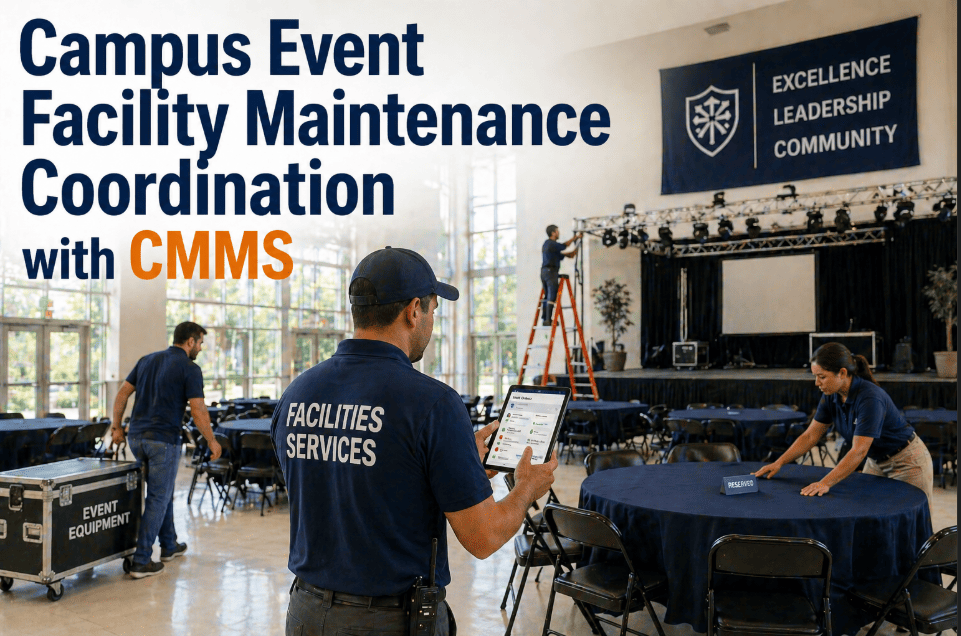
Campus Event Facility Maintenance
Every Major Campus Event Creates a Maintenance Surge. Plan for It — or Spend the Weekend Reacting to It.
340+
Significant events per year at a mid-size university
Each one creates a maintenance readiness requirement that does not appear in the standard PM calendar
72 hrs
Minimum advance preparation window
Pre-event PM completion, equipment staging, contingency staffing — all must finish before first guest arrives
4.8x
Emergency repair cost multiplier during active events
After-hours call-out rates, priority vendor fees, and event disruption liability compound the standard repair cost
$185K
Average liability exposure per equipment failure during a ticketed event
Injury claims, ticket refunds, vendor penalties, and reputational damage — before OSHA investigation costs
Why Campus Events Break Standard Maintenance Planning
Large campus events do not just increase occupancy — they fundamentally change the load profile, the failure consequences, and the maintenance response requirements for affected facilities. A residence hall elevator handling 340 student trips per day may handle 1,800 trips on graduation weekend. A HVAC system sized for standard academic occupancy runs at maximum capacity when 1,200 guests fill the alumni center. A restroom facility on a twice-weekly cleaning schedule needs service every 90 minutes during a football Saturday. None of this is a surprise — it is entirely predictable from the events calendar. The gap is that most campus CMMS deployments have no formal connection to that calendar. Maintenance happens on the normal operational cadence. Events happen on the events team's calendar. The two systems never talk. Teams ready to close that coordination gap permanently can start a free trial or book a demo to map their events calendar to the maintenance workflow.
The Four Event Types That Create the Highest Maintenance Surge
01
Commencement and Graduation
5,000–50,000 people across 2–3 days
Highest-consequence event in the campus calendar. Stadium and arena systems at full load. Elevator demand 4–6x normal. Restroom facilities serving family volumes they see once per year. Pre-event PM completion is non-negotiable — failures during commencement have the highest institutional visibility.
Elevator inspection — all units serving ceremony buildings
HVAC load test — venues at full occupancy simulation
Accessible route audit — ADA compliance on all event circulation paths
Outdoor power distribution — stage, lighting, PA system feeds
02
Homecoming and Athletics Events
10,000–100,000 people across a full weekend
Multi-venue, multi-day events with concurrent occupancy across the entire campus. Stadium systems, parking structures, and auxiliary spaces all under simultaneous peak load — while alumni center, field houses, and event tents run different load profiles than their standard configuration.
Stadium structural and electrical inspection
Parking structure safety audit — lighting, ventilation, exit signage
Temporary power distribution — all vendor and tent connections
Alumni center HVAC and elevator pre-event completion
03
Academic Conferences and Public Lectures
500–5,000 people over 1–5 days
Conference facilities running at full occupancy with AV, lighting, and HVAC under sustained multi-day load. Accessibility route integrity is critical — conference attendees include disability community members who will document ADA failures in real time and publicly.
AV and PA system functional test — all conference zones
Catering kitchen equipment check — before multi-day service load
Accessible route audit — elevator, ramp, door hardware
Lighting audit — stage, emergency exit, accessible routes
04
Donor and Board Events
50–500 high-profile guests — highest reputational stakes
Smallest events with highest consequences per failure. A donor reception that goes wrong because of an HVAC fault, elevator malfunction, or improperly serviced restroom does more institutional damage than a football Saturday issue affecting ten times as many people. Zero tolerance for visible maintenance failures.
Full venue inspection 24 hours before event
Elevator dedicated check within 4 hours of guest arrival
HVAC temperature verified 2 hours before guests arrive
Standby technician on-site or within 15-minute response
Four Maintenance Planning Failures Without Event Integration
01
PMs Deferred Into the Event Window
A quarterly elevator PM is due during homecoming week. The technician defers it because of "event conflicts." The elevator runs the homecoming weekend at 6x normal load without servicing. The PM was deferred to protect the event. The deferral created the risk the event then experienced.
Fix: PM schedule auto-adjusted to complete before event — never deferred past it
02
No Aggregate View of Concurrent Event Load
The stadium game, the alumni gala, and the donor reception happen the same Saturday. Each event coordinator submitted facility requests. Facilities prepared for each individually. Nobody produced an aggregate view of combined infrastructure demand — or noticed that the same technician was assigned as on-call for all three events simultaneously.
Fix: Portfolio event view shows aggregated load and technician assignment conflicts weeks in advance
03
Post-Event Damage Never Becomes a Work Order
A homecoming walk-through finds a broken door handle, scuffed walls, and a filter needing replacement. Notes are written on paper. Three weeks later, none of it has been addressed. The next users of the space find the damage still present and file a facilities complaint against the team that documented it and did nothing.
Fix: Post-event inspection checklist auto-generates a work order for every finding with photo and location
04
No Standby Technician for High-Risk Events
A 1,200-guest gala runs 6 PM to 11 PM. The on-call technician is at home, 22 minutes away. At 8:15 PM, the ballroom HVAC develops a fault. Room temperature rises 8 degrees before the technician arrives. The event coordinator had requested facilities coverage in the event request. Nobody converted that request into an actual assignment.
Fix: Event risk classification automatically triggers standby technician assignment — confirmed before event begins
How OxMaint Integrates Campus Events With Maintenance Planning
01
Events Calendar Integration
OxMaint connects to 25Live, EMS, Ungerboeck, and any calendar system with API or iCal export. When an event is confirmed, OxMaint automatically creates the event record and triggers the maintenance planning workflow. Zero manual handoff between events and facilities teams.
Events calendar changes auto-reflected in maintenance planning
02
Automatic Pre-Event Work Order Generation
Each event type maps to a pre-event checklist. Commencement triggers elevator inspections, HVAC load tests, restroom audits, and accessible route checks — all auto-generated with due dates 72 hours before event start. Escalation fires automatically if any work order approaches the event window unresolved.
Pre-event PM completion guaranteed 72 hours before first guest arrives
03
PM Schedule Conflict Resolution
When a scheduled PM falls within the 72-hour event blackout window, OxMaint automatically moves it to complete before the blackout — never defers it past the event. The PM that should be done before homecoming gets done before homecoming. The system enforces the sequence that human memory fails to maintain under event pressure.
No PMs deferred into event windows — automatic sequence enforcement
04
Concurrent Event Load Dashboard
All confirmed events over a 30-day window displayed with venues, attendance, shared infrastructure demands, and technician assignments in a single portfolio view. Conflicts surface immediately — two events sharing an elevator bank, one technician assigned to two concurrent high-risk events, power demand exceeding panel capacity. Identified weeks before the weekend, not discovered on the day.
Infrastructure conflicts identified weeks before the event — not on the day
05
Standby Technician Assignment
Events are classified by attendance, venue type, and time into risk tiers. High-risk events automatically generate a standby technician assignment with defined response time requirements. The standby assignment is visible to the event coordinator — they confirm coverage without calling the facilities office.
Every high-risk event has a named standby technician confirmed before the event begins
06
Post-Event Damage Capture
After every event, a post-event inspection checklist deploys automatically to the responsible technician's mobile device. Every finding is photographed and documented. Every finding above the minor threshold auto-generates a work order assigned to the appropriate trade with the event reference attached for cost tracking and insurance documentation.
Every post-event finding work-ordered within 24 hours — nothing falls through the gap
The Event Readiness Timeline
Event confirmed — venue, attendance, type, and risk classification assigned in OxMaint
Pre-event work order set auto-generated with 72-hour completion deadline
PM schedule conflict check — any PMs in event window moved to pre-event completion
Standby technician confirmed for high-risk events
All pre-event work orders closed — open WOs trigger escalation to facilities director
Elevator inspection complete — documented pass/fail per unit
HVAC load verification at simulated peak occupancy
PA and AV system functional test — all zones confirmed operational
Technician walk-through 4 hours before guest arrival
Elevator dedicated check within 2 hours of event start
HVAC confirmed at target temperature
Event facilities ready status marked — event coordinator receives automated confirmation
Post-event inspection checklist completed — all venues surveyed
All findings photographed and documented with location and severity
Work orders auto-generated for all findings above minor threshold
Event cost summary generated — total maintenance labor and damage for financial reporting
Frequently Asked Questions
How does OxMaint connect to our campus events management system like 25Live or EMS?+
OxMaint integrates with 25Live, EMS, Ungerboeck, and any platform supporting iCal export, REST API, or CSV export. Event confirmations in the events system trigger maintenance planning workflows in OxMaint automatically. For platforms without direct API, a daily CSV import keeps OxMaint current with the upcoming event schedule. Standard integration setup: 4–8 hours.
Book a demo to see the integration configured for your specific platform.
How do we track facilities costs attributable to specific events?+
Every work order in OxMaint can be tagged to an event reference. Pre-event preparation work, standby technician hours, and post-event damage repair all carry the event identifier. OxMaint's event cost summary aggregates all labor hours, materials, vendor expenses, and damage repair by event — producing a per-event facilities cost usable for event pricing, department chargeback, or insurance documentation. Campuses implementing event cost tracking typically discover that high-frequency low-ticket events consume disproportionate facilities resources — the data drives better event pricing and resource planning decisions.
What happens when an event is added with less than 72 hours notice?+
Short-notice events trigger a compressed readiness workflow in OxMaint — all pre-event work orders generate immediately with urgent priority, and the facilities director receives automatic notification with a readiness gap assessment showing which checks can complete in the available time and which cannot. This gives leadership the information to make a risk-informed decision about accepting the event, requesting a time extension, or proceeding with documented partial-readiness status. Documented short-notice events with a risk acknowledgment are defensible. Undocumented ones are not.
How does event maintenance data feed into long-term CapEx planning?+
Every pre-event inspection and post-event damage capture creates a condition data point in the OxMaint asset record. Over time, the system builds a condition trend line for each venue — showing whether the facility is holding steady or degrading under accumulated event stress. For high-frequency event venues like auditoriums and athletics facilities, this trend data feeds directly into OxMaint's rolling CapEx forecasting model. Facilities directors can present the projected replacement cost curve to institutional leadership without any manual analysis — the data is built from actual condition scores across every event cycle.
Start a free trial to connect your first event to a maintenance planning and CapEx tracking workflow.
Campus Event Maintenance — OxMaint
Every Event Starts With a Facility That Is Ready. Not Almost Ready.
OxMaint connects the events calendar to the maintenance workflow — automatic pre-event work orders, PM conflict resolution, standby technician assignment, concurrent event load visibility, and post-event damage capture. The coordination gap that causes event failures closes permanently.
72 hrs
Pre-event PM completion guaranteed
Zero
PMs deferred into event windows
100%
Post-event findings captured and work-ordered
24 hrs
Post-event damage documented and assigned


.png)