Board-Ready One-Page Campus Maintenance Reports from CMMS
By Jamie lanister on April 22, 2026
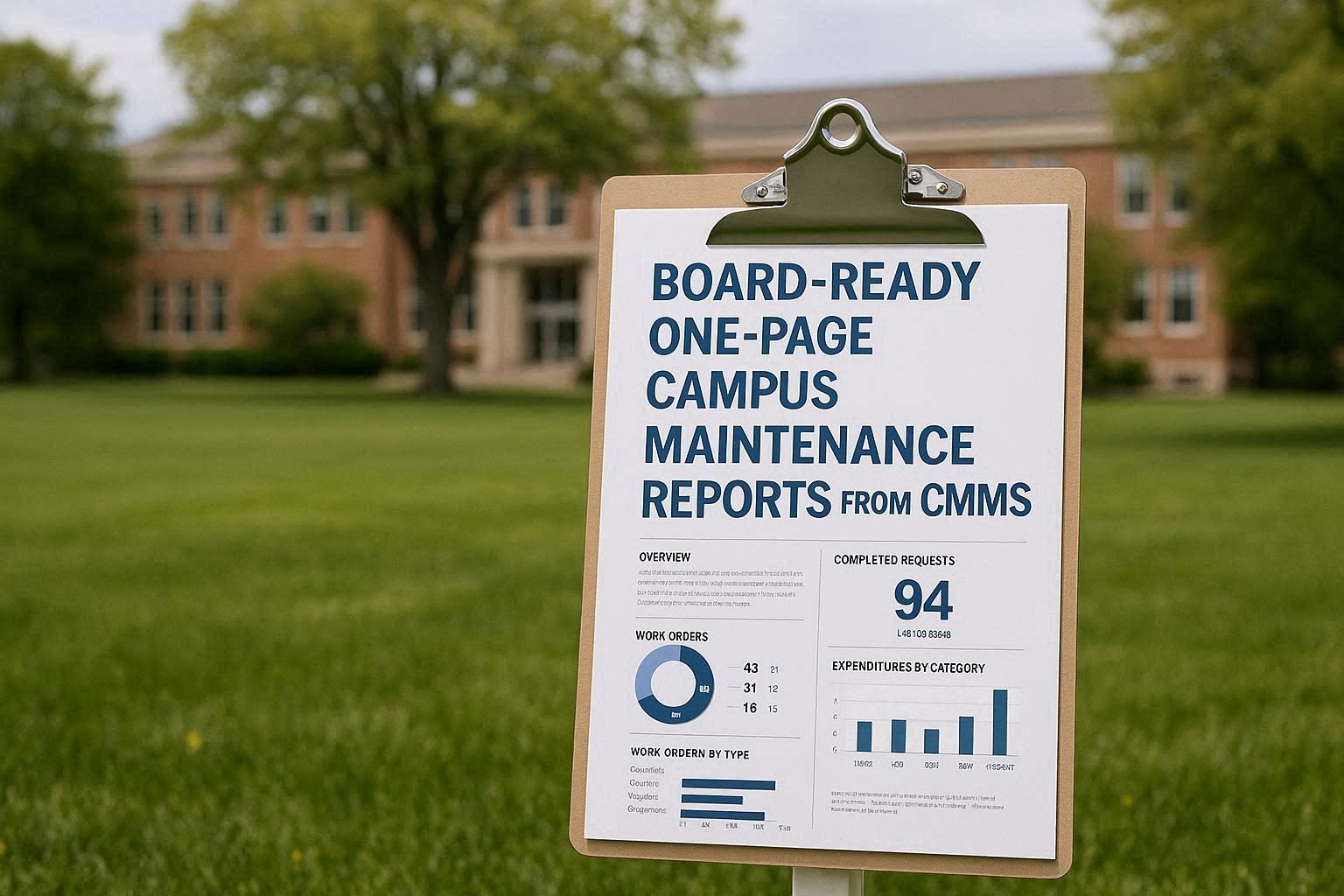
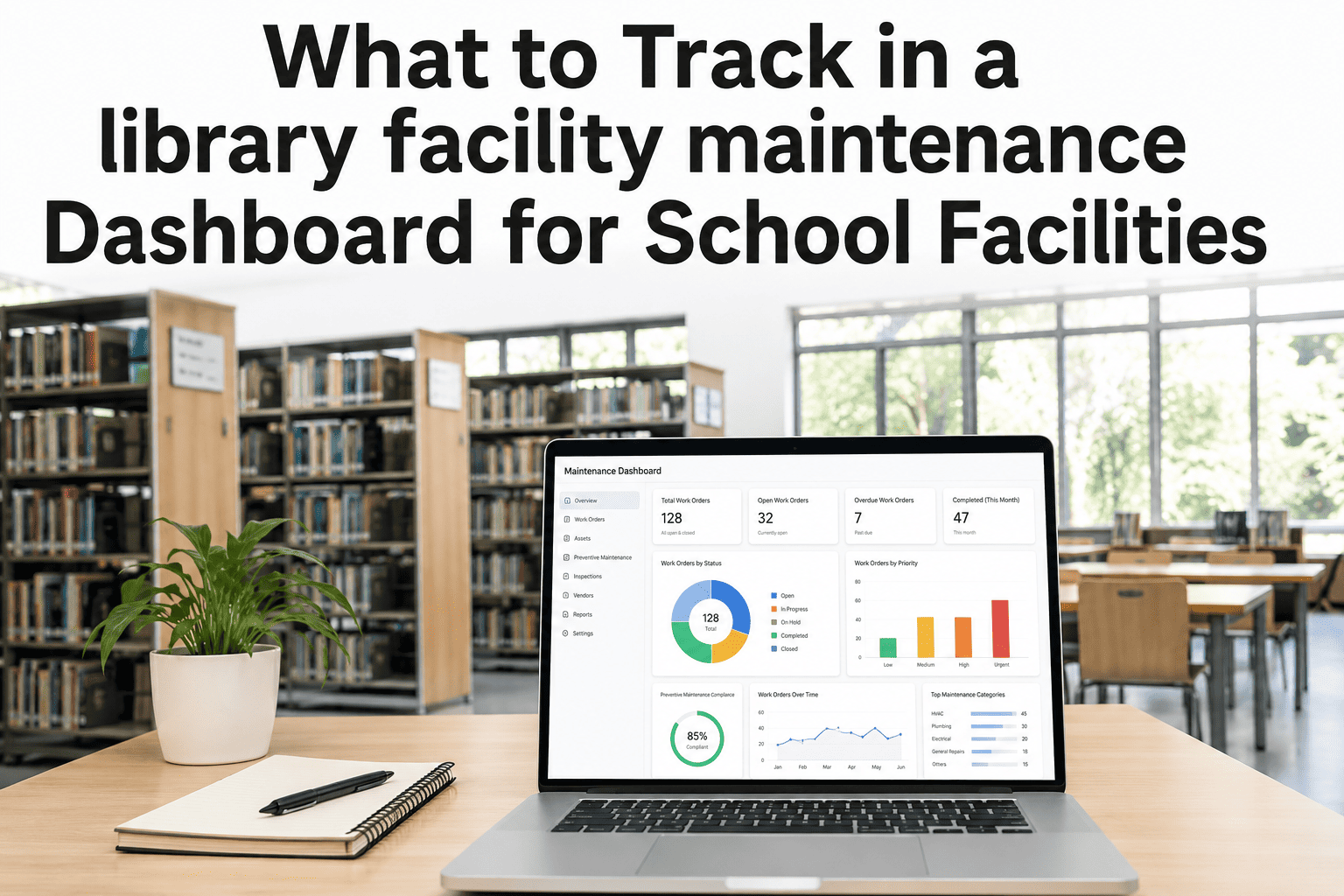
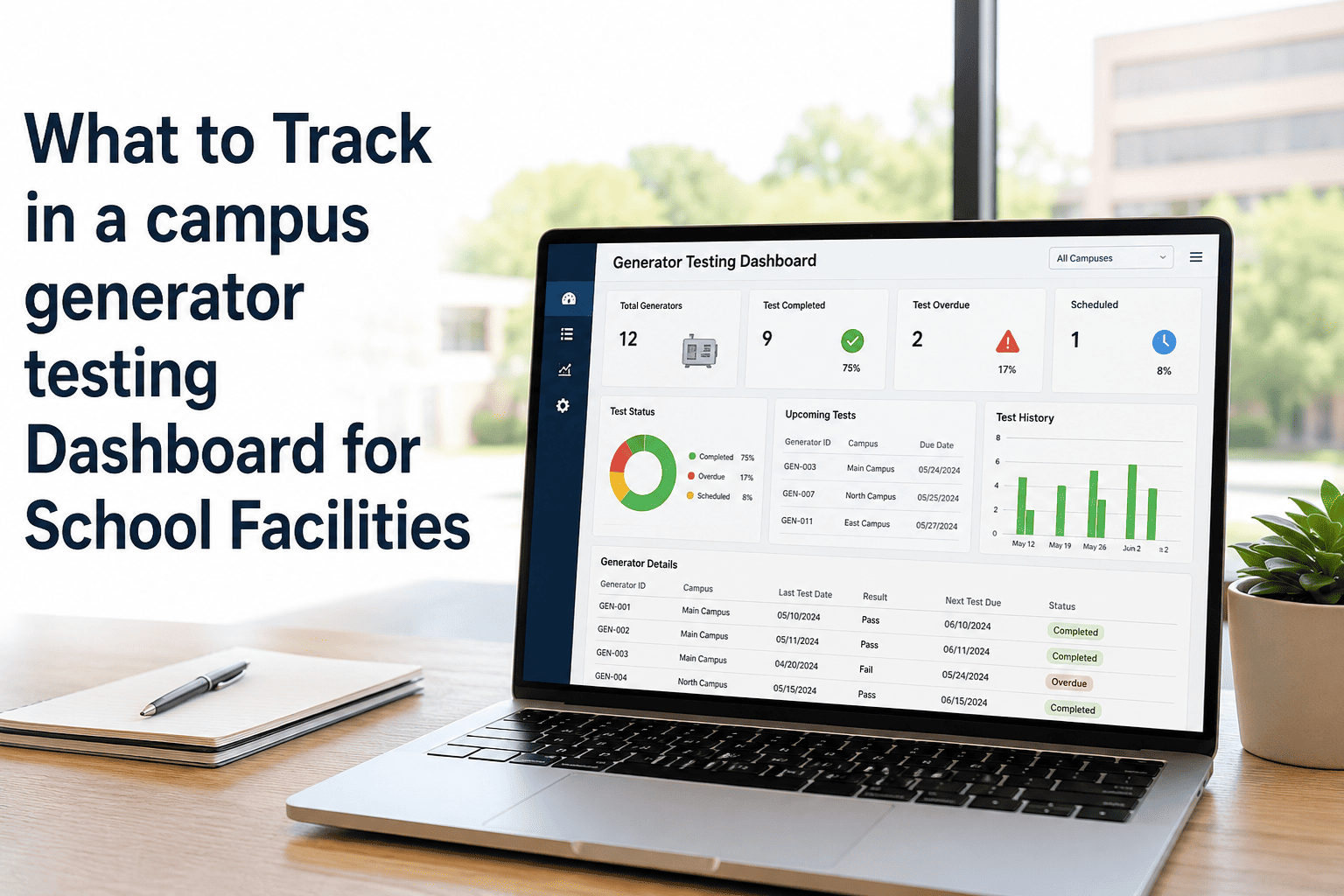
A VP of Administration at a mid-size university in Denver prepared for the quarterly board of trustees facilities update the same way she had for four years — assembling a 38-page report from four different systems, manually calculating the PM compliance rate, summarising deferred maintenance value from a spreadsheet that was three months out of date, and hoping the board would not ask a follow-up question that required data she had not extracted. The board received the report two days before the meeting. The chair read the executive summary. Two trustees asked about the $2.4 million deferred maintenance line. The VP could not explain which buildings, which systems, or what the risk was of continuing to defer — because that detail was buried in pages 22–31 that nobody had read. The board voted to defer the capital request pending more information. The information existed. It was just not in a format that board members would read or that presented the risk context they needed to approve the budget. A facilities report that board members do not read is not a report — it is a legal obligation fulfilled and an opportunity wasted. OxMaint board-ready reporting generates a one-page visual facility summary automatically — PM compliance rate, deferred maintenance by risk tier, top five open items by consequence, and capital investment recommendation — in a format that takes three minutes to read and that gives trustees the context they need to approve the budgets that keep the campus safe.
One Page. Three Minutes to Read. Everything the Board Needs to Approve the Capital Budget.
OxMaint generates board-ready facility summary reports automatically — PM compliance, deferred maintenance risk tiers, top open items, and capital recommendation — on any schedule, in any format, without manual assembly
Denver university board report — two trustees read the executive summary. The $2.4M deferred maintenance capital request was deferred pending more information nobody asked for
3 min
Time to read an OxMaint one-page board facility summary — with PM compliance, deferred risk tiers, top open items, and capital recommendation visible at a glance
84%
Capital request approval rate at campuses using OxMaint board-ready facility reports vs 52% at campuses submitting multi-page manual compilation reports
Six Elements of a Board-Ready Campus Facilities Report
A report that trustees will read and act on contains six specific elements — each answering one of the questions that trustees and school boards actually ask about campus facilities. OxMaint generates all six automatically from live maintenance data — no manual compilation, no three-month-old spreadsheet, no 38 pages.
PM Compliance Rate — One Number
Trustees ask: "Are we maintaining the campus properly?"
OxMaint calculates the campus PM compliance rate — percentage of scheduled preventive maintenance work orders completed within their target window — as a single number per period. The one-page report shows the current compliance rate, the trend over the last four quarters, and a brief explanation of any significant variance. Trustees understand 94% compliance intuitively. They cannot interpret a 38-page work order log with the same speed or confidence.
Deferred Maintenance by Risk Tier
Trustees ask: "What happens if we don't fund this?"
OxMaint categorises the deferred maintenance backlog into three risk tiers — Critical (safety or regulatory consequence within 12 months if deferred), High (significant operational impact within 2 years), and Planned (capital renewal within 5 years). The one-page report shows the dollar value and number of items in each tier, with the critical tier highlighted. Trustees who understand that $1.2M of the $2.4M deferred maintenance backlog is in the critical tier vote differently from trustees who see "$2.4M deferred" with no context.
Top Five Open Items by Consequence
Trustees ask: "What is the most urgent issue right now?"
OxMaint AI ranks open maintenance items by consequence severity and presents the top five in the board report — each item described in plain language (not maintenance jargon), with the building, the risk if unaddressed, the estimated cost, and the recommended timeline. "Chiller 2 at Mendoza Hall showing bearing failure indicators — $48,000 repair, unaddressed within 60 days risks complete chiller replacement at $280,000" is information trustees can act on. "WO-24891: HVAC PM overdue" is not.
Compliance and Regulatory Status
Trustees ask: "Are we exposed to regulatory risk?"
OxMaint reports compliance status for ADA accessibility inspections, AHERA asbestos surveillance, elevator certificates, fire suppression tests, and other regulatory obligations — showing current versus required inspection rates and any upcoming certificate expirations. Trustees have a fiduciary duty to ensure regulatory compliance — a one-page summary that shows "3 elevator certificates expire in 90 days — renewal scheduled" enables oversight without requiring trustees to understand 40 CFR Part 763.
Maintenance Spend vs Budget
Trustees ask: "Are we on budget and spending efficiently?"
OxMaint shows year-to-date maintenance spend against approved budget — split between planned PM spend, corrective maintenance, and emergency repairs. The ratio of planned to reactive spend is a performance indicator trustees understand intuitively: a campus spending 70% of its maintenance budget on planned work and 30% on reactive repairs is better managed than one spending 30% planned and 70% reactive. OxMaint presents this ratio as a single bar chart that requires no interpretation.
Capital Recommendation — One Clear Ask
Trustees ask: "What do you need us to approve?"
Every board-ready OxMaint facility report ends with one capital recommendation — the single highest-priority investment supported by the data in the report. A specific dollar amount, a specific building and system, a specific consequence of deferral, and a specific return on investment from addressing it. Boards approve specific requests with evidence. They defer vague requests for "additional maintenance funding." OxMaint's report format is built around producing the specific ask with the evidence to support it.
OxMaint — Board-Ready Reporting
84% Capital Approval Rate. One Page. Automatic. Every Quarter.
PM compliance rate, deferred maintenance risk tiers, top five open items, regulatory status, budget vs actual, and capital recommendation — all generated automatically from live OxMaint data.
38-Page Report vs OxMaint One-Page Summary — Board Engagement Comparison
These tiers show the difference in board trustee engagement, capital approval rate, and reporting effort between manual multi-page reports and OxMaint automated one-page facility summaries — measured from OxMaint campus deployments. OxMaint generates board-ready reports automatically on any schedule configured by the facilities director.
Technology Stack: How OxMaint Generates Board-Ready Reports Automatically
OxMaint board-ready reporting is powered by four connected functions that pull live data from the maintenance platform, structure it into board-readable language, and deliver it in the format trustees expect. Configure your campus board report template in OxMaint and schedule it to generate automatically before every board meeting.
Automated Data Aggregation
OxMaint aggregates the six report elements automatically from live maintenance data — PM compliance rate from work order completion records, deferred maintenance value from the open work order backlog scored by AI FMEA risk tier, top five items from the current AI risk ranking, compliance status from certificate tracking records, and spend data from work order cost records. No manual export, no spreadsheet assembly, no three-month-old data.
AI Plain Language Translation
OxMaint AI translates maintenance data into plain language that board trustees read — "Chiller 2 at Mendoza Hall is showing bearing deterioration indicators. Without intervention within 60 days, full replacement cost is estimated at $280,000 vs $48,000 repair cost today" is generated automatically from the OxMaint AI FMEA risk assessment and cost history. Trustees receive the risk context, not the technical specification.
SAP and ERP Budget Integration
OxMaint pulls actual spend data from SAP Plant Maintenance and institutional ERP systems — presenting year-to-date maintenance expenditure against approved budget, split by planned PM, corrective maintenance, and emergency repairs. The planned-to-reactive spend ratio in the board report is calculated from actual ERP transaction data, giving trustees a current-period financial picture rather than a projection based on prior year actuals.
Scheduled Automatic Delivery
OxMaint generates and distributes board facility reports automatically on the configured schedule — weekly, monthly, or quarterly. Reports are delivered as PDF attachments to the VP of Administration, board secretary, and any configured distribution list before the board meeting date. The facilities director receives a preview 48 hours before delivery with a one-click approval or edit option — eliminating the last-minute weekend report assembly that has characterised campus board preparation for decades.
"Our board chair said at the last meeting that the one-page facility summary was the best change to our reporting in 10 years. We got $1.8 million in capital approved in 8 minutes because the risk context was right there on the page — the trustees could see what they were approving and why. Before OxMaint, we spent 3 days preparing a report that produced a 45-minute debate and a deferral."
— VP of Administration and Finance, Regional University · 34 buildings · Colorado, USA
Frequently Asked Questions
Q1Can the OxMaint board report be customised for a specific university's board format requirements?▼
Yes — OxMaint board report templates are configurable per institution. Section titles, metric labels, risk tier definitions, compliance categories, and capital recommendation format are all editable. Institutions with specific board reporting requirements — SACS accreditation documentation, state governance compliance, or specific audit committee formats — can configure OxMaint report templates to meet those requirements while drawing from the same live maintenance data.
Q2How does OxMaint categorise deferred maintenance into risk tiers — who sets the tier definitions?▼
OxMaint uses AI FMEA risk scores to classify deferred maintenance into tiers — Critical, High, and Planned — based on failure probability, consequence severity, and regulatory deadline. Default tier thresholds are based on APPA and TEFAP facility condition assessment standards and are configurable per institution. Facilities directors can override the AI tier assignment for any specific item and can configure custom tier definitions that align with their institution's capital planning framework.
Q3Can OxMaint generate separate board reports for different school or college units within a university?▼
Yes — OxMaint supports multi-unit report generation. A large university can generate campus-wide board reports for the full board alongside building-level or college-specific facility summaries for individual deans or unit-level governing committees. Each report draws from the same live data source but filters and aggregates by the configured building group or organisational unit — eliminating the manual sub-report preparation that consumes facilities staff time before each committee cycle.
Q4Does OxMaint support reporting formats for UAE and international university governance structures?▼
Yes — OxMaint board reporting supports international governance structures including UAE Ministry of Education facility reporting requirements, UK HEFCE facility condition reporting standards, and Australian TEQSA facility compliance documentation. Report templates are configurable for local currency, local regulatory frameworks, and local academic governance terminology. The underlying data model and AI risk scoring apply to campus facilities regardless of geography.
Q5Can the facilities director edit the board report before it is distributed — or is it fully automatic?▼
OxMaint generates the board report automatically and delivers a preview to the facilities director 48 hours before the scheduled distribution. The director can review all six sections, edit plain-language descriptions, adjust the capital recommendation, and add context notes before the final report is distributed. One-click approval sends the report as configured; the edit option opens a structured editor. The 2–3 day manual assembly process is replaced by a 15-minute review and approval.