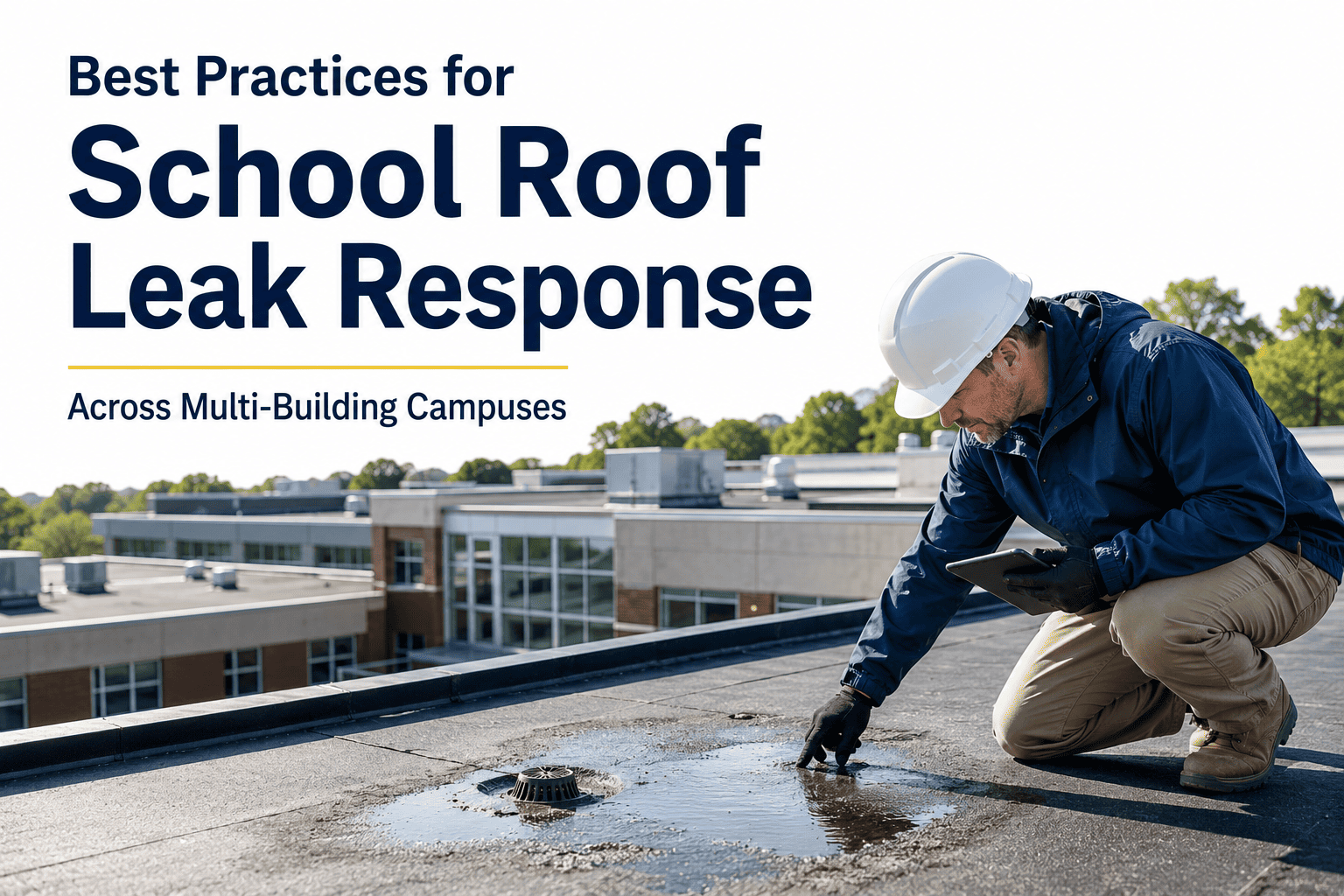
Roof failures are the leading cause of campus building damage — and almost every catastrophic roof failure is preceded by months of warning signs that a structured inspection programme would have caught. A campus building with a 20-year membrane roof that receives its first inspection in year 14 will find problems. The same building with annual inspections from year one will find those same problems in year 8 — when a $3,000 seam repair is still on the table, instead of the $180,000 full membrane replacement the deferred maintenance has made inevitable. The compounding logic is straightforward: water that enters through a 4-inch seam failure in October saturates R-30 insulation by November, degrades structural decking by January, and stains interior ceilings by February — at which point a facilities director is managing a code violation, an insurance claim, a contractor emergency schedule, and a displaced academic programme simultaneously. Oxmaint CMMS with drone inspection integration prevents this by scheduling annual inspections, tracking defect findings per roof section, auto-generating repair work orders at the correct urgency, and maintaining the complete inspection history that insurance adjusters and capital planning committees need.
Cause of campus building damage — roof failure, ahead of HVAC and plumbing
60×
Higher repair cost when roof defects are caught at membrane failure vs seam inspection
94%
Defect detection rate with thermal drone inspection vs 61% visual walkover
3× faster
Drone inspection vs manual roof walkover for a 50,000 sq ft campus building
Roof Defect Risk Over Time — Inspection vs No Inspection
Every campus roof follows the same deterioration curve — the only variable is whether defects are caught early or discovered at failure. Oxmaint annual inspection scheduling keeps every roof on the left side of the curve.
Typical 20-Year Roof — Repair Cost at Point of Discovery
Years 1–6: Seam & Flashing Defects
Years 7–11: Membrane Degradation
Years 12–16: Ponding & Penetration
Years 17–20: Structural Risk
$1K–$5K repair if caught annually
$15K–$40K if first inspection in year 8
$80K–$140K if first inspection year 13
$180K–$350K full replacement
Oxmaint schedules annual drone inspection from year 1 — keeping every campus roof in the $1K–$5K repair window.
What Drone + Thermal Inspection Finds That Walkovers Miss
Sub-Surface Moisture
Thermal imaging detects wet insulation under intact membrane — invisible to visual inspection until the deck is rotting. Detected in year 3, not year 9.
Seam & Flashing Separation
High-resolution drone imagery identifies seam lifting and flashing gaps at millimetre scale — found and sealed for $800 before the first rain event creates interior water ingress.
Ponding Water Zones
Drone photogrammetry maps roof surface topography, identifying low spots where water accumulates — accelerating membrane degradation and creating structural load risk in freeze-thaw climates.
Penetration Seal Degradation
HVAC curbs, skylights, pipe boots, and conduit penetrations — all high-failure zones. Thermal imaging detects air infiltration and moisture ingress before visible deterioration.
Parapet & Edge Condition
Parapet cap flashing, drip edge condition, and edge metal separation — primary water ingress points in older campus buildings, all inspected from drone altitude without ladder access.
Drain & Scupper Blockage
Roof drain obstruction is the primary cause of structural overload events. Drone thermal mapping identifies blocked drains from standing water patterns after rainfall — before loading risk occurs.
Oxmaint Roof Asset Management Features
Annual Inspection Scheduling
Inspection work orders auto-generated for every roof asset annually. Drone contractor dispatch managed through Oxmaint vendor work order system.
Defect Register per Section
Each roof section has its own defect history — findings from each inspection logged with photo, GPS coordinate, severity rating, and repair outcome. Trend visible across inspection cycles.
Capital Replacement Planning
Roof age, membrane type, and condition rating stored per asset. Replacement forecast generated for 5-year capital plan — roof by roof, with estimated replacement cost and urgency ranking.
IoT Leak Sensor Integration
Roof moisture sensors integrated with Oxmaint — real-time alerts when water penetrates the membrane at monitored locations between annual inspection cycles.
60×
Higher repair cost when defects found at membrane failure vs annual seam inspection
94%
Defect detection rate with thermal drone vs 61% manual walkover
3× faster
Drone inspection vs manual walkover for a 50,000 sq ft building roof
"Drone inspection found subsurface moisture in six roof sections of our science building — none of them were visually apparent. Oxmaint logged the findings, generated repair work orders, and we fixed all six for $22,000. Our structural engineer estimated that if we'd found the same condition two years later, we'd be replacing the entire east wing roof for $340,000."
Director of Campus Planning · R1 Research University · Mid-Atlantic, USA
Frequently Asked Questions
Q1How does drone inspection data integrate with Oxmaint CMMS?▾
Drone inspection reports in standard formats (PDF, XML, or direct API from platforms like DroneDeploy and Skydio) import into Oxmaint, with defect findings automatically populating work orders. Each defect is geo-referenced and linked to the roof section asset, maintaining complete traceability from detection to repair closure.
Q2Can Oxmaint track roof condition ratings across multiple inspection cycles?▾
Yes — Oxmaint assigns and tracks condition ratings (typically 1–5 or A–F) per roof section at each inspection cycle. The deterioration curve per section is visible across inspection history, enabling facilities directors to identify roofs with accelerating degradation before they require emergency replacement rather than planned renewal.
Q3How does Oxmaint support roof replacement capital planning?▾
Each roof asset in Oxmaint stores installation date, membrane type, design life expectancy, current condition rating, and estimated replacement cost per square foot. The capital planning module generates replacement forecasts by year across the entire campus roof portfolio, prioritising by condition rating and risk level — giving CFOs the evidence-based capital schedule that board approval requires.
Q4Does Oxmaint integrate with IoT roof moisture sensors for between-inspection monitoring?▾
Yes — Oxmaint integrates with IoT moisture sensors from Monnit, Honeywell, and custom MQTT-enabled sensors. When a sensor threshold is breached, Oxmaint generates a work order with sensor location, reading, and nearest inspection defect record — giving the maintenance team complete context on arrival.
Q5What documentation does Oxmaint produce for insurance claims from roof damage?▾
Oxmaint generates a complete inspection and maintenance history for any roof asset — all inspection dates, defect findings, repair work orders, contractor invoices, and photo documentation. This evidence package demonstrates proactive maintenance, which insurers require to process water damage claims and assess repair vs replacement coverage eligibility.