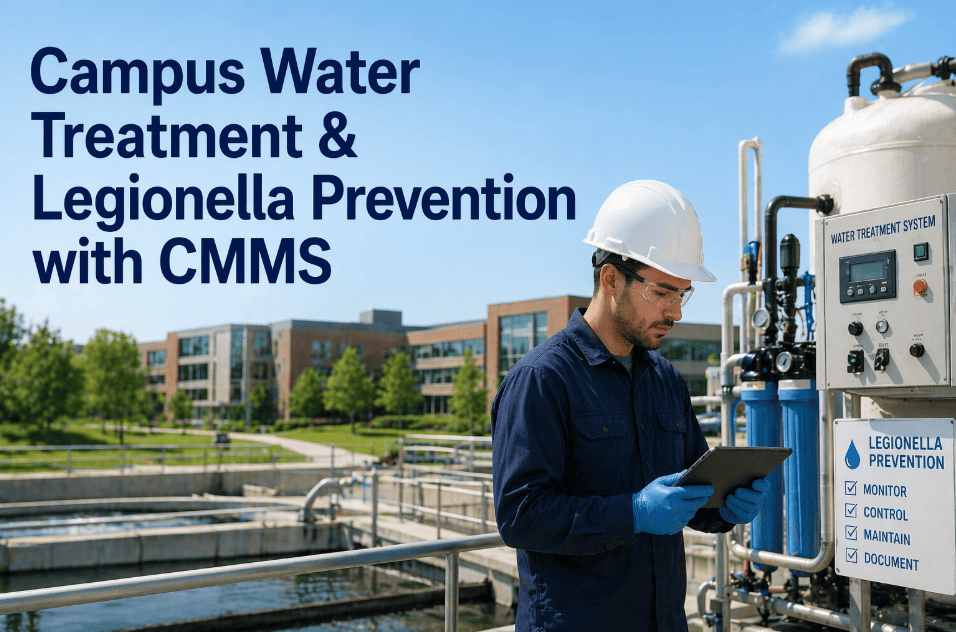
Campus Water Treatment & Legionella Prevention with CMMS
By Jamie lanister on April 22, 2026
A facilities director at a liberal arts college in upstate New York received a call from the county health department at 7:18 AM on a Thursday in October — a student had been admitted to the local hospital with Legionnaires' disease, and the probable source was the cooling tower serving the main academic building. The college had a water management plan. It had been reviewed annually by an outside consultant and filed in the compliance binder. The problem was the execution: of the 48 scheduled water system inspections listed in the plan for the prior 12 months, 31 had been completed, 9 had been completed late, and 8 had never been recorded at all. The plan was compliant on paper. The execution had gaps. When the county health investigation concluded, the likely source was identified as a section of the domestic hot water system that had been operating below the 140°F minimum required temperature for Legionella suppression — a condition that the quarterly thermometry inspection should have caught. That inspection had been in the "not recorded" category for two consecutive quarters. Legionella compliance is not about having a water management plan — it is about executing the plan consistently, recording every inspection, and having an automated system that escalates missed inspections before they become outbreak conditions. OxMaint campus water management generates every scheduled water system inspection work order automatically, tracks completion against the plan, escalates missed inspections before the next interval arrives, and maintains the complete water management execution record that ASHRAE 188 and state health department audits require.
Water Management Plan on File. Zero Missed Inspections. Automatic Escalation. ASHRAE 188 Documented.
OxMaint generates every scheduled water system inspection from your WMP automatically, escalates missed checks before the next interval, and maintains the execution record that health department audits require — not just the plan on a shelf
Upstate NY college — 8 of 48 scheduled water system inspections never recorded. Hot water thermometry gap in 2 consecutive quarters = probable Legionella source
140°F
Minimum domestic hot water temperature required for Legionella suppression — the quarterly check the college's plan required but the CMMS failed to track
100%
Water management plan inspection completion rate at campuses using OxMaint automated scheduling — zero missed checks across cooling towers, hot water, and dead legs
Six Water System Hazard Control Points OxMaint Tracks for Campus Legionella Prevention
ASHRAE 188 and CDC Water Management Programme guidelines identify specific control points across campus water systems that require scheduled monitoring, temperature verification, and bacteriological testing at defined intervals. The gap between having these control points listed in a water management plan and actually executing them consistently is where Legionella outbreaks originate. OxMaint automates execution across all six control points — every work order generated, every result recorded, every missed inspection escalated before the next interval passes.
Cooling Tower Water Treatment and Disinfection
Highest-risk system — amplification and aerosolization in one unit
Cooling towers combine warm water, nutrients, and aerosol generation — the ideal Legionella amplification and dispersal environment. OxMaint schedules weekly biocide residual testing, monthly visual inspections, quarterly bacteriological culture testing, and semiannual physical cleaning work orders per cooling tower unit. Temperature logs, biocide residual readings, and culture results are recorded in OxMaint against each tower's water management record — creating the documented execution history ASHRAE 188 audits require.
Domestic Hot Water Temperature Monitoring
Most commonly missed control — 140°F storage, 120°F minimum at outlets
Domestic hot water systems must maintain storage temperature at or above 140°F (60°C) and deliver water at or above 120°F at the most distal outlet to suppress Legionella proliferation. OxMaint schedules quarterly thermometry inspections at storage tanks and distal outlets, records temperatures with timestamp and location, and generates an alert when any reading falls below the configured threshold — before the condition persists into a second inspection cycle as it did at the upstate New York college.
Dead Legs, Infrequently Used Outlets, and Stagnant Zones
Highest risk per linear foot — low-flow zones accumulate temperature-optimal water
Dead legs — pipe sections that terminate without circulation — and infrequently used outlets such as guest rooms, seasonal buildings, and seldom-opened lab faucets allow water to stagnate at temperatures optimal for Legionella growth. OxMaint maintains a campus dead leg register and schedules flushing and temperature verification at each identified dead leg and low-use outlet on a weekly or monthly basis depending on stagnation risk classification. Seasonal building recommissioning work orders are generated automatically before reoccupancy each year.
Decorative Water Features and Fountains
High aerosol exposure to pedestrian traffic — campus quad fountains
Campus decorative fountains, reflecting pools, and misting features generate aerosols in high-pedestrian areas. OxMaint schedules weekly biocide testing, monthly visual inspection, and quarterly bacteriological testing for all decorative water features. Seasonal startup and shutdown procedures — including hyperchlorination at opening and full system draining at closing — are scheduled as work orders in OxMaint 2 weeks before the configured seasonal dates, with pre-opening bacteriological testing required before public access is permitted.
Domestic Cold Water Storage and Distribution
Below 68°F required — warm supply pipe near heat sources
Cold water supply that is allowed to warm above 68°F (20°C) — particularly in roof tanks, supply lines routed near heat sources, or in uninsulated pipe runs during summer — creates Legionella growth conditions. OxMaint schedules quarterly cold water temperature checks at storage tanks and heat-exposed pipe sections, and generates alerts when readings approach the 68°F threshold. Summer ambient temperature increases that create seasonal cold water warming risks are flagged in the facilities manager dashboard automatically when outdoor temperature data indicates elevated risk periods.
ASHRAE 188 requires that positive Legionella culture results trigger a documented response protocol — investigation, remediation, and verification testing — within defined timeframes. OxMaint records all culture results against the specific water system location and automatically activates the response protocol work order sequence when a positive result above the configured threshold is recorded. The complete response documentation — from positive result notification through remediation completion and clearance testing — is stored in OxMaint for regulatory submission and legal documentation.
OxMaint — Campus Water Management and Legionella Prevention
The Plan Was Compliant. The Execution Had 8 Gaps. One Student Was Hospitalised. OxMaint Closes the Gaps.
Cooling towers, hot water monitoring, dead legs, decorative features, cold water checks, and culture testing — all control points scheduled, executed, and documented in OxMaint.
WMP Execution vs Compliance Documentation — Three Maturity Levels
These tiers show the water management programme execution quality and legal liability exposure at each maturity level for a 20-building campus. The difference between tier 1 and tier 3 is not the plan — it is who or what ensures the plan is executed every time. OxMaint delivers tier 3 from day one of deployment.
WMP on File — Manual Tracking
Plan documented, calendar reminders, paper logs
Annual WMP inspection completion rate
64–78% avg
Missed inspection escalation
None — discovered at audit
Positive culture response time
Variable — no automated trigger
Health department audit outcome
Plan compliant, execution gaps cited
WMP + Spreadsheet Tracking
Excel log, supervisor review, monthly check
Annual WMP inspection completion rate
84–91% avg
Missed inspection escalation
Monthly review — 2–4 week lag
Positive culture response time
Same-day if log reviewed
Health department audit outcome
Generally passes — minor gaps
OxMaint Automated WMP
Auto work orders, instant escalation, full documentation
Annual WMP inspection completion rate
100% — no missed inspections
Missed inspection escalation
Same day — auto-escalated
Positive culture response time
Auto-triggered protocol immediately
Health department audit outcome
Full execution record — no gaps
Technology Stack: How OxMaint Manages Campus Legionella Prevention
ASHRAE 188 WMP Work Order Automation
OxMaint converts the campus Water Management Plan control point schedule directly into a CMMS work order calendar — every inspection, test, and treatment task for every water system asset generates automatically at the specified frequency. Control point work orders include embedded measurement fields (temperature in °F/°C, biocide residual in ppm, pH), acceptance thresholds, and immediate alert triggers when readings fall outside the WMP-specified range. The work order completion record is the execution documentation.
Automated Escalation and Response Protocols
When a water system inspection is not completed within the scheduled window, OxMaint automatically escalates to the facilities director and the campus WMP programme coordinator — not the maintenance crew's task queue. When a positive Legionella culture result or an out-of-range temperature reading is recorded, OxMaint activates the documented response protocol work order sequence automatically, notifying the appropriate health and safety officer, recording all response actions, and timestamping the complete response chain for regulatory submission.
Water Asset Register and Dead Leg Mapping
OxMaint maintains a campus water asset register — every cooling tower, hot water storage tank, cold water tank, booster pump, decorative feature, and identified dead leg is an asset record with its own inspection schedule, temperature history, and bacteriological test record. The dead leg register is updated when building work creates new pipe terminations or when reoccupancy surveys identify previously unregistered stagnant zones. Asset-level water quality history is available for any system on any building for any date range.
Regulatory Audit Documentation Export
OxMaint generates a complete ASHRAE 188 and state health department WMP compliance documentation package on demand — inspection completion records, measurement logs, culture test results, temperature trend data, and response protocol activation records — structured for submission to the New York State DOH, California CDPH, UK HSE ACOP L8, UAE DHA, and other regulatory frameworks. The 8 missing inspection records that produced the upstate NY outbreak are impossible when OxMaint manages the execution.
"After the county health survey, I reviewed our WMP execution records and found we had genuinely good intentions and genuinely inconsistent execution. The plan was excellent. The CMMS was not tracking it. OxMaint automated every single inspection work order from our WMP. The next annual health department review confirmed 100% inspection completion. That number never existed before."
— Director of Facilities, Liberal Arts College · 24 buildings · New York, USA
Frequently Asked Questions
Q1Does OxMaint support ASHRAE 188, CDC Water Management Programme Guidelines, and UK ACOP L8 formats?▼
Yes — OxMaint water management templates are configurable for ASHRAE 188 (USA), CDC Water Management Programme Guidelines (USA healthcare and campus), HSE ACOP L8 (UK), ESENER guidance (EU), and UAE DHA/MOHAP water safety programme requirements. The underlying inspection schedule and measurement recording model is the same across all frameworks — only the documentation format and regulatory threshold values differ by jurisdiction.
Q2How does OxMaint handle the water management programme for buildings that are seasonally closed — residence halls in summer?▼
OxMaint generates pre-closure mothballing work orders and pre-reoccupancy recommissioning work orders for seasonally closed buildings — timed to the configured seasonal calendar. Recommissioning work orders include flushing of all outlets, temperature verification before any student occupancy, and bacteriological sampling if the closure period exceeded the configured stagnation threshold (typically 7 days without water movement). Buildings cannot be marked as occupancy-ready in OxMaint until all recommissioning items are closed.
Q3Can OxMaint manage culture testing by an external laboratory — not just in-house water checks?▼
Yes — OxMaint generates bacteriological sample collection work orders that include the required sample location, collection procedure, and laboratory submission instructions. When the laboratory returns results, they are entered into the corresponding sample work order in OxMaint — recording the result against the specific water asset, triggering the appropriate response protocol if positive, and adding the culture result to the asset's water quality history. Laboratory report PDFs can be attached to the work order for complete documentation.
Q4What happens if a campus building has a new construction or renovation that affects the water system — how does OxMaint update the WMP?▼
Building work that affects the water system — new pipe runs, cap-offs, added fixtures, changes to hot water routing — generates a water asset register update work order in OxMaint, requiring the facilities team to survey and document new dead legs, changed flow patterns, and new control points. The WMP inspection schedule automatically includes new control points from the date the asset register update is completed — ensuring that post-construction water system changes are captured in the prevention programme, not discovered at the next health audit.
Q5How does OxMaint protect the campus from legal liability in the event of a Legionella investigation?▼
OxMaint provides a complete, timestamped, tamper-evident execution record — every inspection completed, every measurement recorded, every escalation triggered, and every response action taken. In a legal investigation, the ability to demonstrate 100% WMP execution — every control point inspected at the scheduled frequency, all results within range, all positive results triggering documented response — is the difference between demonstrated due diligence and the liability exposure created by the 8 missing inspection records that the New York college could not produce.
OxMaint — Campus Legionella Prevention
The Plan Exists. OxMaint Makes Sure It Is Executed — Every Inspection, Every Time.