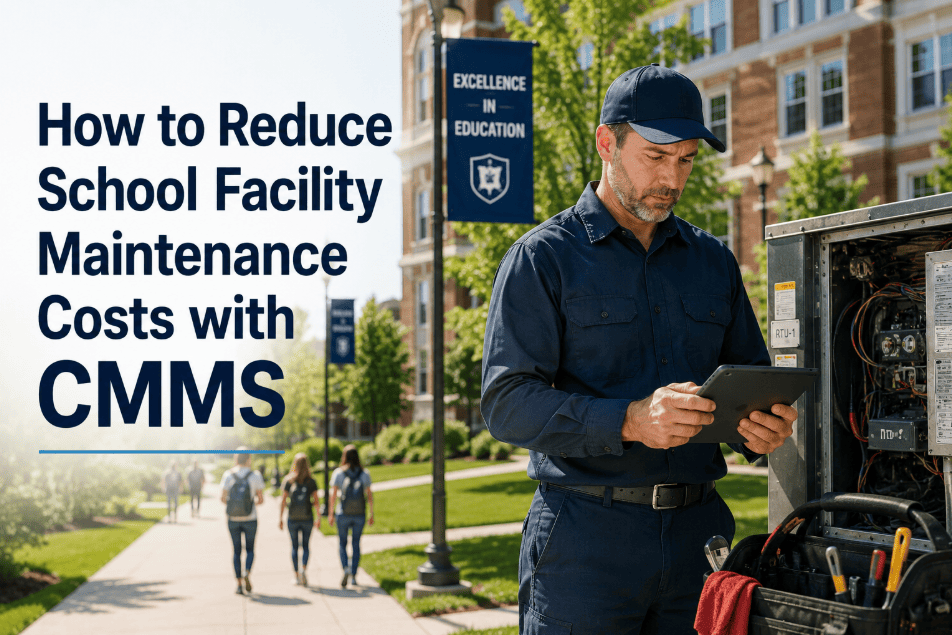
Education facilities are currently facing a silent crisis: the compounding debt of deferred maintenance. When budget constraints force schools to push back routine repairs, they aren't just saving money—they are taking out a high-interest "maintenance loan" that eventually comes due as catastrophic equipment failure. In U.S. schools, this backlog has ballooned into a multi-billion dollar hurdle that threatens both student safety and institutional stability. Understanding the true meaning of deferred maintenance and applying reliability metrics like MTBF (Mean Time Between Failure) and ROA (Return on Assets) is no longer just for engineers—it’s a financial necessity for facility leaders. Sign up for OxMaint free to transform your backlog into a data-driven reliability strategy.
Stop Guessing. Start Quantifying.
Turn Deferred Maintenance into
Reliable School Infrastructure.
Most schools view deferred maintenance as a list of "someday" tasks. OxMaint helps you view it as a reliability risk. By calculating MTBF, MTTF, and ROA, we empower facility managers to justify budgets and prioritize the repairs that actually matter to the student experience.
Understanding the True Cost of Deferred Maintenance
Deferred maintenance is the practice of postponing maintenance activities such as repairs on real property (like school buildings) and equipment in order to save costs or meet budget shortfalls. However, delay leads to a 4x cost multiplier over time.
The Hidden Interest Rate
Every dollar "saved" by deferring a roof patch or HVAC filter change results in roughly $4 of emergency repair costs within three years. Water leaks lead to mold, and strained chillers lead to total compressor failure.
Impact on Learning Environments
Research consistently shows that poor facility conditions—broken AC, poor lighting, or drafty windows—directly correlate with lower student test scores and higher teacher turnover. Facility health is student health.
Liability and Safety Risks
Deferring maintenance on fire alarms, elevators, or structural elements doesn't just cost money; it creates legal exposure. Systematic tracking using reliability metrics is the only way to mitigate this institutional risk.
Prioritizing Repairs with Math, Not Guesswork
Facility managers must transition from "squeaky wheel" prioritization to data-driven reliability strategy. These four metrics allow you to speak the language of the finance department.
MTBF (Mean Time Between Failure)
Calculated as Total Uptime divided by the number of failures. This tells you how reliable an asset is. If an AC unit's MTBF is dropping, it’s a signal that the asset is reaching the end of its useful life and should no longer be "deferred."
MTTF (Mean Time To Failure)
Used for non-repairable assets like light bulbs or specific sensors. This metric helps you forecast exactly when an asset will "die," allowing you to schedule a replacement during school breaks rather than during an exam.
MTTR (Mean Time To Repair)
The average time it takes to get a system back up after a failure. High MTTR in schools indicates a lack of spare parts or training, which compounds the negative impact of deferred maintenance.
ROA (Return on Assets)
In a school context, ROA measures how effectively the institution uses its facilities to support education. High deferred maintenance lowers the "value" of the asset, effectively tanking your institutional ROA. Investing in maintenance "cleans" the balance sheet.
The Reliability Toolkit for Facility Leaders
Use these standard industry formulas to quantify the health of your school's physical plant and justify your next budget request.
6 Critical Areas to Stop Deferring Today
If you can't fund everything, use reliability data to prioritize these high-risk categories where failure is most expensive.
From Firefighting to Strategic Facility Management
The 5-Step Reliability Deployment
Eliminating a backlog takes time, but starting the tracking takes minutes. Follow this roadmap to reclaim your school's facilities.
Centralize the Asset Registry
Upload your HVAC, electrical, and plumbing data into OxMaint. Tag assets with QR codes so technicians can log failures instantly from their phones, creating the data stream for MTBF calculation.
Identify the "Top 10" Risks
Use current condition data to identify the ten assets most likely to fail (lowest MTTF). These move to the top of the budget priority list immediately, regardless of whose classroom they are in.
Automate PM Schedules
Set up recurring preventive maintenance work orders. By increasing PM completion rates, you naturally extend the MTBF, reducing the growth of the deferred maintenance backlog.
Analyze MTTR Gaps
Review repair times. Are certain buildings taking longer to fix? Use this data to justify hiring more staff or stocking specific parts locally to reduce downtime.
Calculate School ROA
Present a report to the board showing how maintenance investment has stabilized building value and reduced emergency spending. Use FCI scores to prove the backlog is shrinking.
Connecting Reliability to School Operations
OxMaint doesn't exist in a vacuum. It connects your technical data to the broader school ecosystem.
Financial Integration
Link work order costs to your district’s ERP. This allows for real-time ROA tracking and ensures that every bolt and filter is accounted for in the annual audit.
Smart Sensors (IoT)
Connect vibration and temp sensors directly to OxMaint. When a motor starts to fail, a work order is triggered automatically, maximizing the MTTF of the component.
Staff Mobile App
Give custodians and teachers the power to report issues. Crowdsourced data improves your failure detection rate, lowering MTTR by catching issues early.
Answering Common Reliability Questions
What is the difference between MTBF and MTTF for schools?
MTBF (Mean Time Between Failure) is for assets you fix, like a chiller or a pump. MTTF (Mean Time To Failure) is for assets you replace, like a LED bulb or a smoke detector battery. Both are vital for predicting when your backlog will grow.
How do I explain ROA to a School Board?
Explain that school buildings are assets that "produce" education. If the building is falling apart (high deferred maintenance), it is a less efficient asset. By investing in maintenance, we increase the "Return" by ensuring more days of uninterrupted learning and higher property value.
Can we use OxMaint if we currently have no data?
Yes! OxMaint is designed to help you build that data from scratch. By starting today with digital work orders, the system will automatically begin calculating your MTBF and MTTR trends within just a few weeks of use.
Stop Reacting. Start Leading.
Deferred maintenance is a choice, but with OxMaint, it's a choice you no longer have to make in the dark. Use MTBF, MTTF, and ROA to light the way toward a safer, more efficient campus.