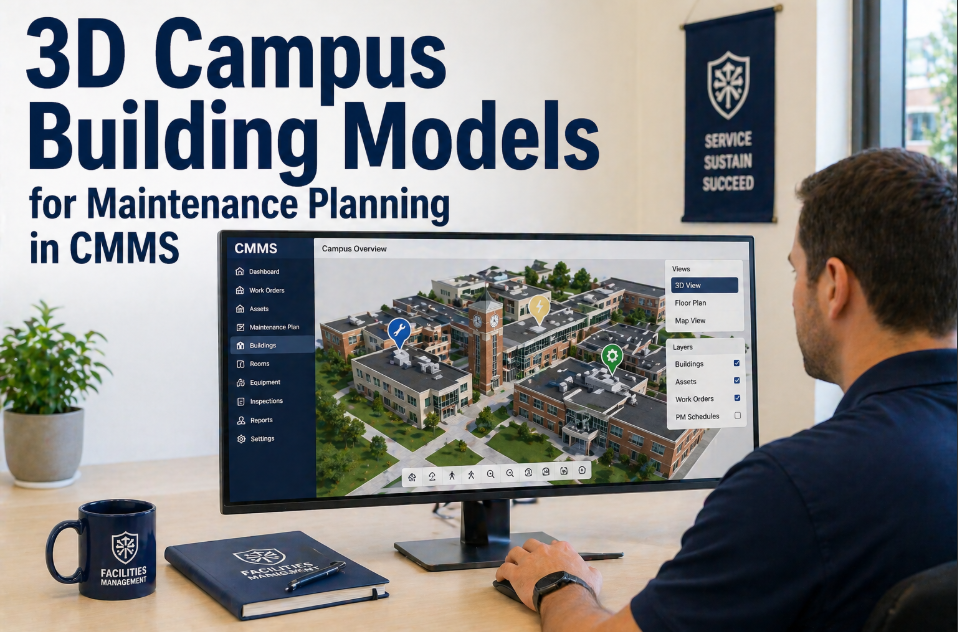
A digital twin of a campus building is a living virtual model that reflects the building's actual physical state — not its as-built drawings from 1994, not its condition assessment from 2019, but its current asset health, maintenance history, sensor readings, and capital projections, updated continuously. When integrated with Oxmaint's CMMS, the digital twin becomes a planning tool: facilities teams can simulate the effect of different maintenance scenarios on asset lifespan, project the capital cost of deferring a chiller replacement by 3 years versus replacing it now, and identify the specific assets whose failure would have the highest operational impact on teaching and research space. This transforms campus capital planning from an exercise in educated guessing into a data-driven process that boards fund because the scenarios are traceable, the costs are estimated from real data, and the risk of inaction is quantified. See Oxmaint digital twin integration for campus maintenance planning — start free.
Digital Twin Campus Buildings for Smarter Maintenance Planning
A living virtual model of every campus building — asset health, sensor data, maintenance history, and capital projections updated continuously. Simulate maintenance scenarios, predict failure timelines, and optimize capital spending before committing budgets.
Oxmaint's digital twin integration creates a virtual model of each campus building populated with real asset health data, sensor readings, maintenance history, and replacement cost estimates. Facilities teams run scenario models — 'what if we defer this chiller 3 years?' — and see projected failure probability, cumulative maintenance cost, and capital outlay side by side before making any commitment.
What a Digital Twin Changes About Campus Capital Planning
Traditional campus capital planning is based on asset age and periodic condition assessments — two data points that miss the most important variables. An asset that is 15 years old but has been meticulously maintained and runs in a controlled environment may have 10 more years of serviceable life. An asset that is 8 years old but has been overloaded, poorly maintained, and runs in a harsh environment may be 2 years from failure.
Digital twin scenario modeling uses actual condition data — sensor readings, maintenance history, defect frequency, and failure probability scores — to project asset failure timelines specific to each unit's actual operating history, not its age bracket. This makes capital planning conversations with boards fundamentally different: instead of 'we think this chiller will need replacing in 3 to 5 years,' the facilities director can say 'this specific chiller has a 78% failure probability within 18 months at current maintenance trajectory, and replacing it this fiscal year costs $140,000 versus $290,000 in emergency replacement and program disruption if it fails during the semester.'
Boards fund capital requests that are specific, traceable, and risk-quantified. Digital twin data delivers all three. Book a demo to see digital twin capital planning for your campus.
Digital Twin Scenario Modeling — What Oxmaint Simulates
Oxmaint's digital twin integration supports six capital planning scenario types — each producing a cost-versus-risk comparison that facilities directors use directly in board presentations. See the demo for your campus.
| Scenario Type | What It Models | Output | Planning Use |
|---|---|---|---|
| Defer vs Replace | Failure probability + cumulative repair cost vs replace cost | Cost crossover point | Capital budget timing |
| PM Intensity Change | Impact of more/less frequent PM on asset lifespan | Extended life projection | PM budget optimization |
| Energy Efficiency Impact | Maintenance intervention effect on energy consumption | kWh and $ saving | Sustainability reporting |
| Multi-Asset Failure Clustering | Probability of simultaneous failures by building zone | Cascade risk map | Emergency preparedness |
| 5-Year Capital Projection | Replacement cost timeline for all monitored assets | Annual capital need by year | Board capital plan |
| Renovation vs Replace | Full building renovation ROI vs asset-by-asset replacement | NPV comparison | Master planning |
Results — Oxmaint Deployments
Measured outcomes — 12-month post-deployment data.
How It Works — Five Steps
Oxmaint's five-step workflow from data collection through automated action.
We modeled three chiller replacement scenarios for our board: immediate replacement, 2-year deferral, and 4-year deferral. The digital twin showed the 4-year deferral had a 91% failure probability in year 3 — with a $340,000 emergency replacement cost versus $140,000 planned. The board approved the immediate replacement budget in a single meeting. That used to take three budget cycles.
Frequently Asked Questions
+68% Capital Approval Rate. 3–5 Year Planning Horizon. Live Building Data.
Digital twin campus maintenance planning — integrated with Oxmaint within 2 weeks.