Your campus has 147 buildings. You know the age of each one. You probably know which roofs leak. But can you answer this question: if the chiller in the Engineering building fails on the hottest day in August during freshman move-in, what's the cascade? Which classrooms lose cooling? Which labs hit temperature thresholds that destroy $400,000 in biological samples? Which residence halls become uninhabitable — and how many incoming students does that cost you before classes even start? You can't answer that with a spreadsheet. You can't answer it with a traditional CMMS. You can answer it with a digital twin — a real-time virtual replica of your entire campus that simulates failures, models scenarios, and tells you what breaks next before it actually breaks. Digital twin technology has been standard practice in aerospace and manufacturing for a decade. In 2026, it's arriving in higher education — and it's arriving because the enrollment cliff, tightening compliance mandates, and Moody's credit scrutiny have made "we'll deal with it when it happens" an unacceptable risk posture for any university managing $500M+ in physical assets. Start your free Oxmaint account and begin building your campus digital twin from your existing asset and maintenance data.
What a Digital Twin Actually Is — And Isn't
A digital twin is not a 3D rendering of your campus for marketing tours. It's not a BIM model sitting untouched on a hard drive since construction. A digital twin is a living, data-fed virtual replica of your physical campus that updates continuously from IoT sensors, maintenance records, inspection data, energy meters, and occupancy systems. It knows the current condition of every asset, the historical failure pattern of every system, and the interdependencies between them. When you change something in the real world — replace a pump, update an electrical panel, add a building — the twin updates. When a sensor detects an anomaly in the real world — vibration spike on an air handler, temperature drift in a server room, pressure drop in a steam line — the twin simulates what happens next.
The practical value for university CBOs and facilities directors is this: a digital twin converts your maintenance operation from reactive (we fix what breaks) to predictive (we know what's about to break) to prescriptive (we know what to fix first, in what order, to prevent the maximum downstream damage). That progression — reactive → predictive → prescriptive — is the difference between a $38,000 emergency boiler replacement in January and a $9,000 planned component swap during summer break.
How Oxmaint Builds Your Campus Digital Twin
You don't need a $5 million BIM modeling project to get a digital twin. Oxmaint builds your campus twin incrementally — starting with the maintenance and asset data you already have, and enriching it continuously with IoT sensor feeds, inspection results, energy data, and work order outcomes. The twin matures over time, getting smarter with every work order completed and every sensor reading ingested.
The Five Simulation Layers of a Campus Digital Twin
A campus digital twin isn't a single model — it's five interconnected simulation layers, each providing a different type of operational intelligence. Oxmaint's platform integrates all five into your existing maintenance workflows, so simulation results translate directly into prioritized work orders, capital planning inputs, and compliance documentation.
Digital Twin vs. Traditional CMMS: The Intelligence Gap
A traditional CMMS tells you what happened. A digital twin tells you what's about to happen — and what to do about it. The difference isn't incremental; it's a fundamentally different operating model for campus facilities management. Here's the side-by-side reality for university operations:
Real-World Simulation Scenarios
The value of a digital twin is best understood through the scenarios it runs — and the disasters it prevents. Each of these is a simulation that Oxmaint's twin performs continuously, updating risk scores as conditions change:
Summer Cooling Failure During Orientation
Electrical Cascade During Final Exams
Fire Suppression Compliance Gap
Residence Hall Water Contamination
Digital Twin KPIs for University Leadership
The digital twin doesn't just prevent failures — it generates the data that transforms how your leadership team makes decisions. Here are the KPIs university CBOs and provosts track through Oxmaint's digital twin dashboards:
Unplanned Downtime Rate
Percentage of total system hours lost to unplanned failures. Digital twin simulation reduces this by 35-50% within the first year by predicting failures before they cause operational disruption.
Avoided Emergency Cost
Dollar value of emergency repairs prevented by predictive work orders. Tracked per simulation event with actual-vs-projected cost comparison documenting ROI of the digital twin investment.
Portfolio FCI Trajectory
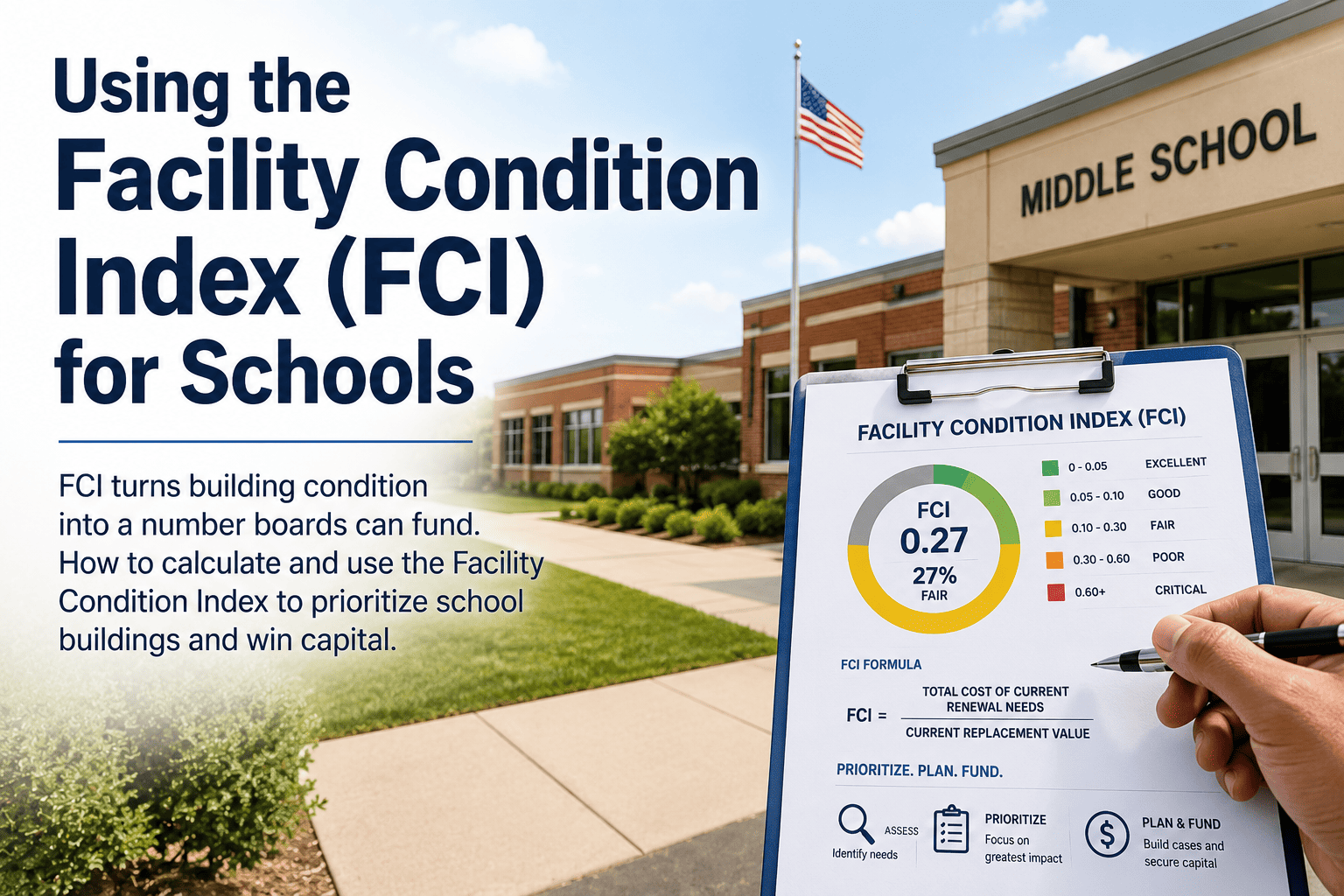
Facility Condition Index trend over time. The twin models how current maintenance investment rates affect FCI over 5, 10, and 20-year horizons — showing board members exactly when deferred maintenance becomes irreversible.
Failure Prediction Accuracy
Percentage of actual failures that the twin predicted within its confidence window. Improves over time as the model ingests more operational data. Best-in-class campus twins achieve 80%+ accuracy within 18 months.
Energy Simulation ROI
Actual energy savings from operational changes tested in the twin before real-world implementation. Eliminates the cost and risk of trial-and-error energy optimization.
Enrollment Impact Score
Correlation between facility investment decisions and enrollment outcomes. The twin models which facility improvements generate the highest return in student recruitment and retention per dollar invested.
Implementation: From Data to Digital Twin in 90 Days
Oxmaint's digital twin implementation doesn't require your campus to be fully sensor-equipped on day one. The twin starts with your existing data and grows in intelligence as you add IoT layers over time:
Foundation: Data Twin
Intelligence: Simulation Twin
Strategy: Prescriptive Twin
Why 2026 Is the Year Digital Twins Become Standard in Higher Ed
Three forces make digital twin adoption urgent for US universities this year. First, the enrollment cliff is forcing institutions to compete on facility quality — and you can't compete on quality if you can't predict which building systems will fail during the academic year. Second, Moody's and S&P now factor deferred maintenance backlogs and facility condition into credit assessments — and a digital twin is the only tool that produces the portfolio-level FCI data and risk modeling that credit analysts demand. Third, the compliance environment is tightening: OSHA's Heat Illness Prevention rule, expanded EPA testing, and stricter ADA enforcement create regulatory exposure that multiplies without centralized, simulation-driven risk management.
The universities that deploy digital twins in 2026 will compound their advantage for decades. Every work order completed, every sensor reading ingested, and every failure (or prevented failure) recorded makes the twin smarter. The institutions that start now will have 3 years of predictive intelligence by 2029 — when the enrollment cliff hits its steepest point and the competition for every remaining student is fiercest. The ones that wait will still be replacing boilers in January and explaining to their boards why the emergency budget request tripled.
Frequently Asked Questions
Do we need to be fully IoT-equipped before deploying a digital twin?
No. Oxmaint's digital twin starts with the data you already have — asset inventories, maintenance histories, inspection records, and equipment ages. The first phase (Data Twin) builds health scores and dependency maps from historical data alone, identifying your highest-risk assets and failure scenarios without any sensor infrastructure. IoT sensors are added in Phase 2, starting with the 20-30 highest-risk assets identified in Phase 1. This targeted approach typically costs $15,000-$40,000 in sensor hardware — not the $500K+ of a full-campus IoT deployment. The twin gets smarter over time as sensor coverage expands, but it delivers value from day one with data you already own.
How does the digital twin integrate with our existing BIM models?
If you have BIM models from recent construction or renovation projects, Oxmaint can ingest them as a spatial layer in the digital twin — mapping assets to their physical locations within buildings. However, BIM is not required. Most universities have BIM for only 10-30% of their buildings (newer construction), and the digital twin works equally well with non-BIM buildings using asset registry data and system dependency mapping. Where BIM is available, it enhances the twin's spatial reasoning — for example, modeling how a pipe burst on Floor 3 affects equipment on Floor 2. Where BIM isn't available, the twin relies on logical dependency mapping, which captures the same failure cascades through system-level relationships.
What ROI should we expect from a campus digital twin?
Universities deploying digital twin platforms typically see $1.8M–$4.2M in annual value from four sources: avoided emergency repairs (converting $38K emergency jobs into $9K planned maintenance), reduced unplanned downtime (35-50% reduction protecting academic continuity and research), energy optimization (10-15% reduction from simulation-tested operational changes), and improved capital planning accuracy (investing renovation dollars where they generate the highest enrollment and credit rating returns). A single prevented cascade event — like the chiller failure during orientation week — often justifies the entire annual platform investment. Payback period is typically 6-12 months, with compounding returns as the twin's prediction accuracy improves with operational data maturity.
How does the enrollment impact modeling work?
The twin correlates Facility Condition Index (FCI) scores with historical enrollment data, campus tour satisfaction surveys, and student retention rates at the building level. When your admissions team reports that prospective students rated the Science Hall poorly during tours, and the twin shows that building's FCI is 0.22 (critical), the model quantifies how many enrollment decisions that building condition is likely influencing. It then simulates the enrollment impact of different renovation scenarios — full HVAC replacement vs. cosmetic renovation vs. doing nothing — and presents the expected enrollment revenue delta for each option over 5, 10, and 20 years. This converts capital planning from "which building looks worst" to "which investment generates the most enrollment revenue per dollar spent."
Is this different from building automation system (BAS) analytics?
Yes — fundamentally. A BAS monitors and controls building systems in real time (setpoints, schedules, alarms). It tells you what's happening right now in a single building. A digital twin ingests BAS data as one of many inputs, then adds asset condition modeling, cross-building dependency mapping, failure prediction, cascade simulation, compliance risk scoring, and capital planning intelligence across your entire campus portfolio. Think of the BAS as the nervous system of one building — the digital twin is the brain of your entire campus, using BAS data alongside maintenance records, inspection results, energy data, and enrollment metrics to make strategic decisions. Oxmaint integrates with all major BAS platforms (Tridium, Johnson Controls, Siemens, Honeywell) to pull real-time data into the twin.