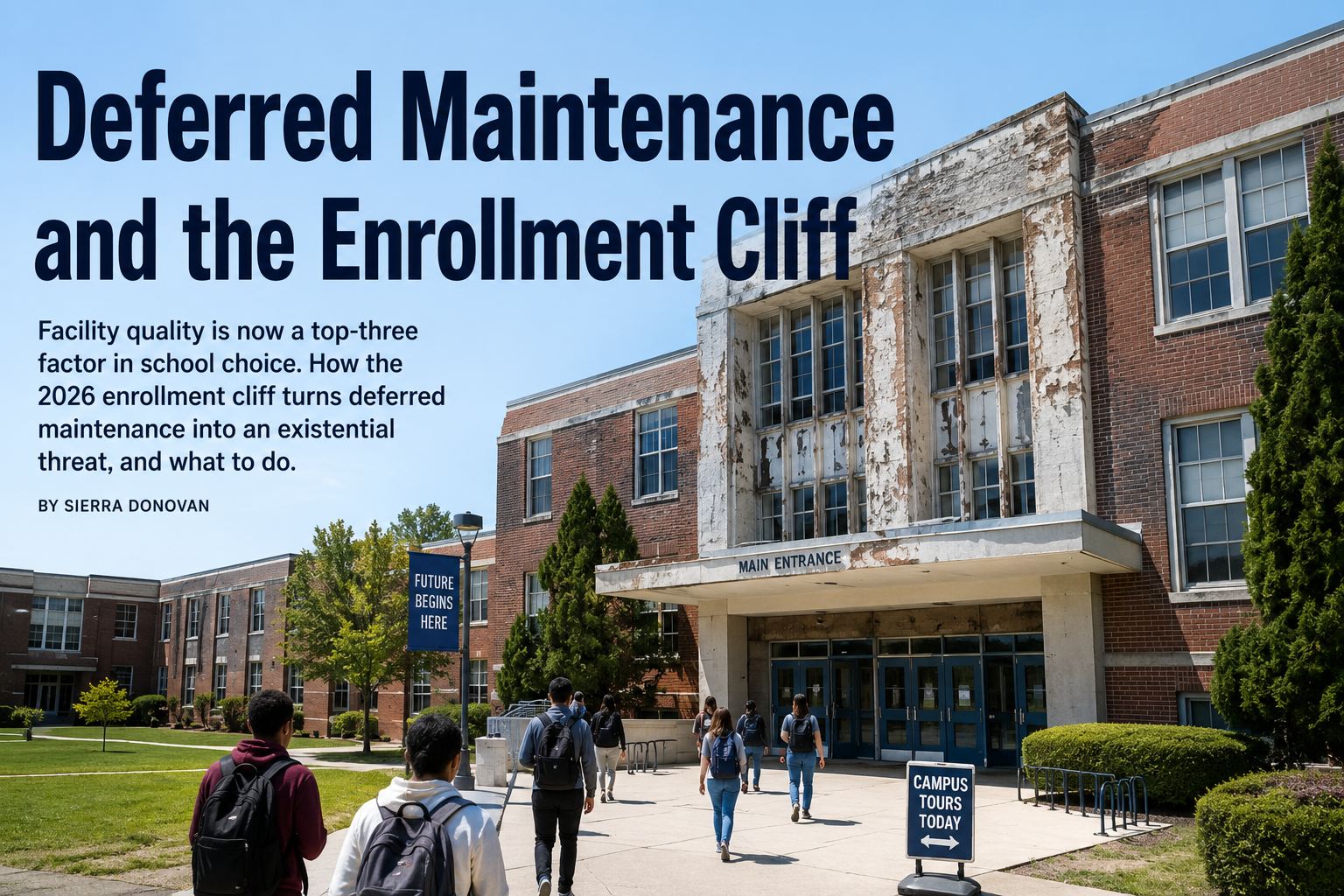
U.S. postsecondary enrollment has dropped by over 1.2 million students since 2019 — but the buildings didn't shrink with the headcount. The GAO estimates a $90 billion school infrastructure funding gap, and Moody's now flags deferred maintenance as a credit risk. Superintendents and CBOs who treat facilities as overhead — rather than a strategic asset tied to enrollment retention and institutional credit — are accelerating the decline they're trying to survive. Book a Demo to see how AI-driven campus maintenance cuts operating costs and turns facility quality into an enrollment advantage.
Strategic Planning / Education Industry
How Enrollment Decline Is Forcing Universities to Rethink Facility Operations
AI maintenance systems that cut operational overhead, extend asset life, and turn facility quality into a recruitment advantage during the 2026 enrollment cliff.
Average Enrollment Decline at Regional 4-Year Institutions
U.S. School Infrastructure Funding Gap
Of Students Cite Facility Quality as Top-3 Enrollment Factor
3×
more expensive
Reactive vs. Predictive Maintenance
The Fiscal Stewardship Crisis: Deferred Maintenance Is Now a Credit Risk
Every year of deferred maintenance adds 2–4% to total remediation cost through accelerated deterioration and emergency premiums. A $50 million backlog addressed over 10 years at $5M annually becomes $65–$70M if deferred another 5 years. Moody's evaluates deferred maintenance ratios in credit assessments — backlogs exceeding 5% of replacement value trigger bond rating pressure.
82%
Of U.S. school districts report facilities budgets haven't kept pace with building needs. The facilities that fall furthest behind lose students first — families can see deferred maintenance, even when administrators can't quantify it.
Enrollment decline reduces revenue, deferred maintenance compounds costs, and facility quality directly influences whether students enroll and stay. Sign Up to get a free facilities risk assessment tailored to your campus portfolio.
Pillar 1: Infrastructure & Indoor Air Quality
ASHRAE 62.1 sets minimum ventilation rates, and 24 states have adopted 2026 decarbonization targets most campuses aren't on track to meet.
Key Metrics:
CO₂ per occupied zone (ASHRAE threshold: 1,000 ppm)
Ventilation rate verification (CFM per occupant)
Filter differential pressure monitoring
Key Metrics:
EUI benchmarking (kWh/BTU per square foot)
Equipment runtime vs. occupancy schedules
Carbon intensity tracking (tCO₂e per GSF)
Pillar 2: Campus Safety & Security
NFPA compliance failures shut down buildings. Cyber-physical IoT threats compromise student data and physical access simultaneously.
CMMS Coverage:
Fire alarm and sprinkler inspection scheduling (NFPA 72/25)
Emergency lighting tests and guard interlock verification
Impairment documentation and AHJ finding resolution
CMMS Coverage:
IoT firmware version tracking and CVE monitoring
Network segmentation verification for BAS devices
Device certificate expiration and anomaly alerting
Free US School Facilities Risk Assessment
Get a data-driven assessment of your deferred maintenance exposure, compliance gaps, and energy optimization opportunities — mapped to ROI projections in a 30-minute consultation.
Pillar 3: The Enrollment Cliff — Facility Quality as a Retention Weapon
Students experiencing HVAC failures or mold in their first semester are 2.3× more likely to transfer. Every visible maintenance issue on a 90-minute campus tour subtracts from enrollment yield.
Retention-Critical Systems:
HVAC comfort maintained within ±2°F of setpoint
Plumbing: hot water within 60 seconds at all fixtures
Access control: 99.9% lock availability, zero lockouts
Experience-Critical Systems:
Tour route building exteriors and grounds condition
Classroom AV system uptime and reliability
Athletic and recreation facility condition vs. competitors
Pillar 4: Educator Retention — AI as the Force Multiplier
Maintenance staff shortages mean remaining workers spend excessive time on reactive emergencies instead of preventive work. AI eliminates that burden.
01
Automated Work Orders
IoT thresholds trigger and route work orders automatically — 35–45% reduction in admin time.
02
Predictive Scheduling
AI predicts failures 2–8 weeks out. Emergency work costs 3–5× more. Reducing emergency calls by 60–70% cuts cost and burnout.
03
Auto Compliance Docs
OSHA, NFPA, EPA, and ADA audit records assemble from daily operations — eliminating 15–25 hours/month of manual prep.
04
Capital Planning Intelligence
AI aggregates maintenance history into TCO per asset — giving CBOs data to justify capital requests with ROI, not anecdotes.
Pillar 5: Federal Compliance — OSHA, ADA, and EPA Audit Readiness
The compliance landscape is tightening. Institutions that can't produce audit-ready documentation face enforcement actions compounding the enrollment cliff's financial pressure.
Requirements:
Indoor heat monitoring in non-AC spaces
Documented prevention plans for facilities staff
CMMS Response:
IoT sensors auto-log conditions and alert when OSHA thresholds are approached.
Requirements:
Auto door, elevator, ramp maintenance tracking
Accessible route inspection documentation
CMMS Response:
Every ADA asset tracked with PM schedules — DOJ audit records produced in minutes.
Requirements:
Asbestos management plans and surveillance
Lead-based paint management (pre-1978)
CMMS Response:
Hazardous materials tagged per asset — work orders auto-include abatement protocols.
Requirements:
Lead service line inventory and water testing
Flushing protocols for low-use fixtures
CMMS Response:
Testing schedules and results tracked per fixture — compliance reports auto-generated.
Legacy Reactive Budgets vs. Oxmaint Predictive Capital Planning
Reactive maintenance costs 3× more per dollar spent — and the gap compounds as facilities age.
3×
Reactive vs. Predictive
Reactive: $4.50–$7.00/sf. Predictive: $2.10–$3.50/sf.
Cost Drivers Eliminated:
Emergency overtime and weekend labor
Expedited parts (40–80% premium)
15%
Energy Savings Target
Fouled coils and failed economizers waste 15–25% of energy spend — all detectable through IoT.
Sources:
HVAC optimization (8–12%)
Occupancy-based scheduling (3–5%)
Audit-ready documentation generated as a byproduct of daily operations.
Coverage:
OSHA, NFPA, ADA, EPA — one platform
Accreditation and Clery Act records
Condition-based maintenance extends equipment 25–35% beyond calendar replacement.
Examples:
Chiller: 20 → 26–28 years
Roof: 20 → 24–27 years
Implementation Roadmap
Phased approach that demonstrates ROI early — critical when every dollar faces enrollment-driven scrutiny. Book a Demo to plan your campus implementation roadmap with a facilities strategist.
Asset Inventory & Baseline
Weeks 1–4
Register all campus assets with condition and criticality
Quantify deferred maintenance backlog and baseline cost metrics
IoT Deployment & Integration
Weeks 4–10
Deploy sensors on HVAC, access control, IAQ, energy systems
Configure alerts, work order automation, and compliance tracking
Pilot Validation
Weeks 10–18
Run predictive maintenance across pilot buildings for two cycles
Present documented cost avoidance to board leadership
Campus-Wide Rollout
Months 5–12
Expand to all buildings; integrate facility data into enrollment marketing
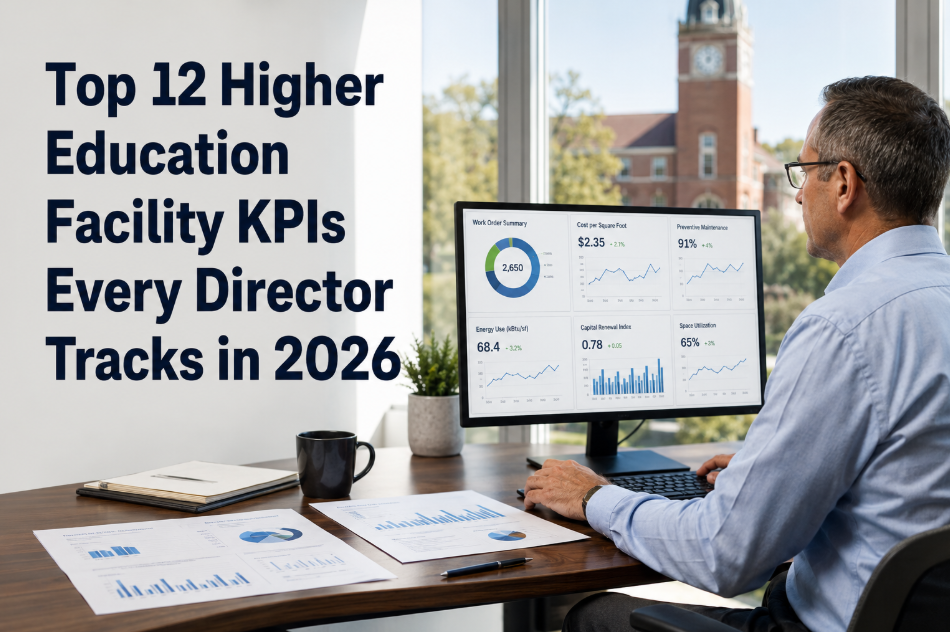
Build executive dashboard: TCO, compliance, energy, deferred maintenance
Transform Facilities from Cost Center to Enrollment Advantage
Oxmaint's AI-driven CMMS gives complete visibility into asset health, energy performance, compliance status, and deferred maintenance — with predictive maintenance that cuts costs while improving the conditions that retain students.
Frequently Asked Questions
How does facility quality directly impact enrollment?
Facility quality ranks among the top three enrollment decision factors. Students choosing between comparable institutions select the better-maintained campus. Students experiencing recurring HVAC or plumbing failures transfer at 2–3× higher rates.
Sign Up to quantify your facility quality gap with a free risk assessment.
What ROI should we expect?
Most institutions see 12–18 month payback: maintenance cost reduction (15–25%), energy savings (10–15%), asset life extension (25–35%). A campus spending $4M annually typically saves $600K–$1M/year — plus each retained student represents $15K–$40K in net tuition.
Book a Demo to start building your ROI case.
Are schools affected by OSHA 2026 Heat Illness Prevention?
Yes. The rule applies to all employers including schools. Facilities staff in non-AC spaces require documented prevention plans and temperature monitoring. IoT sensors through CMMS provide continuous recording the rule requires.
Can smaller institutions afford this?
Smaller teams get the most proportional value — a team of 8–12 operates at the effectiveness of 15–20 when CMMS handles work orders, scheduling, compliance, and reporting. ROI typically exceeds subscription cost within year one.
Sign Up to get an assessment scaled to your institution's size.
Free US School Facilities Risk Assessment
The enrollment cliff doesn't wait for budget cycles. Oxmaint gives Superintendents and CBOs predictive maintenance that reduces operating costs by 15–25%, extends asset life by 30%, achieves 100% audit readiness, and turns facility quality into the enrollment differentiator that retains students. Free. 30 minutes. Actionable ROI projections.