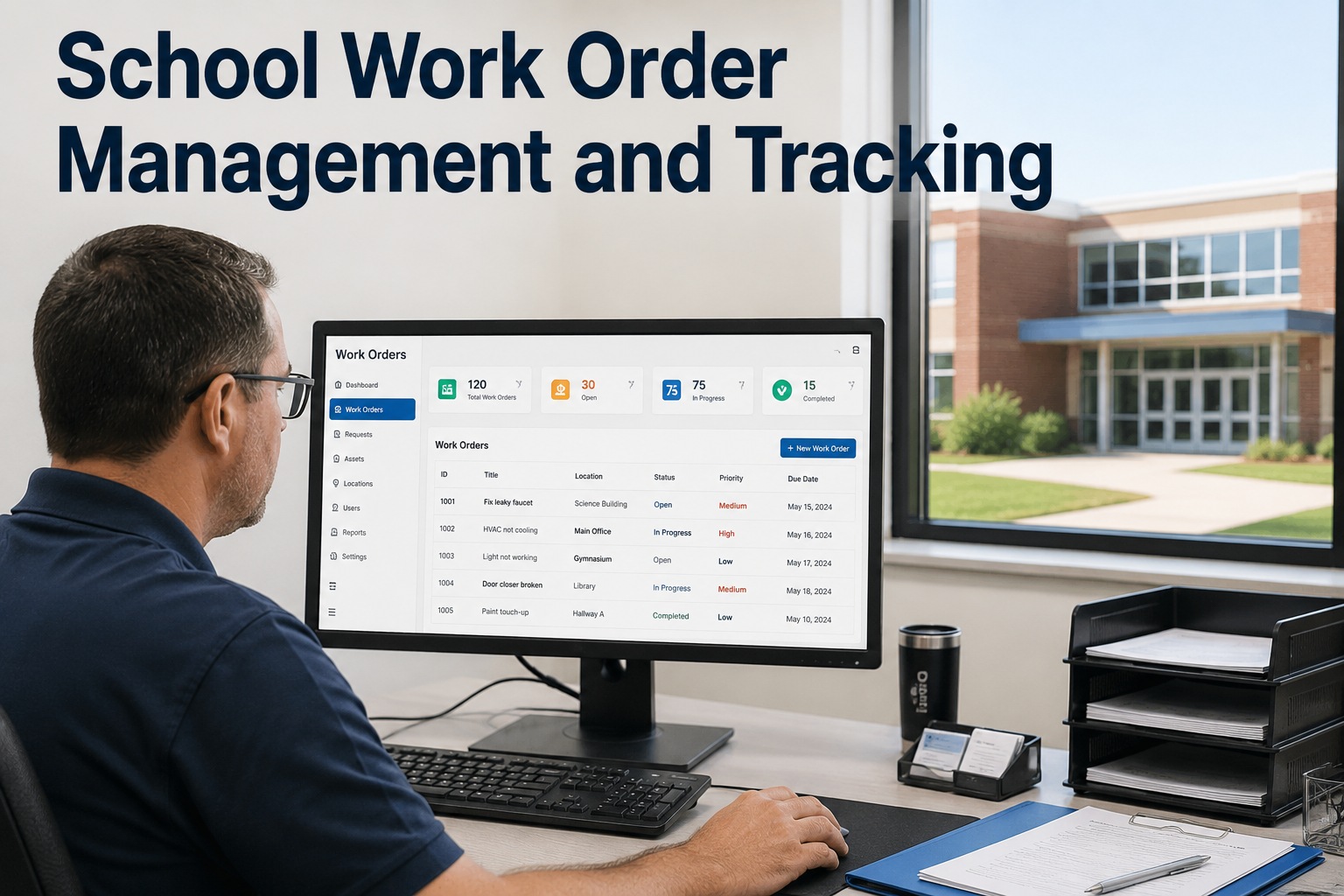
It's 6:47 AM on a Monday. The head custodian at Jefferson Elementary calls to report a burst pipe flooding the cafeteria. At the same time, a teacher at Lincoln Middle School submits a work order for a broken HVAC unit—her classroom hit 84°F by Friday afternoon. The athletic director at Washington High needs the gym floor refinished before Saturday's tournament. Your facilities coordinator opens three different spreadsheets, checks two email inboxes, and calls four people to figure out which technician is available, which school has priority, and whether the plumbing contractor's insurance is still current. By 8:15 AM, the cafeteria is still flooding.
This is daily reality for district facilities managers overseeing 10, 20, or 50+ school buildings with fragmented maintenance systems. Each campus generates its own work orders through different channels—paper forms, emails, phone calls, hallway conversations—while the central office struggles to allocate shared technicians, track spending across buildings, and prove to the school board that maintenance dollars are being spent wisely.
Multi-campus maintenance software eliminates this chaos by centralizing every work order, every asset, every technician schedule, and every budget line into a single platform visible from any device. Districts implementing centralized CMMS platforms reduce average work order completion time by 40-55%, cut emergency repair spending by 35%, and give superintendents real-time visibility into facilities conditions across every campus. Sign up free to start centralizing maintenance operations across your district.
The Hidden Cost of Fragmented School Maintenance
Most school districts don't have a maintenance problem—they have a visibility problem. Work orders exist in email threads. Asset histories live in retired custodians' memories. Budget data sits in spreadsheets that haven't been reconciled since last fiscal year. When maintenance operations are fragmented across campuses, the consequences compound silently until they surface as budget crises, safety incidents, or failed inspections.
The financial impact of fragmented maintenance operations extends far beyond the obvious emergency repair bills. Districts operating without centralized systems experience systemic inefficiencies that drain budgets across every campus simultaneously. Request a demo to see how centralized visibility eliminates these hidden costs.
Schools independently ordering the same parts, supplies, and contractor services without volume coordination or shared inventory visibility
Maintenance staff driving between campuses without optimized routing; responding to verbal requests instead of prioritized queues
Equipment repaired at district expense because nobody tracked warranty expiration dates across buildings; $15,000-40,000 annually left on the table
Central office unable to compare maintenance cost per square foot across schools; some buildings consuming 3x the budget without triggering review
Fire safety inspections, playground certifications, and elevator checks tracked on paper at individual schools; audit failures and liability exposure
No centralized asset condition data means capital planning relies on guesswork; premature replacements and surprise failures drain reserves
Without workload analytics, some campuses are overstaffed while others can't keep up; no data to justify rebalancing or hiring decisions
Individual schools calling their own contractors without rate negotiation; district paying premium rates without volume leverage or performance tracking
Facilities director spending 60+ hours preparing annual reports from scattered data; inability to produce real-time facility condition assessments on demand
Every dollar wasted on fragmented maintenance operations is a dollar diverted from classrooms, technology, and student programs. Sign up free to quantify your district's maintenance efficiency gaps.
Core Capabilities of Multi-Campus CMMS
A multi-campus maintenance platform must solve fundamentally different problems than single-site software. The core challenge isn't just tracking work orders—it's providing district-level visibility while preserving campus-level operational control. Building principals need to see their school's maintenance status; the facilities director needs to see all 28 schools simultaneously; the superintendent needs budget summaries that connect maintenance spending to educational outcomes.
Eliminates lost work orders, duplicate submissions, and the "I told the custodian last week" problem. Every request enters a single system regardless of which school or channel it originates from.
Teachers, staff, and administrators submit requests via mobile app, web portal, or QR code scanning. Requests auto-route to the correct queue based on school, priority, and trade type.
100% work order capture rate across all campuses. Average response time drops from days to hours. Complete audit trail for every maintenance interaction at every school.
Shared maintenance technicians dispatched efficiently across buildings based on skill, proximity, and workload—not who called first or yelled loudest.
Skill-based routing matches work orders to qualified technicians. Workload dashboards show real-time capacity. Auto-scheduling optimizes multi-campus routes for mobile crews.
Technician utilization improves 25-35%. Travel time between campuses reduced through intelligent routing. Equitable resource distribution across all schools regardless of size.
Complete inventory of every managed asset across all campuses—HVAC units, kitchen equipment, playground structures, fire safety systems—with location, condition, and service history.
Barcode or QR code tagging links physical equipment to digital records. Mobile scanning loads complete asset profiles. Every work order automatically attaches to the correct asset.
Inventory accuracy jumps from 55-65% to 97%+. Warranty recovery increases dramatically. Capital replacement planning built on actual condition data instead of guesswork.
Replaces calendar reminders and custodian memory with systematic PM schedules that generate work orders automatically based on manufacturer recommendations and compliance requirements.
PM templates configured by asset type auto-generate work orders on schedule. Seasonal tasks (HVAC changeover, boiler startup) coordinated across all campuses simultaneously.
PM completion rates reach 95%+. Unplanned equipment failures drop 40-55%. Compliance inspection documentation generated automatically for every campus.
Every maintenance dollar tracked by school, building system, asset, and budget code. Facilities directors see exactly where money goes and can compare cost efficiency across campuses.
Work orders capture labor hours, parts costs, and contractor invoices automatically. Spending dashboards show real-time budget consumption by school, category, and fiscal period.
Maintenance cost per square foot benchmarked across all schools. Budget variance reports generated on demand. Data-backed justification for board budget requests.
These five capabilities work together as a unified system—not five separate tools bolted together. Sign up free to experience all five capabilities in a single platform.
Standardizing Maintenance Procedures Across Schools
Standardization is the bridge between having multi-campus software and actually achieving multi-campus results. Without consistent procedures, the same HVAC filter change takes 20 minutes at one school and 90 minutes at another—not because of building differences, but because every custodian developed their own approach over the years.
District-wide standardization ensures that a work order submitted at School #3 follows the same classification, priority assignment, and resolution workflow as one at School #27. This consistency is what makes cross-campus benchmarking meaningful and resource allocation fair. Request a demo to see standardized workflow templates built for school districts.
- Work order categories (Plumbing, Electrical, HVAC, Structural, Grounds, Safety)
- Priority levels with clear definitions (Emergency, Urgent, Standard, Scheduled)
- Required information fields for each category
- Photo documentation requirements by issue type
- Naming conventions for assets, locations, and building systems
Without consistent classification, a "leaking pipe" at one school might be logged as plumbing while the same issue at another school appears under "building damage." Cross-campus reporting becomes meaningless, and priority comparisons are impossible.
- Emergency (30 min-1 hr): Safety hazards, active flooding, gas leaks, security breaches, fire system failures
- Urgent (2-4 hrs): HVAC failure in occupied classroom, restroom closure, kitchen equipment down before meal service
- Standard (24-48 hrs): Non-critical repairs, cosmetic issues, minor fixture problems, routine requests
- Scheduled (1-2 weeks): Preventive tasks, improvement projects, seasonal preparation, non-urgent upgrades
Every priority level needs automatic escalation triggers. If an emergency work order hasn't been acknowledged within 15 minutes, the system escalates to the facilities supervisor. If an urgent request misses its 4-hour window, the facilities director gets notified. These rules must apply identically at every school.
- Asset-specific PM checklists with required inspection points
- Frequency schedules aligned to manufacturer recommendations
- Seasonal PM calendars (summer HVAC prep, winter boiler startup, spring grounds)
- Compliance-driven inspection schedules (fire safety, playground, elevator)
- Documentation requirements including photo evidence and condition scoring
When every school follows identical PM templates, the facilities director can compare boiler maintenance completion rates at School A versus School B and identify which campus needs additional training or resources. Templates also ensure compliance documentation is uniform for auditors reviewing multiple buildings.
- Approved vendor list maintained centrally with insurance verification
- Negotiated rate schedules applied across all campuses automatically
- Purchase order approval workflows with spending thresholds by role
- Contractor performance tracked by response time, quality, and cost
- Emergency contractor protocols with pre-authorized spending limits
Without centralized vendor management, individual schools call their own contractors at whatever rate they negotiate—or don't negotiate. A plumbing call that costs $150 through the district contract might cost $400 when a school calls independently. Multiply across 28 schools and the waste is staggering.
Survey your maintenance staff across five campuses: ask each team to describe how they classify, prioritize, and track a "broken classroom door handle." If you get five different answers—different categories, different priorities, different documentation—you've identified your standardization starting point. Sign up free to deploy standardized templates across every campus.
District-Level KPIs and Performance Dashboards
What gets measured gets managed—and in a multi-campus district, what gets measured consistently across all schools becomes the foundation for equitable resource allocation, honest board reporting, and continuous improvement. The right KPIs transform maintenance from a cost center that nobody understands into a strategic function that demonstrably protects district assets. Request a demo to see real-time district dashboards with cross-campus benchmarking.
Average time from submission to resolution across all campuses. Breakdowns by school identify which buildings need additional resources or process improvements.
Percentage of scheduled preventive maintenance tasks completed on time. Tracked by school and asset category to identify compliance gaps before they become safety issues.
Maintenance cost normalized by building size enables fair comparison across schools of different sizes and ages. Outliers trigger investigation into root causes.
Mature maintenance programs keep emergency work orders below 20% of total volume. Higher ratios indicate insufficient preventive maintenance or aging infrastructure.
Productive wrench time versus travel, waiting, and administrative tasks. Cross-campus analysis reveals routing inefficiencies and staffing imbalances.
Average age of open work orders by campus. Growing backlogs at specific schools signal resource shortfalls before they become visible complaints.
These results reflect a 22-school district that centralized maintenance operations over 12 months. Sign up free to start building your district's performance baseline today.
Implementation Roadmap for Multi-Campus Rollout
Deploying centralized maintenance software across an entire district is a change management challenge as much as a technology project. The districts that succeed follow a phased approach—proving the system at one campus before rolling it out district-wide. Rushing deployment across all schools simultaneously overwhelms staff and invites resistance.
Audit current maintenance workflows at 3-5 representative schools. Document how work orders are submitted, tracked, and closed at each campus. Select a pilot school that represents typical district conditions—not the best or worst performer. Define asset naming conventions and work order categories that will scale district-wide.
Configure the CMMS at the pilot campus with full asset inventory, barcode tagging, PM schedules, and work order workflows. Train the custodial team, building principal, and office staff on submitting and tracking requests. Run parallel operations for 2 weeks—old system alongside new—before full cutover.
Measure pilot results against baseline metrics. Identify workflow friction points and resolve them before district expansion. Collect feedback from technicians, custodians, and school administrators. Refine templates, escalation rules, and notification settings based on actual usage data. Create the rollout playbook.
Deploy to remaining schools in cohorts of 3-5 campuses every 2 weeks. Pilot campus champions assist with peer training at each new school. Activate cross-campus dashboards as schools come online. Establish weekly check-ins during rollout to address issues before they become resistance.
Ready to start your district's centralization journey? Request a demo to discuss your specific rollout strategy with our school district specialists.
"Districts that deploy maintenance software to all schools simultaneously experience 45% higher failure rates than those using phased approaches. The pilot-then-expand model succeeds because it creates internal advocates—the custodian at the pilot school who shows colleagues at other schools how much easier the system makes their daily routine. Technology adoption in school maintenance environments is driven by peer credibility, not management mandates. When the pilot school's technician demonstrates how a QR code scan loads complete equipment history on their phone, adoption resistance at the next school drops dramatically."
Frequently Asked Questions
A typical 15-25 school district completes full deployment in 5-7 months using a phased approach. The pilot campus takes 6-10 weeks, followed by district-wide rollout in cohorts of 3-5 schools every 2 weeks. Smaller districts (under 10 schools) can often complete deployment in 3-4 months.
The timeline depends more on change management readiness than technical complexity. Districts with supportive facilities leadership and a strong pilot champion consistently deploy faster. Sign up free to begin your pilot campus deployment today.
Modern multi-campus platforms support multiple submission channels. Teachers can submit requests via mobile app or QR codes mounted in classrooms—eliminating the "tell the custodian in the hallway" problem that loses 30-40% of maintenance requests.
Role-based permissions ensure teachers see only their submitted requests, principals see their school's full queue, and the facilities director sees the entire district. This transparency actually reduces complaint volume because teachers can track their request status instead of submitting duplicates.
The system accommodates building-specific differences within a standardized framework. Asset registries are configured per campus with location-specific equipment records, while PM templates adjust frequency and procedures based on equipment age and manufacturer specifications.
A 1960s elementary school with steam radiators and a 2018 middle school with VRF systems both fit within the same platform—each with appropriate maintenance schedules and inspection checklists tailored to their specific equipment profiles.
Lead with three metrics boards respond to: emergency repair reduction (typically $120,000-200,000 annually for a 20-school district), warranty recovery (most districts leave $30,000-60,000 on the table each year), and audit readiness (reducing compliance documentation prep from 60+ hours to under 5 hours).
Most districts achieve positive ROI within 4-6 months. Frame it as an investment that protects the district's $50-200M facility portfolio—the same way the district insures buildings, it should invest in maintaining them systematically. Request a demo and we'll help you build a board-ready business case with your district's actual numbers.
Resistance typically comes from two sources: fear that the system will be used to monitor and punish them, and legitimate concern that technology will slow down their workflow. Address both directly.
Frame the system as a tool that makes their expertise visible and valued—documented work history protects them during performance reviews and proves what they accomplish daily. Start with mobile-first features that save them time immediately, like scanning a QR code instead of handwriting equipment details. The pilot campus approach creates internal champions who sell the system to peers more effectively than any management presentation.
Most modern CMMS platforms offer API integrations and data export capabilities that connect with district financial systems, allowing maintenance costs to flow directly into budget management without dual data entry.
Integration with student information systems enables enrollment-based maintenance planning—allocating resources proportionally to campus population and usage intensity. Start with standalone deployment and add integrations in the optimization phase once the core maintenance workflows are stabilized. Sign up free to explore integration capabilities with your district's existing systems.