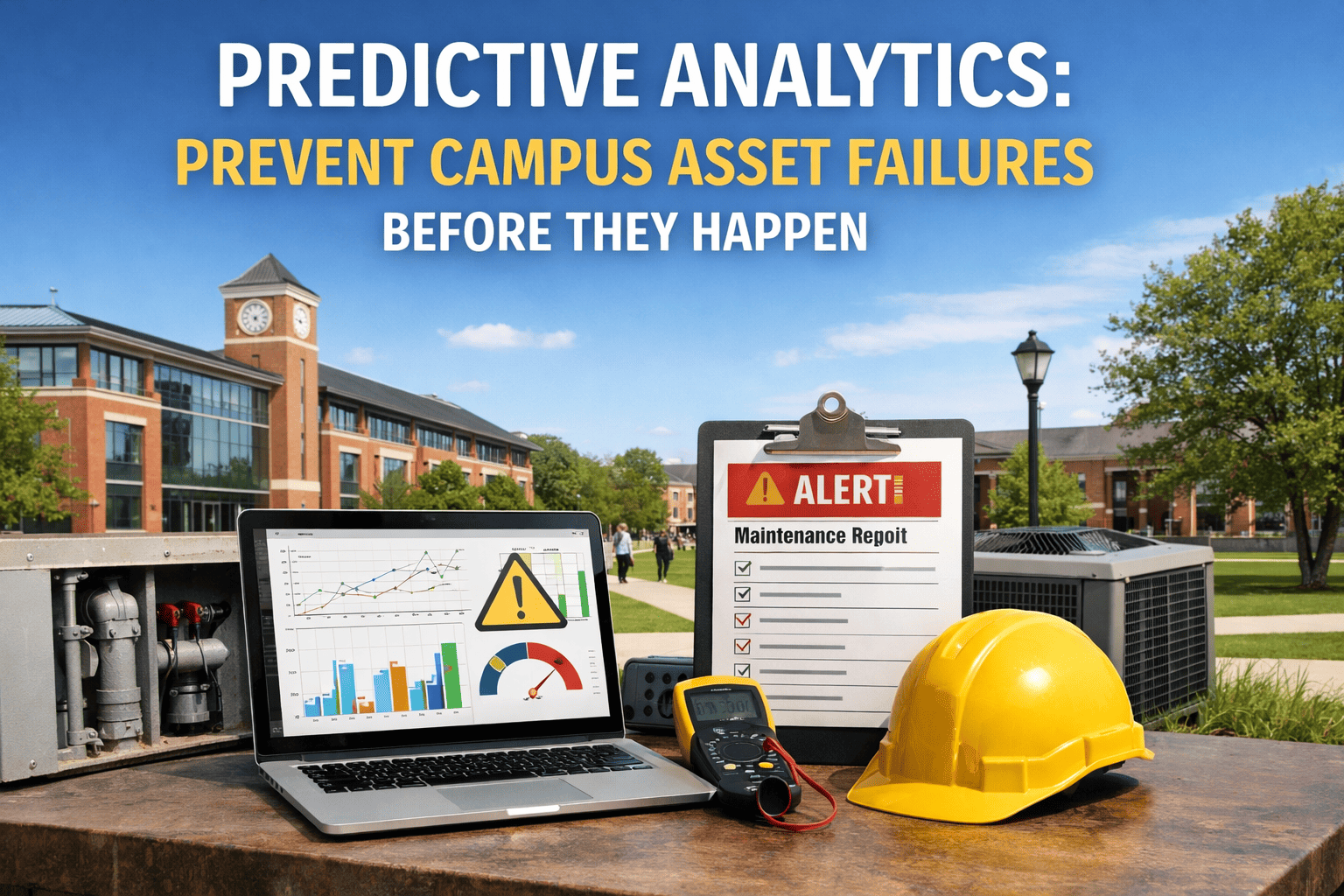
Most campus asset failures are not sudden events — they are gradual processes that generate measurable signals weeks before breakdown. A chiller bearing that will fail in six weeks is already showing a rising vibration frequency signature. A pump motor that will trip offline in three weeks is already drawing more current than its baseline. The problem is not that these signals are invisible — it is that without predictive analytics, no one is watching them continuously. Oxmaint's AI predictive analytics engine monitors every instrumented campus asset continuously, calculates a failure probability score from sensor trends, maintenance history, and asset age, and surfaces high-risk assets to facilities teams while there is still a service window to intervene. The result: campus equipment failures that cost $20,000 to $80,000 in emergency repair and program disruption get resolved for $400 to $2,000 in planned maintenance — weeks before the failure would have occurred. See Oxmaint predictive analytics configured for your campus assets — start free.
Predictive Analytics: Prevent Campus Asset Failures Before They Happen
AI-driven failure probability scores for every campus asset — HVAC, chillers, boilers, pumps, elevators. High-risk assets surface 3–6 weeks before breakdown so facilities teams intervene with planned maintenance, not emergency response.
Oxmaint's AI engine combines vibration sensor trends, temperature readings, power consumption patterns, maintenance history, and asset age to calculate a daily failure probability score for every monitored campus asset. Assets crossing the alert threshold appear in the facilities team's dashboard — with the specific signals driving the score and a recommended intervention.
Why Scheduled PM Alone Cannot Prevent Campus Asset Failures
Preventive maintenance schedules are built on average equipment lifespans — a chiller PM every 90 days because most chillers need it every 90 days. But individual assets do not follow averages. A heavily loaded chiller in a research building that runs 22 hours a day degrades faster than the schedule assumes. A pump in a new HVAC system with clean water may last twice as long as the scheduled interval suggests.
Scheduled PM creates two compounding problems: it over-maintains healthy equipment (wasting labor and parts) and under-maintains stressed equipment (missing developing failures). Predictive analytics solves both by making maintenance frequency a function of the specific asset's actual condition — not its age bracket. Assets that are healthy get longer intervals. Assets that are developing failures get immediate attention.
At a 200-building campus, shifting even 20% of equipment from scheduled PM to condition-based maintenance typically reduces maintenance labor by 12% while simultaneously reducing emergency repair events by 60%+. Book a demo to see predictive analytics for your asset inventory.
Asset Failure Prediction — Oxmaint Risk Score by Asset Type
Oxmaint's predictive engine monitors the following campus asset categories — each with specific sensor signals, failure modes, and alert thresholds that drive the risk score. See the demo for your campus.
| Asset Type | Sensor Signals Monitored | Key Failure Mode Detected | Avg Alert Lead Time |
|---|---|---|---|
| Chillers | Vibration, kW/ton, refrigerant pressure | Compressor bearing failure, refrigerant loss | 4–6 weeks |
| Air Handlers | Vibration, motor current, duct pressure | Belt wear, bearing failure, coil blockage | 3–5 weeks |
| Boilers | Temperature, pressure, flue gas temp | Scale buildup, valve failure, heat loss | 3–6 weeks |
| Pumps | Vibration, current, flow rate | Cavitation, impeller wear, seal failure | 2–4 weeks |
| Cooling Towers | Water temp, fan vibration, water chemistry | Fan bearing, fill fouling, basin leak | 3–5 weeks |
| Elevators | Motor current, door cycle count, travel time | Motor wear, door mechanism failure | 4–8 weeks |
Results — Oxmaint Deployments
Measured outcomes — 12-month post-deployment data.
How It Works — Five Steps
Oxmaint's five-step workflow from data collection through automated action.
Our research building chiller compressor was 11 weeks from failure according to Oxmaint's prediction. We scheduled a bearing replacement during winter break for $1,900. The same failure in April — during a biosafety level 3 experiment cycle — would have cost us $47,000 in repair, temporary cooling, and research disruption. Predictive analytics paid for itself in one prevented failure.
Frequently Asked Questions
-67% Emergency Repairs. 7:1 ROI. 3–6 Week Failure Lead Time.
Predictive analytics for campus assets — live in Oxmaint within 2 weeks of sensor integration.
![campus-construction-site-coordination-bim-cobie-cmms-asset-onboarding[1]](./manage-post-2k26/uploads/campus-construction-site-coordination-bim-cobie-cmms-asset-onboarding[1].png)