School Lockout/Tagout (LOTO) Procedure Checklist for Maintenance
By jamie lanister on March 27, 2026
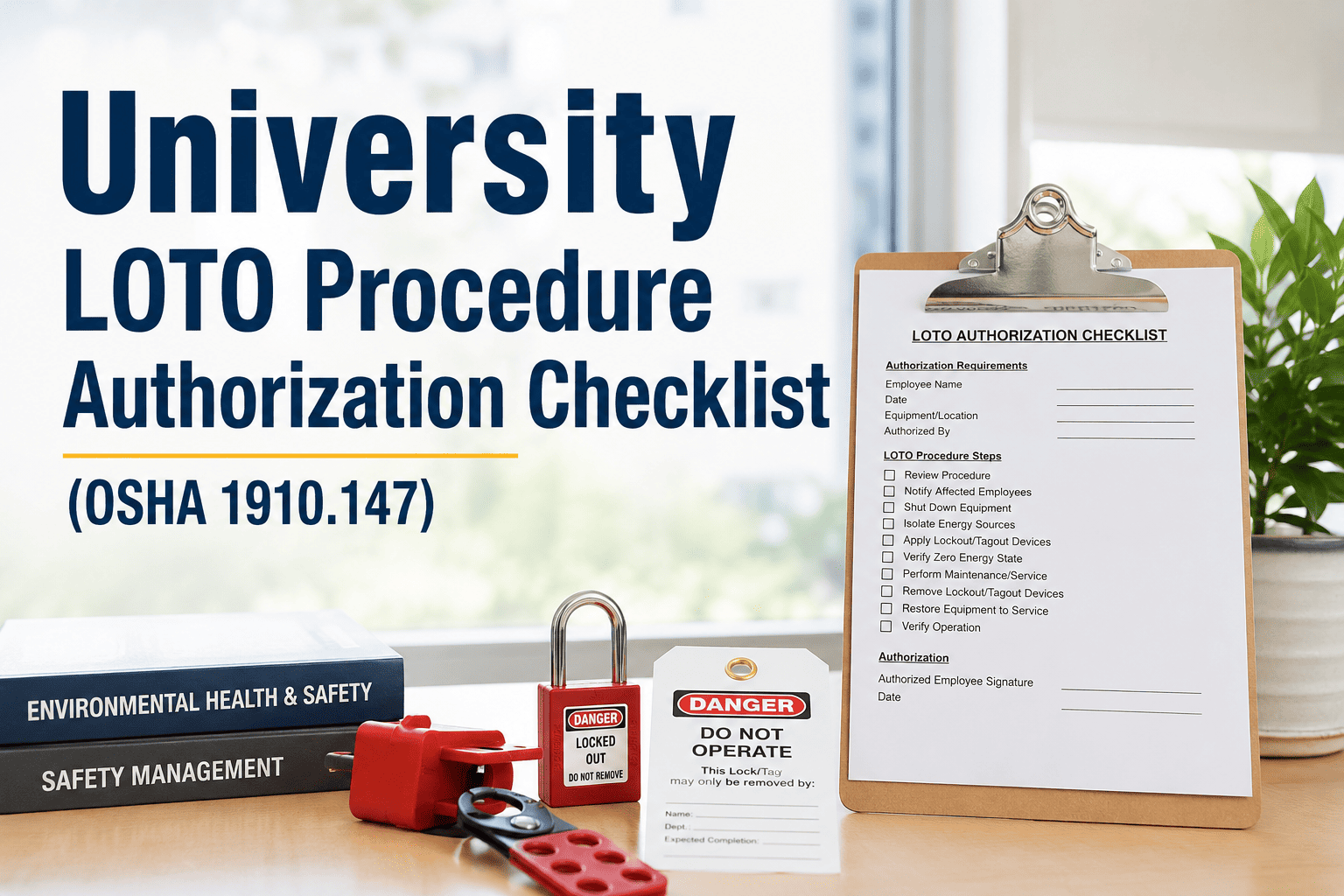
A maintenance technician at a Colorado middle school was seriously injured in 2022 when a ventilation unit he was working on was energized by a colleague who did not know work was in progress. The lockout/tagout programme at that facility existed on paper — but the procedure checklist was never used in the field. OSHA 29 CFR 1910.147 requires a documented, specific energy control procedure for every piece of equipment that could unexpectedly start during servicing. This checklist covers the complete school LOTO programme — energy source identification, isolation verification, lock application, stored energy release, and return to service — for HVAC, electrical, and mechanical equipment. Deploy it in OxMaint as a required work order step before any qualifying maintenance task begins. Book a demo.
School Lockout/Tagout (LOTO) Procedure Checklist
Energy source identification, isolation verification, lock application, stored energy release, and return to service — the complete OSHA 29 CFR 1910.147 LOTO procedure for school HVAC, electrical, and mechanical equipment.
This checklist must be completed in sequence for every qualifying maintenance task. Do not skip steps. Every authorized employee performing LOTO must apply their own personal lock. No supervisor, manager, or other employee may apply or remove a lock on behalf of another worker. Items marked Stop require work to cease immediately until the condition is resolved.
1. Notification and Preparation
Notification is the step most often skipped in school maintenance LOTO programmes — and the one that causes the most injuries. Other staff working in the building, custodians, and teachers need to know that a system is being serviced and must not be operated. In a school, a well-meaning custodian restarting a HVAC unit at 3 PM to cool a classroom before dismissal is a foreseeable event that LOTO notification prevents.
Before Work BeginsPre-LOTO Notification
2. Energy Source Identification
At EquipmentIdentify All Energy Sources
LOTO Procedures Attached to Equipment Assets in OxMaint
Every piece of equipment in OxMaint has its specific LOTO procedure attached to the asset record — technicians pull up the procedure on their phone at the equipment before starting work. LOTO completion is a required step in all qualifying work orders; the work order cannot be closed without LOTO sign-off documented.
Every Authorized EmployeePersonal Lock Application
5. Stored Energy Release and Restraint
After Lock ApplicationEliminate Residual Energy
6. Verify Zero Energy State
Before Touching EquipmentZero Energy Verification
7. Return to Service
After Work CompleteRestore Energy Sequence
8. Programme Compliance and Training
AnnualLOTO Programme Requirements
Frequently Asked Questions
Yes. OSHA 29 CFR 1910.147 (The Control of Hazardous Energy) applies to all general industry employers, including school districts, and covers any maintenance, servicing, or repair of equipment where unexpected energization or startup could injure workers. OSHA estimates that 120 workers are killed and 50,000 injured each year from failure to follow LOTO procedures. The current OSHA penalty for a serious LOTO violation is up to $15,625 per violation, and willful violations can reach $156,259.
No. OSHA 1910.147 requires each authorized employee to apply their own personal lock to every energy isolation point. A supervisor or lead technician cannot apply a single lock on behalf of the crew. If multiple workers are servicing the same equipment, a hasp must be used so every worker can hang their own lock — and the isolation point cannot be re-energized until every worker has removed their own lock. This one-person one-lock requirement is the core protection that prevents a coworker from inadvertently restoring energy while another is still working.
Any equipment that must be serviced or maintained — and where unexpected energization, startup, or release of stored energy could injure a worker — requires a written LOTO procedure. In a typical school this includes: HVAC units, air handling units, boilers and water heaters, electrical panels, kitchen equipment (ovens, dishwashers, fryers), pool pumps and motors, gym equipment, and custodial equipment. OSHA requires a written procedure for each piece of equipment unless the equipment meets all six exceptions under 1910.147(c)(4)(i).
OSHA requires initial training before an employee performs LOTO tasks, and retraining whenever there is reason to believe the employee does not have the required knowledge or when new equipment or procedures are introduced. OSHA also requires an annual review of the energy control programme — but this is a programme review, not necessarily individual retraining. Best practice for school districts is to conduct annual refresher training for all authorized employees and document it in OxMaint against each employee record.
Yes — every piece of equipment has its LOTO procedure attached as a document in OxMaint. Any qualifying maintenance work order requires LOTO completion as a mandatory step before the work can begin. LOTO application and removal are logged with technician name and timestamp. Training records for all authorized employees are tracked per person with expiry dates. The district safety director can view LOTO compliance status across every building in real time. Start free today.
School LOTO Compliance — OxMaint CMMS
Every Worker Protected. Every Procedure Documented.
OSHA
1910.147 compliant
Per asset
LOTO procedure attached
Required
step in all qualifying WOs
Free
to start today
✓Equipment-specific LOTO procedure attached to every asset record
✓LOTO completion required before qualifying work order can close
✓Authorized employee training records tracked with expiry alerts
✓Annual programme audit generated automatically — no missed reviews