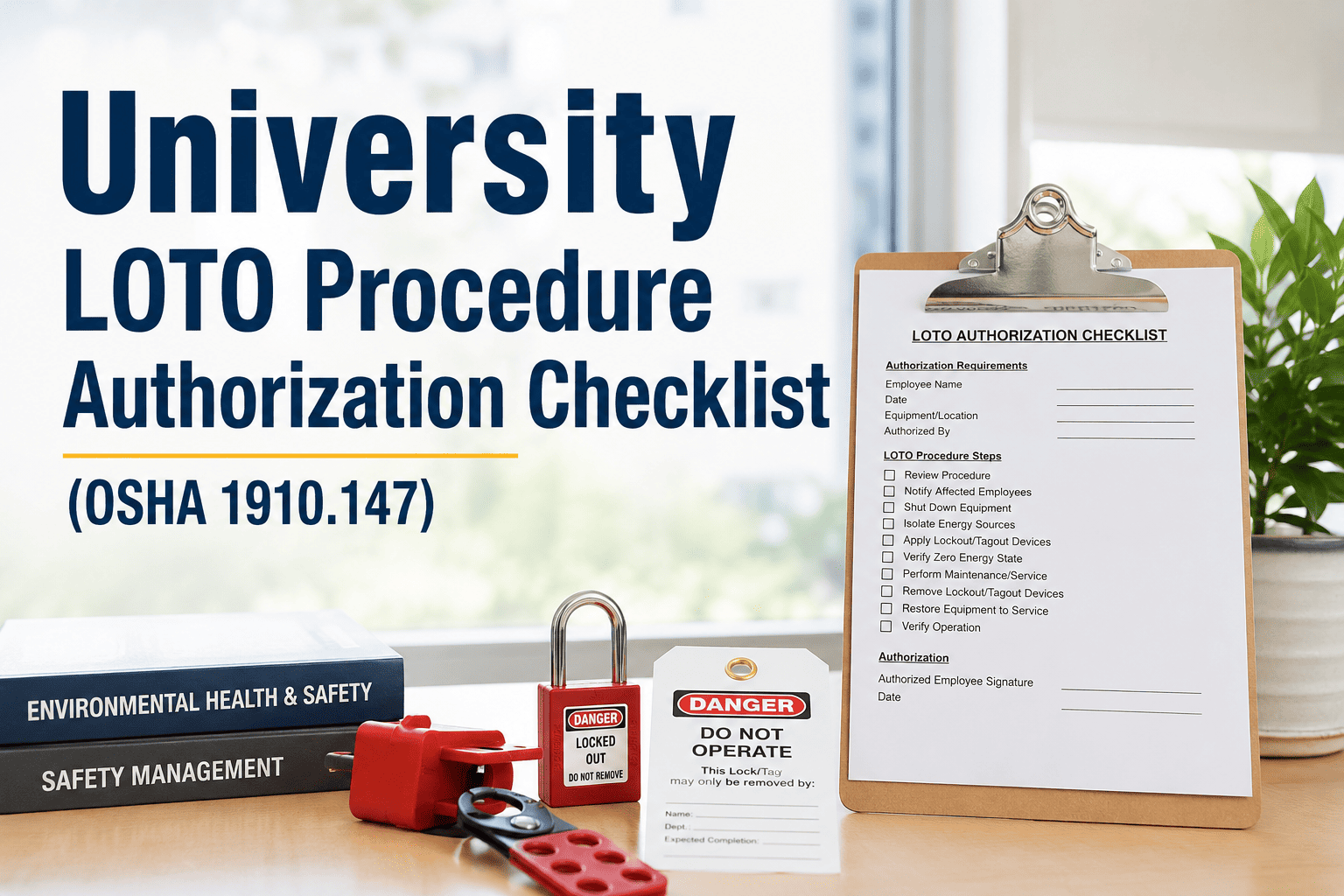
University facilities and campus maintenance teams are required under OSHA 1910.147 to implement a written lockout/tagout (LOTO) program before any authorized employee performs service or maintenance on equipment where unexpected energization could cause injury. A missing or incomplete LOTO authorization record exposes the institution to OSHA citations, worker injury liability, and failed compliance audits. This checklist covers the complete OSHA 1910.147 LOTO procedure authorization for university environments — energy source identification, isolation steps, verification, authorized employee fields, and re-energization sign-off. Sign Up Free on OxMaint to generate LOTO work orders linked directly to campus equipment assets and produce OSHA-ready records on demand. Book a Demo to see how university facilities teams automate LOTO compliance tracking across every building and lab.
OSHA 1910.147 Compliant
University LOTO Procedure Authorization Checklist
Complete lockout/tagout authorization checklist for campus maintenance — energy isolation, verification, authorized employee records, and re-energization sign-off per OSHA 1910.147.
How to Use This Checklist
Complete this authorization record before any maintenance, servicing, or repair begins on energy-controlled equipment. Each procedure must be specific to the machine or equipment being isolated — generic procedures do not satisfy OSHA 1910.147(c)(4). Any step that cannot be verified must halt work until a qualified person resolves the condition. Items marked Stop Work require immediate work stoppage and supervisor notification. Items marked Document must be logged and retained per your university's LOTO program recordkeeping requirements.
LOTO Work Orders Linked to Campus Assets — Auto-Generated in OxMaint
OxMaint ties each LOTO authorization directly to the equipment asset record. Authorized employees complete the procedure on mobile, out-of-service flags reach the supervisor instantly, and every record is OSHA-exportable by asset, date, or department.
1. Procedure Authorization Header
Every LOTO procedure must be machine-specific and include complete identification of the equipment, the authorized employee, the date, and the department. OSHA 1910.147(c)(4)(ii) requires the written procedure to be developed, documented, and used. A procedure without a completed header is not a compliant record.
2. Energy Source Identification
OSHA 1910.147 requires that all energy sources — not just the most obvious ones — be identified before any isolation step begins. University equipment frequently contains multiple energy types in a single machine: electrical, pneumatic, hydraulic, gravitational, spring-loaded, thermal, and chemical. Missing a secondary energy source is the most common cause of LOTO-related incidents.
Every Energy Source Tracked Per Asset in OxMaint
OxMaint stores machine-specific energy source records against each campus equipment asset. When a LOTO work order opens, the authorized employee sees the pre-populated energy source list for that exact machine — no guesswork, no missed isolation points.
3. Pre-Isolation Preparation
Preparation before isolation prevents incidents caused by unexpected machine movement during shutdown. OSHA 1910.147(d)(1)–(d)(2) require that equipment be brought to a safe position and that affected employees be notified before any energy isolation step begins.
4. Energy Isolation Steps
Isolation must follow the machine-specific sequence documented in the written procedure. Sequence matters — isolating pneumatic before electrical on some systems can cause unexpected movement. The order of isolation steps in this checklist must match the written procedure on file for this specific equipment.
5. Lock and Tag Application
OSHA 1910.147(c)(5) requires that lockout devices be used wherever isolation devices are capable of being locked. Where a device is not lockable, tagout alone may be used — but the employer must demonstrate that tagout provides equivalent protection. University programs must specify which devices require locks versus tags.
6. Zero Energy Verification
Verification is the most critical step in the LOTO procedure. OSHA 1910.147(d)(6) requires that before work begins, the authorized employee verifies that isolation and de-energization have been accomplished. Verification must be active — testing with a meter or actuating controls — not assumed. Skipping verification is the leading cause of LOTO fatalities.
Zero Energy Verification Captured in Real Time — OxMaint CMMS
OxMaint's mobile checklist requires authorized employees to enter actual meter readings and confirm each verification step before the work order advances. A verification step left blank cannot be bypassed — the system holds the work order open and flags the supervisor automatically.
Sign Up Free to deploy OSHA-grade LOTO records across your campus.
Book a Demo to see live verification tracking in action.
7. Work Authorization and Active Work Period
Once zero energy is verified, the work authorization section documents who is cleared to work and the scope of the authorized task. Any expansion of scope — working on an additional machine, accessing an adjacent panel — requires a new LOTO procedure. Scope creep without re-authorization is a citation-level OSHA violation.
8. Group Lockout Procedure
Group LOTO applies when multiple authorized employees work simultaneously on the same equipment. OSHA 1910.147(f)(3) requires that each employee apply a personal lock. The group coordinator is responsible for confirming all employees are clear before re-energization — this step must be documented on the authorization record.
9. Re-energization and LOTO Removal
Re-energization must follow the specific sequence documented in the written procedure. OSHA 1910.147(e) requires that each authorized employee remove only their own lock, that all employees and tools are clear before power is restored, and that affected employees be notified before the machine is re-energized. Removing another employee's lock without authorization is a serious violation that voids the entire LOTO procedure.
Frequently Asked Questions — University LOTO Procedure Authorization
What does OSHA 1910.147 require for university facilities?
OSHA 1910.147 requires any employer — including universities — whose employees perform servicing or maintenance on equipment with hazardous energy sources to establish a written energy control program. The program must include machine-specific written procedures, annual inspections of each procedure, and documented training for authorized and affected employees. Non-compliance results in OSHA citations and significant institutional liability.
Who is an "authorized employee" under OSHA 1910.147?
An authorized employee is a person who locks or tags out machines to perform servicing or maintenance. This includes campus facilities technicians, electricians, HVAC mechanics, lab equipment maintainers, and any contractor performing work on university-owned equipment. Authorized employees must be trained specifically on the energy control procedures for each type of equipment they service.
How often must university LOTO procedures be reviewed?
OSHA 1910.147(c)(6) requires an annual inspection of each energy control procedure by an authorized employee other than the one using it. The inspection must be certified in writing, including the machine name, date, employees involved, and the inspector's name. OxMaint schedules and documents these annual procedure reviews against each campus equipment asset automatically.
Does LOTO apply to lab equipment in university research facilities?
Yes. Laboratory equipment with electrical, pneumatic, hydraulic, thermal, or chemical energy sources is covered under OSHA 1910.147. University research labs that employ maintenance staff — including graduate students performing equipment maintenance as part of their duties — are subject to the full LOTO standard. Minor servicing exemptions exist for plug-and-cord equipment but apply narrowly.
Can OxMaint replace paper-based LOTO records for university compliance?
Yes. OxMaint generates machine-specific LOTO work orders tied to campus asset records. Authorized employees complete the procedure on mobile with timestamped entries. Completed records are stored against the equipment asset and exportable for OSHA inspections, insurance audits, or internal compliance reviews — eliminating paper-based records that are frequently incomplete or lost.
What is the penalty for an OSHA 1910.147 violation at a university?
OSHA serious violations for LOTO non-compliance carry penalties up to $16,550 per violation. Willful violations — where the employer knew of the hazard and failed to correct it — carry penalties up to $165,514 per violation. Universities with incomplete written procedures, missing annual inspections, or undocumented training records are exposed to multiple simultaneous citations in a single inspection.
University Facilities — OxMaint CMMS
Every LOTO Authorization. Every Campus Asset. Every Record Documented.
✓Machine-specific LOTO work orders auto-generated per asset
✓Stop-work defects instantly escalated to facilities supervisor
✓Full authorization history per equipment — OSHA-ready at any time
✓Annual procedure review scheduled and documented per OSHA 1910.147(c)(6)