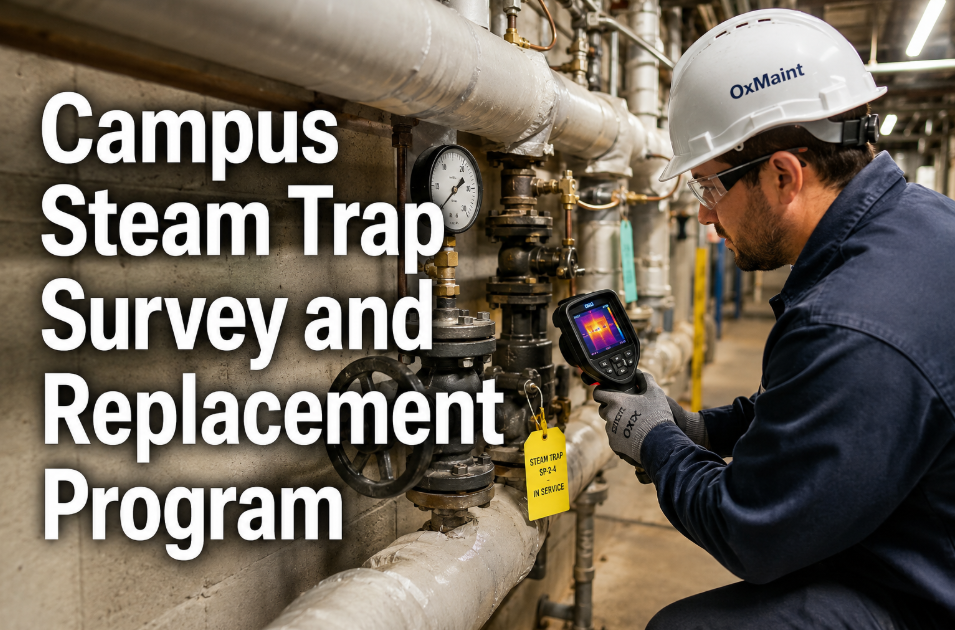
Universities running aging steam distribution networks face a silent drain on energy budgets that rarely shows up on a single work order. When a mid-sized research university initiated a campus-wide steam trap audit, the facilities team discovered that nearly 38% of traps were failed-open—venting live steam directly to condensate return lines without doing any useful work. The annual loss had compounded to an estimated $620,000 in wasted energy. The root cause was not a lack of maintenance effort; it was the absence of a structured inspection program with trackable survey data. Before deploying Oxmaint, the steam trap inventory lived across printed maps, technician memory, and spreadsheet fragments that hadn't been reconciled in three years. To understand how a structured CMMS-driven survey and replacement program could eliminate this kind of loss at your institution, Sign Up Free or Book a Demo to walk through the workflow with a product specialist.
Stop Losing Energy Through Failed Steam Traps
See how Oxmaint structures campus-wide steam trap surveys, tracks every replacement, and generates audit-ready compliance records automatically.
The Challenge
38%
of steam traps found failed-open during initial survey, venting live steam continuously
$620K
estimated annual energy loss from undetected trap failures across 47 campus buildings
3 Years
since the last full steam trap inventory reconciliation—records were incomplete and siloed
Zero
structured inspection routes existed; technicians surveyed reactively when leaks were reported
The Solution
Digital Asset Register for Every Trap
Each steam trap was entered into Oxmaint as a uniquely tagged asset with manufacturer, model, type, age, and location data. QR codes were affixed to physical trap bodies so technicians could pull up the full history in seconds from a mobile device without returning to the shop.
Structured Survey Routes with Inspection Checklists
Oxmaint's inspection module was configured with standardized check lists covering ultrasonic test readings, visual blowthrough, temperature differential, and trap type. Routes were assigned by building zone and scheduled on a 90-day cycle, ensuring every trap received a documented test within a fixed window.
Automated Replacement Work Orders
When a failed trap was flagged during inspection, Oxmaint automatically generated a corrective work order, pre-populated with the asset record, failure mode, and parts recommendations. This cut the gap between detection and replacement from an average of 34 days to under 5 days.
Energy Savings Reporting Tied to Work Orders
Each replacement work order captured the estimated lb/hr steam loss for the failed trap using standard DOE calculation tables. Oxmaint aggregated these values automatically, giving the facilities director a real-time running total of recovered energy savings that could be exported for grant reporting and board presentations.
Implementation Approach
01
Days 1–21 — Asset Inventory & Tagging
Facilities staff walked all 47 buildings, physically located every steam trap, and logged each into Oxmaint using the mobile app. Traps were tagged by building, system line, and trap type. QR code labels were printed and applied on-site during the same walkthrough, eliminating a second visit.
Deliverable: 1,140-trap asset register with baseline condition status
02
Days 22–45 — Inspection Rollout & Prioritization
The first full survey cycle was completed using Oxmaint inspection checklists. The 432 failed traps identified were automatically ranked by estimated energy loss severity, allowing the replacement crew to address the highest-impact units first. Technicians used the Book a Demo workflow to understand mobile field entry before going live.
Deliverable: Ranked corrective work order queue with energy impact scores
03
Days 46–90 — Replacement Campaign & Verification
All 432 failed traps were replaced over an eight-week window. Each replacement was closed in Oxmaint with parts used, labor time, and post-replacement test readings. The system automatically updated the asset condition record and scheduled the next inspection. Facilities teams that want the same structure can Sign Up Free and configure inspection routes within a single day.
Deliverable: Completed replacement log with verified post-repair test data
04
Ongoing — 90-Day Preventive Survey Cycle
Oxmaint's PM scheduler now auto-generates the next inspection cycle 30 days before each survey window closes. Technicians receive mobile notifications for their assigned building zones. The energy savings report refreshes in real time as inspection and replacement records accumulate.
Deliverable: Continuous audit trail supporting utility grant applications
Results
$620K
Annual energy loss eliminated after first full replacement cycle
432
Failed traps replaced in 8 weeks using Oxmaint-generated work order queue
34 → 5
Days from trap failure detection to replacement, reduced by 85%
90-Day
Recurring inspection cycle now runs automatically with zero manual scheduling
100%
Audit-ready energy savings documentation for utility rebate and grant claims
18 Mo.
Estimated payback period including CMMS implementation and labor costs
Key Business Impact
Compliance-Ready Documentation
Every inspection reading, failure code, and replacement record is timestamped and tamper-proof inside Oxmaint. The university submitted its first verified steam trap energy savings report to the state energy office within 60 days of program launch, unlocking $180,000 in utility rebates.
Reduced Emergency Repair Spend
With failed traps caught during scheduled survey rounds rather than after visible blowthrough or pipe damage, emergency repair dispatches related to the steam distribution system dropped by 61% in the 12 months following the first survey cycle. Technicians can Sign Up Free and immediately begin logging trap inspections from a phone.
Carbon Neutrality Reporting Support
Steam trap failures are a direct Scope 1 emissions source. With Oxmaint capturing the lb/hr loss data per trap and per replacement, the sustainability team was able to calculate verified GHG reductions and include them in the institution's annual carbon inventory—a requirement under AASHE STARS 3.0 operational energy credits.
Scalable Across All Campus Systems
The same inspection and work order structure built for steam traps was replicated within Oxmaint for HVAC coil cleaning, cooling tower chemical treatment, and boiler room inspections—giving the facilities director a single platform for all system-level preventive programs. Teams interested in this unified approach can Book a Demo to see the full asset hierarchy in action.
Ready to Audit Your Campus Steam Traps?
Oxmaint gives facilities teams the inspection checklists, asset registers, and automated work order workflows to run a defensible steam trap program from day one.
Frequently Asked Questions
How does Oxmaint structure a steam trap inspection program?
Oxmaint lets you create a digital asset record for each trap, build inspection checklists with test fields like ultrasonic readings and temperature differential, assign routes by building zone, and schedule recurring survey cycles. When a trap fails, a corrective work order is generated automatically.
Can Oxmaint calculate and report energy savings from trap replacements?
Yes. Each corrective work order can capture estimated steam loss in lb/hr. Oxmaint aggregates these values across the campus and exports them in formats suitable for utility rebate applications, state energy reporting, and AASHE STARS operational credit submissions.
How long does it take to set up a steam trap program in Oxmaint?
Most institutions complete the initial asset inventory and inspection route configuration within 3–4 weeks. The mobile QR code workflow allows technicians to log trap data on-site without returning to a desktop, significantly accelerating the rollout.
Does the platform support compliance documentation for utility rebates?
Yes. All inspection records, failure codes, replacement logs, and energy savings calculations are timestamped and stored with full audit trails. The university in this case study used exported Oxmaint reports directly in its utility rebate submission to recover $180,000.
Can the same platform manage other campus mechanical systems beyond steam traps?
Oxmaint's asset and inspection framework applies to any equipment type. HVAC, boilers, cooling towers, and building envelope systems can all be managed under the same platform using the same work order and reporting infrastructure.
Turn Your Steam Trap Program Into Verified Savings
Join the facilities teams using Oxmaint to run audit-ready inspection programs that document energy recovery, support grant applications, and eliminate reactive emergency repairs.