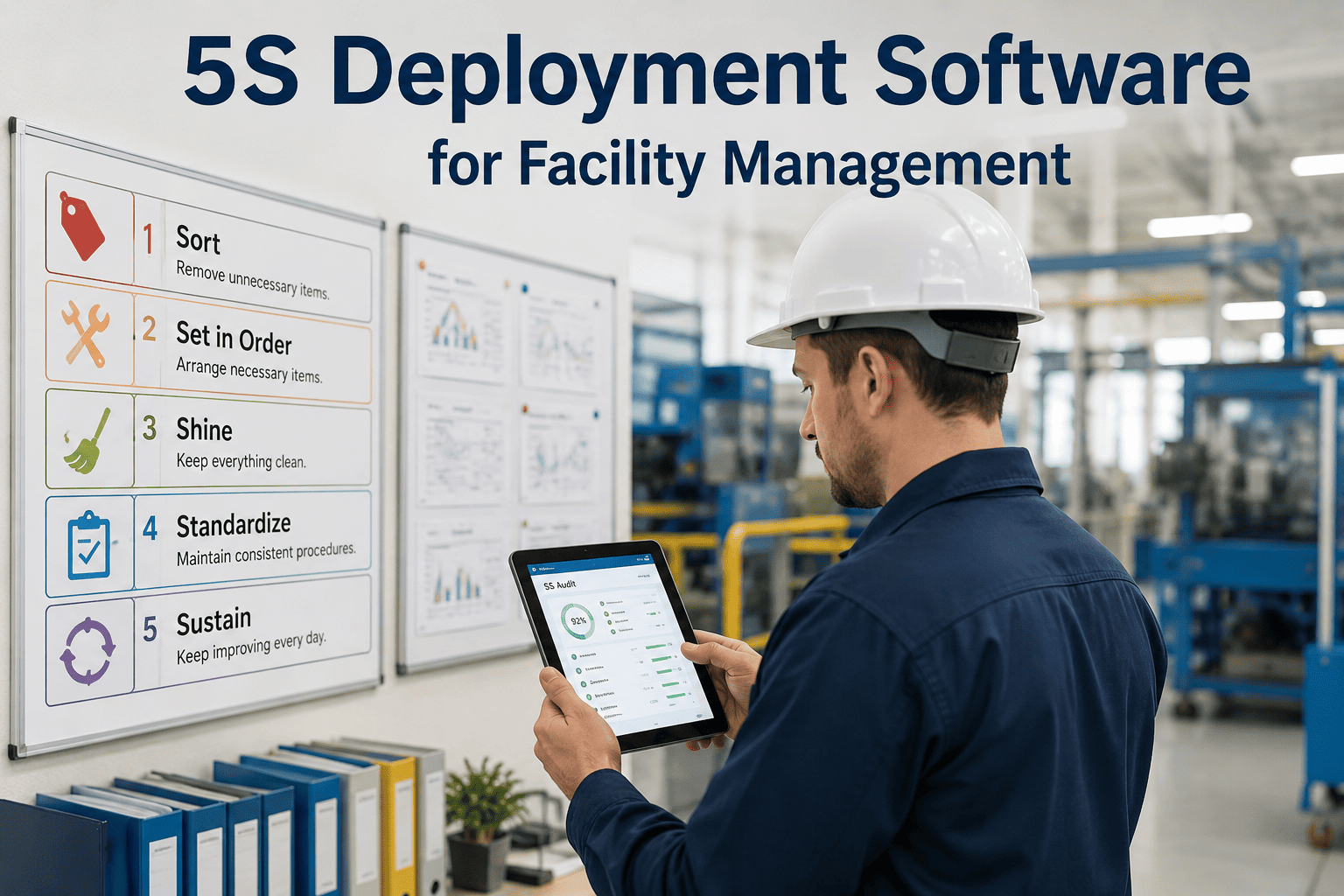
Most facility teams start 5S the same way: a weekend cleanup, some new labels, a laminated poster on the wall. Six months later the poster is still there, but the shadow boards are empty, the labels have peeled off, and nobody remembers who owns the next audit. Sort, Set in Order, and Shine are the easy part — teams finish the first pass in a week or two. What actually determines whether 5S sticks is Standardize and Sustain, the two steps that depend entirely on someone tracking scores, assigning corrective work, and repeating the audit on schedule. Facilities that run 5S through a CMMS instead of a binder keep that rhythm going long after the initial cleanup, turning a one-time project into a permanent operating standard. Book a demo with Oxmaint to see how digital 5S audits keep every site accountable.
5S Facility Management · Digital Workplace Organization
5S Deployment Software Built for Facility Teams
Sort, Set in Order, Shine, Standardize, Sustain — the five steps are simple. Keeping them alive across shifts, buildings, and departments is where most programs break down. Oxmaint turns 5S from a laminated checklist into a live, auditable score every engineering and janitorial team can see.
25%
fewer workplace injuries reported where 5S standards are audited consistently
40%
drop in near-miss incidents once visual management and audits become routine
3–6 mo
is roughly how long a paper-based 5S program lasts before standards quietly slip
Why Most 5S Programs Quietly Fail
5S is easy to launch and hard to keep. The methodology itself hasn't changed since it left the Toyota Production System decades ago — what fails is the tracking behind it.
Sort Breaks Down
No Record of What Was Removed
Red-tag decisions get made verbally on the floor and forgotten by the next shift. Without a logged history, items that were sorted out quietly reappear a few weeks later.
Standardize Drifts
Every Shift Labels Differently
Color coding and shadow boards set up by one team rarely match the next shift's version. Without a shared digital standard, "standardized" becomes whoever set it up last.
Sustain Decays
Audits Stop After the Launch Week
The hardest S has no natural deadline forcing it forward. Once the initial excitement fades, recurring audits are the first thing to disappear from the schedule.
No Visibility
Leadership Can't See the Score
A facilities director managing several sites has no single view of which area is compliant and which one hasn't been audited in months — until an incident forces the question.
The Five Steps, Digitized
Each S maps to a specific piece of software functionality — not a replacement for the discipline, just a way to make it repeatable across every technician and every site.
1
Sort — Seiri
Technicians log every item removed or red-tagged straight from a mobile checklist, with a photo and reason attached, so nothing quietly drifts back onto the floor.
2
Set in Order — Seiton
Every tool, part, and storage location gets a QR tag linked to its correct home, so anyone on any shift can scan and confirm placement in seconds.
3
Shine — Seiso
Cleaning and inspection checklists capture before-and-after photos automatically, turning "looks clean" into a documented, comparable record.
4
Standardize — Seiketsu
One shared template for labeling, color coding, and floor marking is pushed to every area, so a night-shift technician sees the exact same standard as the day crew.
5
Sustain — Shitsuke
Recurring audits are scheduled automatically, scored on a consistent rubric, and any gap opens a corrective work order — the step that keeps everything above it alive.
Manual 5S vs. Digital 5S in a CMMS
On paper, both approaches use the same five steps. In practice, only one of them survives past the first quarter.
| Activity |
Manual / Paper 5S |
Digital 5S in a CMMS |
| Audit scoring |
Handwritten checklist, scored subjectively per auditor |
Standard rubric with photo evidence, scored the same way every time |
| Corrective action |
Written on a clipboard, followed up if someone remembers |
Work order auto-generated and assigned the moment a gap is flagged |
| Cross-site view |
Each site keeps its own binder, no shared visibility |
One dashboard shows the live 5S score for every building and area |
| Audit frequency |
Depends on whoever remembers to schedule it |
Recurring audits trigger automatically on a set cadence |
| Training record |
Sign-in sheet, easy to lose, hard to prove in an audit |
Timestamped completion log tied to each technician's profile |
Turn a Laminated Poster Into a Live Score
Oxmaint schedules the audit, scores it consistently, and opens the corrective work order automatically — so Sustain stops depending on memory.
How a 5S Audit Moves Through Oxmaint
From a scheduled audit to a closed corrective action, here is the path a single 5S check follows inside the platform.
1
Recurring Audit Scheduled
A 5S audit is set to repeat weekly or monthly for each area, so it never depends on someone remembering to plan it.
2
Mobile Checklist Completed
A technician walks the area with a standard checklist on their phone, attaching photos for each of the five categories.
3
Score Calculated Automatically
Each category is scored against the same rubric every time, removing the guesswork of a subjective walk-through.
4
Corrective Work Order Opens
Any category that falls below standard automatically creates a work order and assigns it to the responsible technician.
5
Facility Score Updates Live
The dashboard reflects the new score instantly, giving facility leadership one place to see every area, every site.
What Sustained 5S Actually Delivers
The numbers below hold up only when Standardize and Sustain are actually maintained — which is the part software is built to protect.
1–2 weeks
To complete Sort, Set in Order, and Shine in a single pilot area
6–12 months
Typical timeline for a full facility-wide 5S rollout across departments
20–25%
Reported reduction in workplace injuries once 5S standards are sustained
40%
Reduction in near-miss incidents tied to consistent visual management
Expert Review
FM
Facilities Operations Intelligence
Lean Workplace & CMMS Analysis
5S remains the same five-step discipline it was in the original Toyota Production System, and that is exactly why software struggles to replace it — the value was never the labels, it was the repetition behind them. The two steps that separate a program that lasts from one that quietly disappears are Standardize and Sustain, and both depend on a consistent audit rhythm rather than a single cleanup event. Facilities that move 5S auditing into a CMMS remove the two most common points of failure: inconsistent scoring between auditors and audits that simply stop happening once initial enthusiasm fades. The result isn't a different methodology, it's the same one held accountable on a schedule nobody has to remember manually.
Frequently Asked Questions
What is 5S in facility management?
5S is a five-step workplace organization method — Sort, Set in Order, Shine, Standardize, Sustain — used to keep engineering and janitorial areas clean, labeled, and audit-ready.
Book a demo to see it mapped to a facility CMMS.
Why do most 5S programs fail after a few months?
The first three steps finish quickly, but Standardize and Sustain rely on recurring audits that get skipped once the initial launch energy fades, letting standards slip within a few months.
How long does a full 5S rollout take?
A single pilot area usually finishes Sort, Set in Order, and Shine within one to two weeks, while a facility-wide rollout across multiple departments typically takes six to twelve months.
Can 5S audits be tracked across multiple sites?
Yes — a shared dashboard shows the live 5S score for every building and area from one place, instead of each site keeping a separate paper binder.
Start free on Oxmaint to set it up.
How does digital 5S scoring stay consistent between auditors?
Every audit follows the same rubric with required photo evidence, so a score reflects the standard rather than which technician happened to walk the area that week.
Give 5S a Score It Can't Quietly Lose
Recurring audits, automatic corrective work orders, and one live dashboard for every site — Oxmaint keeps Standardize and Sustain from becoming the two steps everyone forgets.