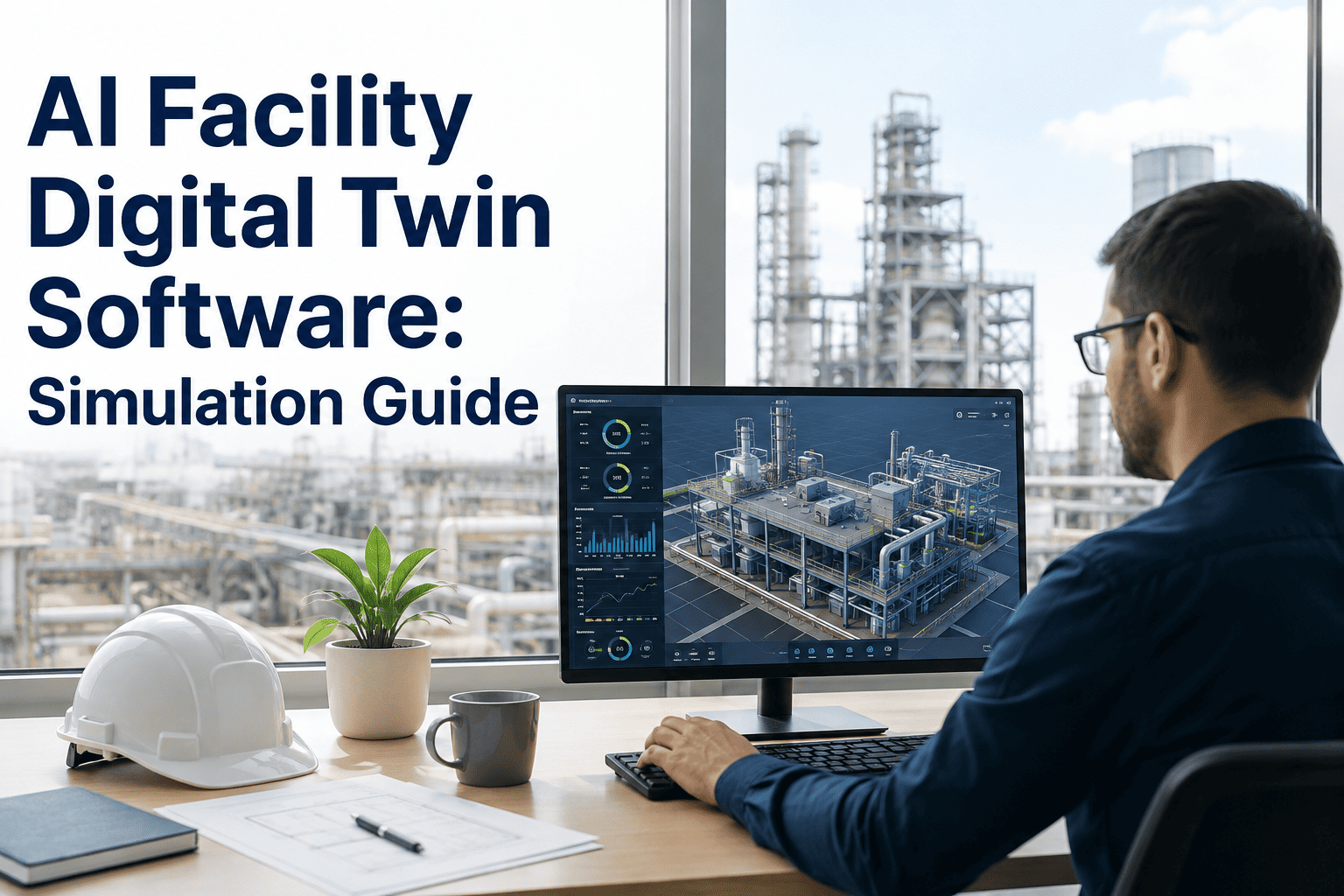
Facility teams have spent decades fixing problems only after they happen — a bearing seizes, a chiller trips offline, a conveyor jams mid-shift, and only then does anyone reach for a wrench. A digital twin flips that sequence entirely, giving reliability engineers a living, data-fed replica of every asset so failures can be rehearsed and resolved in software long before they cost a single hour of uptime. Instead of guessing how a retrofit, a load change, or a new PM schedule will play out on the floor, teams can run the scenario against the twin first and watch the outcome unfold safely on a screen. This shift from reactive firefighting to rehearsed decision-making is why forward-looking facility directors are asking how a modern simulation platform fits their 2026 roadmap, and it's worth seeing the rehearsal in action by taking a look at a live walkthrough with our engineering team.
AI Simulation Platform — 2026
AI Facility Digital Twin Software That Rehearses Every Decision
A facility digital twin mirrors your real assets in real time, pulling live sensor feeds, work order history, and utility data into one model. Facility directors use it to test retrofits, capacity changes, and maintenance schedules virtually before committing budget or downtime on the floor.
Live MirroringSensor and asset data synced continuously
Scenario TestingRetrofits and schedules validated pre-rollout
Failure ForecastingPredictive models flag drift before breakdown
60%Faster root cause diagnosis
24/7Live asset mirroring
3xMore scenarios tested before rollout
100%Simulation-backed change approvals
Why Facilities Are Rethinking Trial-and-Error Maintenance
Most facility teams still validate changes the expensive way: they make the change, then watch what happens. A new chiller sequence, an added production line, a revised PM interval — each gets tested live, on real equipment, with real consequences if the assumption is wrong. A digital twin removes that risk by letting the same test run first inside a model built from your actual asset history, so the floor only sees the version that already works. This matters most for the decisions that are hardest to reverse: a retrofit that requires downtime to install, a capacity expansion that commits capital for years, or a schedule change that affects every technician's route for the next quarter. When those calls are backed by a simulation instead of a hunch, the conversation with finance and leadership changes from "we think this will work" to "we already tested this and here is the modeled outcome."
Blind Retrofits
42%
Equipment upgrades are approved on vendor specs alone, without modeling how the change interacts with existing loads and schedules.
Untested Schedules
High
New maintenance intervals are rolled out facility-wide before anyone confirms they actually reduce failures for that asset class.
Guesswork Capacity
55%
Expansion and load-growth decisions rely on static spreadsheets instead of a model that reflects current asset condition.
Delayed Root Cause
Severe
Without a synced model, engineers reconstruct failure timelines manually, losing days before the true cause is confirmed.
How the Digital Twin Engine Works
Underneath every simulation is a four-stage pipeline that keeps the virtual model honest against the real facility. Each stage feeds the next, so a twin built on stale data never gets a chance to mislead a planning decision.
CAPTURE
Continuous Asset Data Ingestion
Sensor feeds, meter readings, and PLC tags stream into the twin in real time.
Work order history and parts consumption are attached to each modeled asset.
Manufacturer specs and warranty data anchor the model's baseline performance curve.
MODEL
Behavioral & Failure Modeling
AI builds a degradation curve for each asset based on years of maintenance history.
Interdependencies between systems, like HVAC load and process heat, are mapped automatically.
Confidence scores show how closely the model matches recent live readings.
SIMULATE
Scenario Rehearsal
Planners run what-if scenarios: added load, changed setpoints, deferred maintenance, and more.
The engine forecasts failure probability and energy impact for each scenario before rollout.
Results are ranked so teams can compare outcomes side by side before choosing a path.
DEPLOY
Validated Rollout & Feedback
Approved scenarios convert directly into work orders and updated PM schedules.
Live results are compared back against the simulation to refine future accuracy.
Every rollout carries a documented, simulation-backed justification for audit trails.
See Your Own Facility Modeled in Minutes
Connect your existing asset list and OxMaint builds a working digital twin from your maintenance history, no rip-and-replace of your current systems required.
What's Inside the Platform
A facility twin is only useful if it stays close to reality. These are the three capabilities that keep the model trustworthy enough to base real spending decisions on.
Live Mirroring
Real-time sensor and meter sync
Automatic asset hierarchy mapping
Drift alerts when the model diverges from readings
Keeps the virtual model within a tight margin of the physical facility at all times.
Failure Modeling
Degradation curves per asset class
Cross-system dependency mapping
Probability-ranked failure forecasts
Turns years of maintenance history into a forward-looking risk score.
Scenario Simulation
Retrofit and capacity what-if testing
Schedule and setpoint experimentation
Side-by-side outcome comparison
Lets teams test the expensive decision virtually before it becomes a physical one.
Traditional Maintenance vs. a Digital Twin Approach
The difference shows up most clearly when you line the two approaches up side by side across the decisions facility teams make every week. None of these comparisons require exotic technology on the floor — the same sensors and work order data most teams already collect are simply routed through a model instead of sitting in separate reports that nobody cross-references.
| Decision Point | Traditional Approach | Digital Twin Approach |
| Root Cause Diagnosis |
Manual timeline reconstruction, days of delay |
Modeled replay in minutes from live data |
| Retrofit Validation |
Live trial on real equipment |
Simulated outcome before purchase order |
| Capacity Planning |
Static spreadsheet estimates |
Model reflecting current asset condition |
| Schedule Changes |
Facility-wide rollout, then observation |
Tested against historical failure data first |
| Downtime Risk |
Discovered after the fact |
Forecast before the change is made |
From First Sensor to Full Simulation
Standing up a facility-wide twin does not happen overnight, but most teams reach useful predictive value well before the full portfolio is connected.
01
Asset Baseline & Data Audit
Existing work order history, asset lists, and available sensor points are reviewed to establish what the twin can model on day one.
02
Sensor & Meter Integration
Live telemetry connections are established for priority assets so the model begins receiving continuous, real-world feedback.
03
Behavioral Model Training
AI trains degradation and dependency models against historical failures until confidence scores clear the reliability threshold.
04
Scenario Rehearsal Rollout
Planners begin running real retrofit, capacity, and scheduling scenarios against the twin ahead of committed spending.
05
Continuous Accuracy Tuning
Live outcomes are compared back against forecasts, tightening the model's accuracy with every completed work order.
What Reliability Teams Are Seeing
We used to approve a chiller retrofit on paper specs and hope. Now we run the exact load profile through the twin first and see the actual energy and failure-risk outcome before a purchase order goes out. Our maintenance planners caught a scheduling conflict in the model that would have taken down two production lines simultaneously had we rolled it out live. That single catch paid for the platform.
Reliability Manager, Multi-Site Manufacturing Group
60%Faster diagnosis time
3xScenarios tested pre-rollout
ZeroUnplanned retrofit failures
Frequently Asked Questions
What data does a facility digital twin actually need to get started?
A useful starting model needs an asset list, recent work order history, and whatever live sensor or meter points already exist. You can
start a free trial to see what your current data supports.
How is this different from a standard CMMS dashboard?
A dashboard reports what already happened. A digital twin forecasts what will happen under a proposed change, letting teams test a decision before committing budget or downtime to it.
Can the twin model interactions between different systems?
Yes. The engine maps dependencies across HVAC, process, and electrical systems so a change in one area shows its downstream effect on connected assets automatically.
How accurate is the simulation compared to real outcomes?
Accuracy improves continuously as live results feed back into the model. Most facilities see forecast confidence tighten significantly within the first few completed work order cycles.
Do we need to replace our current maintenance software?
No. The twin connects to your existing asset and work order data.
Book a walkthrough to see how it layers onto your current setup.
Rehearse Your Next Facility Decision Before You Make It
OxMaint turns your maintenance history and live telemetry into a working digital twin, so every retrofit, schedule change, and capacity decision gets tested before it costs you anything.