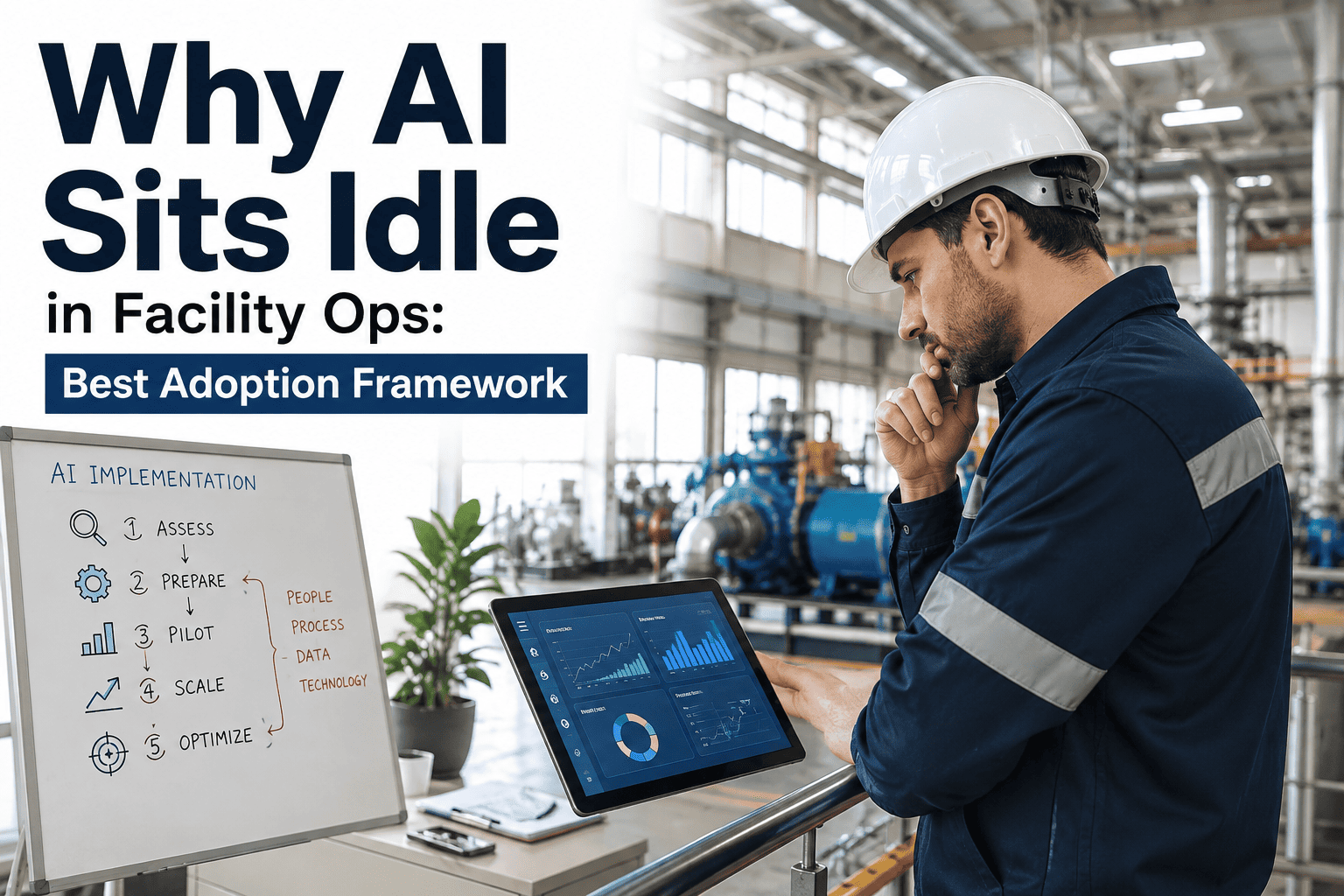
Most facility teams already have an AI pilot running somewhere — a predictive maintenance trial on one chiller, a vision-based inspection test on one floor, a chatbot handling a handful of tenant requests. Few of those pilots ever become the way the facility actually runs. Industry research now puts the pilot-to-production failure rate for enterprise AI agents as high as 88 percent, and facility operations is no exception: two out of three maintenance teams say they plan to adopt AI, yet fewer than a third have moved past isolated experiments into daily use. The gap is rarely the algorithm — it is missing asset data, no named owner, and a maintenance workflow that was never built to receive machine output in the first place. Start a free OxMaint trial to see what a facility CMMS built for that transition looks like, or book a working demo below.
The Adoption Gap
Why AI Sits Idle in Facility Ops
Facility leaders are not short on AI tools. Vision inspection apps, chatbot layers, and predictive dashboards get demoed constantly, and most facility teams have tried at least one. What almost none of them have is a repeatable path that turns a working demo into a system technicians rely on every day. The four patterns below account for nearly every stalled facility AI project reviewed in 2026 industry surveys, and every one of them is fixable with the right platform underneath the AI layer.
01
Dirty or Missing Asset Data
AI predicts failures per asset. If the register lives in three spreadsheets with inconsistent naming, or half your chillers were never tagged, the model has no clean object to attach a prediction to. Facility managers now rank data quality and integration ahead of budget as the single biggest barrier to scaling AI.
02
No Named Owner for the Workflow
A pilot with a project sponsor is not the same as a workflow with an owner. When nobody is accountable for reviewing alerts, actioning them, and reporting the outcome every month, the dashboard quietly stops getting opened after week six.
03
Predictions With Nowhere to Land
Most facility AI pilots stop at the alert. A model flags a bearing trending toward failure, and the notification lands in an inbox instead of a scheduled work order. Without a CMMS pipeline connected on the back end, every prediction becomes one more thing a technician has to remember manually.
04
Governance Nobody Trusts Yet
Roughly a fifth of organizations report having a mature framework for reviewing what an AI agent is allowed to decide on its own. Without that clarity, technicians treat every recommendation with suspicion, and the model never earns the trust it needs to move from advisory to autonomous.
Move Your Facility AI Program Past the Pilot Stage
OxMaint gives predictive maintenance a place to land — a structured asset register, an automated work order pipeline, and a compliance record that turns every AI alert into a completed job with a paper trail.
2026 Benchmark
Where Facility AI Adoption Actually Stands
Adoption headlines tend to average very different realities into one number. The breakdown below separates facility AI use cases by how many teams have moved a given workflow into daily production versus how many are still running it as a side pilot, along with the blocker that shows up most often in each category.
| Use Case |
Already in Daily Use |
Still Pilot-Only |
Most Common Blocker |
| Predictive Maintenance |
47% |
38% |
Sensor and data quality gaps |
| Digital Inspections & Vision Checks |
34% |
41% |
No standardized checklist data |
| Compliance & Test-Log Reporting |
29% |
33% |
Manual logs never digitized |
| Energy & HVAC Optimization |
42% |
36% |
BAS and CMMS systems don't connect |
| Work Order Routing & Triage |
31% |
44% |
No structured asset hierarchy |
The Framework
The Five-Stage Path From Pilot to Production
Facilities that successfully scale AI almost never start with the model. They start with the plumbing underneath it — the asset data, the ownership, and the CMMS pipeline that turns a prediction into a scheduled, tracked, and closed work order. The sequence below is the order that consistently works, in the order it needs to happen.
Stage 1
Fix the Asset Register First
Every asset needs a consistent ID, a location, a criticality rating, and a maintenance history before any model can predict anything useful about it. This is unglamorous work, and it is the step most pilots skip — which is exactly why most pilots stall.
Stage 2
Pick One Failure Mode, Not the Whole Building
Choose a single, high-frequency, high-cost failure — a chiller bearing, a cooling tower biocide lapse, a recurring HVAC belt failure — and prove the model against six to twelve months of history before expanding scope.
Stage 3
Route Predictions Into Real Work Orders
An alert that does not generate a scheduled, assigned work order inside the CMMS is not a production system — it is a notification. This single connection is the difference between a demo and a workflow technicians actually follow.
Stage 4
Name an Owner and a Success Metric
Assign one person accountable for the workflow, and define success in operational terms — reduced unplanned downtime, PM compliance rate, mean time to repair — not in terms of how impressive the model demo looked.
Stage 5
Expand Only After Ninety Days of Clean Telemetry
Once the pilot asset class shows ninety days of reliable, low-noise predictions with a documented outcome trail, extend the same configuration to the next asset class rather than starting a new pilot from scratch.
Pilot vs Production
What Actually Changes When AI Ships
The difference between a pilot and a production system is rarely the sophistication of the model. It is what surrounds it — where the data lives, who is accountable, and whether a prediction can turn into a finished job without someone remembering to act on it manually.
Still a Pilot
Runs on one asset or one building only
Every alert reviewed manually before any action
Success measured by how the demo looked
Data lives in a spreadsheet or side dashboard
Owned informally by whoever ran the trial
In Production
Runs across the full asset register
Predictions auto-generate scheduled work orders
Success measured in downtime and PM compliance
Data lives inside the CMMS asset history
Owned by a manager with a monthly reporting metric
Give Every Prediction a Work Order to Land In
OxMaint connects predictive alerts directly to scheduled, assigned, and tracked work orders, so your AI program produces completed maintenance instead of unread notifications.
Expert Review
What Maintenance and AI Operations Leaders Say
The mistake I see most often is treating the model as the project. The model is the easy part in 2026 — almost any vendor can plug one in. The hard part is the asset register underneath it and the discipline to route every prediction into a work order that someone is accountable for closing. Facilities that get that sequence right scale in months. Facilities that skip it are still running the same pilot two years later.
Facility teams do not fail at AI because the technology is unreliable. They fail because nobody owns the workflow after the pilot ends. I tell every client the same thing before they buy a predictive maintenance tool: name the person who will act on the first hundred alerts, and build the reporting metric before you build the dashboard, not after.
Frequently Asked Questions
AI Adoption in Facility Operations — Common Questions
Stop Running Pilots. Start Running Production.
OxMaint is the CMMS layer that turns AI predictions into scheduled work, documented outcomes, and a reporting trail your leadership team can actually measure — built to take facility AI from proof of concept to everyday operations.