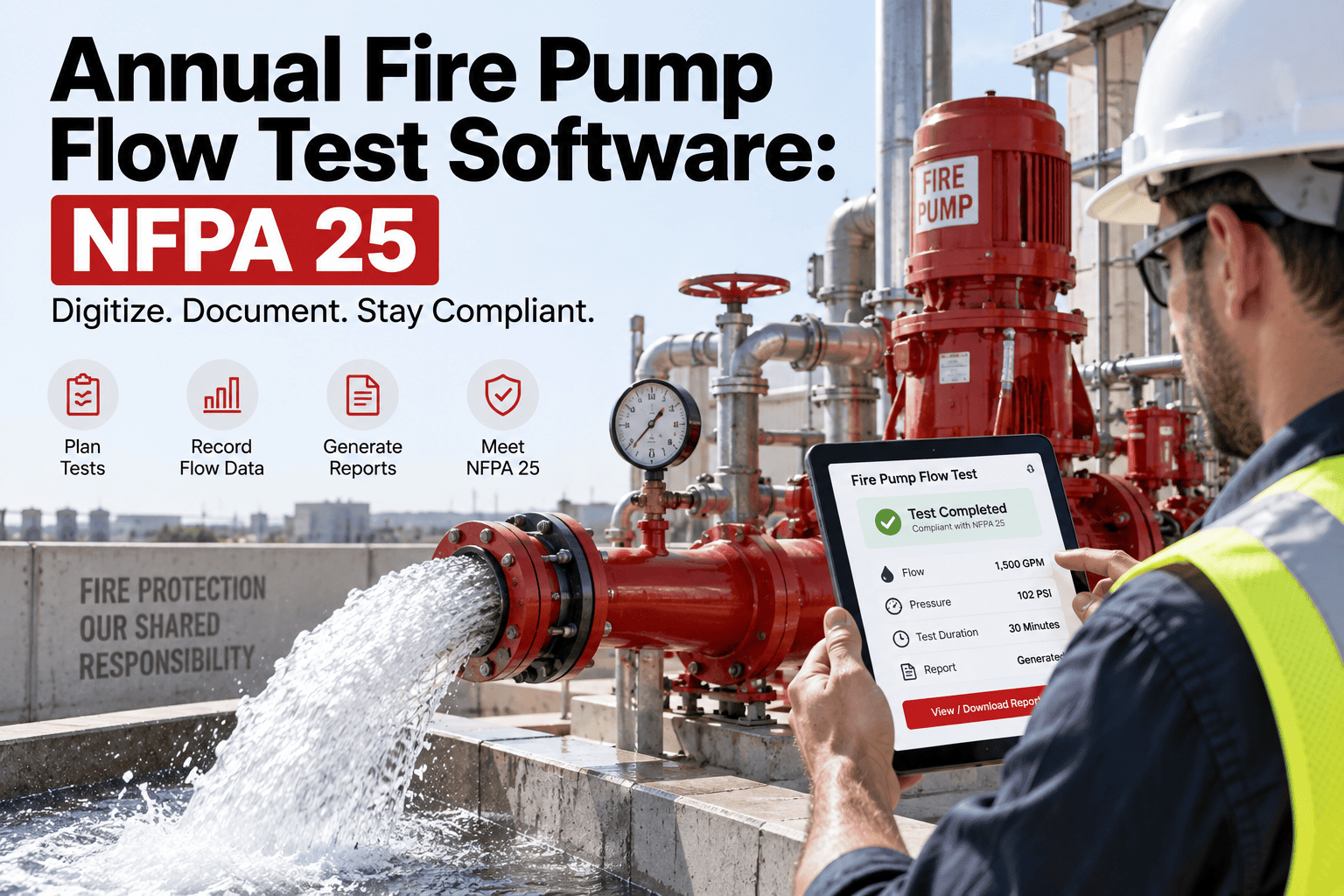
An annual fire pump flow test is one of the few inspections where the acceptable outcome is "prove the pump can actually do its job under full demand," not just "confirm it starts." NFPA 25 requires this test every year, and the authority having jurisdiction will want to see curves, not just a pass/fail note. Facility and life-safety teams that manage flow tests on paper often struggle to produce a defensible record, while those running the process through a CMMS can pull hydraulic data, prior-year comparisons, and corrective actions in minutes rather than digging through a filing cabinet the week before an inspection. See how a connected platform like OxMaint AI handles this in practice.
Your fire pump only matters if it performs when tested
NFPA 25 annual flow testing checks whether your fire pump delivers rated flow and pressure across churn, rated, and peak load conditions. A test that is run but not properly documented offers little protection during an AHJ review or an insurance audit, and a pump that quietly loses capacity year over year can go unnoticed until it is called on during an actual fire event.
The annual flow test is easy to run poorly and hard to run well
Flow testing a fire pump involves coordinated valve operations, pressure readings at three flow conditions, and calculations that must be checked against the pump's rated performance curve. Skipping steps or recording readings loosely creates a test that will not hold up to scrutiny.
The annual flow test sequence, step by step
NFPA 25 defines a specific sequence for the annual churn, rated, and peak flow test. Running it consistently, with every reading logged against the right condition, is what makes the record defensible.
Pre-test setup
Confirm suction supply, verify test header or flow meter calibration, and record static suction and discharge pressure before starting the pump.
Churn condition (0% flow)
Start the pump with no flow through the test outlets and record suction pressure, discharge pressure, and driver speed or amperage.
Rated flow (100%)
Open test outlets to reach rated capacity, hold steady, and log pressure and flow readings for the required duration.
Peak flow (150%)
Increase flow to 150% of rated capacity to confirm the pump still meets minimum pressure requirements at the top of its curve.
Plot and compare
Plot all three points against the acceptance curve and the prior year's results to identify any measurable degradation in performance.
Log corrective actions
Any deficiency, from a worn impeller to a packing gland leak, is converted into a scheduled work order with a clear owner and due date, with the finding attached directly to the test record it came from.
What an inspector expects to see in your test record
| Requirement | NFPA 25 Expectation | Common Gap Without a CMMS |
|---|---|---|
| Test frequency | Annual flow test for all fire pumps | Tests slip past the anniversary date without a tracked reminder |
| Flow conditions | Churn, rated, and 150% rated flow readings | Peak flow condition skipped to save time |
| Curve comparison | Results plotted against acceptance curve | Raw numbers recorded but never plotted or compared |
| Record retention | Test records retained and available for AHJ review | Paper records misfiled or lost between annual visits |
| Deficiency follow-up | Identified deficiencies corrected and documented | Findings noted verbally but never tracked to closure |
How the annual flow test fits into the broader NFPA 25 program
The annual flow test is the headline requirement, but it does not stand alone. NFPA 25 builds a layered testing calendar around the fire pump, and gaps in the surrounding tasks often show up first as a failed annual flow test.
Weekly and monthly churn tests set the baseline
Diesel-driven pumps typically require weekly no-flow churn runs, while electric-driven pumps are usually tested monthly. These shorter tests confirm the driver starts reliably and build a running log of suction and discharge pressure that makes the annual flow test results easier to interpret in context.
Component inspections catch problems between flow tests
Suction and discharge gauges, relief valves, packing glands, and alignment all have their own inspection intervals under NFPA 25. A relief valve drifting out of adjustment or a packing gland leaking excessively will often surface during these smaller checks well before it affects the annual flow numbers.
Five-year internal inspections close the loop
Every five years, NFPA 25 calls for an internal inspection of the pump casing and impeller. Facilities that have kept consistent annual flow data have an easier time deciding whether that five-year teardown is precautionary or genuinely overdue based on measurable performance decline.
See a fire pump flow test logged start to finish in OxMaint
Watch how churn, rated, and peak flow readings turn into a curve comparison and an audit-ready record in one session.
What a failed flow test usually points to
When a fire pump does not meet its rated curve during the annual test, the cause is usually one of a small number of mechanical or hydraulic issues rather than a mystery requiring a full teardown.
Who should own the flow test process end to end
Flow testing typically involves more than one party, and unclear ownership is a common reason records end up incomplete or inconsistent from year to year.
Third-party fire protection contractors run the physical test
Most facilities contract a licensed fire protection company to physically operate valves, take readings, and certify the test. That relationship does not remove the facility's responsibility to retain and organize the resulting records for the AHJ.
Facility teams own the corrective action loop
When a contractor flags a deficiency, it becomes the facility team's job to schedule the repair, verify it, and document closure. A CMMS that converts a contractor's finding directly into an internal work order keeps that handoff from getting lost between two separate systems.
The AHJ ultimately holds the building owner accountable
Regardless of who performs the physical test, the fire marshal or authority having jurisdiction holds the building owner responsible for producing current, complete records on request. That responsibility is why the record-keeping system matters as much as the contractor relationship itself.
What changes when the flow test moves off paper
- Readings jotted on a clipboard and transcribed later, sometimes inaccurately
- Prior-year results require digging through a filing cabinet
- Curve comparison done manually, if it happens at all
- Deficiencies mentioned in a verbal handoff, easy to forget
- Readings entered directly against each flow condition on a mobile checklist
- Every prior year's test pulled up instantly for side-by-side comparison
- Curve deviation flagged automatically against the acceptance curve
- Deficiencies become tracked work orders with due dates and sign-off
Making the annual flow test a repeatable, provable process
OxMaint does not replace the physical flow test, the gauges, or the trained technician running it. It gives fire protection and facility teams the structure to schedule, capture, compare, and retain that test the same way every year.
Automatic Test Scheduling
Annual flow tests generate as recurring work orders tied to each fire pump asset, so a due date never gets missed between inspections.
Structured Field Checklists
Technicians record churn, rated, and peak readings directly on a mobile checklist built around the pump's nameplate data.
Historical Curve Comparison
Every year's results are stored against the same asset record, making year-over-year performance trends visible at a glance.
Audit-Ready Reporting
Exportable test history and corrective action records are ready to hand to an AHJ, insurance auditor, or fire marshal on request.
Annual fire pump flow test questions
How often does NFPA 25 require a fire pump flow test?
NFPA 25 requires a full flow test annually, in addition to weekly or monthly churn tests depending on the pump's driver type and configuration.
What three flow conditions must be tested?
Churn (no flow), rated flow (100% of nameplate capacity), and peak flow (150% of rated capacity) are all required to confirm the pump curve holds across its full range.
What happens if the pump fails to meet its curve?
A deficiency must be documented and corrected, which often means impeller wear, valve issues, or driver problems. Tracking this as a work order prevents it from being forgotten, see how at Calendly.
Do test records need to be kept on-site?
NFPA 25 expects records to be retained and available for review by the AHJ, so they need to be organized and retrievable, not just completed once and filed away.
How fast can a facility set up flow test tracking in OxMaint?
Most fire protection teams load their pump asset records and build their first flow test checklist within a week. Start a free trial at OxMaint.
Managing flow test compliance across multiple buildings
Organizations running fire pumps across several sites face a version of this problem that a single facility never sees: dozens of anniversary dates, different local AHJs, and inconsistent test quality between contractors and regions.
A shared calendar prevents dates from slipping through the cracks
When every site tracks its own flow test schedule independently, a regional facilities manager has no reliable way to confirm compliance across the portfolio without calling each location. Centralizing every pump's test date, contractor, and status in one system turns that into a single dashboard view instead of a round of phone calls before a corporate audit.
Standardized checklists keep quality consistent across contractors
Different fire protection contractors bring different habits to a flow test. Enforcing the same structured checklist, the same required readings, and the same documentation standard across every site, regardless of which contractor performs the physical test, keeps the resulting records comparable and defensible everywhere.
Portfolio-level reporting supports insurance renewals
Property insurers covering a multi-site portfolio increasingly ask for consolidated evidence of life-safety testing compliance during renewal underwriting. A single exportable report covering every pump's current status is a materially easier conversation than assembling records site by site under deadline pressure.
Overdue tests are easier to catch before they become findings
A pump that slips past its annual test anniversary by even a few weeks becomes a finding the moment an inspector notices it. A portfolio dashboard that flags approaching and overdue dates across every site gives regional teams the lead time to close that gap before it is ever written up, rather than discovering the gap during the inspection itself.
Rolling out flow test tracking without disrupting this year's schedule
Facility and fire protection teams do not need to wait for a new testing cycle to begin structuring their records. Most of the value comes from organizing what already exists and building forward from there.
Load the current fire pump register first
Creating an asset record for each fire pump, complete with nameplate rating and acceptance curve, gives every future test a fixed reference point to compare against, even before historical data is fully digitized.
Digitize the most recent test as the new baseline
Rather than backfilling years of paper records, most facilities start by entering the most recent completed flow test as the current baseline, then build forward with every subsequent test logged directly in the system.
Connect deficiencies to the corrective action workflow immediately
As soon as test tracking is in place, route any newly identified deficiency directly into a scheduled work order rather than a separate notes file. This single change is usually what closes the biggest compliance gap facilities have going into their next AHJ inspection.
Turn your annual flow test into a defensible record
A test that is logged, compared, and tracked to closure protects your facility far better than a stack of paper readings. Build that record with OxMaint.
Free 14-day trial · No credit card