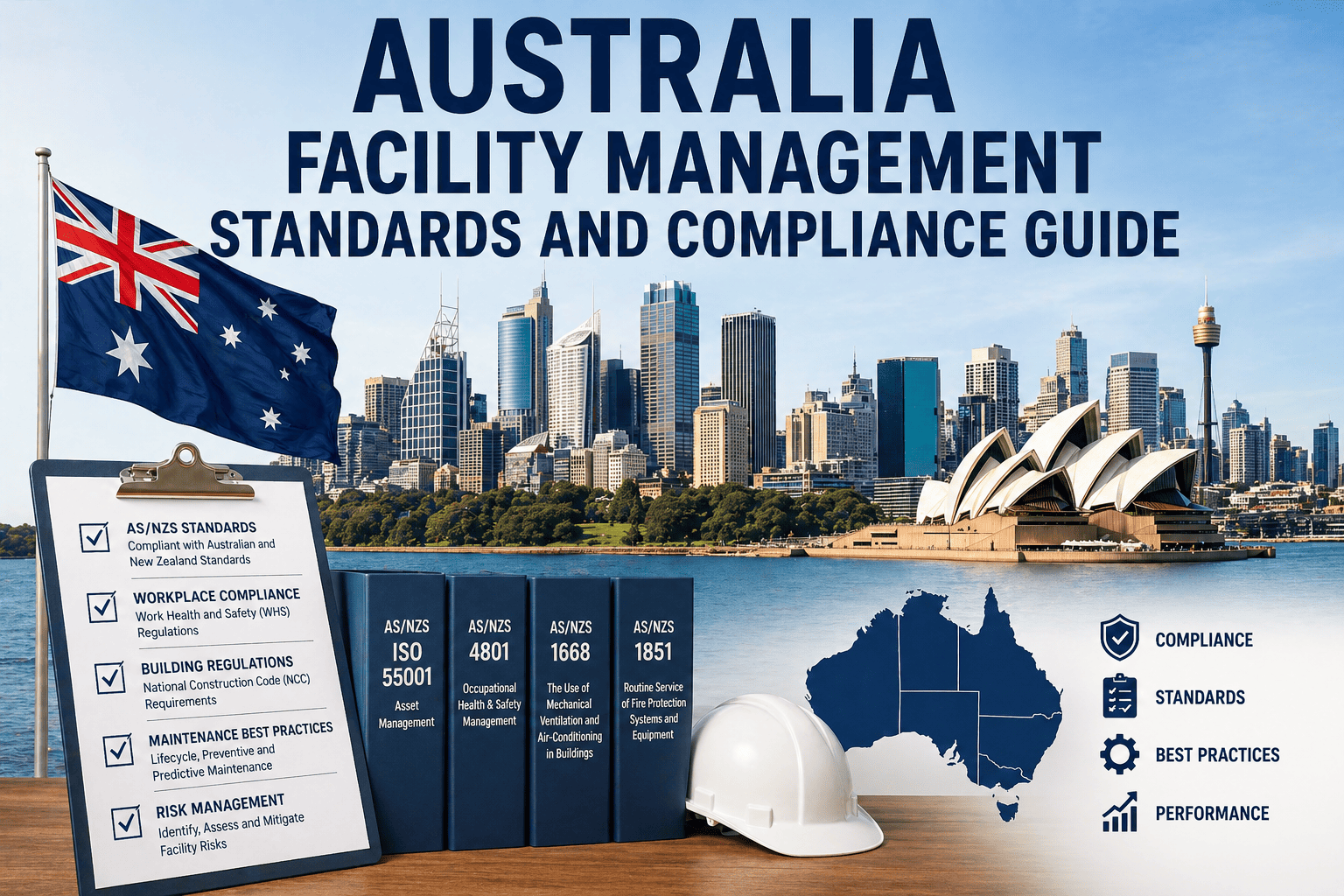
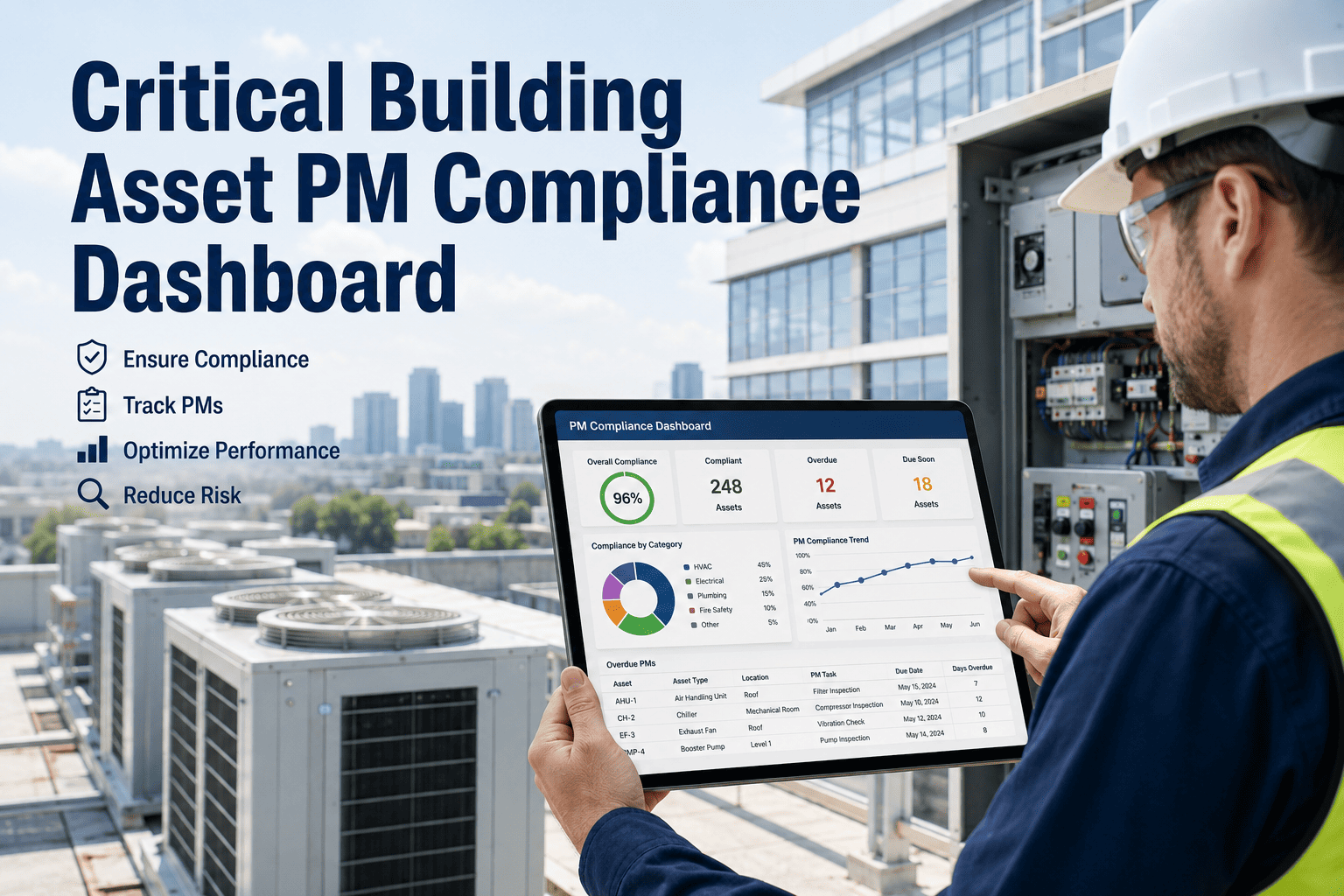
This guide is part of OxMaint's Facility Management Resource Centre .Australian facility managers navigating AS/NZS standards, WHS legislation, and building compliance requirements will find this article a practical reference for maintaining safe, efficient, and audit-ready operations. Whether you manage a commercial tower in Sydney, an industrial site in Perth, or a healthcare campus in Melbourne, understanding the compliance landscape is the first step toward proactive maintenance management.
Regional Compliance Guide · Australia
Australia Facility Management Standards & Compliance Guide
A complete reference for facility directors, operations heads, and compliance managers navigating AS/NZS standards, WHS regulations, and building maintenance obligations across Australian jurisdictions.
Updated May 2026
AS/NZS & WHS Covered
All Australian Jurisdictions
78%
of contractors report inconsistencies between state WHS requirements
5–10%
of construction cost goes to structural compliance — but protects entire asset value
7
Australian jurisdictions that have enacted harmonised WHS legislation
SECTION 1: KEY STANDARDS
1 Core AS/NZS Standards Every Facility Manager Must Know
These standards are referenced by the National Construction Code (NCC) and the Plumbing Code of Australia (PCA), making compliance effectively mandatory for facility teams.
| Standard |
Scope |
Applies To |
Status |
| AS/NZS 3000:2018 |
Electrical Wiring Rules — design, installation, safety of all electrical systems |
All commercial & industrial buildings |
Mandatory via legislation |
| AS/NZS 3500 (2025) |
Plumbing & drainage — water services, sanitary, stormwater, heating |
All new plumbing work from Oct 2025 |
Active 2025 |
| AS/NZS ISO 14001 |
Environmental management system — impacts, sustainability performance |
Facilities with environmental obligations |
Referenced by NCC |
| AS/NZS ISO 9001 |
Quality management — documented procedures, risk management, efficiency |
FM service providers & operators |
Voluntary / Contractual |
| AS 1657 |
Fixed platforms, walkways, stairways & ladders — design & construction |
Industrial & warehouse facilities |
Safety-critical |
| AS/NZS 3760 |
Testing & tagging of electrical equipment in residential, commercial & industrial settings |
All workplaces with portable equipment |
WHS Regulation linked |
2 WHS Legislation Framework for Facility Teams
The Work Health and Safety Act and WHS Regulation 2025 govern how facility managers must identify hazards, control risks, and maintain safe built environments. The 2025 WHS Regulation in NSW introduces strengthened psychosocial risk controls, lithium-ion battery emergency planning, and a new silica worker register effective October 2025.
Identify Hazards
Conduct systematic inspections of physical, chemical, biological, and psychosocial hazards across all facility areas. WHS Regulation (Part 3.1) requires documented hazard identification for all work activities.
Apply Hierarchy of Controls
Eliminate, substitute, isolate, engineer, administrate, or provide PPE — in that order. Documentation of selected controls is a legal obligation for PCBUs (Persons Conducting a Business or Undertaking).
Maintain & Review Controls
Controls must be actively maintained and periodically reviewed to confirm ongoing effectiveness. Facilities with changing occupancy, systems upgrades, or new chemical use must trigger fresh risk assessments.
Consult Workers & Contractors
Sections 46–47 of the WHS Act make consultation a legal requirement. Facility teams must involve workers, safety representatives, and contractors in hazard identification and risk decisions.
Maintain Records & Emergency Plans
Emergency plans, first-aid resources, and training records must be kept current. Facilities storing 25+ tonnes of lithium-ion batteries must now lodge emergency plans with Fire and Rescue NSW.
01
Compliance Tracking
Track AS/NZS standard deadlines, WHS obligations, and inspection schedules in one platform
02
Audit-Ready Records
Auto-generated maintenance logs and safety records that satisfy regulatory inspections
03
Multi-Site Control
Manage compliance across all Australian states and territories from a single dashboard
3 Compliance Risk Matrix for Australian Facility Managers
Understanding which gaps carry the highest regulatory and financial exposure helps prioritise your compliance programme.
| Compliance Area |
Penalty Risk |
Operational Risk |
Priority |
| Electrical safety (AS/NZS 3000) |
High |
Critical |
Immediate |
| Asbestos management & removal |
High |
Critical |
Immediate |
| Psychosocial hazard controls (2025) |
Medium |
Critical |
Q1 Priority |
| Plumbing compliance (AS/NZS 3500) |
High |
Medium |
Q1 Priority |
| Silica worker registration |
High |
Low |
Oct 2025+ |
| Fire safety & emergency plans |
Medium |
Critical |
Ongoing |
| Workplace exposure limits (WEL) |
Low (now) |
Medium |
Prepare by Dec 2026 |
4 2026 Compliance Readiness Checklist
Use this checklist to assess where your facility currently stands against Australian regulatory requirements.
WHS Gap Analysis
Review all existing WHS management systems against the 2025 Regulation requirements and document gaps
Electrical Test & Tag Records
Verify AS/NZS 3760 testing schedules are current and all portable equipment is in compliance
Plumbing Transition (Oct 2025)
Confirm all new plumbing work references AS/NZS 3500:2025 editions, not the superseded 2021 versions
Psychosocial Risk Assessment
Conduct updated risk assessments for psychosocial hazards using hierarchy of controls documentation
Asbestos Register & Plans
Maintain a current asbestos management plan and register for any building constructed before 1990
Emergency Plan Filing
Lodge updated emergency plans with relevant fire authorities, especially for lithium-ion battery storage
Stop Tracking Compliance on Spreadsheets
OxMaint's Compliance Tracking module maps your Australian standards obligations, schedules inspections, and keeps audit-ready records — automatically.
SR
Australian facility managers are caught between dozens of overlapping standards and state-specific WHS amendments that change every year. The facilities that stay ahead are the ones using digital systems to track obligations in real time — not annual reviews from a compliance folder. With the 2025 WHS Regulation now live in NSW and psychosocial risk controls becoming enforceable, the days of reactive compliance are over. Proactive tracking is now a legal requirement, not just best practice.
Sarah Reynolds
Senior Facility Compliance Consultant, Sydney · 18 years in Australian FM & WHS
5 Frequently Asked Questions
What is the difference between AS/NZS standards and the National Construction Code (NCC)?
AS/NZS standards are technical documents developed by Standards Australia and Standards New Zealand. They are generally voluntary on their own. However, when the NCC references a specific standard in its Deemed-to-Satisfy Provisions, that standard becomes legally enforceable for construction in Australia. Facility managers should regularly check the Australian Building Codes Board to identify which standards are currently referenced and therefore mandatory for their building type and jurisdiction.
How do the WHS Regulation 2025 changes affect my maintenance programme?
The WHS Regulation 2025, particularly the NSW version that commenced in August 2025, strengthens psychosocial risk controls, introduces penalty notice offences for silica worker registration failures, and adds requirements for lithium-ion battery emergency plans. Facility managers must update risk assessments to reflect these changes, retrain relevant staff, and ensure maintenance control measures are documented using the hierarchy of controls. A compliance gap analysis against your current maintenance programme is the recommended first step.
When did the new AS/NZS 3500 plumbing standards become mandatory?
The 2025 editions of the AS/NZS 3500 series became mandatory for new plumbing work from 20 October 2025. Before that date, facilities could use either the 2021 or 2025 editions under a transition window. From October 20, 2025, only the 2025 editions are accepted as Deemed-to-Satisfy under the Plumbing Code of Australia. Facilities undergoing maintenance or upgrades involving plumbing systems — including roof drainage, water services, and sanitary systems — must now ensure contractors reference the current editions. Failure to do so can create certification and liability issues during property transactions or insurance claims.
Can OxMaint help track compliance deadlines across multiple Australian sites?
Yes. OxMaint's
Compliance Tracking module is designed for multi-site facility operations. It allows facility directors to set jurisdiction-specific compliance schedules, assign inspection tasks to site-level teams, receive automated deadline alerts, and generate audit-ready reports for regulators and insurers. Teams managing assets across NSW, Victoria, Queensland, and Western Australia — each with their own WHS amendments — can manage all obligations from a single centralised dashboard. This eliminates the risk of a site-level team missing a state-specific obligation that the head office wasn't aware of.
Ready to Simplify Australian FM Compliance?
Join hundreds of Australian facility teams using OxMaint to stay ahead of AS/NZS deadlines, WHS obligations, and building code requirements.