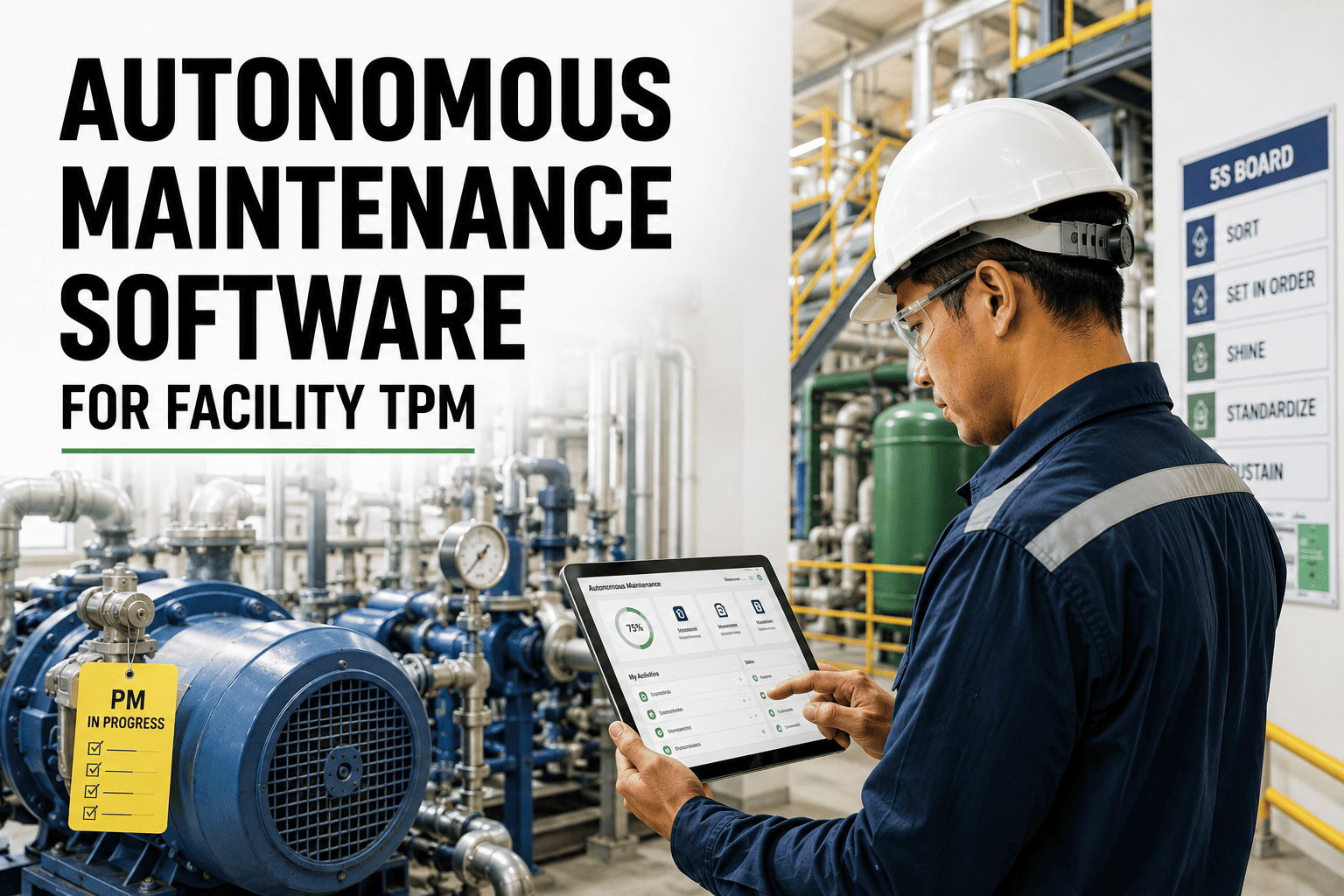
Most TPM programs collapse at exactly one point — the moment equipment ownership is supposed to move from the maintenance department to the operators running the machines every shift. Autonomous maintenance is the pillar that makes this transfer real, training operators to clean, inspect, lubricate, and flag abnormalities before they turn into breakdowns. Facilities that try to run this pillar on paper checklists or scattered spreadsheets lose the one thing that makes it work: a clear record of who inspected what, and what happened next. OxMaint's autonomous maintenance software puts structured digital checklists directly in operators' hands and turns every logged abnormality into a tracked work order automatically. See how facility teams are running operator-led TPM programs inside OxMaint.
Operators Are Your Earliest Warning System. Most Facilities Never Use Them That Way.
OxMaint's autonomous maintenance software gives operators structured inspection checklists on mobile, tags every abnormality the moment it's found, and routes it straight into your maintenance team's work order queue — no whiteboards, no lost defect tags.
Why Autonomous Maintenance Is the Pillar Where Most TPM Programs Actually Fail
Facility leaders rarely fail at writing an autonomous maintenance policy. They fail at sustaining it, because paper checklists get skipped under production pressure, verbal defect reports get lost at shift change, and nobody can see whether an inspection round actually happened this week or three weeks ago.
A CMMS built for this pillar closes that gap by making the checklist the only path to completing the shift task, and by turning every abnormality tag into a timestamped, assigned, trackable record automatically.
The 7 Steps of Autonomous Maintenance — Digitized Inside OxMaint
What Changes When Autonomous Maintenance Runs on a CMMS Instead of Paper
- Operators report faults only after production is already affected
- Equipment condition unknown between scheduled PM cycles
- Maintenance team stays reactive, buried in breakdowns
- Defect tags are verbal and get lost at shift change
- No visibility into who inspected what, or when
- Operators complete structured inspection rounds every shift
- Abnormalities are tagged and routed before they escalate
- Maintenance focuses on planned, complex repair work
- Every defect tag becomes a trackable, assigned work order
- Live compliance dashboards by asset, line, and crew
Give Every Operator a Checklist That Actually Prevents Downtime.
OxMaint turns shift-based inspections into a live early-warning system — tagged abnormalities, routed work orders, and compliance you can actually see.
What Facilities Report After Digitizing Autonomous Maintenance
Paper Checklists vs. a CMMS Built for Autonomous Maintenance
| Capability | Paper / Spreadsheet Process | OxMaint Autonomous Maintenance |
|---|---|---|
| Inspection completion | Self-reported, often skipped under pressure | Mandatory mobile checklist, timestamped |
| Abnormality tagging | Verbal or written note, frequently lost | Photo-tagged, auto-routed as a work order |
| Shift handover | Depends on memory and verbal handoff | Live log visible to the next shift instantly |
| Compliance visibility | No consolidated view for planners | Live dashboard by asset, line, and crew |
| Escalation of recurring issues | Each occurrence treated as new | Recurrence detected and auto-escalated |
Autonomous maintenance is the pillar every TPM consultant talks about and almost every plant under-delivers on, because it depends on a habit forming across hundreds of shifts, not a policy document. The facilities that get it right are the ones where the CMMS makes the checklist the path of least resistance for the operator, and makes every tag visible to a planner within minutes. That is what turns a training initiative into a daily discipline.
Autonomous Maintenance Software — Common Questions
Your Operators Already Notice the Warning Signs. Give Them a System That Captures Them.
OxMaint turns everyday operator inspections into a structured, trackable, plant-wide autonomous maintenance program — built into the CMMS your team already runs on.