Boiler failures are among the most catastrophic events in industrial and commercial facilities — ASME and the National Board of Boiler and Pressure Vessel Inspectors record hundreds of pressure vessel incidents annually, with improper maintenance as the leading root cause in over 60% of cases. Every commercial and industrial facility running steam systems operates under mandatory inspection intervals, licensed operator requirements, and documented maintenance obligations. OxMaint's preventive maintenance platform keeps your boiler programme on schedule, fully documented, and ready for statutory inspection without last-minute scrambles.
Equipment & Asset Management · Boiler Systems · Preventive Maintenance
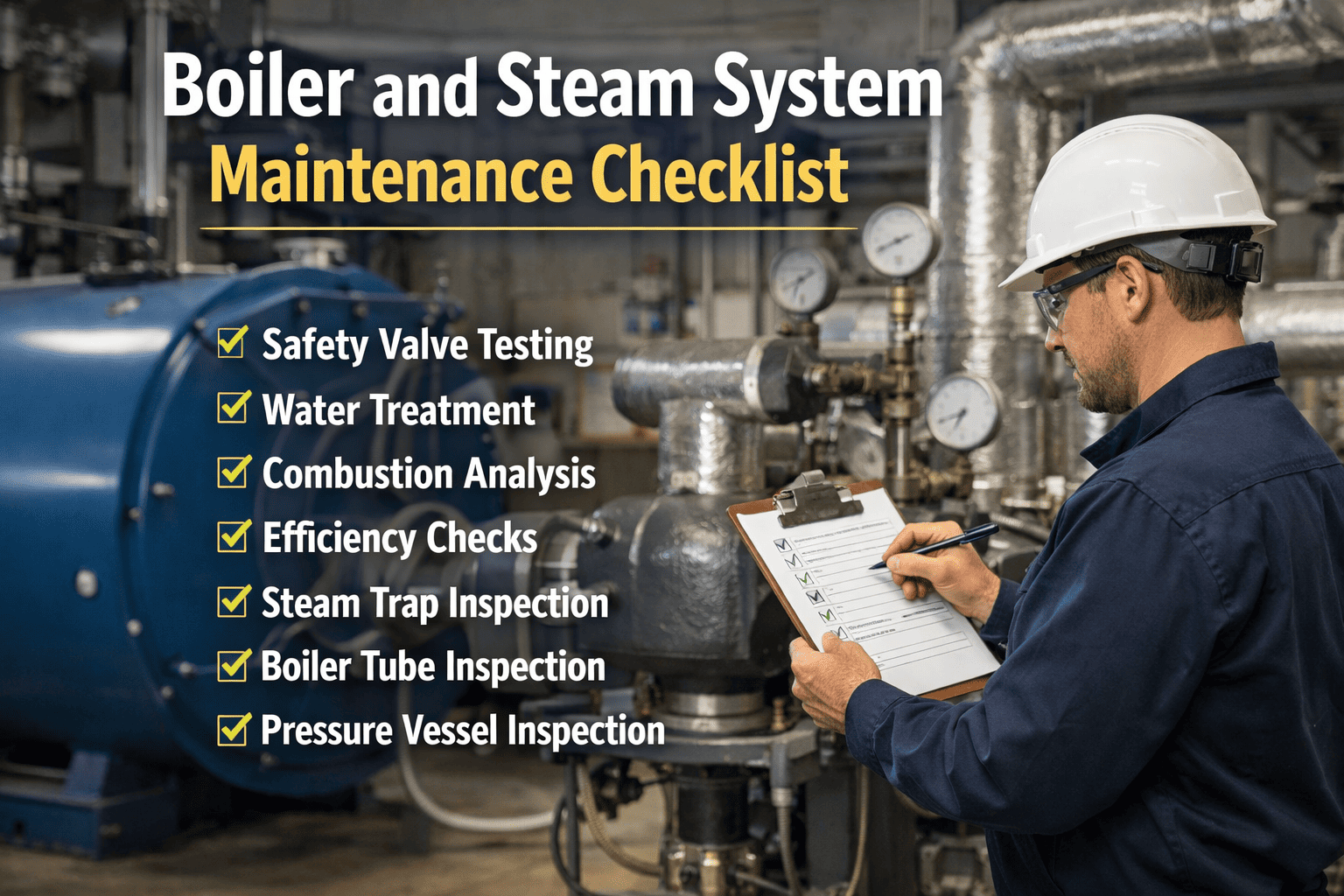
Boiler and Steam System Maintenance Checklist
Complete maintenance framework for commercial and industrial boilers — safety valve testing, water treatment, combustion analysis, steam trap inspection, and efficiency checks — with inspection intervals and compliance references.
60%+
Of boiler failures linked to inadequate maintenance per NBBI incident data
10–15%
Fuel efficiency loss from fouled heat transfer surfaces (ASHRAE data)
Annual
Statutory boiler inspection required in all Indian states under IBR 1950
30%
Of steam trap energy loss from failed traps in average industrial facility
Daily
Gauge readings, water level, blowdown
—
Weekly
Low-water cutoff test, burner visual, valve checks
—
Monthly
Water treatment analysis, combustion check, log review
—
Annual
Safety valve test, tube inspection, statutory certificate
Section 01 — Daily
Daily Operating Checks
Daily boiler checks are the first line of defence against catastrophic failure. Water level, pressure, and fuel system status must be verified at every shift start — and documented. Undocumented daily checks are treated as non-existent by inspectors and insurers.
Pressure & Water Level
Steam pressure gauge reading within normal operating range — record gauge reading at start of each shift; investigate any unexplained pressure deviation immediately
Role: Licensed Boiler Operator · Record: Shift operating log
Boiler water level at correct level in gauge glass — verify gauge glass is clear and reading is accurate; no clouding or blockage in glass
Role: Licensed Boiler Operator · Record: Shift operating log
Feedwater pump operating correctly — check pressure, flow, and listen for abnormal noise or cavitation; confirm makeup water supply uninterrupted
Role: Boiler Operator · Record: Equipment condition log
Blowdown & Venting
Bottom blowdown performed per facility schedule — typically once or twice daily depending on water quality; document time, duration, and operator
Role: Licensed Boiler Operator · Record: Blowdown log
Surface blowdown (skimming) performed — remove dissolved solids accumulating at water surface; adjust frequency based on conductivity readings
Role: Boiler Operator / Water Treatment Technician · Record: Blowdown and conductivity log
Fuel & Combustion
Burner flame character observed through inspection port — flame should be steady, well-defined, and correctly coloured for fuel type; yellow or wavering flames require immediate investigation
Role: Boiler Operator · Record: Burner condition log
Flue gas temperature at stack checked against baseline — rising stack temperature indicates fouled heat transfer surfaces; note deviation exceeding 50°F from baseline
Role: Boiler Operator · Record: Stack temperature log
Section 02 — Weekly
Weekly Safety & Control System Checks
Weekly boiler safety system testing is mandated under most state boiler codes and ASME CSD-1 (Controls and Safety Devices for Automatically Fired Boilers). Safety device failures go undetected for weeks in facilities that skip weekly function tests — until an incident exposes the gap.
Low-Water Cutoff (LWCO)
Low-water cutoff tested by slow-drain test — confirm burner shuts off at correct water level; record test result and water level at cutoff point
Standard: ASME CSD-1 · Role: Licensed Boiler Operator · Record: LWCO test log
LWCO body flushed to clear accumulated sediment — open drain cock, flush until discharge runs clear, verify float mechanism free-moving after flush
Role: Boiler Operator · Record: LWCO maintenance log
Pressure Controls & Burner
Operating pressure control and high-limit pressure control both tested — confirm operating control cycles burner correctly and high-limit shuts down at set point
Standard: ASME CSD-1 · Role: Licensed Boiler Operator · Record: Pressure control test log
Burner and flame safeguard system function verified — confirm ignition, pilot establishment, and main flame signal are within normal parameters on startup sequence
Role: Boiler Technician · Record: Burner start-up check log
Valves & Piping Visual
All steam and condensate piping visually inspected for leaks, unusual condensation, or insulation damage — mark and log any leaks for prompt repair
Role: Boiler Operator / Maintenance Lead · Record: Piping inspection log
All isolation valves in normal operating position — no unexplained closed valves in steam supply or condensate return lines
Role: Boiler Operator · Record: Valve position log
Boiler compliance gaps are invisible until an inspector or incident reveals them. OxMaint makes every check visible, documented, and on schedule.
Section 03 — Monthly
Monthly Water Treatment & Combustion Analysis
Boiler water quality directly determines equipment longevity. Scale deposits of just 1/16 inch reduce heat transfer efficiency by up to 12%, and corrosion from untreated water is responsible for 25% of all boiler tube failures. Monthly water analysis and combustion testing are the two highest-return maintenance tasks in any boiler programme.
Water Treatment
Boiler water sample collected and tested — pH, conductivity, hardness, alkalinity, dissolved oxygen, and treatment chemical concentrations all within target range
Role: Water Treatment Technician · Record: Monthly water analysis report
Feedwater sample tested — confirm softener is producing zero-hardness water; resins regenerated if softener performance has degraded
Role: Water Treatment Technician · Record: Feedwater quality log
Chemical treatment dosing pump output verified — confirm correct dose rate for current boiler load; adjust per water treatment programme specifications
Role: Water Treatment Technician · Record: Chemical dosing log
Combustion Analysis
Flue gas analysis performed with calibrated analyser — record O2, CO2, CO, and excess air percentage; compare against commissioning baseline and manufacturer specification
Role: Boiler Technician / Service Engineer · Record: Combustion analysis report
Combustion efficiency calculated and recorded — deviation of more than 3 percentage points from baseline triggers burner adjustment or service call
Role: Boiler Service Engineer · Record: Efficiency trend log
Section 04 — Annual
Annual Safety Valve Testing & Internal Inspection
Safety Valve (Relief Valve) Testing
Safety valve manually tested by lifting lever — confirm valve lifts freely and reseats completely without leakage after release; do not test on cold boiler
Standard: ASME Section I / IBR 1950 · Role: Licensed Boiler Operator · Record: Safety valve test log
Safety valve pop-test by qualified inspector — verify valve lifts at or below stamped set pressure; reseat and seal tight; any valve failing pop-test replaced immediately before return to service
Standard: ASME Section I · Role: Authorized Inspector · Record: Safety valve test certificate
Internal Inspection & Statutory Compliance
Annual internal boiler inspection completed by IBR-authorised Inspector (India) or Jurisdictional Inspector (ASME) — access all manholes, handholes, and inspection ports; document tube condition, scale deposits, and corrosion
Standard: IBR 1950 (India) / ASME · Role: Authorized Inspector · Record: Annual inspection certificate
Boiler tubes visually inspected and thickness tested at identified corrosion-prone locations — any tube below minimum wall thickness requires immediate repair before return to service
Role: Inspector / NDT Technician · Record: Tube inspection report with thickness readings
Refractory and insulation inspected during annual shutdown — cracks, spalling, or hot spots documented; repair completed before boiler returned to service
Role: Boiler Technician · Record: Refractory inspection report
Steam Trap Survey
All steam traps tested by ultrasonic or infrared thermography — identify failed-open (continuous steam loss) and failed-closed (waterlogged system) traps; 30% of traps in average facility fail annually
Role: Steam System Technician · Record: Annual steam trap survey report
Failed traps replaced and system re-tested — calculate energy savings from trap repair programme and document for management reporting
Role: Maintenance Team · Record: Steam trap replacement and savings report
Performance Reference
Boiler Efficiency & Maintenance Impact Data
| Maintenance Area |
Failure Effect |
Efficiency / Cost Impact |
Maintenance Interval |
| Heat Transfer Surface Fouling |
Reduced heat transfer, elevated stack temp |
10–15% fuel loss |
Annual cleaning |
| Scale (1/16 inch) |
Overheating, tube failure |
12% efficiency reduction |
Monthly water treatment |
| Failed Steam Traps |
Live steam loss or waterlogged system |
Up to 30% steam loss |
Annual trap survey |
| Poor Combustion Tune |
Excess air, high CO, soot |
3–8% fuel waste |
Monthly combustion analysis |
| Safety Valve Not Tested |
Valve may not open or may fail to reseat |
Catastrophic risk — zero tolerance |
Annual (mandatory) |
| LWCO Not Tested |
Boiler may fire on low water |
Catastrophic risk — zero tolerance |
Weekly (mandatory) |
Expert Review
What Boiler & Steam System Specialists Say
01
The LWCO weekly test is non-negotiable. I have seen boiler rooms where the cutoff had not been tested in six months because it was not on a formal schedule. When I did the slow-drain test, the float had seized — the boiler would have fired on low water without anyone knowing. Weekly testing, logged with operator name and time, is the minimum acceptable standard.
Authorised Boiler Inspector, IBR-licensed, 22 years field experience
02
Water treatment is the most neglected and most impactful part of any boiler programme. Facilities that test their boiler water monthly and maintain treatment within specification consistently get 20 to 25 more years of service life from their equipment than those that treat it as an afterthought. The chemistry is not complicated — the discipline to test and document it consistently is the hard part.
Chief Water Treatment Engineer, Industrial Boiler Services Group
03
We moved our entire boiler maintenance programme to OxMaint 18 months ago. The daily log is now completed on a mobile device by the shift operator, monthly water treatment results upload directly from the lab, and the annual inspection schedule is built-in with automatic reminders. Our last IBR inspection took 40 minutes — the inspector reviewed the digital log and said it was the most organised boiler room he had inspected that year.
Plant Engineering Manager, Textile Processing Facility, Ahmedabad
FAQs
Frequently Asked Questions
How often must boilers be inspected under Indian regulations?
Under the Indian Boiler Regulations 1950 (IBR), every boiler must undergo an annual statutory inspection by an IBR-authorised Inspector. The inspection covers internal condition, safety valve function, pressure gauge accuracy, and overall fitness-for-service. A valid IBR certificate of inspection must be maintained at the boiler location at all times and presented on demand to factory inspectors or state boiler authorities.
OxMaint tracks certificate expiry and generates reminders 60, 30, and 7 days before the renewal deadline so your statutory certificate never lapses.
What is the correct procedure for testing a boiler safety valve?
Safety valves should be manually tested by lifting the test lever when the boiler is at normal operating pressure — never on a cold or low-pressure boiler. The valve must lift freely and reseat completely without leaking after the lever is released. An annual pop-test by a qualified inspector verifies that the valve opens at or below its stamped set pressure. Any safety valve that fails to lift, does not reseat, or leaks after the test must be replaced before the boiler is returned to service.
Book a demo to see how OxMaint tracks safety valve test intervals and certification status.
Why is steam trap maintenance so important and how often should traps be surveyed?
A failed-open steam trap passes live steam directly to the condensate return line — wasting energy continuously and invisibly. Industry surveys consistently find that 15 to 30% of steam traps in an average facility are in a failed state at any given time. An annual comprehensive trap survey using ultrasonic testing or infrared thermography identifies failed traps, and prompt replacement delivers energy savings that typically pay back the survey cost within 6 months. High-pressure or critical systems benefit from bi-annual surveys.
See how OxMaint schedules and records steam trap surveys.
What boiler water quality parameters should be tested monthly?
A complete monthly boiler water test should cover pH (target: 8.5–10.5 for low-pressure steam), total dissolved solids or conductivity, total alkalinity, hardness (should be zero — any hardness indicates softener failure), dissolved oxygen, and chemical treatment residuals (sulphite or DEHA for oxygen scavenging). Feedwater should also be tested for hardness and pH at the same interval. Results should be compared against the water treatment programme's target ranges and documented by a qualified water treatment technician.
Book a demo to see how OxMaint digitises your boiler water treatment logs.
Keep Your Boiler Programme Compliant, Efficient, and Audit-Ready
OxMaint schedules daily checks, weekly safety tests, monthly water analysis, and annual inspection reminders automatically — with digital logs, photo evidence, and compliance reports your IBR inspector or ASME auditor can review in minutes.