The building envelope is the largest single asset in any commercial real estate portfolio — and the one most commonly managed without a defined lifecycle programme. Facades, glazing, roofing, and below-grade waterproofing collectively represent 15–25% of total construction value. Yet most facilities teams manage envelope condition reactively: a tenant calls about a leak, a facilities manager books a contractor, the contractor patches the visible symptom, and the underlying moisture infiltration continues behind the cladding until it reaches structural framing or insulation. By that point, a $2,000 sealant repair has become a $150,000 remediation. OxMaint’s Asset Lifecycle Management platform structures building envelope PM into documented inspection cycles, condition ratings, and defect-triggered work orders — connecting envelope inspections to the asset record that tracks cumulative deterioration, repair history, and remaining service life across every facade zone and system.
Equipment & Asset Management · Facade & Envelope · Lifecycle Management
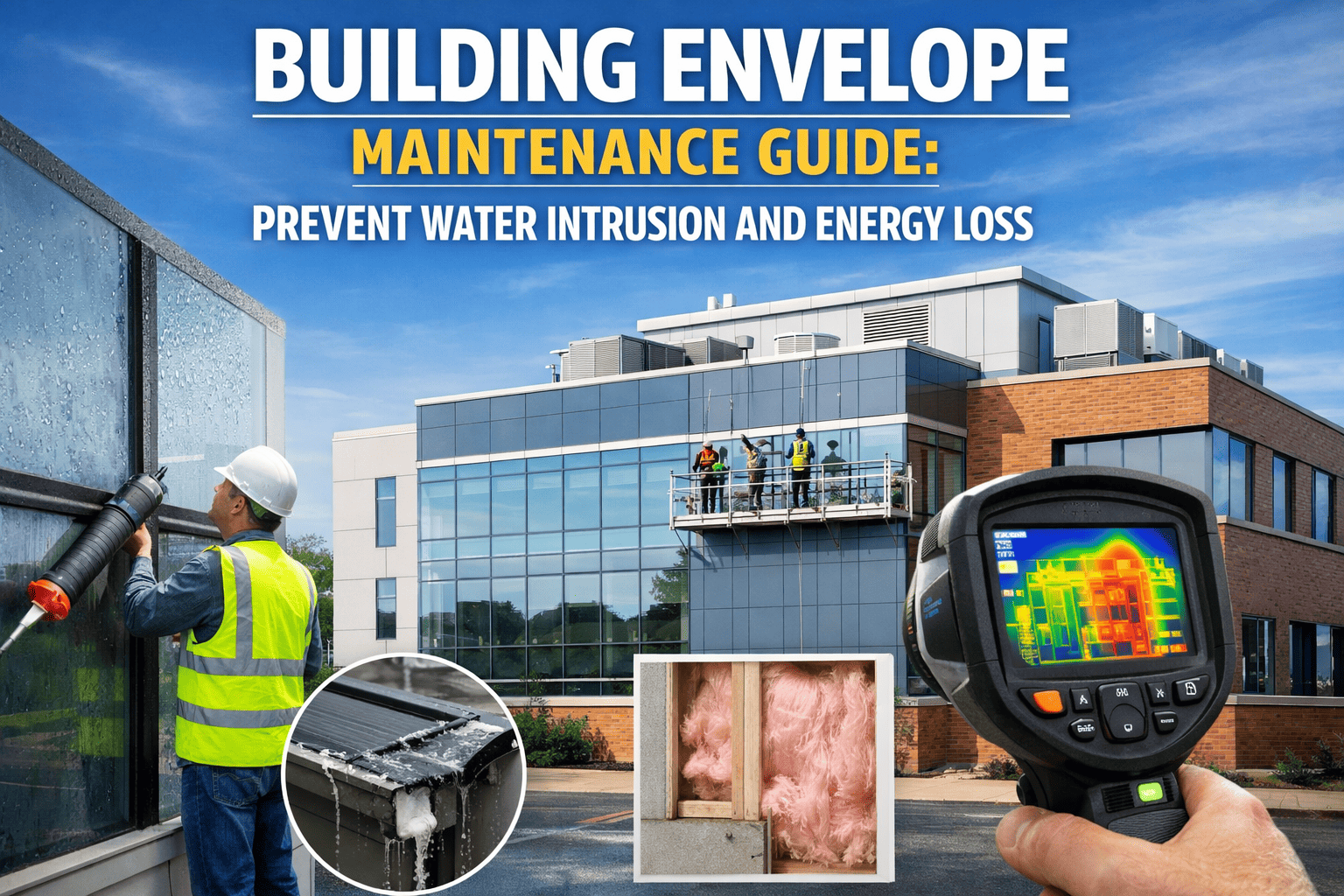
Building Envelope Maintenance Guide: Prevent Water Intrusion and Energy Loss
Sealant joints, glazing systems, curtain walls, cladding, roofing, and below-grade waterproofing — complete maintenance strategy for commercial building envelopes. Structured for facilities managers, property owners, and envelope consultants managing long-term facade performance.
90%
of building envelope failures involve water intrusion — the primary cause of structural damage, mould, and energy loss in commercial buildings
15–25%
of total construction value represented by the building envelope — the largest single asset class in most portfolios
10–25yr
Typical sealant service life — without an inspection programme, failure goes undetected until water damage is visible inside
40%
of commercial building energy loss attributable to the building envelope — thermal bridging, air leakage, and degraded glazing
Why Reactive Envelope Management Fails
The Four Failure Mechanisms That Proactive Maintenance Prevents
Reactive envelope management does not just cost more than proactive management — it causes failures that proactive inspection would have caught years earlier. Each of the four mechanisms below operates silently, without interior symptoms, until the damage has compounded to the point where remediation is significantly more expensive than the original maintenance would have been.
01
Sealant Joint Failure
Silicone and polyurethane sealants at facade joints, window perimeters, and penetrations lose adhesion, develop cohesive splitting, or UV-degrade in 10–25 years. Failed sealant is invisible from inside. By the time water staining appears at an interior ceiling or wall, the moisture path has typically been active for months and insulation is already saturated.
02
Glazing System Degradation
Curtain wall and storefront glazing systems rely on gaskets, pressure plates, and structural silicone bonds that degrade with UV exposure and thermal cycling. Failed glazing seals allow air and water infiltration at the glass-to-frame interface; broken IGU seals produce condensation between panes, reducing thermal performance and indicating failed perimeter sealing.
03
Cladding System Failure
Metal cladding, EIFS, stone, and precast panel systems rely on concealed flashings, drainage planes, and anchors that are inaccessible once installed. Anchor corrosion, flashing failure, and drainage blockage each produce moisture intrusion into the wall cavity — invisible until internal damage is significant. Movement joints that have closed from thermal cycling create cracking in adjacent panels before any interior symptom appears.
04
Thermal & Air Barrier Degradation
Building envelope air barriers and continuous insulation systems deteriorate at penetration points, transitions, and corners where installation quality is most variable. A 1% increase in building air leakage can increase HVAC energy consumption by 5–10%. Thermal bridges at cladding anchors, window frames, and structural connections create cold-surface condensation risk that accelerates moisture damage independent of weather-driven infiltration.
Inspection Frequency by System
Building Envelope Inspection Programme: Frequency & Scope by System
Envelope inspection frequency must be calibrated to system age, exposure severity, and consequence of failure. The table below provides the industry-standard inspection framework for each envelope system type, aligned with ASTM E2128 (standard guide for evaluating water leakage of building walls) and general facilities management practice.
| Envelope System |
Annual Inspection |
Periodic Deep Inspection |
Trigger for Unscheduled Inspection |
OxMaint Scheduling |
| Sealant joints (facade & glazing) |
Visual survey — all accessible joints |
Full probe inspection every 5–7 years |
Any interior water intrusion report |
Annual PM work order per facade zone; sealant age tracked per joint batch |
| Curtain wall & storefront glazing |
Visual inspection — gaskets, condensation, drainage |
Full system inspection every 3–5 years with probes |
IGU fogging, cracked glass, loose pressure plates |
Annual glazing inspection work order; failed IGU count tracked per elevation |
| Metal cladding & rain screen panels |
Visual panel condition and fastener inspection |
Anchor and flashing inspection every 5 years |
Panel movement, corrosion staining, water at base of system |
Annual inspection per elevation; anchor inspection work order at 5-year trigger |
| EIFS / stucco cladding |
Probe testing of suspect areas; visual crack survey |
Full moisture survey (IR thermography) every 3 years |
Any crack wider than 1/16”, delamination, or staining |
Annual probe inspection work order; IR thermography linked to 3-year cycle |
| Masonry & stone facades |
Mortar joint and surface condition survey |
Anchor and tie inspection every 5–10 years |
Spalling, efflorescence, displaced units, or crack widening |
Annual masonry survey; anchor inspection scheduled from original installation date |
| Flat / low-slope roofing |
Biannual (spring + fall) surface inspection |
Full membrane condition report every 3 years |
Any interior leak, drain blockage, or storm event |
Biannual roof PM work order; storm event inspection auto-triggered |
| Below-grade waterproofing |
Annual sump, drain, and crack inspection |
Full system review every 5–10 years |
Any evidence of seepage, efflorescence, or crack growth |
Annual below-grade inspection; crack measurement recorded for trend comparison |
Inspection Protocol
What a Structured Envelope Inspection Covers
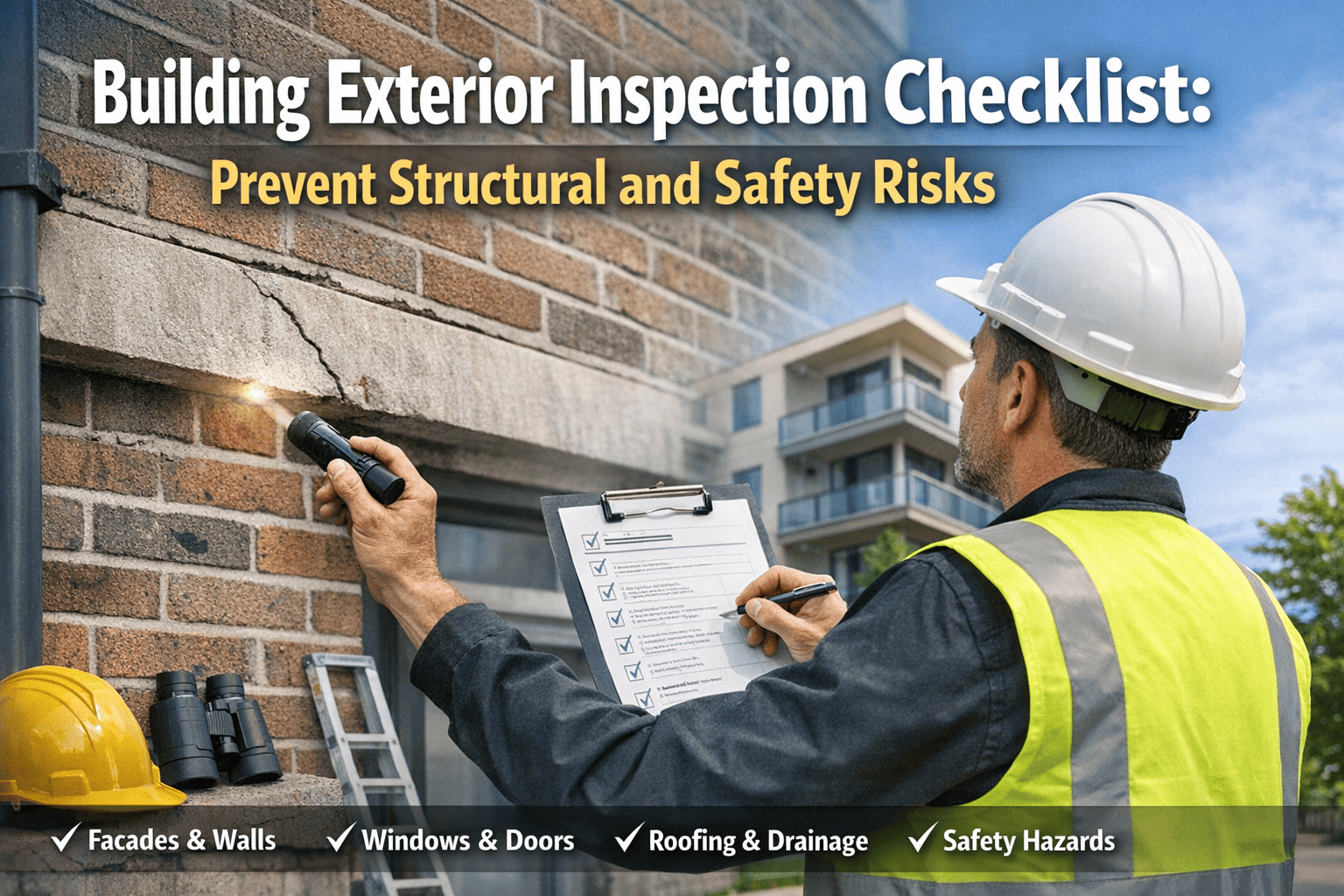
An envelope inspection that produces a defensible condition record — one that supports repair prioritisation, budget forecasting, and warranty or litigation evidence — requires consistent methodology, zone-by-zone documentation, and a condition rating system that enables comparison across inspection cycles. The five elements below define the minimum standard for a structured envelope inspection.
01
Zone-Based Condition Rating
Divide the envelope into elevation zones and sub-zones. Assign a condition rating (Good / Fair / Poor / Critical) to each zone for each system — sealants, glazing, cladding, and flashings rated independently. Condition ratings must be assigned consistently using the same criteria at every inspection cycle so deterioration trends are visible across years, not just within a single inspection.
02
Photographic Documentation
Every defect must be documented with a photograph tagged to the zone location and GPS coordinates where possible. Reference photographs taken at the same location on each inspection cycle allow visual comparison of deterioration rates. A written defect description without a photograph provides less than half the evidentiary value for repair contractor scoping and insurance documentation.
03
Defect Classification & Prioritisation
Every identified defect classified by: type (sealant failure, crack, anchor corrosion, delamination), severity (aesthetic, functional, structural), and urgency (immediate — safety or active water penetration; near-term — deteriorating but not yet causing damage; routine — schedule with next planned cycle). Only classified defects can be effectively prioritised for repair budgets.
04
Repair Cost Estimation by Priority
Each defect classified as immediate or near-term should carry a repair cost estimate or at minimum a cost range, enabling the facilities team to build a defensible capital maintenance budget. Without cost estimates linked to condition ratings, envelope maintenance remains un-budgetable and the default response to any defect is deferral — until a defect becomes an emergency.
05
Service Life Tracking per System
Record the installation date and expected service life of every envelope system and component: original sealant installation date, glazing gasket replacement date, cladding installation year, roofing membrane installation and warranty dates. As components approach end of design life, the inspection frequency should increase and capital replacement should enter the 3–5 year forecast budget.
Connect Every Facade Defect to a Work Order. Track Every System’s Service Life.
OxMaint’s Asset Lifecycle Management platform registers every envelope system as an asset with installation date, design life, inspection schedule, and repair history — turning point-in-time inspections into a continuous condition record that drives budget forecasting and capital planning.
Water Intrusion Investigation
Identifying & Eliminating Water Intrusion Paths
Water intrusion investigation is one of the most technically demanding aspects of building envelope maintenance because the entry point and the interior symptom are frequently in different locations. Water follows the path of least resistance — entering at a failed sealant joint on the fifth floor and appearing at a second-floor ceiling, travelling laterally 15 feet from a window frame leak before emerging at a column base. Systematic investigation methodology is required to identify the actual entry point, not just the symptom location.
| Investigation Tool |
What It Detects |
Application |
Typical Cost Range |
| Visual inspection + probe testing |
Sealant adhesion failure, joint cracking, cladding gaps |
First-line investigation for all facade systems |
$500–$3,000 per elevation survey |
| ASTM E1105 water test (controlled spray) |
Active entry points on glazing, sealant joints, transitions |
Targeted testing after visual inspection identifies suspect areas |
$1,500–$6,000 per test area |
| Infrared thermography (IR) |
Moisture-laden insulation, thermal bridges, air leakage |
EIFS, flat roofing, and cavity wall systems; requires temperature differential >10°F |
$2,000–$8,000 per building |
| Blower door / air barrier test (ASTM E779) |
Overall air leakage rate and primary leakage zones |
New construction commissioning and existing building envelope upgrades |
$3,000–$12,000 per building |
| Moisture meter / pin probing |
Moisture content in substrate (gypsum, wood, concrete masonry) |
Confirming moisture intrusion extent; mapping wet zone boundaries for remediation |
Included in inspection cost |
| Drone / rope-access visual survey |
High-level facade conditions not accessible from ground |
High-rise facades, curtain wall systems, roofing above access-limited areas |
$3,000–$20,000 depending on height |
Lifecycle Management
Envelope System Service Life & Replacement Forecast
Lifecycle management of the building envelope requires treating each system as a depreciating asset with a defined service life, not as a passive building component. The table below provides reference service life ranges for common envelope systems. Actual service life depends heavily on original installation quality, exposure severity, and maintenance history.
| System / Component |
Design Service Life |
End-of-Life Indicators |
Budget Category |
OxMaint Lifecycle Trigger |
| Facade sealant joints |
10–25 years (silicone: up to 25; polyurethane: 10–15) |
Cohesive splitting, adhesion loss, UV chalking, joint movement cracking |
Cyclical maintenance |
Sealant age flag at 15 years; replacement forecast at 20 |
| Curtain wall glazing gaskets |
15–20 years |
Compression set, cracking, hardening, loss of contact at glass edge |
Planned maintenance |
Gasket installation date tracked; inspection frequency increases at year 12 |
| Insulating glazing units (IGUs) |
20–30 years |
Seal failure (fogging between panes), edge seal delamination |
Capital replacement |
Failed IGU count tracked per elevation; replacement trigger at 5% of units failed |
| TPO / EPDM flat roofing membrane |
20–30 years |
Surface erosion, shrinkage, seam failure, ponding areas |
Capital replacement |
Installation date and warranty expiry tracked; biannual inspection mandatory from year 15 |
| EIFS cladding system |
20–30 years (with maintenance) |
Mesh exposure, delamination from substrate, moisture in cavity |
Planned maintenance + capital |
Annual probe inspection; moisture survey triggered from year 10 |
| Below-grade waterproofing membrane |
25–50 years (type-dependent) |
Active seepage, crack propagation, drain blockage, efflorescence |
Capital (extremely difficult to replace) |
Annual inspection; crack measurements recorded for growth rate trending |
| Stone / masonry anchors & ties |
40–75 years (stainless) / 20–40 years (galvanised) |
Corrosion staining, spalling from anchor, panel movement |
Capital (safety-critical) |
Anchor material type recorded; inspection interval set by anchor type and exposure |
Expert Perspective
What Building Envelope Consultants Say
★★★★★
The single question that determines whether a building owner is managing their envelope or being managed by it is: do you know the installation date of your facade sealant joints? If you don’t, you cannot know how far you are through the sealant service life, you cannot plan a replacement budget, and you will inevitably discover the answer when water appears inside a tenant space during a storm event. The installation date is the starting point of every lifecycle management programme. It belongs in the asset record from the day of installation, not in a contractor file that nobody can find fifteen years later.
GS
Dr. Georg Sattler, PE, RIBA
Principal Facade Consultant — 28 Years High-Rise Envelope Commissioning & Investigation
★★★★★
EIFS moisture investigations consistently reveal the same pattern: the moisture has been present for 3–7 years before it becomes visible on the interior. In every case, the building had a maintenance programme that covered mechanical, electrical, and plumbing systems on documented cycles — but the facade received attention only when a leak was reported. The cost of the moisture remediation, insulation replacement, and framing treatment was 40 to 80 times what an annual probe-and-patch programme would have cost over the same period. The irony is that the building’s PM budget was completely absorbed by M&E maintenance while the most expensive failure was developing in the walls.
RM
Rachel M., Assoc. AIA, CDT
Building Envelope Consultant — Specialty in EIFS & Stucco Failure Investigation · 19 Years
★★★★☆
The energy impact of a deteriorated building envelope is consistently underestimated in facilities management budgets because it is invisible — it shows up as a higher utility bill, not as a maintenance line item. A 10-year-old curtain wall with failed gaskets and compressed perimeter sealant can be responsible for 15–25% of a building’s heating energy loss in winter climates. Resealing the curtain wall perimeter and replacing failed gaskets typically costs $15–$30 per linear foot — a fraction of the annual utility premium the building is paying for the air leakage the failed seals are causing.
TK
Thomas K., PE, LEED AP BD+C
Energy & Envelope Engineer — Building Performance Consulting · 22 Years
Frequently Asked Questions
Building Envelope Maintenance — Common Questions
How do I know when building facade sealant needs replacement rather than repair?
Spot repair of sealant is appropriate when failure is isolated to specific joints and the adjacent sealant is intact with good adhesion and flexibility. Full replacement is warranted when: the sealant system is approaching or past its design service life (15–20 years for silicone, 10–15 for polyurethane); when probe testing reveals widespread adhesion loss on multiple elevations; or when the building has experienced significant water intrusion events that indicate systemic sealant failure. A sealant system that requires spot repairs on more than 20–25% of its joints in a single inspection cycle is typically more economical to replace entirely than to maintain through continuous patching.
OxMaint’s asset lifecycle tracking records sealant installation date and cumulative repair history to support this decision.
What is the difference between a facade inspection and a building envelope assessment?
A facade inspection is a visual survey of the exterior surface conditions — typically conducted from ground level, swing stage, or drone — to identify visible defects such as cracking, staining, failed sealants, and displaced cladding. A building envelope assessment is a comprehensive evaluation that includes the facade inspection plus: water testing of identified defect areas (ASTM E1105), moisture content measurements, review of as-built drawings, analysis of historical leak reports and repair records, and a lifecycle cost projection for each envelope system. Envelope assessments are typically performed every 5–10 years and provide the technical basis for the capital maintenance plan; annual facade inspections maintain the condition record between assessments.
Book a demo to see how OxMaint structures both inspection types as separate PM work order templates.
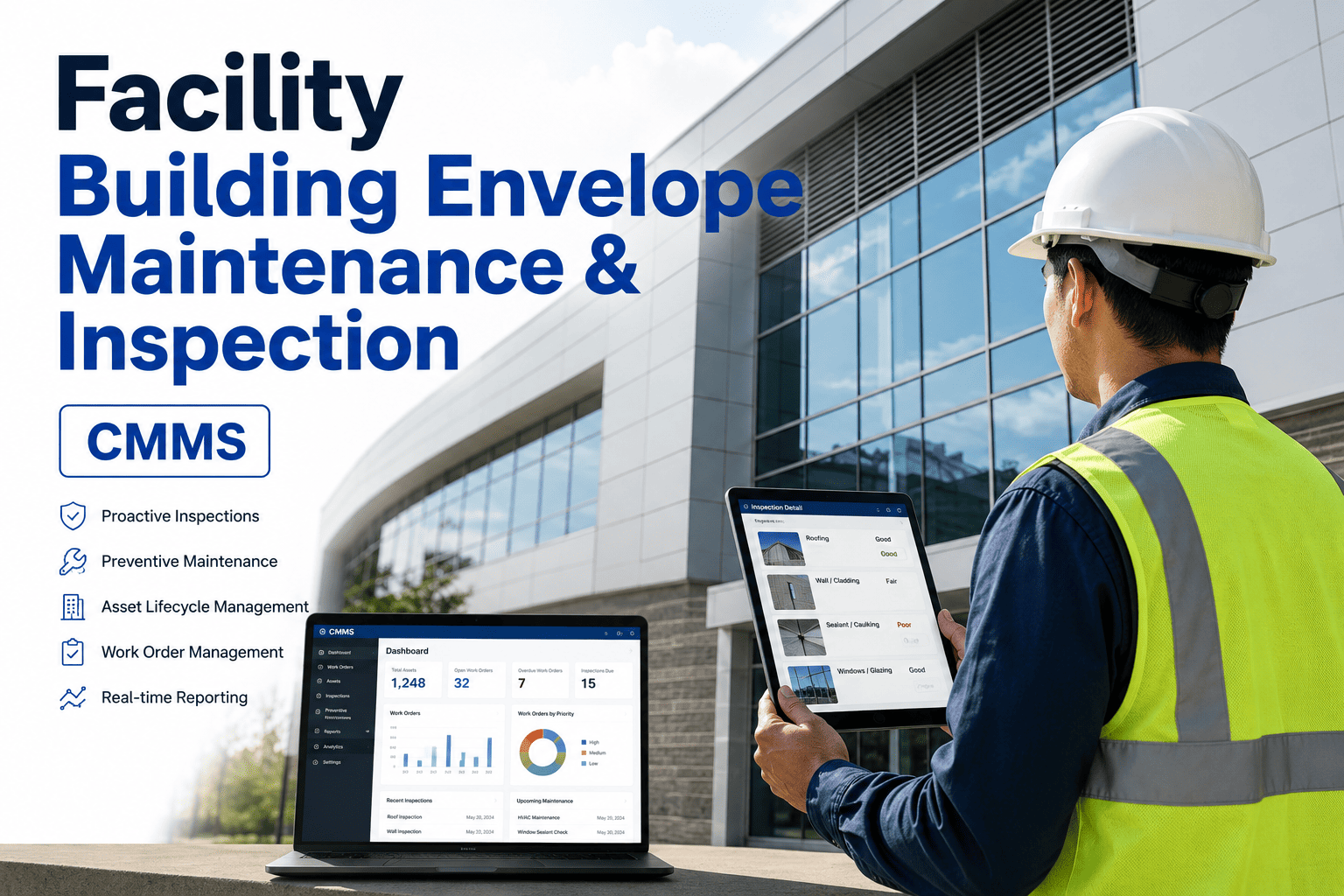
How does OxMaint support building envelope lifecycle management differently from a standard CMMS?
OxMaint registers each envelope system — each elevation zone of sealant, each curtain wall section, each roof area — as an individual asset with installation date, design service life, inspection schedule, and repair history. This allows the system to calculate remaining service life, generate inspection work orders at the correct interval for each system’s age, and build a 5–10 year capital replacement forecast from the actual condition data rather than from generic industry averages. Defects found during inspection generate child work orders with priority classification, estimated repair cost, and follow-up inspection date — creating the continuous condition record that supports defensible maintenance budgets and owner reporting.
Should building envelope inspections be conducted by in-house facilities staff or specialist consultants?
Annual visual inspections and routine defect documentation are appropriate for trained facilities staff using a structured checklist and digital recording tool. Periodic deep inspections — probe testing, water testing, thermographic surveys, and anchor inspections on high-rise facades — require registered architects, professional engineers, or building envelope consultants with specific training and access equipment. For buildings above 6 storeys, the periodic envelope assessment should always be conducted by a qualified consultant. In-house staff handle the annual cycle; specialist consultants conduct the comprehensive assessment and interpret the findings. The combination produces more reliable lifecycle data than either approach alone.
Asset Lifecycle Management · OxMaint · Building Envelope
Your Building Envelope Is Depreciating. Manage It Like the Asset It Is.
OxMaint’s Asset Lifecycle Management platform tracks every envelope system from installation date to end-of-life, schedules annual and periodic inspections per system type and age, documents defects with photos and condition ratings, generates repair work orders with priority classification, and builds the 5–10 year capital replacement forecast your ownership and finance teams need to plan intelligently rather than react expensively.


.jpeg)