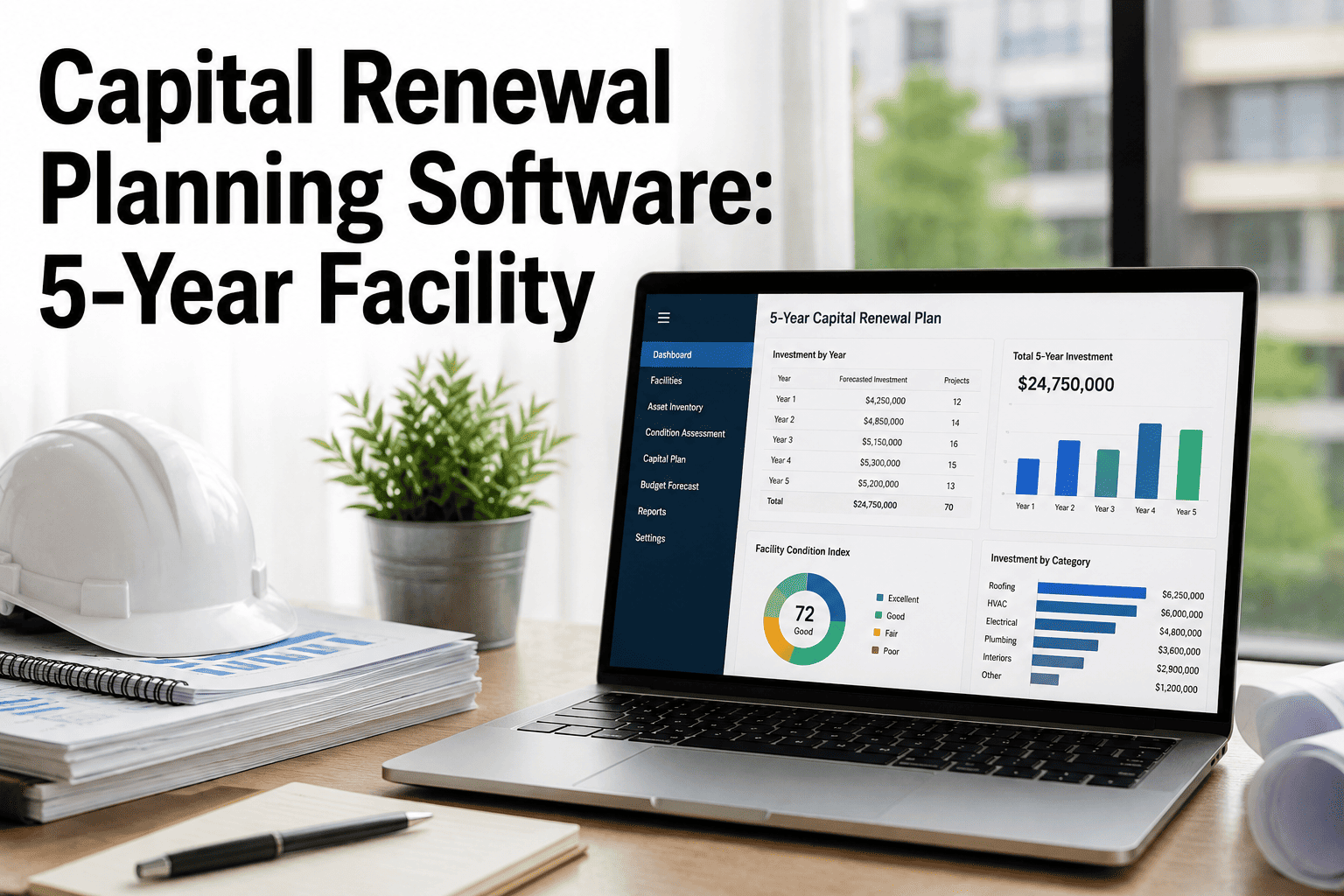
Every facility eventually faces the same reckoning: roofs, chillers, and electrical gear all aging toward replacement at once, with a finance team asking for a defensible five-year number instead of a gut feeling. Most facility teams still build that number in a spreadsheet that goes stale the moment a new work order closes, which is exactly why capital requests get rejected far more often than they get approved. A capital renewal plan built on live Facility Condition Index data, not an annual consultant snapshot, turns "we think we need a new roof" into a dated, costed, board-ready line item. See how a CMMS-driven five-year plan looks for your own portfolio — Start Free Trial and import your first asset list today.
Is your five-year capital plan a forecast, or a guess dressed up in a spreadsheet?
Facility Condition Index data, refreshed with every closed work order, replaces the once-a-year consultant audit with a living capital renewal plan finance teams can actually approve.
The Facility Condition Index, in four bands you can act on
FCI is the ratio of deferred maintenance cost to current replacement value. Where your buildings sit on this scale decides whether you're planning renewal or absorbing emergency cost.
Facility is well maintained. Reserve contributions on schedule are enough to hold this band.
Backlog is building. A five-year renewal plan should already be prioritizing the worst systems.
Deferred maintenance is now a capital problem, not a maintenance one. Budget cycles need reprioritizing.
Replacement is frequently cheaper than continued repair. Emergency spend is now the default, not the exception.
What a stale capital plan actually costs
A plan rebuilt once a year, off a spreadsheet, drifts further from reality with every quarter that passes.
| Planning Approach | Refresh Cycle | Data Source | Board Approval Odds |
|---|---|---|---|
| Spreadsheet + annual audit | Once a year | Consultant walkthrough, static | Roughly 1 in 2 |
| CMMS-linked FCI tracking | Continuous | Live work order and asset data | Roughly 9 in 10 |
| No condition data at all | Reactive only | Whichever system fails first | Lowest of the three |
From asset list to five-year forecast in four steps
Import the asset register
Bring in every major system with install date, expected service life, and current condition score.
Score condition continuously
Inspections and work orders update condition automatically instead of waiting for the next audit cycle.
Forecast by asset class
Roll condition and replacement cost into a rolling five to ten year capital forecast, updated as data changes.
Present a defensible number
Export an audit-ready capital plan with FCI trend lines finance and leadership can actually approve.
What actually belongs in a five-year renewal plan
A capital plan is only as strong as the data feeding it. These are the components finance teams expect to see before they approve a number.
Full asset inventory
Every major system logged with install date, expected service life, and current replacement cost.
Condition scoring by system
HVAC, roofing, electrical, and envelope scored independently, since they age at different rates.
Risk-weighted priority order
Systems ranked by failure consequence, not just age, so critical infrastructure gets funded first.
Year-by-year funding schedule
Spend spread across the forecast window instead of arriving as one unmanageable spike.
Reserve fund alignment
Planned contributions checked against forecasted need, so reserves don't quietly fall behind.
Trend line, not a snapshot
FCI shown as a moving trend across quarters, proving the plan is tracked, not assembled once.
Where capital renewal plans usually go wrong
Replacement value left stale
Construction costs move every year. A CRV figure carried forward unchanged quietly distorts every FCI calculation built on top of it.
Deficiencies under-counted
Skipping minor findings during an assessment produces an FCI that looks better than the building actually is.
Plan treated as a one-time report
A PDF filed away after the audit stops reflecting reality the moment the next work order closes.
Turn your next capital request into an easy approval
Build a living, FCI-backed five-year renewal plan directly from your maintenance data — no annual consultant engagement required.
Questions facility and finance teams ask together
What is a good Facility Condition Index score?
Most industry benchmarks treat an FCI under 10% as good to fair condition, with anything above 30% considered critical, where replacement often beats continued repair. See how your own portfolio scores — Start Free Trial.
How often should a capital renewal plan be updated?
Continuously is ideal. A plan tied to live work order and inspection data reflects real conditions every day, instead of drifting out of date the moment a static annual audit is filed away.
Why do capital requests get rejected without FCI data?
Boards and finance teams need a defensible, dated number tied to condition and replacement cost. Without it, a request reads as an opinion rather than a forecast, and gets deferred to the next cycle.
Can a CMMS replace a formal building condition assessment?
A CMMS keeps FCI current between formal assessments by scoring condition from every inspection and work order, so the periodic assessment starts from real data instead of a blank slate.
How long does it take to stand up a capital renewal plan?
Most facility teams get a working first version running in four to six weeks once assets are imported and condition scoring begins. Talk through your timeline — Book a Demo.
Stop rebuilding your capital plan from scratch every year
Get a living, FCI-driven five-year renewal forecast built directly from your maintenance data.
Free 14-day trial · No credit card