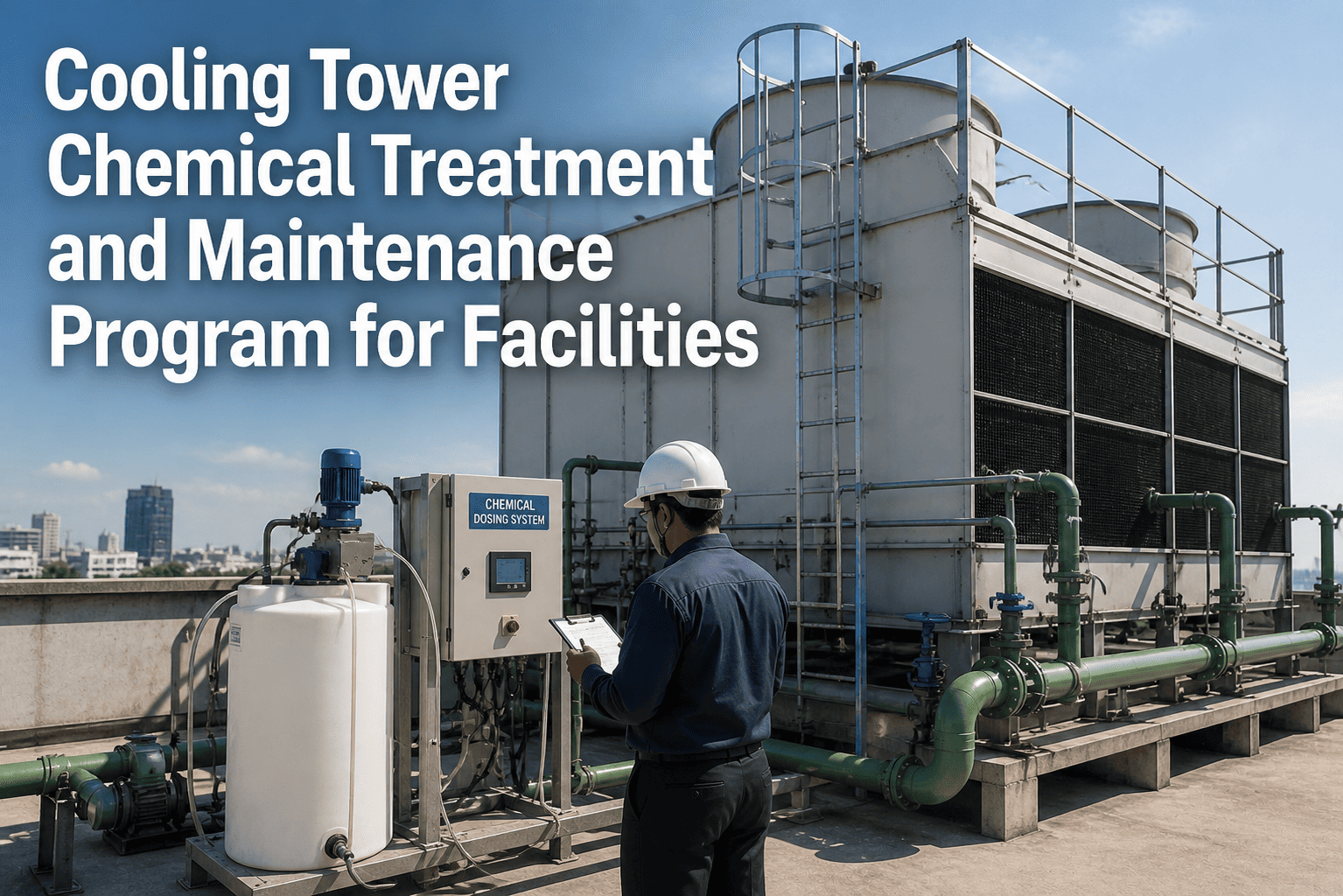
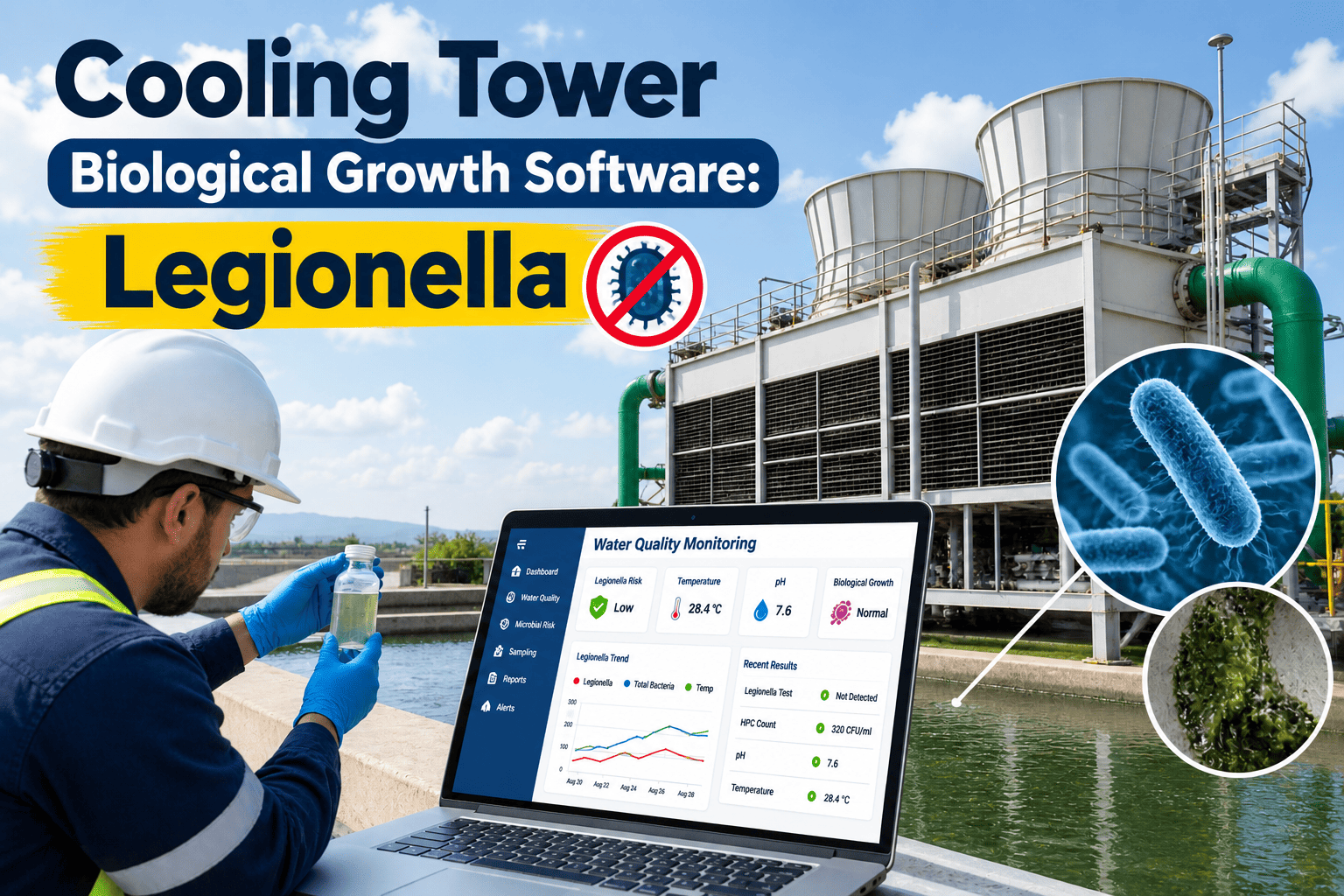
Cooling Tower Chemical Treatment and Maintenance Program for Facilities
By Lewis Abbott on May 3, 2026
A cooling tower that is running but not properly maintained is not a working asset — it is a liability accumulating scale, biofilm, and Legionella risk with every hour of operation. Cooling towers are among the most water-intensive and biologically active systems in a commercial facility, and they are uniquely capable of causing catastrophic consequences — from chiller failure due to fouled heat exchange surfaces, to Legionnaires' disease outbreaks that result in fatalities, regulatory enforcement, and litigation that can end careers and organizations. A properly structured cooling tower water treatment and preventive maintenance program eliminates Legionella risk, extends equipment life by seven to twelve years, reduces chiller energy consumption by 15 to 25%, and provides the documented compliance trail that health authorities and insurance carriers increasingly demand as a condition of occupancy. Start a free OxMaint trial to schedule and track your tower maintenance program, or book a demo with our preventive maintenance team.
The Risk Picture
Four Reasons Cooling Tower Neglect Costs More Than Maintenance
01
Legionella Outbreaks
Cooling towers are the primary amplification environment for Legionella pneumophila. Water temperatures between 25°C and 50°C, combined with biofilm and scale, create ideal growth conditions. A single outbreak costs an average of $3.4M in direct costs and settlements — orders of magnitude more than a year of treatment and maintenance.
02
Chiller Fouling and Energy Penalty
Scale deposits of just 0.5mm on condenser tubes increase chiller energy consumption by 7 to 10%. A typical 500-ton chiller operating with fouled condenser surfaces wastes $40,000 to $80,000 in additional energy per year — a cost invisible without monitoring but measurable immediately after cleaning.
03
Structural Corrosion
Untreated or improperly treated tower water with low inhibitor residual corrodes steel casings, copper heat exchangers, and galvanized fill media. Structural corrosion failures in cooling towers typically require complete replacement — a capital cost of $150,000 to $600,000 depending on tower size.
04
Regulatory and Legal Exposure
ASHRAE 188, CDC guidelines, and increasingly local authority regulations require documented Legionella Water Management Plans and routine testing records. Facilities without documented programs face enforcement notices, mandatory closure orders, and personal liability for the responsible FM manager under corporate manslaughter provisions in some jurisdictions.
Schedule Every Tower Task and Never Miss a Legionella Test
OxMaint's Preventive Maintenance module auto-schedules cooling tower tasks by frequency, captures water test results directly in the mobile app, and generates compliance reports aligned to ASHRAE 188 and HSG274 — so your Water Management Plan is always backed by complete documented evidence.
Cooling Tower Water Chemistry — Target Parameters and Control
Water chemistry control is the foundation of the entire treatment program. The parameters below represent industry-standard target ranges for commercial cooling tower systems. Deviation from these ranges triggers the specific failure modes the treatment program is designed to prevent.
Parameter
Target Range
If Too Low
If Too High
Test Frequency
pH
7.0 — 8.5
Corrosive to metals; accelerated copper and steel loss
Scale formation; calcium carbonate precipitation on tubes
Daily
Conductivity / TDS
800 — 2,500 µS/cm
Excessive blowdown; water waste; treatment cost increase
Concentration ratio too high; scale and corrosion risk elevated
Daily
Cycles of Concentration
3.0 — 6.0
High water and chemical consumption; inefficient operation
Excessive scale and corrosion; Legionella risk elevation
The Four Components of an Effective Chemical Treatment Program
1
Scale Inhibitors
Phosphonate-based or polymer scale inhibitors prevent calcium carbonate and calcium sulphate from precipitating on heat exchange surfaces. Applied via continuous dosing pump controlled to conductivity. Maintains condenser efficiency and eliminates the primary cause of chiller energy degradation.
Continuous dosing
2
Corrosion Inhibitors
Azole compounds protect copper and brass; molybdate or phosphonate inhibitors protect steel. Applied at startup and maintained at residual concentration. Prevents pitting corrosion in copper heat exchangers and structural corrosion in steel tower casings — both of which cause catastrophic failures.
Residual-controlled dosing
3
Biocide Programme
Alternating oxidising biocide (chlorine or bromine) for baseline control combined with a non-oxidising biocide (isothiazolinone or DBNPA) on a shock-dose schedule to penetrate biofilm that oxidisers cannot reach. Dual-biocide programs prevent resistance and eliminate the biofilm matrix that protects Legionella from single-biocide treatment.
Scheduled shock + continuous
4
Blowdown Control
Automated conductivity-controlled blowdown maintains cycles of concentration within target range by discharging concentrated water and replacing it with fresh makeup. Prevents TDS buildup that drives scale and corrosion risk. Poorly controlled blowdown wastes water and treatment chemicals — conductivity control typically reduces water consumption 15 to 25%.
Conductivity-automated
PM Schedule
Cooling Tower Preventive Maintenance — Full Schedule
Physical maintenance and chemical treatment must work together. The schedule below integrates both streams into a single PM program covering every maintenance task from daily checks through annual overhaul.
Daily
Check sump water level and makeup water float valve operation
Test pH, conductivity, and biocide residual — log results in CMMS
Verify dosing pump operation — flow rates and chemical levels
Check for visible leaks, drift, or abnormal spray patterns from distribution nozzles
Weekly
Full water analysis — hardness, alkalinity, inhibitor residual, TDS, Langelier index
Inspect drift eliminators for fouling, displacement, or physical damage
Check fan operation — current draw, vibration, unusual noise
Inspect fill media for biological growth and physical deterioration
Verify blowdown controller setpoint and valve operation
Monthly
Total bacteria count (dip-slide or lab sample) — target below 10,000 CFU/mL
Inspect sump for sediment accumulation and clean as required
Check belt drives and couplings — tension, wear, lubrication
Inspect basin and structural components for corrosion and biological growth
Legionella culture sample — lab analysis against WMP action levels
Full sump cleandown and sediment removal
Nozzle inspection and replacement of blocked or worn spray heads
Gear reducer oil level check and lubrication of fan bearings
Annual
Full system shutdown, cleandown, and disinfection per ASHRAE 188 / HSG274
Fill media inspection and replacement where fouled or collapsed
Fan blade inspection — pitch, erosion, balance check and correction
Condenser tube inspection — eddy current or visual, clean as required
Water Management Plan review and update — signed by responsible person
Corrosion coupon analysis — evaluate corrosion rates vs programme targets
Schedule Every Tower Task and Never Miss a Legionella Test
OxMaint's Preventive Maintenance module auto-schedules cooling tower tasks by frequency, captures water test results directly in the mobile app, and generates compliance reports aligned to ASHRAE 188 and HSG274 — so your Water Management Plan is always backed by complete documented evidence.
The Legionella risk in cooling towers is entirely controllable — but only when chemical treatment, physical cleaning, and routine testing are treated as a single integrated program, not three separate workstreams. The outbreaks I have investigated post-incident almost always trace back to one thing: inconsistent biocide residuals combined with a sump that was not cleaned on schedule. Both are preventable with a functioning PM program.
PH
Paul Hendricks
Principal Water Hygiene Consultant, Legionella Risk Management Specialist
Facility managers consistently underestimate the energy cost of scale fouling on condenser tubes. I have walked into sites where a single cleaning of fouled condenser tubes produced an immediate 18% reduction in chiller energy consumption — an annualised saving of over $60,000 for a single 400-ton chiller. The cleaning took four hours. The payback was immediate. Every FM team should be measuring condenser approach temperatures quarterly and cleaning the moment they see deterioration.
LW
Lisa Watanabe
HVAC Systems Engineer, Commercial Energy Optimization
Frequently Asked Questions
Cooling Tower Maintenance — Common Questions
ASHRAE 188 requires that cooling tower Water Management Plans specify testing frequencies based on risk assessment, but quarterly Legionella culture testing is the widely adopted industry minimum for commercial facilities. High-risk sites — including those serving healthcare facilities, hotels, or facilities with immunocompromised occupants — should test monthly. When a culture result exceeds 10 CFU/100mL, the ASHRAE 188 framework requires immediate remedial action, re-testing within two weeks, and investigation of the control failure. All results must be documented with corrective actions recorded and signed by the responsible person named in the Water Management Plan. OxMaint's PM scheduler auto-generates Legionella sampling work orders on frequency schedules and captures lab results against action thresholds.
Cycles of concentration (COC) is the ratio of dissolved solids in the circulating water to dissolved solids in the makeup water — essentially how many times more concentrated the tower water is compared to the water supply. At 3 COC, you are using three times less water than you would with zero concentration. Optimal COC for most commercial towers is between 3.5 and 5.5 — high enough to minimise water waste, but not so high that scaling and corrosion risk becomes unmanageable. COC is controlled by the blowdown valve, which should be automated via conductivity controller. Manual blowdown without conductivity monitoring almost always results in either excessive water waste or chronic over-concentration. Book a demo to see how OxMaint tracks conductivity trends and blowdown compliance over time.
Trigger events requiring a full disinfection — not just routine maintenance — include: a Legionella culture result above the action level in your WMP, a total bacteria count above 100,000 CFU/mL, any extended period of shutdown or reduced flow where stagnation occurred, discovery of heavy biofilm or visible organic growth, and any period where biocide dosing was interrupted for more than 48 hours. Full disinfection means a full system shutdown, mechanical cleandown of the sump, fill, and distribution system, followed by a hyperchlorination treatment to minimum 5 ppm free chlorine for at least two hours, followed by a clearance Legionella test before restart. The entire procedure must be documented. OxMaint's inspection templates include a full disinfection workflow checklist.
A standardised Water Management Plan framework can be applied across a portfolio, but the specific chemical dosing rates, blowdown setpoints, and testing frequencies must be calibrated individually for each tower based on local water supply quality, tower design, heat load, and operating hours. Makeup water quality varies significantly between locations and between seasons — a program calibrated for low-hardness municipal water in one city will over-dose or under-dose scale inhibitor in a location with high-hardness supply. Each tower needs its own baseline water analysis, its own dosing calculation, and its own documented WMP — even if they all follow the same organisational template and are managed from the same CMMS platform. Talk to our team about managing multi-site cooling tower programs in OxMaint.
Schedule Every Tower Task and Never Miss a Legionella Test
OxMaint's Preventive Maintenance module auto-schedules cooling tower tasks by frequency, captures water test results directly in the mobile app, and generates compliance reports aligned to ASHRAE 188 and HSG274 — so your Water Management Plan is always backed by complete documented evidence.