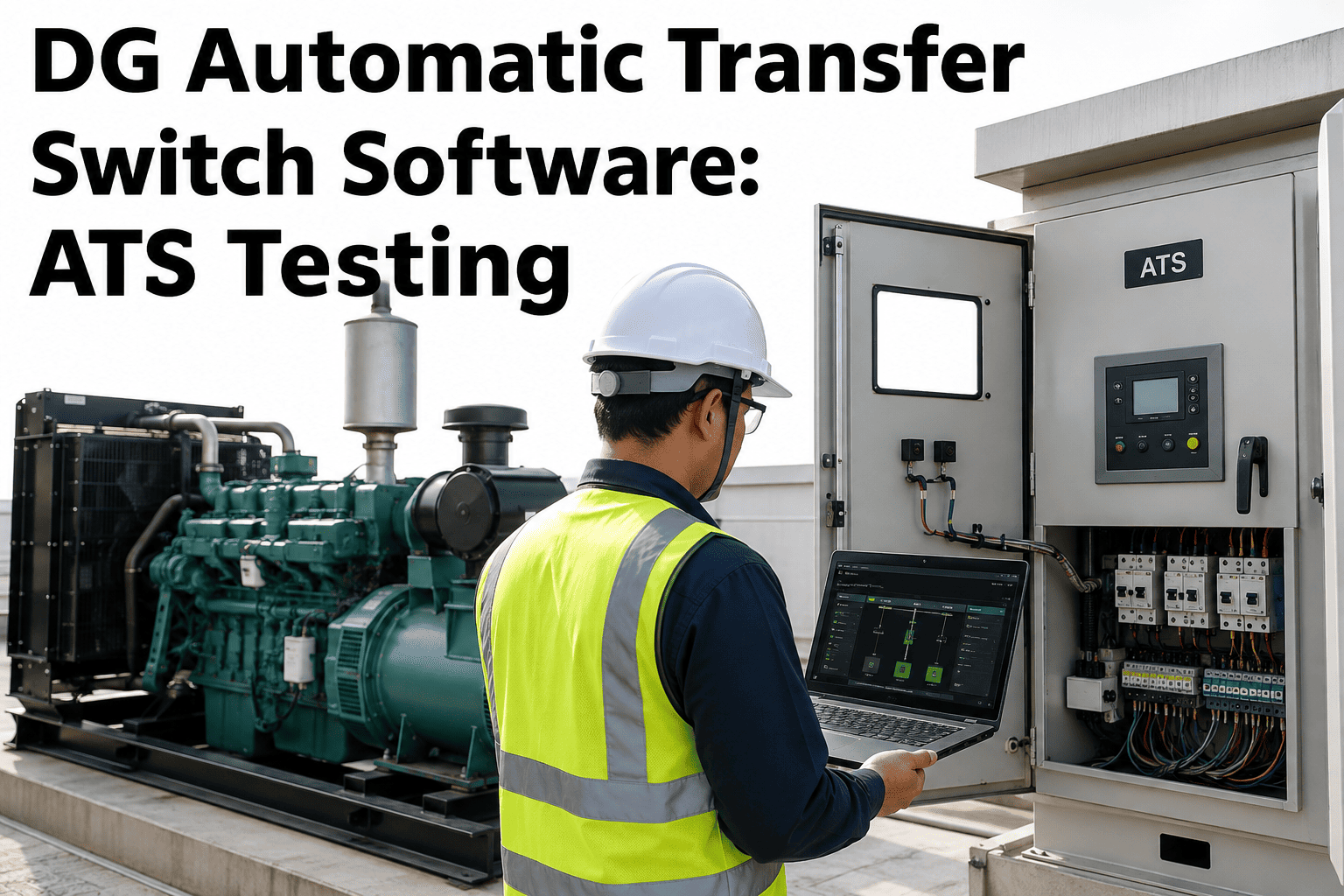
Automatic transfer switches sit at the exact moment utility power fails and a generator has to pick up the load, which is why NFPA 110 treats their testing as a life-safety obligation rather than routine upkeep. Most facility teams still track transfer time, retransfer time, and monthly exercise cycles across paper logs or disconnected spreadsheets, so a single missed entry can turn into a failed inspection months later. Level 1 systems in hospitals, data centers, and critical manufacturing sites are expected to prove every exercise cycle on demand, with no gaps and no reconstructed records. A facility CMMS built around the ATS test cycle closes that gap by capturing transfer time, load percentage, and technician sign-off the moment the test happens. See how OxMaint standardizes ATS testing records for facilities running one generator or fifty.
DG ATS Testing Software
Is your last ATS transfer time test still sitting on a clipboard?
OxMaint turns automatic transfer switch testing into a structured digital record — transfer time, retransfer time, exercise frequency, and load readings captured at the moment of test, mapped straight to NFPA 110 requirements.
The Testing Gap
Why manual ATS test logs fall apart under audit
Teams that log automatic transfer switch tests on paper or in spreadsheets typically discover the gaps only when an AHJ or insurance surveyor asks for twelve consecutive months of exercise records. A missing signature, an undocumented transfer time, or a retest that was never logged is enough to trigger a finding.
The Test Cycle
The four readings every ATS test record needs
An audit-ready ATS test record is built from four data points, captured in sequence, every time the switch is exercised. Missing any one of them is the most common reason a facility fails a spot inspection.
Simulated outage trigger
Technician logs the exact time utility power was interrupted or simulated, with asset ID and site tagged automatically.
Transfer time capture
Seconds between outage detection and load transfer to generator power are recorded against the 10-second Level 1 ceiling.
Load and run verification
Load percentage, voltage, and frequency are logged while the generator carries the building, confirming stable operation.
Retransfer and sign-off
Retransfer time back to utility power is logged, and the technician digitally signs the completed record with a timestamp.
Compliance Reference
NFPA 110 testing requirements by system level
Testing frequency and documentation depth change depending on whether a facility runs a Level 1 or Level 2 emergency power system. This reference maps the core differences your ATS program needs to account for.
| Requirement | Level 1 System | Level 2 System | Documentation Needed |
|---|---|---|---|
| Max transfer time | 10 seconds | 10 seconds | Logged transfer time per test event |
| Exercise frequency | Monthly, 30 min minimum | Monthly, 30 min minimum | Dated exercise log with load reading |
| Load requirement | 30% of nameplate rating | Facility-defined | Recorded load percentage per cycle |
| Record retention | Minimum 12 months on site | Minimum 12 months on site | Immutable digital or signed paper log |
Root Causes
Where ATS testing programs actually break down
Most failed inspections do not come from a switch that malfunctioned during a real outage. They come from the paperwork trail around routine testing. These are the three places facility teams most often lose the thread.
- Transfer time written down after the fact instead of at the moment of test
- No technician signature or timestamp tied to the completed record
- Retransfer reading skipped once the generator test looks successful
- Monthly exercise pushed past the 30-day window during holidays or turnover
- No automatic reminder when a technician is reassigned mid-cycle
- Makeup tests never logged against the missed original date
- Load bank testing skipped when generator runs under building load only
- Battery and control panel checks left off the standard test form
- Multiple ATS units on one site tracked under a single shared record
Who Uses This
Built for every facility where downtime is not an option
ATS testing discipline matters most where a transfer failure has an immediate, visible consequence. OxMaint scales the same test-capture workflow across every environment below.
Hospitals and healthcare
Life-safety branch circuits and surgical suites depend on transfer times inside the 10-second Level 1 ceiling every time.
Data centers
Uptime SLAs make every ATS exercise a contractual event, not just a maintenance task, with records clients can request.
Manufacturing plants
Process lines with continuous-run equipment need documented proof that backup power picks up within tolerance.
Telecom and utilities
Distributed sites with unmanned equipment rooms rely on remote-logged tests instead of a technician on every visit.
Mini Case Study
A hospital campus cut ATS reporting time from 3 days to 45 minutes
A 340-bed hospital campus ran monthly ATS exercises across nine generators but logged results on paper checklists that engineers later re-typed into a spreadsheet. Preparing a 12-month evidence packet for the annual life-safety survey took three full days and still produced two flagged gaps last cycle.
Every exercise now auto-logs transfer time, load, and retransfer directly from the technician's mobile device. The facilities team pulls a full 12-month evidence packet in 45 minutes, with zero missing records during their most recent survey.
Product Fit
How OxMaint captures every ATS test end to end
These four capabilities map directly to the data points an inspector or insurer will ask to see, captured automatically instead of reconstructed later.
Mobile Test Capture
Technicians log transfer time, load, and retransfer readings directly from a mobile device during the test, removing the re-typing step where most errors happen.
Automatic Exercise Scheduling
Every ATS asset gets a recurring 30-day exercise schedule with reminders that reassign automatically if a technician changes.
Immutable Test History
Once a test record is submitted and signed, it writes to a locked history log that shows every asset's full testing timeline on demand.
One-Click Evidence Packets
Filter by site, asset, or date range and export a structured evidence packet mapped to NFPA 110 documentation requirements.
Built For Critical Power Teams
Turn every ATS exercise into an audit-ready record automatically
Technicians log the test once, in the field, and OxMaint handles the transfer time math, the retention clock, and the evidence packet.
FAQ
DG ATS testing software: common questions
What is the difference between transfer time and retransfer time?
Transfer time is how long it takes the ATS to move load from utility to generator power. Retransfer time is the return trip once utility power stabilizes. OxMaint logs both automatically on every test.
How often must an automatic transfer switch be exercised?
NFPA 110 Level 1 systems require a monthly exercise of at least 30 minutes under load. Missing a single monthly cycle is one of the most common inspection findings facility teams face.
Can a CMMS capture ATS transfer time without manual entry?
Yes — mobile-captured test records timestamp the outage trigger and transfer event as they happen, removing the re-typing step where most transcription errors occur. Book a demo to see it on your own switches.
What happens if ATS records are incomplete during an inspection?
Incomplete records typically result in a cited finding and a required retest window, and in regulated facilities can delay accreditation renewal. Digital capture at the point of test is the most reliable way to avoid gaps.
Is this software suited for multi-site generator fleets?
OxMaint tracks ATS assets, exercise schedules, and evidence packets across every site from one dashboard, so a regional facilities manager can see testing status for the full fleet at a glance. Start a free trial to test it on your sites.
Ready When The Inspector Is
Make your next ATS test the easiest part of the audit
Join facility and critical power teams using OxMaint to capture transfer time, retransfer time, and exercise records the moment testing happens.
Free 14-day trial. No credit card required.