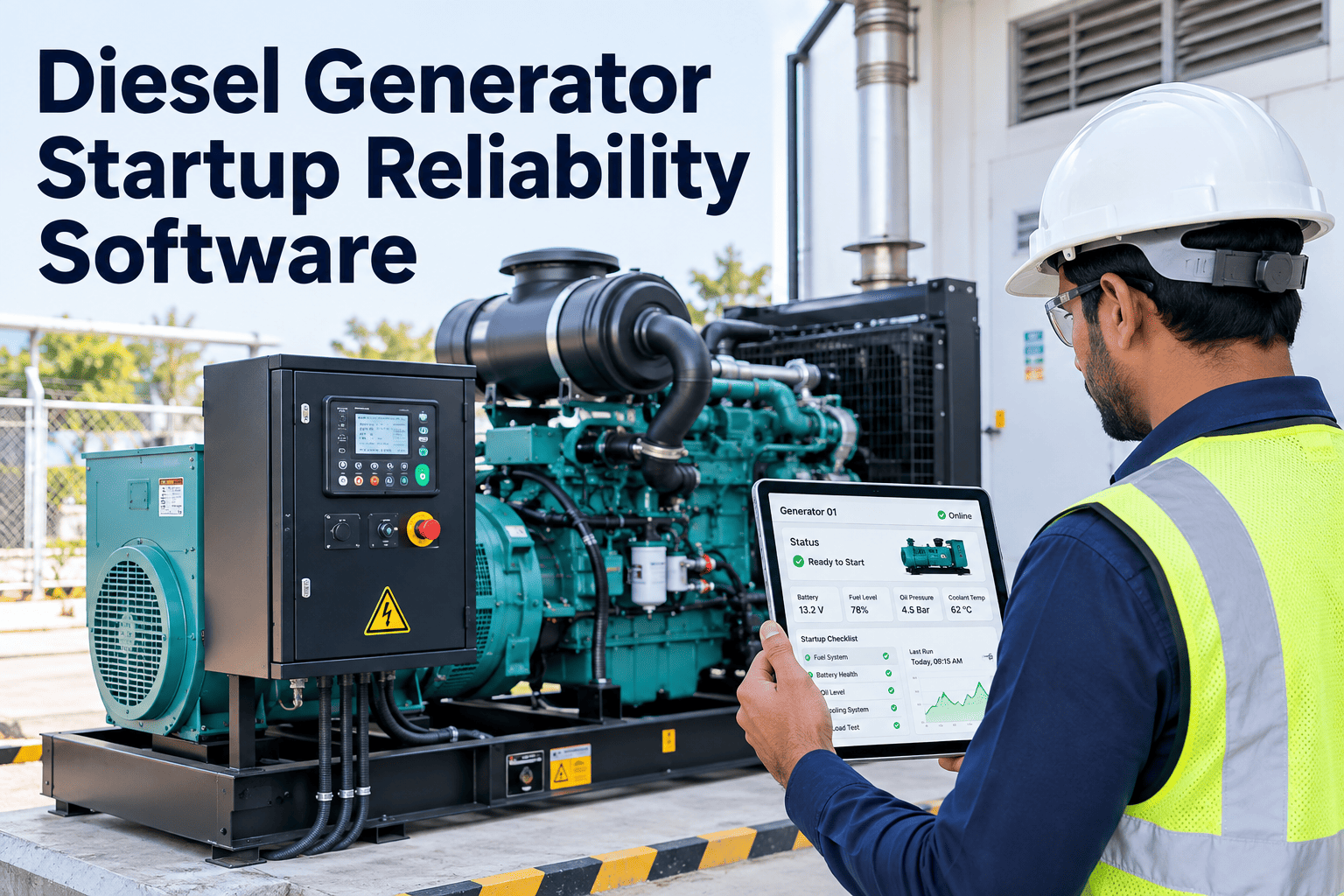
A standby diesel generator can sit idle for months and still be expected to crank, fire, and carry full load within ten seconds of a utility outage. That's the entire point of it — and it's also why startup failure is so dangerous: the one moment the generator has to work is the moment nobody gets a second chance. Field data consistently points to the same five root causes behind failed starts — weak batteries, degraded fuel, worn glow plugs, tired starter motors, and restricted air intake — and preventive maintenance protocols can eliminate the large majority of them before they ever cause a failed start. The teams that stay ahead of all five don't do it with more paperwork; they do it with software that tracks every one of these failure points automatically, which is exactly what facility and data center teams find when they look inside OxMaint.
Facility CMMS · Diesel Generator Startup Reliability
Catch the Five Reasons Your Generator Won't Start — Before the Outage Does
Battery, fuel, glow plug, starter, and air intake — the five root causes behind nearly every failed start — tracked continuously so your standby power is verified ready, not just assumed ready.
43-60%
of all startup failures trace back to the battery system
80%
of starting failures preventable with structured maintenance
6-12 mo
before stored diesel fuel begins meaningful degradation
10 sec
is all a standby generator gets to prove it works
The Diagnostic Map
The 5 Root Causes Behind Nearly Every Failed Start
Every startup failure traces back to one of five systems, and each one degrades on its own quiet timeline. Knowing the pattern is the difference between a generator that's actually ready and one that just looks ready sitting in the utility room.
01
Battery System
The single largest cause of failed starts. Sulfation, corroded terminals, and slow discharge in float mode leave a battery that reads fine but can't deliver cranking amps when it matters.
02
Fuel Degradation
Standby generators run infrequently, so fuel sits. Diesel starts degrading within months, and stale or water-contaminated fuel clogs filters and injectors exactly when full flow is needed.
03
Glow Plug Failure
Cold combustion chambers need glow plug heat to fire cleanly. A failing plug can add 30 or more seconds to start time, or stop a cold start entirely in low temperatures.
04
Starter Motor Wear
Cranking a multi-cylinder diesel against high compression takes enormous torque. A worn starter or solenoid shows up as slow, hesitant cranking long before it fails outright.
05
Air Intake Restriction
A clogged air filter starves combustion of the airflow it needs, and it's one of the easiest checks to skip during a routine inspection — until it's the reason the engine won't fire.
The Warning Signs
What Your Generator Is Already Telling You
Startup failure almost never arrives without warning. The signs show up during routine exercise runs and inspections — the question is whether anyone is tracking them consistently enough to notice the pattern before it becomes a failed start during a real outage.
Voltage Drop Under Load
Cranking voltage below roughly ten volts signals a battery that's already losing its capacity to deliver full cranking amperage.
Slower Start Times
A creeping increase in seconds-to-start across weekly exercise runs is often the earliest signal of glow plug or starter wear.
Fuel Age Past Six Months
Fuel that hasn't been rotated or tested recently is quietly approaching the point where degradation starts affecting reliable flow.
Repeated Fault Codes
The same control panel fault appearing more than once is a pattern, not a fluke — and patterns are easy to miss without a digital log.
The Workflow
How OxMaint Keeps Standby Power Verified, Not Assumed
01
Schedule the Checks
Weekly battery voltage checks, quarterly load testing, and fuel rotation schedules are set up once and run automatically as recurring work orders.
02
Log Every Exercise Run
Start time, cranking voltage, and fault codes are captured on a mobile device every time the generator runs, building a real trend line instead of a one-off reading.
03
Flag the Pattern
Slowing start times, recurring fault codes, or aging fuel batches are surfaced automatically instead of waiting for someone to notice across a stack of paper logs.
04
Fix It Before the Outage
A work order is generated for the specific failing system — battery, fuel, glow plug, starter, or air — so the fix happens on your schedule, not during a blackout.
Know Your Generator Will Start Before You Need It To
Bring your current exercise run schedule and inspection checklist, and we'll show you how every one of the five root causes gets tracked automatically inside OxMaint.
Side by Side
Paper Inspection Logs vs a Connected Startup Reliability Program
| Capability |
Paper Logs |
OxMaint Startup Tracking |
| Battery voltage trend |
One reading, no history |
Trend line flags decline before it's critical |
| Fuel age tracking |
Estimated from memory |
Dated per tank with rotation reminders |
| Start time monitoring |
Not recorded consistently |
Logged every exercise run automatically |
| Fault code patterns |
Each code treated as isolated |
Recurring codes flagged as a pattern |
| Multi-site visibility |
One binder per building |
Every generator's readiness on one screen |
| Compliance reporting |
Rebuilt manually before an audit |
Timestamped and exportable in minutes |
The Payoff
What Facilities Gain From Startup Reliability Tracking
80%
of starting failures avoidable through consistent preventive checks
10+ V
the cranking voltage threshold every load test should confirm
3x
faster pattern detection on recurring electrical faults digitally
3-5 yrs
typical battery service life tracked toward planned replacement
Who Relies On It
Built for Every Facility That Can't Afford a Failed Start
01
Data Centers
Standby generators back up compute load that can't tolerate downtime, so exercise run data and battery health get watched closely, continuously.
02
Hospitals and Healthcare
Life safety systems depend on generators starting within seconds, making documented, auditable readiness testing a regulatory requirement, not an option.
03
Manufacturing Plants
An unplanned outage without backup power means lost production runs, so startup reliability directly protects uptime and output targets.
04
Multi-Site Facility Portfolios
Central teams track generator readiness across every building from one dashboard instead of chasing individual site technicians for status updates.
From the Field
What Facility Teams Say After Digitizing Generator Readiness
5 / 5
We caught a battery bank that was reading fine at rest but dropping below nine volts under crank load. That would have been a failed start during an actual outage, and instead it became a scheduled replacement.
RH
Ravi Hegde
Facility Engineer, Data Center Operations
4 / 5
Our exercise runs used to go into a binder nobody reviewed. Now start times are logged automatically, and we spotted a slow creep on one unit weeks before it would have become a real problem.
LM
Lauren Mercado
Maintenance Supervisor, Regional Hospital System
Common Questions
Diesel Generator Startup Reliability — Frequently Asked Questions
Which of the five causes is responsible for most failed starts?
The battery system, including sulfation, corrosion, and slow float-mode discharge, accounts for the largest share of startup failures by a wide margin.
How often should exercise runs and load tests happen?
Weekly voltage checks and quarterly load testing catch most issues early.
Start a free trial to set the schedule automatically.
Can the system track fuel age across multiple tanks?
Yes. Each fuel batch is dated per tank, with rotation reminders triggered before degradation risk becomes significant.
Does it work across generators at different sites?
Yes. A portfolio view shows readiness status for every generator across every site on one screen.
Book a demo to see your own fleet.
Will this help with compliance audits and inspection records?
Yes. Every check, reading, and fault code is timestamped automatically, so audit-ready reports export in minutes instead of days.
Facility CMMS · Diesel Generator Startup Reliability
Don't Find Out Your Generator Won't Start During the Outage
Battery, fuel, glow plug, starter, and air intake — track all five continuously, and standby power stops being a hope and starts being a verified fact.