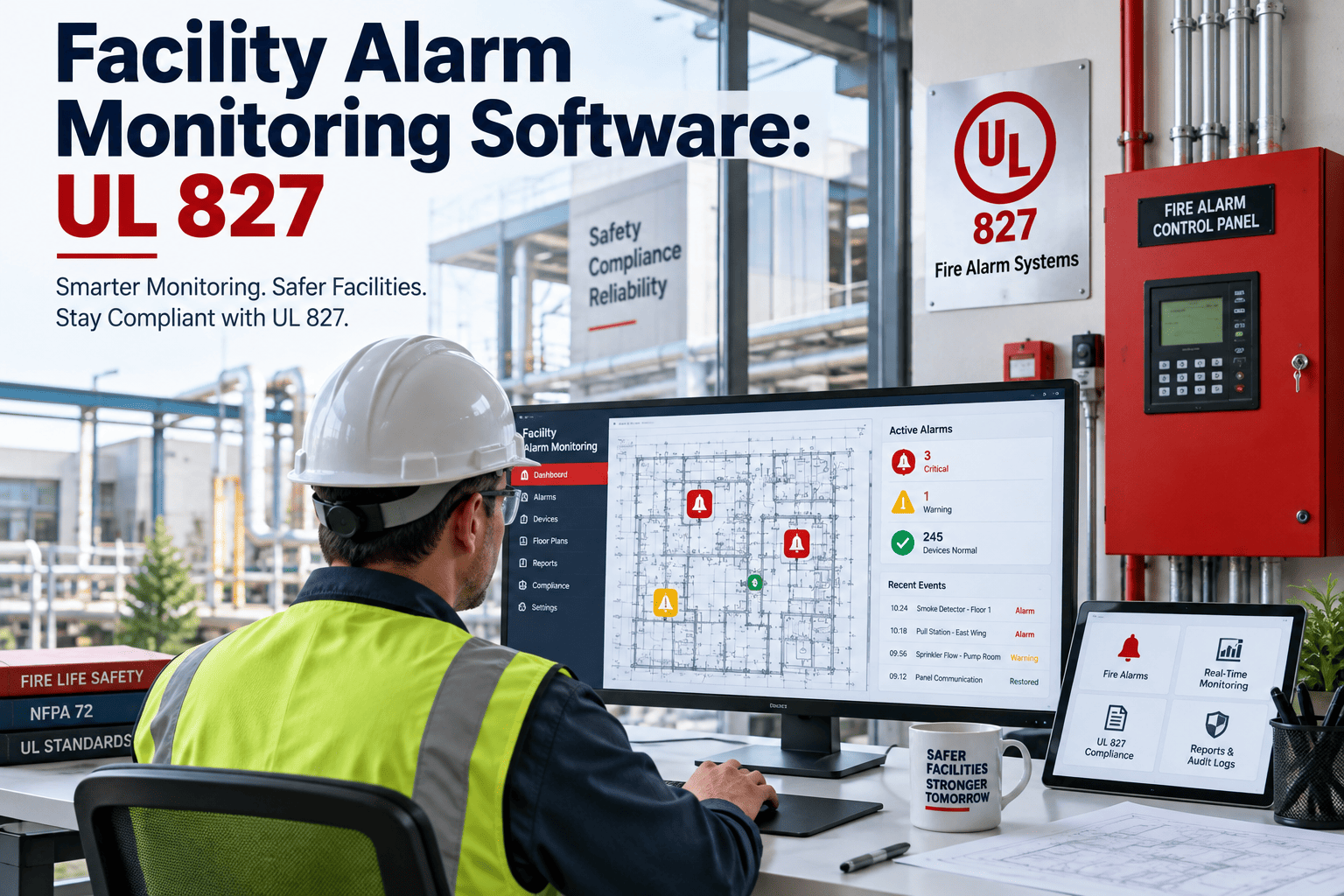
Alarm monitoring fails in two ways: the signal never reaches the central station, or nobody can prove that it did. UL 827 addresses central-station alarm services, and insurers, landlords, and fire authorities often ask for the certificates and records that go with it. This guide explains how supervised alarm signals travel, which documents to keep, and how a CMMS such as Oxmaint ties panel tests, communicator checks, and monitoring records into one audit-ready file.
Facility Alarm Monitoring Software: Keep UL 827 Monitoring Records Audit-Ready
The Alarm Signal Journey and Where It Breaks
Every link in the chain has its own failure mode, and each failure produces a different kind of risk. Mapping them makes it clear which maintenance tasks protect which link.
Signal Types and the Records Each One Creates
Fire alarm systems generally distinguish alarm, supervisory, and trouble conditions, and security systems add burglary and holdup events. Each type should trigger a different response and leave a different record.
| Signal | What it means | Expected facility response | Record to keep |
|---|---|---|---|
| Alarm | A device reports a possible fire or security event | Verify, evacuate or respond per plan, cooperate with dispatch | Time received, cause, responders, reset time |
| Supervisory | A protective system such as a sprinkler valve is out of its normal state | Investigate promptly and restore the normal state | Device, condition found, correction, restore time |
| Trouble | A fault in wiring, power, battery, or communication path | Open a corrective work order and repair | Fault description, parts used, closure date |
| Test | A deliberate signal to prove the path works | Coordinate with the monitoring center before and after | Test date, tester, result, confirmation from the center |
What UL 827 Covers and What Stays on Your Side
UL 827 is the standard for central-station alarm services, so it concerns the monitoring provider. Your building still owns the equipment, tests, and records that make monitoring meaningful.
Provider side
- Monitoring facility, staffing, and procedures
- Signal handling and operator response
- Provider record keeping and certification
- Current certificate for the account
Facility side
- Panels, detectors, and communicators
- Inspection, testing, and maintenance schedule
- Impairment handling and corrective work
- Call lists, contacts, and monitoring contract
Verify the certificate, then file it
- Ask the provider for the certificate that covers your account and service type.
- Check its listing status in UL's public certification directory.
- Store the certificate and the monitoring contract with the asset record for the panel.
- Set a reminder to reconfirm the certificate whenever the contract renews.
One File for Every Alarm Test and Certificate
Communicator Health: Landline Sunset and Network Changes
Copper phone lines are being retired in many areas, and the shutdown of 3G cellular networks in the United States, largely completed in 2022, forced many facilities to replace communicators. Signal paths now depend on cellular and IP services that change without warning.
Root Causes of False and Missed Signals
False alarms waste responder time and erode trust, while missed signals put people at risk. Both trace back to maintenance and configuration gaps.
False alarm drivers
- Dust, insects, and aging smoke detectors
- Construction work without detector covers managed
- Poorly trained staff during arming and disarming
- Panels lacking false alarm reduction features such as those in SIA CP-01
- Door contacts out of alignment
Missed or late signal drivers
- Dead communicator or expired service plan
- Zones left disabled after a renovation
- Outdated call lists at the monitoring center
- Untested changes to network equipment
- Low batteries that fail during an outage
The Inspection, Testing, and Record Cycle
NFPA 72 and the code edition your local authority enforces set testing frequencies. Turn each frequency into a recurring work order so nothing depends on memory.
NFPA 72 generally expects test and inspection records to be kept until the next test and for one year afterward, with acceptance records retained longer. Confirm the exact rule with your authority having jurisdiction.
Handling Impairments Without Losing Track
When a fire alarm system or part of it is out of service, the situation is an impairment. NFPA 72 expects a defined process, and a documented one protects you when questions arise later.
The Evidence Packet Insurers and Inspectors Ask For
How Oxmaint Supports Alarm Monitoring Maintenance
Oxmaint does not monitor alarm signals; your central station does that. It organizes the maintenance and documentation around the system.
| Task | Oxmaint workflow |
|---|---|
| Panel, detector, and communicator inventory | Asset management with location, model, install date, and attached documents |
| Recurring inspections and tests | Preventive maintenance schedules generating work orders on each cycle |
| Field test results | Mobile inspection checklists with notes and photos |
| Trouble signals and failed tests | Corrective work orders with priority and assignment |
| Batteries and spare devices | Inventory tracking linked to the work order |
| Audits and underwriter requests | Compliance records, reports, and dashboards by site |
Scorecard for Alarm Monitoring Performance
Monitoring Contract Points to Settle in Writing
Many missed responses trace back to a contract or call list that nobody has reviewed in years. Settle these points and store the answers with the asset records.
Response instructions
- Who is called first for each signal type
- Whether dispatch is automatic or requires verification
- After-hours and holiday contact rules
- Instructions for supervisory and trouble signals
Account administration
- Passcode and authorized caller list
- Test signal schedule and confirmation method
- Process for placing a system on test
- Notice period for changes and cancellations
Different Systems, Different Maintenance Emphasis
A facility often monitors several systems through the same provider. Each one has its own failure patterns and its own paperwork.
| System | Typical signals | Maintenance emphasis | Records |
|---|---|---|---|
| Fire alarm | Alarm, supervisory, trouble | Detector sensitivity, batteries, circuits, communicator | Inspection and test reports, deficiency log |
| Sprinkler monitoring | Waterflow, valve supervisory, low pressure | Valve tamper switches, flow switches, pressure sensors | Valve inspection logs, impairment records |
| Burglary and intrusion | Alarm, door open, tamper, low battery | Contacts, motion sensors, keypads, arming procedures | Open and close logs, user lists |
| Holdup and duress | Silent alarm, panic button | Button function tests and staff training | Test log and training roster |
Standardizing Alarm Monitoring Across Many Sites
Portfolios often inherit a different panel, communicator, and provider at every building. Consistency is what allows a regional manager to spot problems early.
- Use the same asset naming and location structure at every site.
- Create one standard test checklist for each system type and adapt only where the code requires it.
- Record the monitoring provider and certificate status for each site in one place.
- Track communicator type by site so a carrier or network change can be traced to the affected buildings.
- Review open deficiencies and overdue tests across the whole portfolio each month.
A Practical First 60 Days
Common Alarm Monitoring Mistakes
- Assuming the provider tests the building side of the system.
- Leaving a zone disabled after a renovation and forgetting to restore it.
- Storing certificates in an email inbox that changes when staff leave.
- Waiting for a network upgrade to discover the communicator no longer connects.
- Recording tests on paper that cannot be searched during an audit.
- Closing trouble signals without confirming the root cause was corrected.
Lifecycle and Replacement Planning for Alarm Equipment
Alarm panels and communicators do not fail on a convenient schedule. Tracking age and parts availability turns surprise failures into planned projects.
- Record the installation date and manufacturer support status for each panel and communicator.
- Replace batteries according to manufacturer guidance, and log the replacement date on the asset.
- Watch for obsolete parts, discontinued modules, and software that is no longer supported.
- Flag devices with repeated trouble signals so they can be reviewed for replacement.
- Coordinate replacements with the monitoring provider so the account details stay correct.
- Plan retests for every change, however small the change appears.
Working With Inspectors, Authorities, and Insurers
Each audience asks for slightly different evidence, so a single organized file saves repeated work.
Authority having jurisdiction
- Inspection and test reports
- Impairment and fire watch records
- Evidence that deficiencies were corrected
- Contractor licenses and qualifications
Insurer or underwriter
- Current central-station certificate
- Monitoring agreement and scope of service
- Test history and open deficiencies
- Details of any recent loss events
Requirements differ by region and policy, so ask each party for its written expectations and map them to your records.
Alarm Signals During Construction and Renovation
Construction is one of the biggest sources of false alarms and untested changes. A short control process prevents both.
- Require a permit or notice before any work that affects detectors, wiring, or panels.
- Track detector covers and remove them promptly, with a signed record when protection is restored.
- Notify the monitoring center before dusty or hot work begins.
- Run a targeted test of affected zones at the end of the job.
- Update device lists and floor plans so records match the finished building.
Technician Competence and Sign-Off
Codes and local authorities often require qualified personnel for inspection and testing. A record that shows who did the work, and their qualification, strengthens every audit.
- Keep contractor licenses and certifications on file and note expiry dates.
- Require named sign-off on each completed checklist.
- Record the tools or test equipment used when calibration matters.
- Review deficiencies with the technician before closing the work order.
Questions to Ask Before Your Next Audit
- Can we produce the last test report for every monitored system within minutes?
- Do we know which communicator type and network carries each site's signals?
- Is every open deficiency assigned to a person with a due date?
- Has the provider confirmed our call list in the last twelve months?
- Would a new facility manager find the certificate and contract without asking anyone?