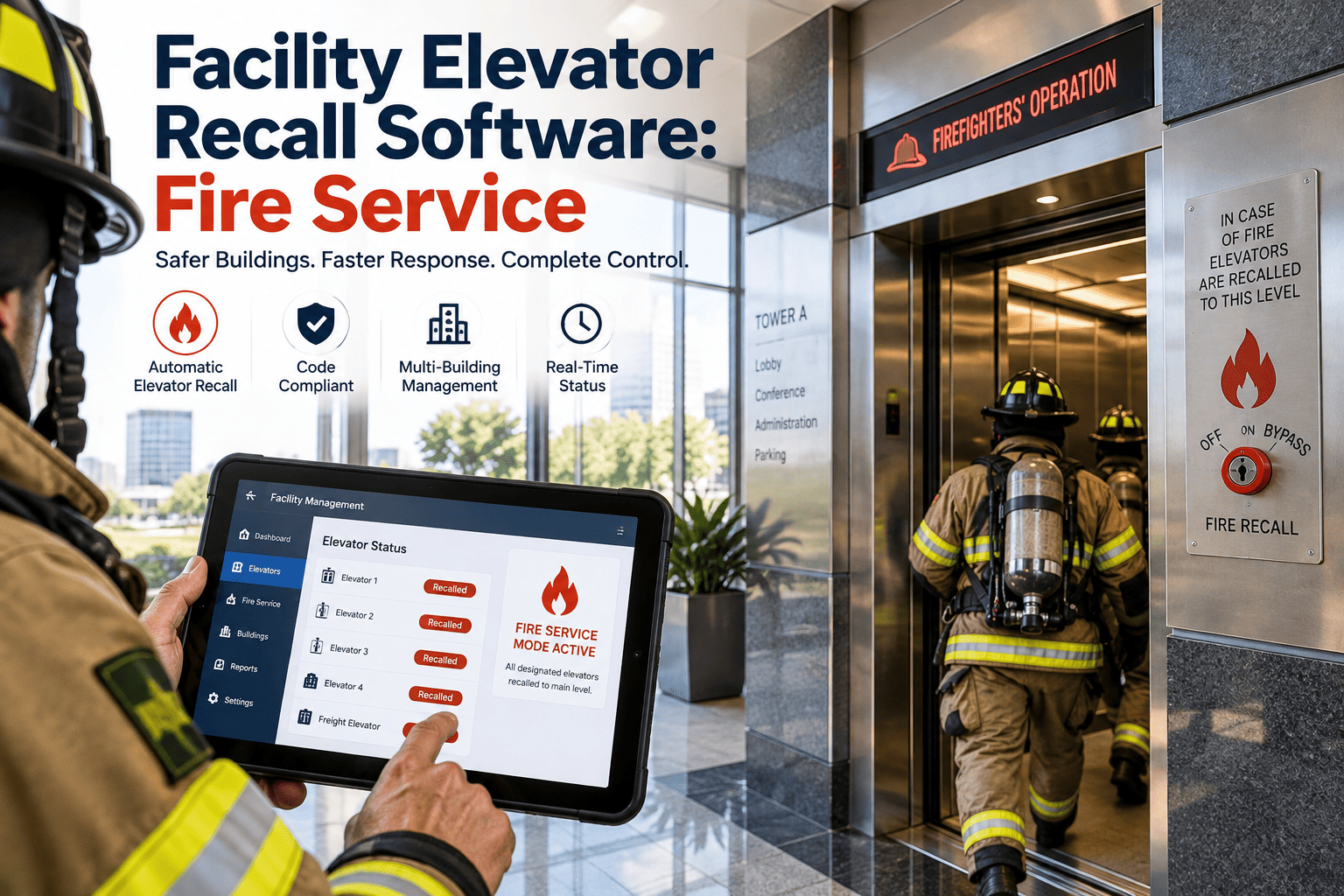
When a smoke detector trips, elevators must stop carrying passengers toward the fire and return to a safe level. That behavior is called Phase I recall, and it depends on fire alarm devices, elevator controllers, and firefighter keys all working together. Testing it regularly and recording the result is where many buildings fall behind. This guide explains Phase I and Phase II operation, what to test, and how a CMMS such as Oxmaint turns each recall test into a documented work order.
Facility Elevator Recall Software: Fire Service Testing You Can Prove
Phase I and Phase II at a Glance
Elevator fire service operation is defined in ASME A17.1 and CSA B44, with the fire alarm interface described in NFPA 72. Two phases matter for maintenance teams.
Automatic recall
- Triggered by smoke detectors in elevator lobbies, machine rooms, and hoistways
- Cars return to the designated level, or an alternate level if the trigger is at the designated level
- Doors open and stay open at the recall level
- A fire hat indicator in the car signals fire service mode
- A lobby key switch allows manual recall
Firefighter in-car control
- Firefighters use a fire service key at the car operating panel
- The car responds only to the firefighter, one call at a time
- Doors are controlled by the firefighter, not by automatic timers
- Firefighters can return the car to the recall level on demand
- Correct keys and labeling must be available to responders
The Recall Sequence Step by Step
Knowing the sequence helps technicians find where a failed test broke down.
Initiating Devices and Expected Elevator Response
| Initiating device | Typical location | Expected response |
|---|---|---|
| Lobby smoke detector | Elevator lobby on a floor other than the designated level | Phase I recall to the designated level |
| Lobby smoke detector at recall level | Designated level lobby | Recall to the alternate level |
| Machine room smoke detector | Elevator machine room or control space | Recall, with the fire hat indicator flashing in the affected elevator |
| Hoistway smoke detector | Top of the hoistway or as required | Recall, with the fire hat indicator flashing in the affected elevator |
| Heat detector for shunt trip | Machine room or hoistway with sprinklers | Recall first, then power removal before sprinkler discharge where applicable |
Designs vary by jurisdiction and code edition, so use your own approved drawings and sequence of operations as the authority.
Turn Every Recall Test Into a Signed Record
What a Monthly Recall Test Record Should Capture
Many jurisdictions, and the maintenance requirements associated with ASME A17.1, call for regular firefighter service testing, commonly monthly. Confirm the interval your inspector enforces.
Why Recall Tests Fail
Failures rarely have a single cause. They usually sit on the fire alarm side, the elevator side, or in the gap between the two contractors.
Fire alarm side
- Dirty or misplaced detectors
- Relay module faults
- Wiring damaged during renovations
- Programming changed and never retested
Elevator side
- Controller relay or input problems
- Worn key switches
- Burned-out fire hat lamps
- Software changes after modernization
Coordination gaps
- Nobody owns the whole test
- Elevator and alarm contractors test separately
- Results filed in different places
- Missing or wrong keys
Who Owns What in an Elevator Recall Program
| Party | Typical responsibility | Record it should provide |
|---|---|---|
| Building owner or manager | Ensures tests happen, keys are available, and deficiencies are corrected | Test log, work orders, inspection certificates |
| Elevator contractor | Maintains controllers, key switches, and in-car equipment | Service reports and callback history |
| Fire alarm contractor | Maintains detectors, panel outputs, and recall relays | Inspection and test reports |
| Building engineer | Coordinates tests, escorts contractors, verifies restoration | Checklists, photos, and sign-offs |
| Fire department and inspector | Verifies operation and reviews documentation | Inspection findings and required corrections |
Fire Service Keys and Phase II Readiness
A recall system does little good if responders cannot operate the car. Include key management in the same program.
- Confirm that the fire service key is stored where responders expect it, such as a lobby key box.
- Verify that the key operates every car in the bank.
- Check that key switches are labeled clearly and that operating instructions are posted.
- Update fire department pre-plans after any elevator modernization.
- Track who holds copies of keys and log any changes.
After Renovations or System Changes
Recall problems often appear right after other work. Build retest triggers into change control.
Without change control
- Tenant fit-out moves a detector
- Fire alarm panel is replaced without an elevator test
- Recall fails at the next inspection
- Cause is unknown and blame is shared
With change control
- Any detector or panel change creates a retest work order
- Elevator and alarm contractors test together
- Result is recorded against both assets
- Failures are found before the inspector arrives
How Oxmaint Organizes the Recall Program
Recall Program Measures
Machine Room and Hoistway Conditions That Affect Recall
Recall relies on detectors and wiring in some of the least visited spaces in a building. Conditions there change slowly and are easy to overlook.
- Dust and construction debris can cause nuisance activations or reduce detector sensitivity.
- High machine room temperatures can shorten the life of controllers, relays, and batteries.
- Water in the pit or leaks from above can damage wiring and devices.
- Storage in machine rooms can block detector coverage and access to equipment.
- Shared spaces need clear labels so other trades do not disconnect recall wiring by accident.
Schedule a periodic walkthrough of machine rooms and pits so these conditions are recorded before they cause a failed test.
Test Procedure Outline for Technicians
Use your elevator and fire alarm contractors' procedures and the applicable code as the authority. This outline shows the coordination points a checklist should cover.
Older Elevators, Modernizations, and Code Editions
Requirements depend on the code edition adopted where the building stands and on when the elevator was installed or altered. Existing installations are often governed by ASME A17.3, the safety code for existing elevators.
- Record the installation year and the last modernization date on each elevator asset.
- Store the approved sequence of operations and wiring diagrams with the record.
- Note which code edition your inspector uses so tests match expectations.
- Retest recall after any controller replacement, software update, or fire alarm change.
- Keep alteration permits and acceptance test reports with the asset file.
Common Findings and How to Prevent Them
| Finding | Why it happens | Preventive action |
|---|---|---|
| Car does not recall | Relay or wiring fault, or programming changed after other work | Retest after any related change and inspect relay connections |
| Fire hat indicator not lit | Burned-out lamp or failed indicator circuit | Include the lamp in each monthly checklist and stock spares |
| Doors close during recall | Door operator setting or controller input problem | Verify door behavior at the recall level on every test |
| Fire service key missing or wrong | Keys moved, lost, or not replaced after a change | Audit key location and fit quarterly |
| No test record available | Records kept by contractors in separate systems | Require test results to be attached to one asset record |
Documentation to Keep for Elevator Inspections
- Monthly recall test logs with tester name and result.
- Annual fire alarm functional test reports that include the elevator interface.
- Elevator maintenance control program and service records.
- Deficiency reports with corrective work order numbers and closure dates.
- Fire service key inventory and storage location.
- Alteration records and acceptance tests after modernizations.
Talking to occupants about recall tests
- Post notices in lobbies before scheduled tests so occupants know cars may pause.
- Stage tests when possible so cars are empty, and check each car before starting.
- Share results with property management so recurring problems are visible.
Sprinklers, Shunt Trip, and Elevator Power
In buildings with sprinklers in elevator machine rooms or hoistways, codes generally require coordination between heat detection, power removal, and recall. This interface deserves its own test steps.
- Confirm which heat detectors are tied to power removal and label them on the asset record.
- Verify that recall occurs before power is removed, as the approved design requires.
- Test shunt trip circuits according to the contractor's procedure and record the outcome.
- Keep the shunt trip breaker or disconnect identified and accessible.
- Involve the sprinkler contractor when the design changes.
Tracking Reliability Car by Car
Recall tests are one data point in a wider picture of elevator health. Combining them with service history shows which cars deserve attention.
Test history
- Pass or fail by month
- Steps that fail repeatedly
- Time to retest after repair
Service history
- Callbacks and entrapments
- Parts replaced
- Contractor response time
Cost history
- Repair spend per car
- Contract scope coverage
- Candidates for modernization
High-Rise and Multi-Tenant Considerations
- Large elevator banks may include several designated and alternate recall levels, so document them in one place.
- Tenant fit-outs on elevator lobbies can move detectors or change ceiling layouts and should trigger a retest.
- Fire command centers may have status panels for elevators that also need testing.
- Service, freight, and parking elevators often have different sequences from passenger cars.
- Coordinate testing windows with tenants to avoid disrupting peak arrival and departure times.
Budgeting for recall-related repairs
- Keep a small reserve for relays, key switches, indicator lamps, and detector replacement.
- Use repeat failure data to justify modernization requests.
- Ask contractors to itemize recall-related work so costs are visible in reports.
Questions to Ask Before Your Next Elevator Inspection
- Do we have a signed recall test record for every car for the past twelve months?
- Was recall retested after the last fire alarm or elevator change?
- Is the fire service key where responders expect it, and does it fit every car?
- Are all open deficiencies assigned, dated, and tied to a work order?
- Can the elevator and fire alarm contractors show their results in one shared record?