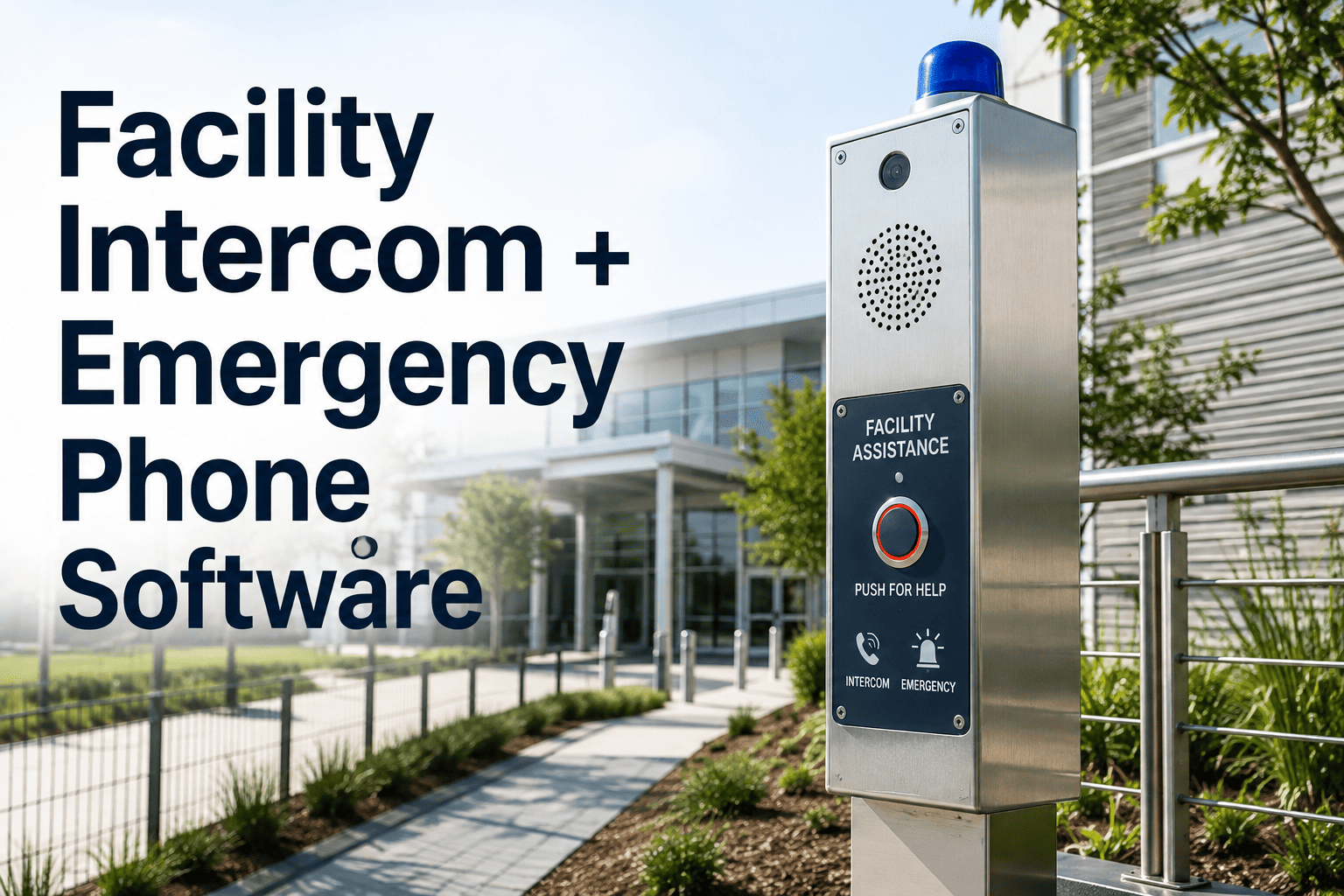
A blue-light emergency phone or lobby intercom sits untouched for months at a time, which is exactly what makes it dangerous when nobody is tracking its condition. A dead call button, a corroded strobe light, or a 911 call that fails to deliver a dispatchable location under RAY BAUM's Act only gets discovered the moment someone presses it in a real emergency — and by then it's too late to fix. Facility teams running these systems on quarterly paper checklists have no way to prove uptime between visits, and no automatic trail showing a unit was ever tested at all. OxMaint's facility intercom and emergency phone software closes that gap with scheduled testing, condition logging, and Kari's Law-aligned documentation built into the same CMMS your team already uses. See how facility teams track emergency phone uptime inside OxMaint.
The System Nobody Touches for Months Is the One That Has to Work in Seconds.
OxMaint schedules and logs testing for blue-light phones, parking intercoms, and lobby entry systems — so every unit's uptime, condition, and compliance status is documented before it's ever needed in an emergency.
Why Emergency Communication Systems Fail Without Anyone Noticing
Unlike a fire alarm that gets tested weekly by code, blue-light phones and lobby intercoms often go unpressed for weeks. A weak audio connection, a burned-out strobe, or a stuck call button doesn't trigger any alarm on its own — it just sits there until someone needs it and it doesn't respond.
That's the exact scenario a documented testing cycle exists to prevent, and it's what a surveyor, auditor, or legal team will ask to see proof of after any incident involving one of these units.
Every Emergency Communication Point You're Responsible For
What Kari's Law and RAY BAUM's Act Actually Require From Your System
Stop Finding Out a Unit Was Down When Someone Needed It Most.
OxMaint schedules recurring tests, logs condition photos, and keeps a timestamped record for every blue-light phone and intercom on your property.
What a Scheduled Testing Program Gives You That a Paper Log Can't
Paper Test Logs vs. OxMaint Emergency Communication Tracking
| Capability | Paper / Clipboard Process | OxMaint Software |
|---|---|---|
| Test scheduling | Manually tracked, easy to miss a cycle | Automated recurring schedule per unit |
| Failed unit response | Reported separately, delay to repair | Auto-generated work order on failure |
| Condition evidence | Written note, no photo record | Photo and timestamp attached to every test |
| Audit or incident review | Manual search through paper files | Searchable history by unit or location |
| Multi-site visibility | Each site tracks independently | Live status across every property |
Emergency phones get treated as a one-time install project, not an ongoing maintenance responsibility, and that's the mistake. A unit that worked perfectly at commissioning can fail silently eighteen months later, and nobody knows until an incident report asks when it was last tested. The facilities that stay ahead of this treat every blue-light phone and intercom the same way they treat a fire extinguisher — on a schedule, with a log, every single time.
Facility Intercom & Emergency Phone Software — Common Questions
Make Sure Every Emergency Phone on Your Property Actually Works When It's Pressed.
OxMaint keeps testing schedules, condition logs, and compliance records for every intercom and emergency phone in one place — built into the CMMS your facility team already runs on.