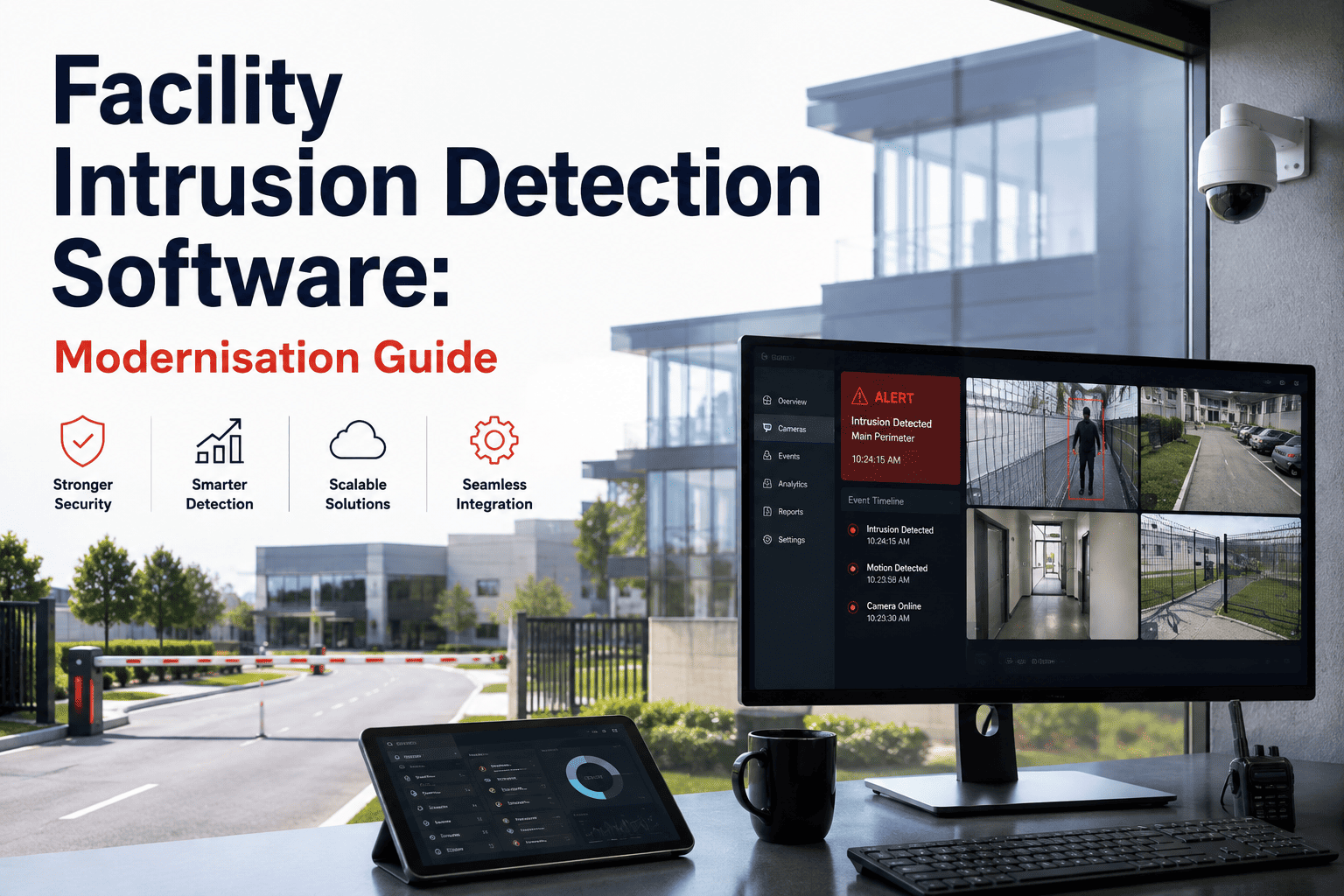
Facility intrusion detection software is undergoing its biggest shift in two decades: wired PIR sensors and standalone alarm panels are being retired in favor of IP-based sensors, dual-technology detection, and analytics-enabled alarms that integrate directly with a CMMS. If your facility still manages intrusion systems on paper logs and reactive service calls, you're exposed to false alarms, compliance gaps, and unplanned security downtime that modern platforms eliminate. This 2026 modernisation guide walks facility and reliability leaders through the top intrusion detection technologies, the real cost of legacy systems, and how a platform like OxMaint turns intrusion asset management into an audit-ready, data-driven operation. Whether you manage one building or a multi-site portfolio, the right facility intrusion CMMS pays for itself within months — Start Free Trial and see the difference on your own assets.
Is Your Intrusion Detection Stack Still Running on 2005 Technology?
Wired PIRs, analog panels, and paper inspection logs create blind spots that cost facilities an average of $18K–$45K per year in false alarm fees, emergency callouts, and compliance exposure. The top intrusion platforms of 2026 replace all of it with IP sensors, dual-tech detection, and CMMS-driven maintenance — here's exactly how to get there.
What Legacy Intrusion Systems Actually Cost You
A single false alarm dispatch runs $75–$250 in municipal fines — and legacy systems generate 3–5x more false alarms than modern dual-tech setups. Here's where the money leaks.
Consider a 200,000 sq ft distribution center running 85 wired PIRs, 12 door contacts, and a single analog panel. The facility logs inspections on paper, discovers dead sensors during quarterly walkthroughs, and pays $200 per false alarm dispatch. Last year they logged 47 false alarms ($9,400 in fines), 6 emergency service calls ($4,800), and spent 3 weeks assembling records for an insurance audit. Total avoidable cost: roughly $21,000 — more than the annual cost of a modern intrusion detection software platform with CMMS integration.
Wired PIR vs. IP-Based Dual-Tech: The 2026 Comparison
The best intrusion platforms of 2026 share a common architecture — IP-native sensors, dual-technology detection, and direct CMMS integration. Here's how the generations stack up.
| Capability | Legacy Wired PIR | 2026 IP-Based Platform |
|---|---|---|
| Detection method | Single-technology passive infrared — prone to false triggers from HVAC, sunlight, rodents | Dual-tech (PIR + microwave or PIR + camera analytics) — alarm only on confirmed dual-signature events |
| False alarm rate | 3–8 per sensor per year | 0.2–0.8 per sensor per year (up to 90% reduction) |
| Connectivity | Hardwired to a local panel; no remote visibility | IP/PoE or encrypted wireless; real-time status from any dashboard |
| Maintenance tracking | Paper logs, spreadsheet, or tribal knowledge | Automated PM schedules, digital checklists, and work orders in a CMMS like OxMaint |
| Compliance reporting | Manual assembly — days to weeks | One-click audit-ready reports (OSHA, NFPA, ISO 55000, insurance) |
| Analytics | None — alarm or no alarm | Event correlation, zone heat maps, predictive battery/health alerts |
| Typical 5-yr TCO (50 sensors) | $38K–$55K (hardware + false alarm fines + reactive service) | $22K–$31K (hardware + platform + minimal false alarms) |
The payback is clear: facilities that modernise to IP-based dual-tech detection and manage it through a facility intrusion CMMS typically recover the investment in 8–14 months through reduced false alarm fines, fewer emergency callouts, and lower insurance premiums.
How to Modernise Facility Intrusion Detection in 6 Months
Most facilities complete a full intrusion modernisation in 24–26 weeks without disrupting operations. Follow this proven timeline.
Catalog every sensor, panel, contact, and camera. Record age, condition, firmware, and false-alarm history. Import the register into OxMaint to establish your single source of truth — most teams finish in 5–10 working days.
Score each zone by criticality (perimeter, server room, loading dock, executive floor). Identify the 15–20% of sensors generating 80% of false alarms — these are your first replacement candidates.
Replace priority zones with IP-based dual-technology sensors. PoE simplifies cabling; encrypted wireless covers hard-to-reach areas. Each new sensor gets an asset record, PM schedule, and inspection checklist in OxMaint from day one.
Configure preventive maintenance intervals (quarterly sensor tests, semi-annual battery checks, annual panel firmware reviews). OxMaint auto-generates work orders, assigns technicians, and sends mobile notifications — no more paper logs.
Turn on dashboards for alarm trends, sensor health, and PM compliance. Generate your first audit-ready report for OSHA, NFPA 731, or ISO 55000 — the entire process takes under 2 hours instead of weeks.
Why Top Facilities Choose OxMaint as Their Intrusion CMMS
OxMaint isn't just a database — it's the operational layer that turns your intrusion detection hardware into a managed, compliant, cost-efficient system. Here's what you get.
Set quarterly sensor tests, battery replacements, and panel inspections once — OxMaint auto-generates work orders, assigns techs, and escalates overdue items. Facilities cut missed PMs by 85% in the first 90 days.
Every sensor, panel, and camera gets a digital twin with install date, warranty, service history, and health score. Know exactly when to replace vs. repair — extending average sensor life by 2–3 years.
Generate OSHA, NFPA, ISO 55000, and insurance-ready reports in one click. What used to take 90 days of manual assembly now takes under 2 hours — with a complete digital trail for every asset.
Facility directors see alarm trends, PM compliance, and sensor health at a glance. Technicians get mobile push notifications the moment a work order is assigned. Managers track cost-per-asset and downtime in real time.
Best Intrusion CMMS 2026: 8 Features That Matter
Not every platform calling itself an "intrusion detection software" actually manages the maintenance lifecycle. Use this checklist when evaluating the top intrusion tools for your facility.
OxMaint checks every box — and adds AI-powered predictive maintenance that flags sensor degradation before it causes a false alarm or a coverage gap. That's why facility teams evaluating the best intrusion CMMS 2026 consistently shortlist OxMaint.
See OxMaint on Your Intrusion Assets — Book a 30-Min Demo
We'll walk your team through a live setup using your actual sensor count, zones, and compliance requirements. No generic slides — just your facility, your data, your ROI.
Facility Intrusion Detection Software: FAQ
Facility intrusion detection software combines sensor management, alarm monitoring, and maintenance workflows into a single platform. Modern solutions like OxMaint add CMMS capabilities — preventive maintenance scheduling, work orders, asset tracking, and compliance reporting — so your intrusion system is maintained proactively, not just monitored reactively.
For a 50-sensor facility, expect $22K–$31K over 5 years including hardware, software, and maintenance — versus $38K–$55K for legacy wired systems when you factor in false alarm fines and emergency service calls. Most facilities see payback in 8–14 months. Book a Demo for a custom ROI estimate.
Yes. OxMaint's asset register and PM engine work with any sensor brand — wired, wireless, IP, or hybrid. You don't need to rip and replace everything at once; import your existing assets, set maintenance schedules, and modernise zone by zone on your own timeline.
Depending on your industry: OSHA recordkeeping, NFPA 731 (installation and maintenance of premises security systems), ISO 55000 (asset management), and insurer-specific requirements. OxMaint generates audit-ready reports for all of these with a complete digital maintenance trail.
Most teams import their asset register and go live within 1–2 weeks. OxMaint's onboarding includes data migration support, PM template setup, and mobile app configuration. There's no IT project required — it's a cloud platform your technicians can start using on day one. Start Free Trial and see for yourself.
Join Facilities Worldwide Running Intrusion Maintenance on OxMaint
Cut false alarms up to 90%, eliminate compliance scramble, and give every technician a mobile-first tool they'll actually use. Your first 14 days are free.