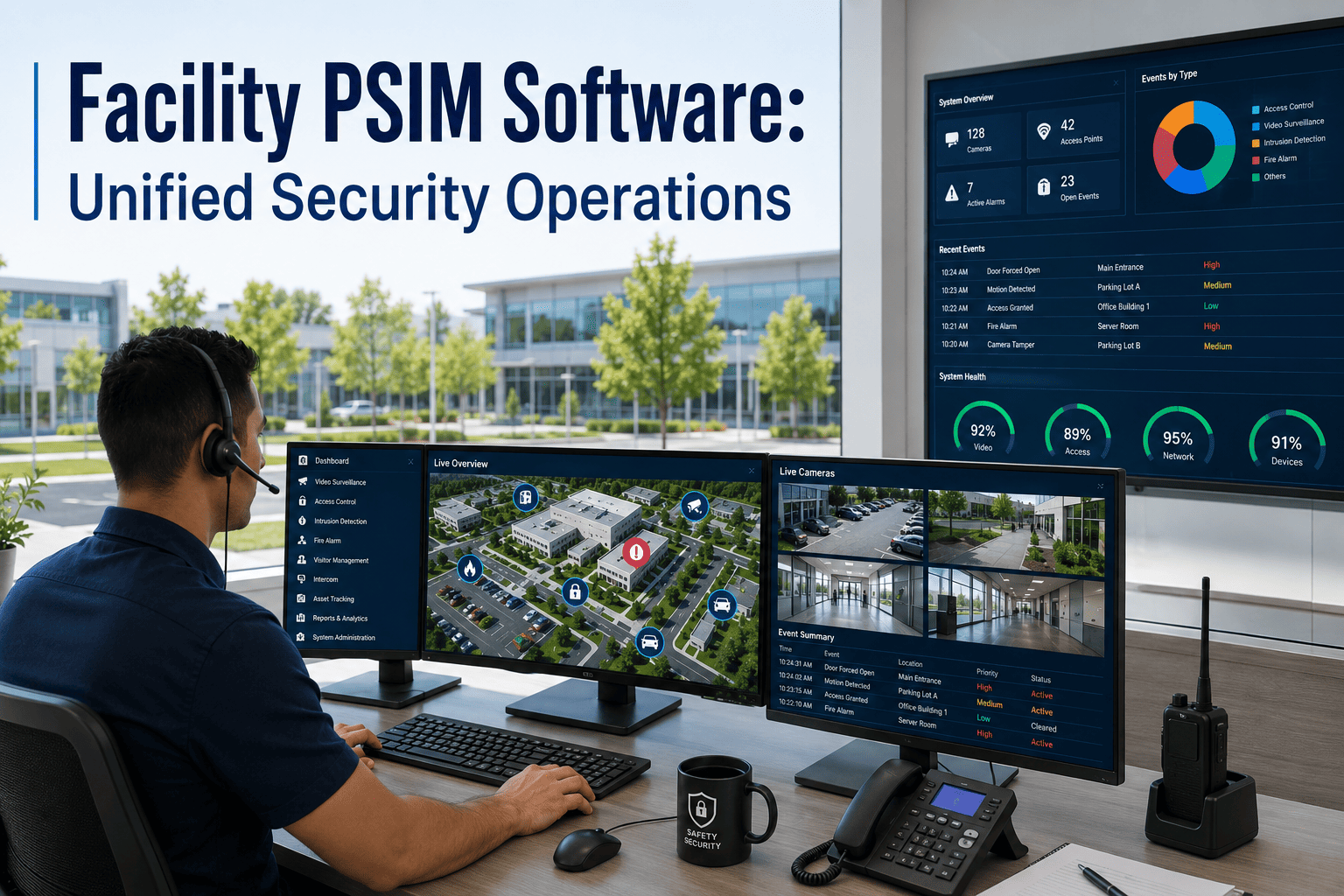
At 03:12 the loading dock camera stopped recording. Nothing appeared on the video wall, no operator was paged, and the incident board stayed green — because a dead camera does not raise an alarm. It raises nothing at all. Six days later a pallet theft investigation opened, the footage was requested, and the gap was discovered by the people who needed it most, at the worst possible moment. This is the structural blind spot in every unified security operation: a PSIM is exceptionally good at correlating the events your devices generate, and completely blind to the devices that have quietly stopped generating them. OxMaint closes that layer by treating every camera, reader, panel and sensor as a maintained asset with a health record.
Four numbers that define the gap between a green dashboard and a working security estate
Up to 30%
Of enterprise CCTV cameras are non-functional at any given moment, according to widely cited industry research
95%+
Camera uptime benchmark for enterprise deployments — below 90% signals a hardware, network or power fault needing action
96–97%
Share of burglar alarm calls to major metro police departments that turn out to be false, year after year
$4.17B
Projected PSIM market by 2030, up from roughly $2.27B in 2026 at about 16% compound annual growth
Where the PSIM Layer Ends and Nobody Picks Up
Unified security operations are usually drawn as a stack, and the drawing is accurate as far as it goes. Devices feed subsystems, subsystems feed the PSIM, the PSIM correlates and presents, the operator responds against an SOP. Every layer in that chain has a clear owner. Then there is a fifth layer underneath the whole thing that appears on no diagram and belongs to no team — the physical condition of the hardware the entire picture is built from.
Layer 5
Operator and SOP response
Triage, escalation, dispatch, incident record. Owned by the GSOC.
Layer 4
PSIM correlation and unified display
Event fusion across subsystems, rules, maps, single pane of glass. Owned by security technology.
Layer 3
Subsystems — VMS, access control, intrusion, fire
Each system healthy in its own console, each reporting only what it can see. Owned by system integrators.
Layer 2
Field devices — cameras, readers, contacts, panels
Thousands of endpoints across buildings, perimeters and remote sites. Owned in theory by everyone.
Gap
Device condition, maintenance history and end of life
Lens drift, failed PoE ports, corroded contacts, dying recorder drives, expired firmware, readers past service life. Owned by nobody — and invisible to every layer above it.
That bottom band is where security investment silently evaporates. It is not a technology gap; the PSIM is doing exactly what it was built to do. It is an ownership gap between the security organisation, which reasons in events and incidents, and the facilities organisation, which reasons in assets and work orders. Bring your device inventory to a working session and the size of the gap is usually apparent within an hour.
The Failures a PSIM Cannot Report
The distinction that matters operationally is between a fault that announces itself and a fault that removes the ability to announce anything. The first kind reaches the video wall. The second kind reaches nothing, and is discovered during an investigation, an audit, or a court disclosure request.
Device
Real-World Failure
Event Raised?
How It Is Usually Found
Fixed IP camera
Lens gradually defocused or obscured; stream still online
Silent
During footage review, when the image is unusable as evidence
Recorder or NVR
Drive degradation causing intermittent write failures and recording gaps
Silent
When a specific timestamp is requested and does not exist
Door contact
Magnet drift or mechanical wear producing recurring forced-door alarms
Noisy
Repeatedly cleared by operators as a known nuisance location
Card reader
Read-head degradation causing repeat badge presentations and tailgating
Silent
Complaints from staff, long after behaviour has already adapted
Network edge switch
PoE port failure taking a small cluster of devices offline
Partial
Noticed if someone reconciles the device list against the live estate
Perimeter detector
Alignment shift from weather or vegetation raising constant nuisance activations
Noisy
Suppressed in the rules engine rather than repaired in the field
Look at the last column of the noisy rows carefully, because it describes the most damaging failure pattern in unified security operations. A maintenance defect presents as a security event, the operator handles it as a security event, and the underlying fault is never routed to anyone who can fix it. The alarm keeps firing, the operator keeps clearing it, and eventually the location is filtered out entirely.
Nuisance Alarms Are a Maintenance Backlog Wearing a Costume
The false alarm numbers in physical security are not marginal. Major metropolitan police departments report that between 96% and 97% of burglar alarm calls are false, a figure that has barely moved in two decades. Some cities now cut off response entirely after as few as two false activations. Inside a GSOC, published estimates put nuisance events at up to 80% of all alarms reaching operators — and a large share of those trace back to a device that needs servicing, not a person who needs intercepting.
What Actually Arrives at a GSOC Operator Position
Total alarms presented to operators
Nuisance and non-actionable events
Traceable to a device fault or environmental defect
Genuine security events requiring response
Controlled research on alarm triage found that analysts working an 86% false alarm rate showed roughly 47% lower precision and were about 40% slower per alarm than those working a 50% rate. Alarm fatigue is not a morale problem — it is a measurable degradation in the accuracy of the human layer you are paying for.
Every nuisance alarm that traces to a faulty contact, a misaligned detector or a weather-exposed housing is a maintenance work order that was never raised. Fix the device and the alarm disappears permanently; suppress the rule and you have created a blind spot with paperwork. Routing recurring alarms into work orders is the single highest-yield change most security operations can make.
Device Integrity for Unified Security Operations
Your PSIM Unifies the Events. Something Has To Unify the Devices.
OxMaint gives every camera, reader, panel, recorder and detector an asset record, a maintenance schedule, a fault history and an end-of-life date — so the estate your unified operating picture depends on is verifiably alive.
Two Lanes, One Operating Picture
This is not an argument for replacing a PSIM with a maintenance platform, and any vendor telling you otherwise is selling badly. The two systems answer different questions on different clocks. A unified security operation works when both lanes run and the handoffs between them are automatic rather than conversational.
PSIM / GSOC lane — seconds to minutes
OxMaint lane — hours to years
Correlates access, video, intrusion and fire events into one picture
Holds the asset record for every device generating those events
Drives SOP-based operator response and escalation
Drives preventive schedules, inspections and firmware currency
Records what happened during the incident
Records whether the device was serviceable when it happened
Flags a recurring alarm at a known location
Converts that recurrence into a corrective work order with a due date
Reports incident volume, response time and closure
Reports device uptime, MTTR, backlog age and replacement forecast
The handoff runs both directions. A repeated alarm becomes maintenance work; a device under maintenance becomes a known, documented coverage gap rather than an unnoticed one.
The practical test of whether both lanes are running is simple. Pick any door on your access control system and ask two questions: when did it last generate an alarm, and when was the contact last physically inspected. In most organisations the first answer takes seconds and the second answer does not exist. That asymmetry is the whole problem in miniature — the event history is meticulous, the condition history is absent, and decisions about coverage and risk are being made on half the picture.
What to Require From Your 2026 Stack
Procurement pressure is moving in one direction. In June 2026 the US General Services Administration published baseline minimum security standards for video surveillance and intrusion detection systems in federally owned facilities, and earlier that year the State Department went to market for a globally deployed PSIM integrating video, access control, intrusion detection and 3D mapping at better than 99.9% availability. Availability commitments of that kind cannot be met by correlation software alone — they are maintenance commitments. Use this as your evaluation list.
Device-level asset register
Every endpoint carried as an individual asset with make, model, install date, firmware, location, parent panel and expected service life — not a line item in a project spreadsheet.
Alarm-to-work-order routing
A recurring or diagnostic event should create a corrective job against the device automatically, with the originating event referenced so the chain survives audit.
Uptime and MTTR reporting by asset
Availability commitments need evidence per device and per site, not a screenshot of a healthy dashboard taken on a good day.
Documented coverage gaps
When a device is down or under maintenance, the gap should be logged, time-bounded and visible — because an undocumented blind spot is the one that appears in litigation.
Offline mobile execution
Riser rooms, roof lines, perimeters and remote gatehouses have poor connectivity. Work completed at the device with QR asset lookup beats work written up hours later.
Retention and export discipline
Maintenance evidence held per asset for the retention period your regulator, insurer or accreditation body expects, exportable without a manual reconstruction exercise.
How the Device Lifecycle Runs in OxMaint
The workflow is deliberately simple, because a maintenance discipline that requires enthusiasm does not survive its first busy quarter. What makes it stick is that nothing depends on anyone remembering an interval, and nothing depends on a technician transcribing findings into a second system after the fact. The schedule generates the work, the work captures the evidence, and the evidence accumulates against the device rather than against a project folder.
01
Register and tag the estate
Every camera, reader, panel, recorder and detector becomes an asset with a QR tag, a parent-child hierarchy and a location, so field lookup takes seconds rather than a call to the integrator.
02
Schedule the preventive cycle
Lens cleaning, housing and seal checks, alignment verification, reader surface inspection, recorder storage checks and firmware currency, each on its own interval with automatic work orders.
03
Convert recurring events into corrective work
Nuisance patterns and diagnostic faults raise linked corrective jobs with priority, assignee and due date — closing the loop that currently ends at an operator clicking acknowledge.
04
Report availability and prove it
Uptime, mean time to repair, open backlog by criticality and replacement forecasting per site — the evidence set that turns an availability promise into a defensible number.
Where This Matters Most
Every estate benefits, but four environments feel the device-integrity gap immediately because their coverage obligations are contractual, regulatory or life-safety rather than discretionary. In each of them the question asked after an incident is not whether a system existed, but whether it was demonstrably working on the day in question — and that is a maintenance record, not a security record.
Data Centres
Customer audits examine camera coverage and access logs directly. A silent recording gap is a finding against a contractual commitment, not an internal issue.
Healthcare Campuses
Infant protection, pharmacy access and behavioural health areas carry coverage expectations that accreditation surveyors test with evidence rather than assurance.
Critical Infrastructure
Perimeter detection and multi-site monitoring sit under regulatory scrutiny where documented device availability is part of the compliance posture itself.
Multi-Site Retail and Logistics
Hundreds of small sites with no local technical staff, where a failed camera is invisible until a loss investigation needs the footage it never captured.
Frequently Asked Questions
Is OxMaint a PSIM, and would it replace our VMS or access control platform?
No. OxMaint is a maintenance management platform that sits underneath and alongside your security stack. The PSIM correlates events and drives operator response; OxMaint owns the condition, schedule, fault history and lifecycle of the devices producing those events.
A demo shows exactly where the boundary sits.
How do we find devices that are already failing silently?
Start with a reconciliation: compare the device list in each subsystem against a physical inventory, then review recorded footage quality on a sample rather than trusting online status. Cameras that are online but unusable are the largest hidden category in most estates.
Why route security alarms into maintenance at all?
Because a large share of nuisance alarms are mechanical or environmental defects, not security events. Suppressing them in the rules engine creates a permanent blind spot; repairing the device removes the alarm and restores the coverage at the same time.
What uptime target should we set for security devices?
Enterprise practice benchmarks camera availability above 95%, with anything below 90% treated as an active fault condition. The number matters less than measuring it per device and per site —
so the trend is visible rather than the snapshot.
Can this work across many sites with no local technicians?
Yes, and that is where it pays back fastest. Centrally scheduled work, QR-tagged assets, offline mobile capture and contractor-facing work orders let a small central team hold a defined maintenance standard across hundreds of unstaffed locations.
OxMaint — Facility Security Device Integrity
A Green Dashboard Is Not Evidence. A Maintained Estate Is.
Every device
tracked as an asset
Every alarm
routable to a work order
Give your unified security operation the layer it has always been missing — verifiable device condition, scheduled preventive work, and availability you can actually prove to an auditor, an insurer or a customer.