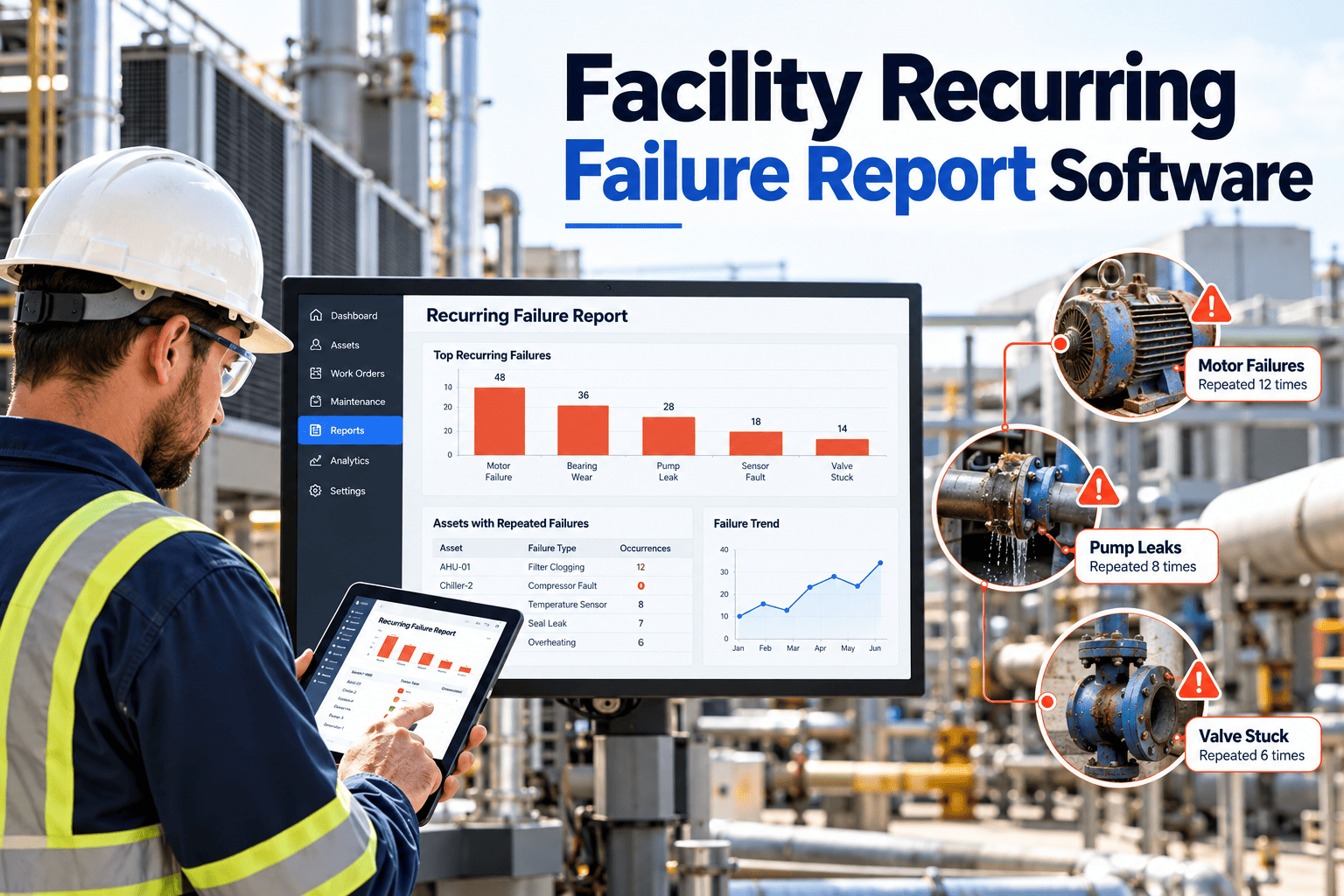
Every facility has them: the rooftop unit that trips every August, the sump pump that fails after each storm, the door controller that gets reset weekly. Each repair closes a work order, yet the same failure returns because nobody can see the pattern across dozens of separate tickets. Recurring failure reporting turns that scattered history into a short list of chronic problems worth fixing at the root. For teams ready to test this on their own equipment, you can book a walkthrough with Oxmaint and bring a few of your worst assets along.
Facility Recurring Failure Report Software: Find the Failures That Keep Coming Back
Group repeat breakdowns by asset, component, and cause, then send the right fix to the right team. Designed for reliability engineers, maintenance supervisors, and facility directors.
What actually counts as a recurring failure
A single breakdown is an event. A recurring failure is a pattern, and patterns can be found from three different angles.
A useful rule: choose a repeat window, such as the same symptom on the same asset within 90 days, and flag every work order that meets it. The exact window should match how fast your equipment normally cycles.
Why the same failure keeps happening
Repeat failures usually come from fixing the symptom that was visible rather than the cause that was hidden. Here is how that looks in practice.
The few-assets-cause-most-repeats effect
In most maintenance histories, a small share of assets generates a large share of repeat work. The bars below show a sample of how a Pareto view looks. The figures are illustrative only, not a benchmark.
The takeaway is where to start. Fix the top few bad actors properly and you free technician hours for everything else.
See which assets keep pulling your team back
Oxmaint links work orders to assets so repeat repairs stand out instead of hiding in a pile of tickets.
Prioritizing repeat failures with a frequency and consequence matrix
Not every repeat deserves the same urgency. Plot each chronic problem by how often it happens and how much it hurts when it does.
- Consequence covers safety risk, tenant impact, regulatory exposure, repair cost, and downtime.
- Frequency comes from work order counts inside your chosen repeat window.
- Act now items should get a formal root cause review and an owner within days, not weeks.
A five-step root cause workflow for recurring failures
Where repeat failures usually hide in a facility
Patterns differ by system. Use this table as a starting point for what to inspect first.
| System | Common repeat symptom | First place to look |
|---|---|---|
| HVAC and rooftop units | Compressor trips, frozen coils, comfort complaints | Filter and coil cleaning intervals, airflow, refrigerant and electrical readings |
| Pumps and hydronics | Seal leaks, bearing noise, loss of pressure | Alignment, lubrication, strainer condition, operating point |
| Electrical and generators | Nuisance trips, failed transfer tests, battery faults | Connections, load levels, test records, battery age |
| Plumbing and water | Repeat leaks, low hot water, valve failures | Water quality, pressure spikes, valve cycling, corrosion |
| Vertical transport | Door faults and callouts on the same car | Vendor service reports, door hardware wear, call-back history |
| Building envelope and roofing | Leaks at the same flashing, drain, or penetration | Drainage, sealant age, inspection photos before and after storms |
| Fire and life safety | Repeat panel troubles and failed device tests | Device age, environmental exposure, inspection findings left open |
The data a recurring failure report depends on
Reports can only group what technicians record. Capture these fields at closeout and the analysis largely takes care of itself.
Identify the failure
- Specific asset, not just the room or building
- Failed component or sub-assembly
- Symptom as observed by the technician
- Date, shift, and operating condition
Explain the failure
- Failure cause from a standard code list
- Whether a PM was due, missed, or completed
- Parts used and labor hours
- Photos and short notes from the repair
Free-text descriptions are hard to group. A short, consistent set of failure codes, informed by taxonomies such as ISO 14224, makes pattern analysis far more reliable.
Before and after: how one work order record changes
Record that hides the pattern
Pump down. Replaced part. Working now. No asset ID, no cause, no parts, no hoursRecord that reveals it
Asset BP-02. Bearing failure. Cause: lubrication interval missed. Parts logged. 2.5 labor hours. Photo attached. Searchable by asset, component, cause, and dateMetrics that show whether recurring failures are shrinking
Standards and compliance angles worth knowing
Recurring failures are not only a cost issue. They can become a documentation and safety problem.
- Fire and life safety: repeated impairments on alarms or sprinklers must be recorded and corrected under applicable NFPA requirements and local rules.
- Workplace safety: chronic failures of guarding, lighting, or ventilation can create OSHA exposure if they remain unresolved.
- Asset management: ISO 55000 emphasizes evidence-based decisions, which a clean failure history supports.
- Reliability practice: reliability-centered maintenance methods use failure history to adjust task content and intervals.
Technology trends affecting failure analysis in 2026
How Oxmaint supports recurring failure reporting
Oxmaint is a cloud-based CMMS that connects day-to-day work to the history reliability teams need.
| What you need | How Oxmaint helps |
|---|---|
| A clear record per asset | Asset management keeps repairs, parts, and notes attached to each piece of equipment, reachable through QR asset tags. |
| Consistent capture in the field | Mobile apps with offline mode let technicians record findings in mechanical rooms and remote sites. |
| Fixes that stick | Corrective work orders and updated preventive maintenance tasks turn analysis into scheduled action. |
| Root cause documentation | Root cause analysis logs capture what was found and what was changed. |
| Early warning | IoT sensor data can sit alongside work history to support condition-based workflows. |
| Visibility for leaders | Dashboards and reports summarize trends for directors and audit reviews. |
Recurring failure report software: frequently asked questions
Turn chronic breakdowns into fixes that last
Give your team one place to flag repeats, find root causes, and prove the problem is gone.