Facilities chasing a credible waste diversion number face a stubborn problem: recycling logs, hauler invoices, and compost tickets rarely live in one place, so nobody can say with confidence whether the site is at 60% diversion or 90%. A facility waste benchmark program fixes that by tying every waste stream to measurable, auditable data instead of estimates written after the fact — the same discipline that underpins the TRUE Zero Waste rating system from GBCI.
Could your facility pass a TRUE Zero Waste audit today?
TRUE-certified facilities must divert at least 90% of nonhazardous waste from landfill, incineration, and the environment for 12 consecutive months, with contamination held below 10%. Most sites cannot prove that number because diversion data is scattered across haulers, spreadsheets, and memory rather than tracked at the source.
Waste diversion is now a measurable operational metric, not a policy statement
Solid waste disposal contributes close to 200 million metric tons of carbon dioxide equivalent in greenhouse gas emissions across North America every year, much of it from organic material that never should have reached a landfill in the first place. Facilities pursuing a genuine zero waste program — whether for TRUE certification, a corporate ESG target, or a procurement requirement — need diversion data that stands up to a third-party audit.
The gap between a facility's claimed diversion rate and its documented diversion rate is usually where certification timelines stall. A site might genuinely be recycling and composting well above 90% of its waste, but if that performance was never logged stream by stream, pickup by pickup, there is nothing for a GBCI assessor to verify — and "trust us" is not an accepted evidence category in a facility audit.
Why the audit trail matters: GBCI assessors verify diversion claims against hauler tonnage reports, internal waste audits, and a documented zero waste policy — not a single end-of-year estimate. A facility that logs stream-level data only during a scramble before renewal typically cannot reconstruct 12 months of defensible history, which is the single most common reason certification timelines slip.
Waste diversion tracking has moved from optional to expected
TRUE-certified facilities now span manufacturing plants, distribution centers, corporate campuses, breweries, and retail supply chains — organizations including Microsoft, Tesla, and Sierra Nevada Brewing have certified sites under the program. The common thread is not industry, it is accountability: a procurement contract, an ESG commitment, or an internal sustainability target that requires a number backed by evidence.
Large multi-site retailers and electronics companies have committed entire supply chain footprints to zero waste certification, working through their facilities one at a time over several years. That kind of rollout only works if diversion data collection is standardized from the first site onward, because retrofitting record-keeping across dozens of locations after the fact is far more expensive than building it in from day one.
Even facilities with no near-term certification plan increasingly need this data for other reasons: landfill tipping fees keep rising in most metro markets, insurers and lenders are starting to ask ESG-adjacent questions during due diligence, and corporate sustainability teams need site-level numbers to roll up into a portfolio-wide diversion figure. Building the tracking habit now, tied to the CMMS a facility already runs on, means that whichever reporting requirement arrives next, the underlying data is already there.
The four root causes behind failed waste benchmark data
Hauler tickets never reach the facility team
Tonnage and contamination data sits in a waste hauler's back office and arrives, if at all, as a PDF invoice nobody reconciles against actual diversion targets.
No stream-level breakdown
Facilities track total waste out the door but not the split between recycling, composting, reuse, and landfill, which is exactly what a TRUE assessor checks first.
Contamination goes unmeasured until it is a rejection
Without routine bin audits, contaminated recycling streams get discovered only when a hauler downgrades or rejects a load, quietly eroding the diversion rate.
Diversion work is disconnected from maintenance operations
Compactor faults, overflowing bins, and missed pickups are handled as ad hoc requests rather than logged work orders, so there is no record to hand an auditor.
None of these four gaps are caused by a lack of effort from facility teams — they are a structural problem. Waste has historically been managed outside the CMMS that already tracks every other piece of equipment on site, so it never inherits the same discipline of scheduled inspections, logged repairs, and dashboard visibility that HVAC or production assets get by default. Bringing waste equipment into the same system used for chillers and conveyors is a configuration change, not a new platform purchase.
What changes when waste tracking moves into the CMMS
Before: reactive, undocumented, estimate-driven
Diversion rate is calculated once a year from hauler invoices. Contamination is discovered only when a load is rejected. Compactor downtime is tracked nowhere. Certification renewal means weeks of reconstructing records from email threads.
After: continuous, evidenced, audit-ready
Every waste asset is tagged and scheduled for inspection. Diversion rate updates as data comes in, not once a year. Compactor faults are logged as work orders with resolution history. Certification renewal is an export, not a project.
Mapping the waste stream from generation to diversion
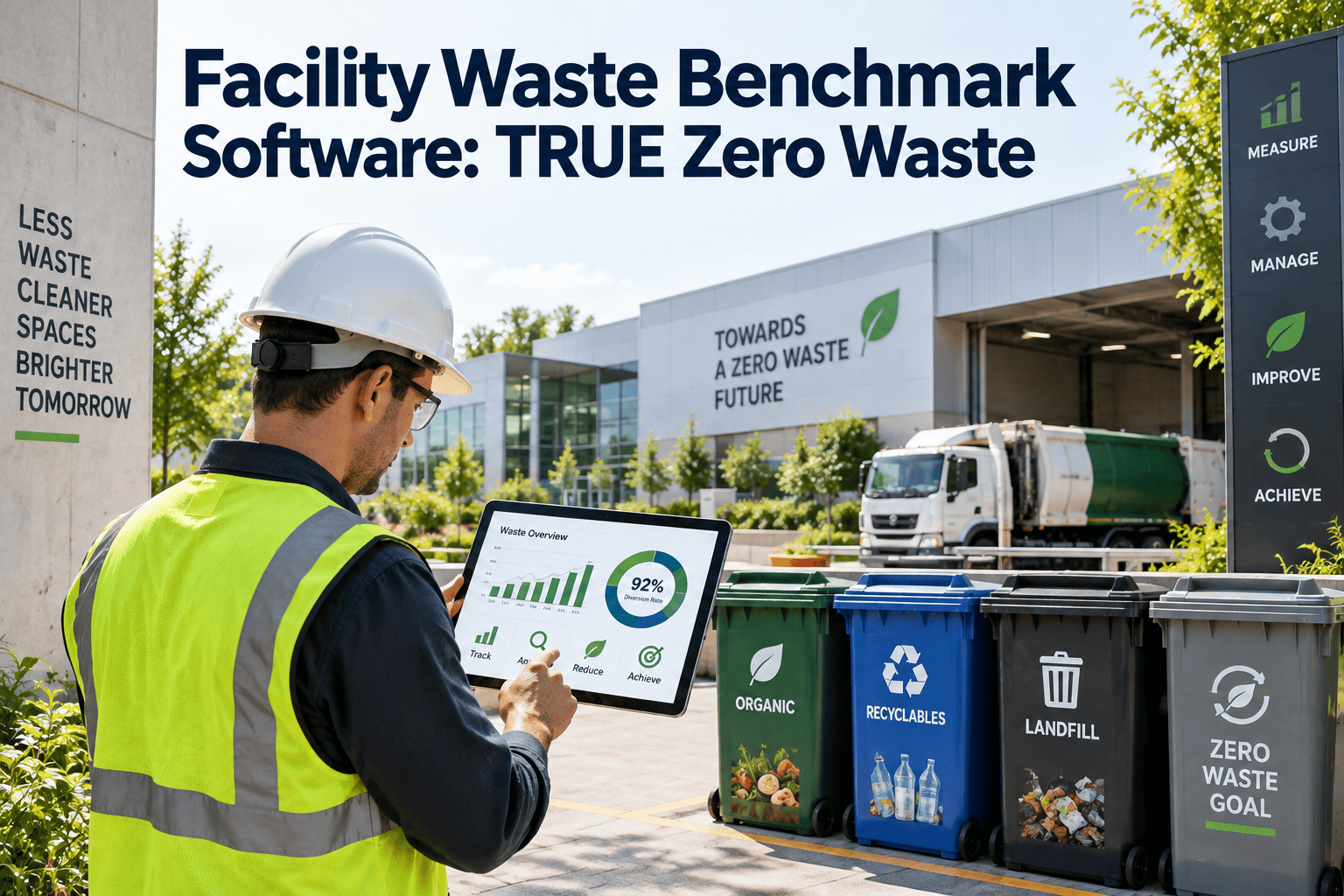
TRUE's whole-systems approach starts by tracing how material actually moves through a facility. The flow below is the same structure OxMaint uses to tag assets and route work orders by stream, so every ton generated has a documented destination.
Waste tagged at the source — production floor, kitchen, office, dock
Stream split into recyclables, compostables, reusable materials, and residual waste
Tonnage recorded per stream, per pickup, against hauler documentation
Recycler, composter, reuse partner, or waste-to-energy — landfill only as the last resort
Twelve months of stream-level data ready for internal review or GBCI assessment
Turn hauler tickets into an audit-ready diversion record
See how OxMaint tags assets by waste stream and logs contamination checks automatically.
What a TRUE Zero Waste assessor actually checks
Certification is built on documentation, not intentions. Before submitting a project, facility teams should be able to answer every item below with a record, not a guess.
Working through this list six to twelve months before a planned submission date gives a facility time to close gaps — building missing contamination audit habits, filling in vendor documentation, or simply accumulating enough clean data to cover the required 12-month window — rather than discovering the shortfall during the assessor's onsite review.
Spreadsheet tracking versus asset-linked diversion data
| Diversion Tracking Task | Manual / Spreadsheet | OxMaint CMMS |
|---|---|---|
| Stream-level tonnage logging | Entered after invoices arrive, often incomplete | Logged against tagged assets at each pickup |
| Contamination audits | Ad hoc, undocumented walk-throughs | Scheduled inspection checklist with photo evidence |
| Compactor and bin repairs | Phone calls, no maintenance history | Work order tied to the asset, closed with a record |
| 12-month diversion rate | Recalculated manually before renewal | Running total visible on a live dashboard |
| Assessor documentation | Assembled under deadline pressure | Exported in minutes from work order history |
Building a defensible waste benchmark inside your CMMS
OxMaint does not replace your waste hauler or your certification consultant — it gives your maintenance and facilities team the operational backbone to prove the numbers those partners need. Waste assets get the same treatment as any other critical equipment: tagged, scheduled, inspected, and reported on.
Asset Tagging by Waste Stream
Compactors, balers, and collection points are logged as assets with a designated stream, so every work order and inspection rolls up to the right diversion category.
Scheduled Contamination Inspections
Recurring digital checklists catch cross-contamination before a hauler flags a load, with photo evidence attached to each completed inspection.
Work Orders for Waste Equipment
Compactor jams, baler faults, and bin damage are logged, assigned, and closed like any other maintenance task — building a repair history auditors can review.
Diversion Dashboards & Reports
Stream-level tonnage, contamination trends, and rolling 12-month diversion rate are visible in one dashboard, exportable for internal review or third-party assessment.
Preventive Maintenance on Waste Equipment
Compactors and balers get the same PM scheduling as any critical asset — belt checks, hydraulic service, and door seal inspections — reducing the breakdown-driven overflow events that quietly push material into the wrong stream.
Mobile Inspections for Field Teams
Technicians complete contamination checks and bin condition inspections from a phone at the dock or compactor, attaching photos on the spot instead of writing notes up later from memory.
How waste benchmark data supports broader compliance reporting
A well-structured waste diversion record rarely serves only TRUE certification. The same stream-level tonnage and contamination data feeds ISO 14001 environmental management audits, GHG Protocol Scope 3 disposal-related emissions reporting, and internal ESG disclosures that increasingly ask for waste diversion by category rather than a single blended figure.
Facilities that build this data once, inside a system that already manages compliance records for safety and asset inspections, avoid running three separate reporting processes for what is fundamentally the same underlying data — pulled at different levels of detail for different audiences.
| Reporting Requirement | Data Needed | Sourced From |
|---|---|---|
| TRUE Zero Waste certification | 12-month stream diversion, contamination rate | Waste asset work orders and inspections |
| ISO 14001 environmental audit | Documented waste handling procedures | Standard operating procedures linked to assets |
| GHG Protocol Scope 3 reporting | Disposal-related emissions by material category | Diversion dashboard export by stream |
| Corporate ESG disclosure | Diversion rate trend, cost avoided | Portfolio-level reporting across sites |
Rolling out a waste benchmark program without disrupting operations
Facility teams do not need to overhaul their hauler contracts or waste infrastructure to start benchmarking. The rollout typically follows a short sequence that fits inside existing maintenance workflows rather than adding a parallel program.
Compactors, balers, and collection points entered into the CMMS with a stream designation
Recent hauler tonnage records loaded to establish a starting diversion rate
Recurring contamination checks assigned to technicians on a fixed cadence
Diversion rate tracked live, exported when a renewal or audit is due
Frequently asked questions about facility waste benchmark software
What waste diversion rate is required for TRUE Zero Waste certification?
TRUE-certified projects must divert a minimum of 90% of nonhazardous waste from landfill, incineration, and the environment, measured over 12 consecutive months and resubmitted annually to keep the certification current. Contamination in each stream must also stay below 10% for the numbers to count.
Does a CMMS replace the need for a zero waste consultant?
No. A CMMS like OxMaint provides the asset-level tracking, inspection records, and work order history a consultant or GBCI assessor needs — it supports the certification process rather than replacing the assessment itself.
How does OxMaint track contamination rates per waste stream?
Recurring digital inspections are scheduled per waste asset, with technicians logging contamination observations and photo evidence that feed directly into the diversion dashboard. Get Started to configure your first inspection template.
Can OxMaint benchmark waste performance across multiple sites?
Yes. Diversion rate, contamination trend, and open work orders are visible per site and rolled up to a portfolio view, making it straightforward to identify which locations need attention before a certification renewal.
How long does it take to set up waste stream tracking in OxMaint?
Most facility teams tag their waste assets and configure inspection schedules within one to two weeks, with historical hauler data imported during onboarding so the diversion baseline is not lost.
Build the audit trail your next waste benchmark actually needs
Tag your waste assets, schedule contamination checks, and generate a defensible diversion report — start with OxMaint today.
Free 14-day trial · No credit card