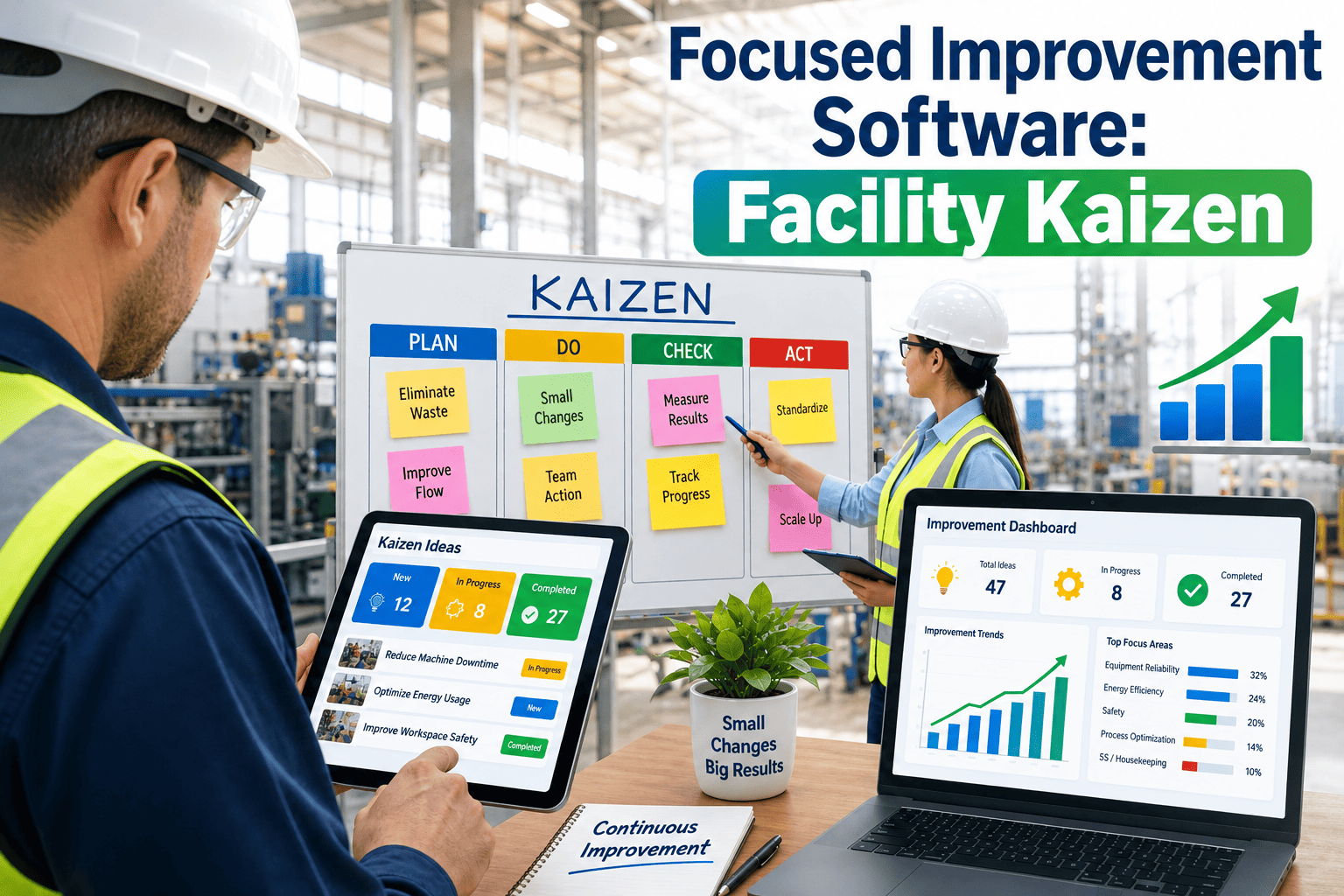
Facility teams chasing lower downtime and provable cost savings in 2026 are moving focused improvement off the whiteboard and into software. Kobetsu Kaizen — the focused improvement pillar of TPM — depends on picking the right problem, running a structured root cause analysis, and proving the dollar value of the fix, and that discipline collapses fast on spreadsheets and sticky notes. Plants without a system lose track of open Kaizen events, miss follow-up dates, and can rarely show finance what their improvement teams actually saved. This guide breaks down what focused improvement software should do, ranks the platforms leading the category in 2026, and shows what a closed-loop Kaizen event actually looks like in practice. Start a free trial with OxMaint or book a demo to see a live Kaizen event tracker.
Focused Improvement · Kobetsu Kaizen · Facility CMMS 2026
Focused Improvement Software: Turn Every Kaizen Idea Into a Tracked, Verified Win
Kaizen event tracking, root cause analysis, PDCA workflows, and ROI capture — built for facility teams who are tired of improvement ideas dying in a notebook.
70%
Of Kaizen ideas raised on paper or whiteboards are never formally closed out
$5K–$20K
Estimated annual value lost per operator when improvement ideas go untracked
14 Days
Typical time to first measurable OEE gain once Kaizen tracking goes digital
6
Big losses focused improvement software is built to systematically eliminate
The Fundamentals
What Focused Improvement Software Actually Needs to Do
Kobetsu Kaizen is not a suggestion box — it is a structured cycle of picking a loss, forming a cross-functional team, testing a countermeasure, and verifying the result before the fix becomes standard work. Facility Kaizen software exists to hold every stage of that cycle accountable, from the first flagged inefficiency to the final signed-off savings figure.
Event Tracking
Kaizen Event Register
A living log of every improvement idea — who raised it, which loss category it targets, current stage, and owner. No idea sits untracked in a notebook or a hallway conversation again.
Diagnosis
Root Cause Analysis Tools
Guided 5-Why and fishbone workflows attached directly to the asset and fault history, so teams fix the actual cause instead of the symptom that keeps coming back.
Big Losses
Loss Category Mapping
Every event tagged against the six big losses — breakdowns, setup delays, minor stops, reduced speed, defects, and yield loss — so leadership sees exactly where waste concentrates.
Discipline
PDCA Workflow Enforcement
Plan, Do, Check, Act stages built into the event itself, with required sign-off before an event can move forward — so countermeasures get verified, not just declared done.
Proof
ROI and Savings Capture
Baseline versus post-fix performance captured automatically from asset and OEE data, giving finance a defensible savings number instead of an estimate on a slide.
Visibility
Cross-Facility Dashboards
Every open, overdue, and closed Kaizen event visible across every site in one view — the difference between a program leadership can manage and one they can only hope is working.
2026 Rankings
Top Focused Improvement and Kaizen CMMS Platforms Compared
Evaluated on the capabilities that actually determine whether a focused improvement program survives past its first quarter: structured event tracking, root cause tools, OEE and IoT connectivity, and verified ROI reporting. A platform that only logs ideas without closing the loop back to a savings figure will not sustain a Kaizen culture.
OxMaint · Focused Improvement · Kaizen Tracking
Stop Losing Kaizen Ideas to Whiteboards and Spreadsheets
OxMaint gives every facility a single Kaizen event register, guided root cause analysis, and automatic savings capture tied to real asset data — so your focused improvement program produces numbers leadership can actually trust at review time.
How It Works
How OxMaint Turns a Kaizen Idea Into a Closed, Verified Event
Every stage of Kobetsu Kaizen — from a floor operator flagging a recurring jam to finance seeing a confirmed savings number — happens inside one workflow. Nothing gets lost between the idea and the close-out.
01
Capture the Idea at the Source
Operators log an improvement idea from the mobile app in seconds, tagged to the asset and loss category automatically. No idea slips into a break-room conversation and disappears.
02
Build the Cross-Functional Team
OxMaint assigns operators, technicians, and engineers to the event with clear ownership and a target date, matching the cross-functional structure Kobetsu Kaizen requires to work.
03
Run Guided Root Cause Analysis
Structured 5-Why and fishbone tools pull directly from fault code and maintenance history, so the team tests the real cause instead of guessing at a fix.
04
Verify the Result and Capture ROI
Post-fix performance is compared against the documented baseline automatically, producing a defensible savings figure attached to the closed event — ready for the next leadership review.
Program Impact
What a Digitized Focused Improvement Program Moves
Kaizen Ideas Formally Closed Out
Up from ~30%
Time to First Measurable OEE Gain
As fast as 14 days
Recurring Micro-Stops Eliminated
Tracked per asset
Improvement Ideas Visible Fleet-Wide
Every site, one dashboard
Why It Matters
The Real Cost of Running Focused Improvement on Paper
70%
Ideas Never Closed
Untracked Kaizen ideas raised in meetings or on paper routinely go unresolved, killing the culture of continuous improvement they were meant to build.
200+
Operators, One Blind Spot
A single untapped improvement idea per operator, multiplied across a plant, adds up to millions in unrealized savings every year.
4x
Recurrence Without RCA
Fixes applied without structured root cause analysis are far more likely to recur, consuming the same maintenance hours repeatedly.
1
Dashboard, Every Site
Multi-facility operators need a single view of every open and closed Kaizen event to know whether the program is actually working.
Facility Team Questions
Focused Improvement Software — Common Questions
What is the difference between Kaizen and Kobetsu Kaizen (Focused Improvement)?
+
Kaizen is the broad philosophy of continuous improvement across an organization. Kobetsu Kaizen, the focused improvement pillar of TPM, is a specific structured event targeting one quantified loss with a defined team and timeline.
Start a free trial to run your first structured event.
What are the six big losses focused improvement targets?
+
Breakdowns, setup and adjustment delays, idling and minor stops, reduced speed, process defects, and reduced yield. Focused improvement software maps every Kaizen event to one of these categories so leadership can see exactly where waste concentrates.
How fast can a facility see results from a digital Kaizen program?
+
Facilities that move from paper tracking to a structured digital workflow typically see a measurable OEE gain within about two weeks, once ideas stop stalling between capture and root cause analysis.
Book a demo to see this in your own data.
Does focused improvement software replace our existing kaizen boards?
+
No. It complements physical kaizen boards and existing lean routines by giving every event a digital record, an owner, a deadline, and a verified savings figure once closed — turning a visual habit into an auditable one.
How is ROI actually calculated on a closed Kaizen event?
+
Baseline performance for the asset is recorded when the event opens. Once the countermeasure is verified, post-fix performance is compared against that baseline automatically, producing a savings figure tied directly to real asset data rather than an estimate.
OxMaint · Focused Improvement · Facility Kaizen
Give Your Facility's Best Ideas a System That Actually Closes Them Out
OxMaint captures every Kaizen idea, guides the root cause analysis, and turns the fix into a verified, dollar-backed result — all inside the same CMMS running your preventive maintenance. Start building a focused improvement program leadership can see, trust, and repeat.