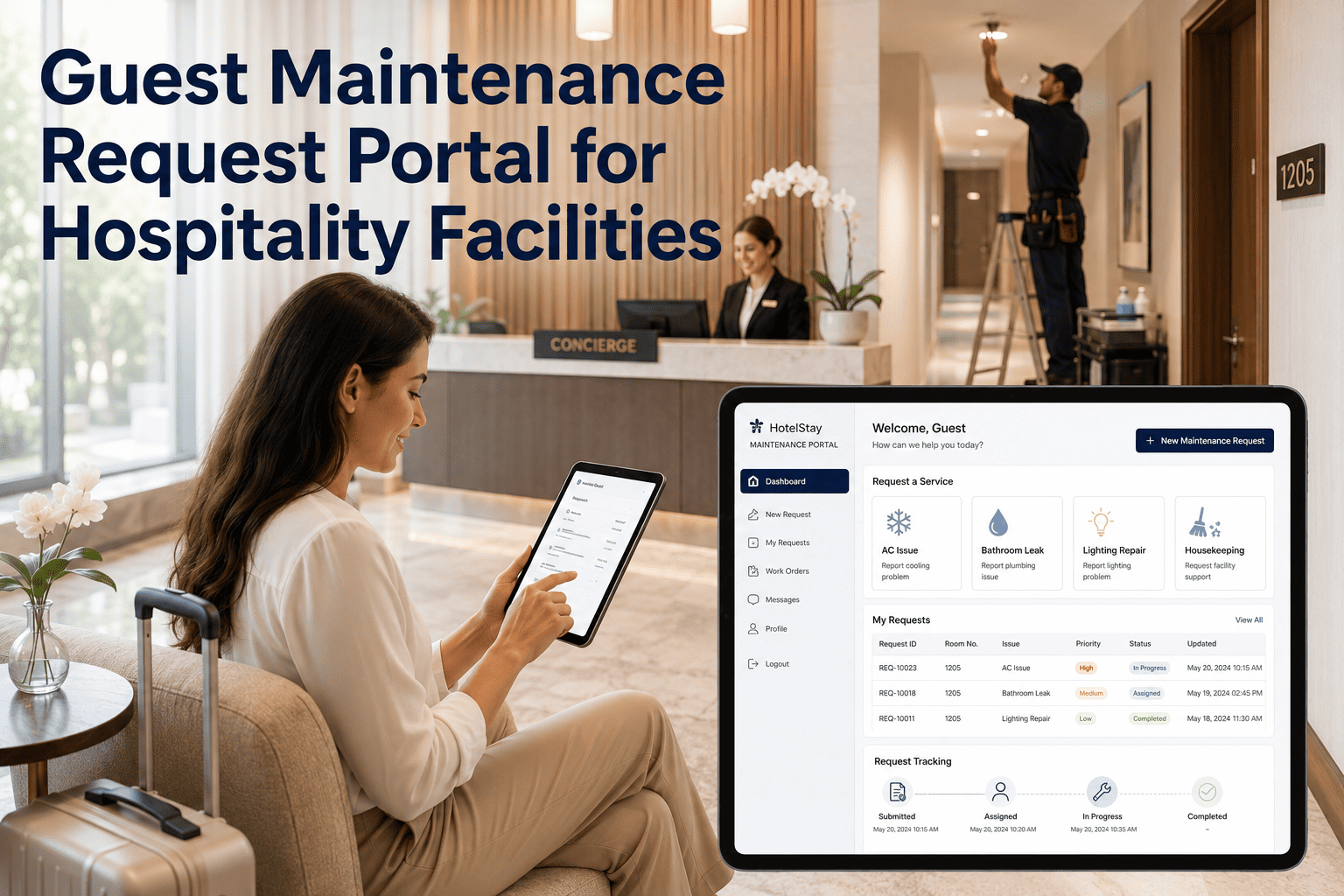
Guest Maintenance Request Portal for Hospitality Facilities
By Lewis Abbott on June 27, 2026
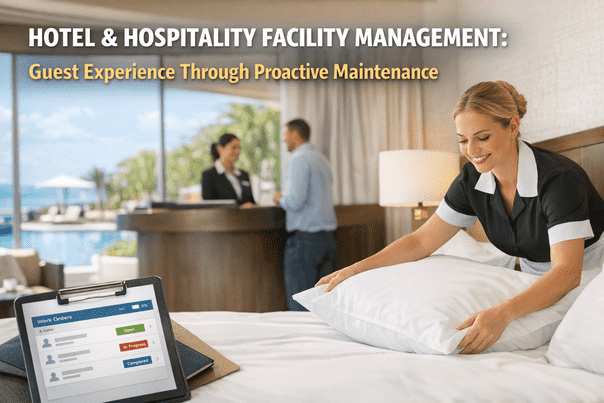
The 2024 TrustYou industry study identified one factor that drags down US hotel guest satisfaction scores more than any other — and it is not bed comfort, breakfast quality, or front-desk friendliness. It is unresolved room-condition and maintenance issues. A leaking shower at 11:30 PM, an AC unit that will not cool below 78°F, a TV remote that has run out of batteries since the last guest checked out — these are the small failures that quietly cost properties 5 to 9% of RevPAR for every one-star drop in review average. The mathematics are unforgiving: 86% of travellers skip booking deals at properties with poor reviews. The average hotel still routes guest-reported issues across four to six independent channels — front desk phone, radio, housekeeping verbal report, engineer self-identification, PMS alert, and sometimes a guest app — each with different latency, different failure modes, and different documentation quality. Oxmaint's Guest Maintenance Request Portal consolidates every channel into one tracked, timestamped, mobile-routed work order — closing the gap between a guest noticing a problem and a technician fixing it, with the priority logic and SLA escalation hotels need to protect their review scores. This page covers the multi-channel intake architecture, the priority routing logic, the mobile technician workflow, and the operational metrics that determine whether your maintenance program is a guest-experience asset or a one-star liability — and how a properly-built mobile CMMS for hospitality work order routing turns ad-hoc guest complaints into a measurable service workflow.
Guest Maintenance Request Portal for Hospitality Facilities
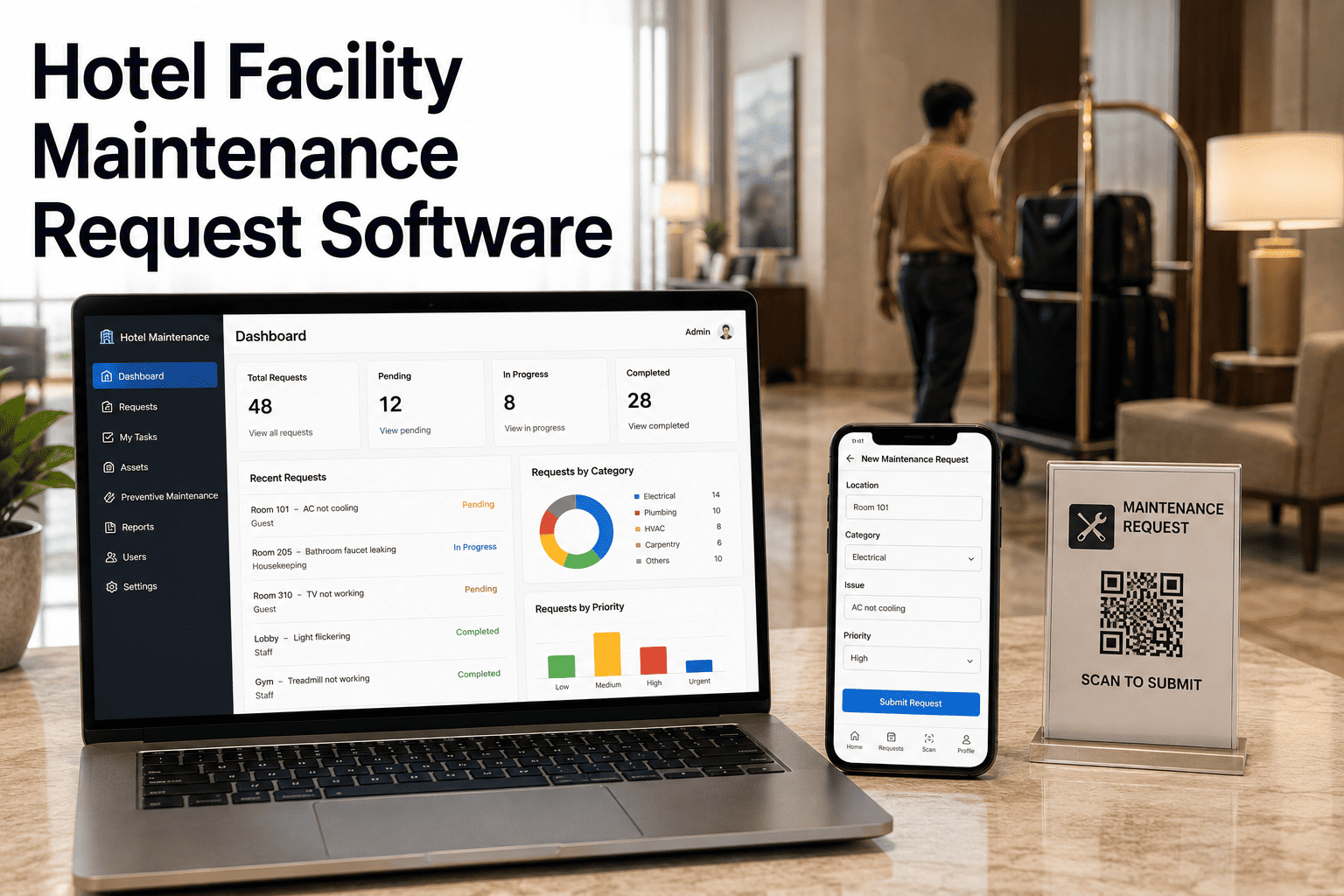
Five intake channels. One work order engine. Every guest-reported issue tracked from the moment it is logged to the moment a photo confirms it is fixed — with the priority rules and mobile dispatch your engineering team already knows how to use.
In-Room QR Code
Scan to submit · No app install required
SMS Text
Guest texts dedicated number · Multilingual
Front Desk Logged
Staff enters via mobile dashboard
OxMaint
Request Portal
Guest Mobile App
Property-branded PWA · Photo upload
Voice / Concierge
Agent transcribes into portal · Audit logged
All five channels create one work order with the same priority logic, SLA timer, and audit trail.
28%
Of all hotel guest communications are maintenance requests — the second-largest category
4–6
Independent intake channels operating in a typical hotel before consolidation
5–9%
RevPAR reduction for every one-star drop in average review score
3.8h → 45m
Issue-to-resolution time after unified digital intake replaces paper slips
Two Perspectives, One Source of Truth: What Your Guest Sees vs What Your Hotel Sees
A guest does not care which department a problem belongs to. They care that they reported it and that someone is doing something about it. The dual-view panel below shows the same maintenance request from both sides of the desk — the only difference is the level of detail, but the timeline and the status are the same.
Guest View
Room 412 · Ms. Tanaka
10:42 PM
Submitted: AC not cooling. Photo attached.
Received
10:43 PM
Auto-acknowledgement: We've received your request and an engineer is on the way. Estimated arrival 11:00 PM.
Acknowledged
10:58 PM
Engineer Marco is at your door. Tap to allow entry or request later.
In Progress
11:24 PM
Repair complete: Thermostat sensor replaced. Room set to 70°F. Please confirm.
Resolved
Hotel View
WO-2026-4471 · P1 Guest-Impact
10:42 PM
Intake: QR code · Asset: HVAC-412 · Severity: P1 · SLA timer: 15 min
Created
10:43 PM
Dispatch: Routed to Engineer Marco · Skills match · Floor 4 zone · 1 active WO
Assigned
10:58 PM
Arrival: Tech on-site at 16 min · SLA met · Photo of fault captured · Parts pulled: Thermostat sensor S-4423
On-site
11:24 PM
Closure: Repair logged · Before/after photo · Cost $42 part + 26 min labor · Guest notification sent
Closed
The Priority Matrix: How OxMaint Decides What Gets Fixed First
Not every guest request needs an engineer at the door in 15 minutes — and treating every request as P1 is the fastest way to break a maintenance team. The matrix below is how the Maintenance Request Portal classifies each new submission by guest impact and severity, with SLA timers attached to each quadrant. These tiers map to the hospitality industry standard adopted by leading hotel CMMS priority routing software.
High Guest Impact
High Impact · High Severity
P1 · Critical
SLA: 15 minutes
No AC during peak season · Active water leak · Door lock failure · No hot water · Power outage in occupied room
Auto-escalates to duty manager at minute 12 if unassigned
High Impact · Standard Severity
P2 · Urgent
SLA: 2 hours
TV not working · Slow drain · Lamp out · Wi-Fi disconnect in room · Toilet running
Auto-escalates to engineering supervisor at 90 minutes if unassigned
Low Impact · High Severity
P3 · Scheduled
SLA: Same day
Squeaky door · Loose drawer · Stained ceiling tile · Mini-fridge cooling weak · Loose tile in bathroom
Batched to engineering daily standup queue · Closed by 10 PM
Low Impact · Low Severity
P4 · Planned
SLA: 48–72 hours
Cosmetic paint chip · Worn carpet edge · Missing minor amenity · Soft good replacement
Bundled into next PM cycle · Cost-optimised scheduling
High Severity →
From scattered intake to one accountable request stream
Every Guest Request, One Work Order, One Audit Trail
Stop losing maintenance requests in radio chatter, voicemail, and post-it notes. OxMaint consolidates QR code, SMS, app, voice, and front-desk intake into one work order engine — with priority logic, SLA timers, and mobile dispatch your engineering team already knows how to use.
Request Lifecycle: Six Tracked States from Submission to Closure
Every request that enters the portal — regardless of channel — moves through the same six tracked states, each timestamped, each audit-logged, each visible to both the guest and the operations team in real time.
1
Submitted
Request lands in OxMaint via any of the five intake channels. Photo, room number, asset ID, and submitter captured.
Avg. dwell: under 30 seconds
2
Classified
Priority matrix applied. SLA timer begins. Asset lookup attaches PM history and warranty status.
Avg. dwell: under 10 seconds
3
Assigned
Routed to on-shift technician by skill match, current workload, and floor zone. Push notification sent to their device.
Repair logged with before/after photo, parts used, time taken, and asset condition update. Guest notified.
Avg. duration: 18–32 min for P1/P2
6
Verified
Guest confirms resolution. Satisfaction score captured. Work order closed and indexed to asset history for future PM scheduling.
Verification capture rate: 91%
The Mobile Technician View: What Your Engineering Team Sees on Their Phone
The portal is only as good as what the technician sees when they pick up their phone at 11 PM. The card below is what the mobile work order looks like for a P1 guest-impacting request — every field populated automatically, no typing required to accept and travel to the room.
10:43 PM
OxMaint
P1
New work order · SLA 14:23 remaining
Room
412 · Floor 4 · West Wing
Asset
HVAC-412 · LG Multi V S installed 2023
Issue
AC not cooling · Set 68°F · Reading 78°F
Guest
Ms. Tanaka · 2-night stay · Loyalty Gold
History
Last PM: 4 days ago · Filter changed
Parts
Suggest: Thermostat sensor S-4423 in stock
Guest photo attached
Accept · Navigate
Defer
Request Volume by Category: Where Your Maintenance Team Spends Its Hours
Industry data from properties using digital request management shows guest communications break down into four predictable categories. Knowing the mix lets your engineering director staff and schedule accordingly — and lets the maintenance team see when the mix shifts in a way that signals a deeper asset problem.
45%
Housekeeping
Towels, amenities, turndown, restocking. Highest volume; lowest urgency. Routes to housekeeping ops, not engineering.
28%
Maintenance
Temperature, plumbing, electrical, in-room tech. Lower volume but fastest SLA — the category that drives review scores up or down.
18%
Concierge
Reservations, recommendations, transportation. Requires local expertise; routes to concierge team with guest profile context.
9%
Food & Beverage
Room service, dietary needs, special occasions. Smallest volume but highest revenue-protection value per request.
The Operational Case: ROI for a 220-Room Mid-Scale Property
Scenario: 220-room property · 88% annual occupancy · ~5,800 maintenance requests per year
Average response time before portal (multi-channel intake)
3.8 hours
Average response time after OxMaint portal deployment
45 minutes
P1 response time for guest-impacting faults (before vs after)
47 min → 14 min
SLA breach event reduction in first 30 days post-deployment
Hospitality KPIs Your General Manager Should See Every Morning
Target: under 15 min
P1 Response Time
Mean elapsed time from P1 submission to technician on-site. The single most predictive metric for review-score recovery. Top quartile properties hold this under 12 minutes.
Target: above 95%
SLA Compliance
Percentage of work orders resolved within their priority tier SLA. Below 85% signals either understaffing, intake fragmentation, or escalation rules misconfigured.
Target: above 90%
First-Visit Resolution
Percentage of requests resolved on the technician's first visit. Below 75% means parts logistics, skill matching, or diagnosis quality needs review — every repeat visit erodes guest trust.
Target: above 85%
Guest Verification Rate
Percentage of closed requests confirmed by the guest as resolved. Acts as a quality control gate — a closed WO without guest verification is an assumption, not a fix.
Target: under 20%
Reactive Ratio
Percentage of work orders triggered by guest report vs PM schedule. Inverting this ratio over 12 months is the operational definition of a guest-experience-protecting maintenance program.
Target: 100%
Photo-Evidence Closure
Percentage of closed work orders with before/after photo attached. The audit-defensibility floor for insurance disputes, ADA inspections, and franchisor brand audits.
Expert Review
"
The single biggest cost in hospitality maintenance is not labor and it is not parts — it is the gap between a guest noticing a problem and the property knowing about it. I have audited four-star properties where the engineering team genuinely cared and was working hard, but where the average maintenance request still took 90 minutes to even reach an engineer because it bounced from front desk to radio to housekeeping back to front desk to a paper slip in a tray. The technology fix here is not exotic. It is a portal that accepts the request from any channel, classifies it against a priority matrix in seconds, and puts it on the right technician's phone with the asset history attached. Properties that get this right see their review scores recover in 90 days because every fixed issue is one fewer one-star review that gets written. OxMaint's Maintenance Request Portal is the operational backbone that makes that recovery possible — but the harder work is the cultural shift to treat every channel as equally valid intake. The guest who SMS'd at 11 PM deserves the same response as the guest who walked downstairs to the front desk at 11 AM.
Helena Vossberg, CHA, CHAE
Former Director of Operations · Four Seasons & Mandarin Oriental properties · 21 years hospitality facility operations · Specialism in CMMS deployment for luxury and upper-upscale hotels
Frequently Asked Questions
Q1
Does the Guest Maintenance Request Portal require guests to download an app?
No. The portal is intentionally designed around friction-free intake — the QR code in the room opens a property-branded web portal that requires no install, no account, and no login. SMS uses the guest's native messaging app. Voice and front-desk channels are agent-mediated. For properties that want a deeper app experience, OxMaint also supports a property-branded Progressive Web App that guests can pin to their home screen, but it is optional. The portal works for the guest whether they downloaded anything or not. Start a free OxMaint trial to preview the QR intake flow on your own property.
Q2
How does the portal integrate with our existing Property Management System (PMS)?
OxMaint integrates with major PMS platforms — Opera Cloud, Stayntouch, Cloudbeds, RoomRaccoon, and Mews — via documented APIs. Integration unlocks guest profile lookup (loyalty status, stay length, prior requests), room assignment context, and check-out coordination so unresolved maintenance requests are flagged before the room is reassigned. For properties on legacy PMS systems, a CSV-import workflow runs nightly to keep room and guest data current. Integration timeline is typically 3–5 days alongside the portal deployment.
Q3
How are priority tiers (P1, P2, P3, P4) actually assigned to incoming requests?
Three layers run in sequence. First, keyword-and-asset matching against your property's request taxonomy — "no AC" or "no hot water" auto-classifies as P1, "lamp out" as P2, "loose drawer" as P3. Second, guest context overlay — a P3 request from a Diamond loyalty guest on a one-night stay may be elevated to P2 by policy. Third, supervisor review queue for any request the system cannot classify with confidence above your threshold. The priority matrix and escalation rules are fully configurable per property, brand standard, or franchisor SOP. Book a demo to see the configuration workflow against your existing priority taxonomy.
Q4
What happens when a guest submits a request during the night audit shift with reduced engineering coverage?
The portal applies an overnight-coverage policy defined per property. P1 requests page the on-call engineer regardless of shift schedule and trigger a duty-manager notification at the SLA midpoint if the engineer has not acknowledged. P2 requests are held in a "next shift" queue with an acknowledgement message sent to the guest setting expectations. P3 and P4 requests are batched to the morning standup. This logic prevents the two common night-audit failures: critical requests that go silent until morning, and non-critical requests that wake a sleeping engineer for a loose drawer. Read more on hotel after-hours maintenance escalation in our hospitality operations guide.
Q5
How does OxMaint handle guest privacy and data retention for the maintenance request portal?
The portal stores only the minimum data needed to route and audit a work order: room number, request description, photo (if attached), and timestamps. Guest PII is referenced via PMS-provided identifiers, never duplicated into maintenance records. OxMaint operates with enterprise encryption, role-based access controls, and regional data residency options that comply with GDPR, CCPA, PIPEDA, and PDPL. Photos and request descriptions follow the property's defined retention policy — typically 24 months for audit purposes — and are auto-purged on schedule. Review the data-handling specifications when you sign up for a free trial.
Protect Your Review Score · Protect Your RevPAR
Your Guests Already Reported the Problem. Make Sure Your Hotel Heard It.
Every missed maintenance request is a one-star review waiting to be written. OxMaint's Guest Maintenance Request Portal consolidates the five channels your hotel already uses, applies the priority logic your engineering team needs, and puts every work order on a technician's phone with the asset history attached — in a deployment that goes live before your next high-occupancy weekend.