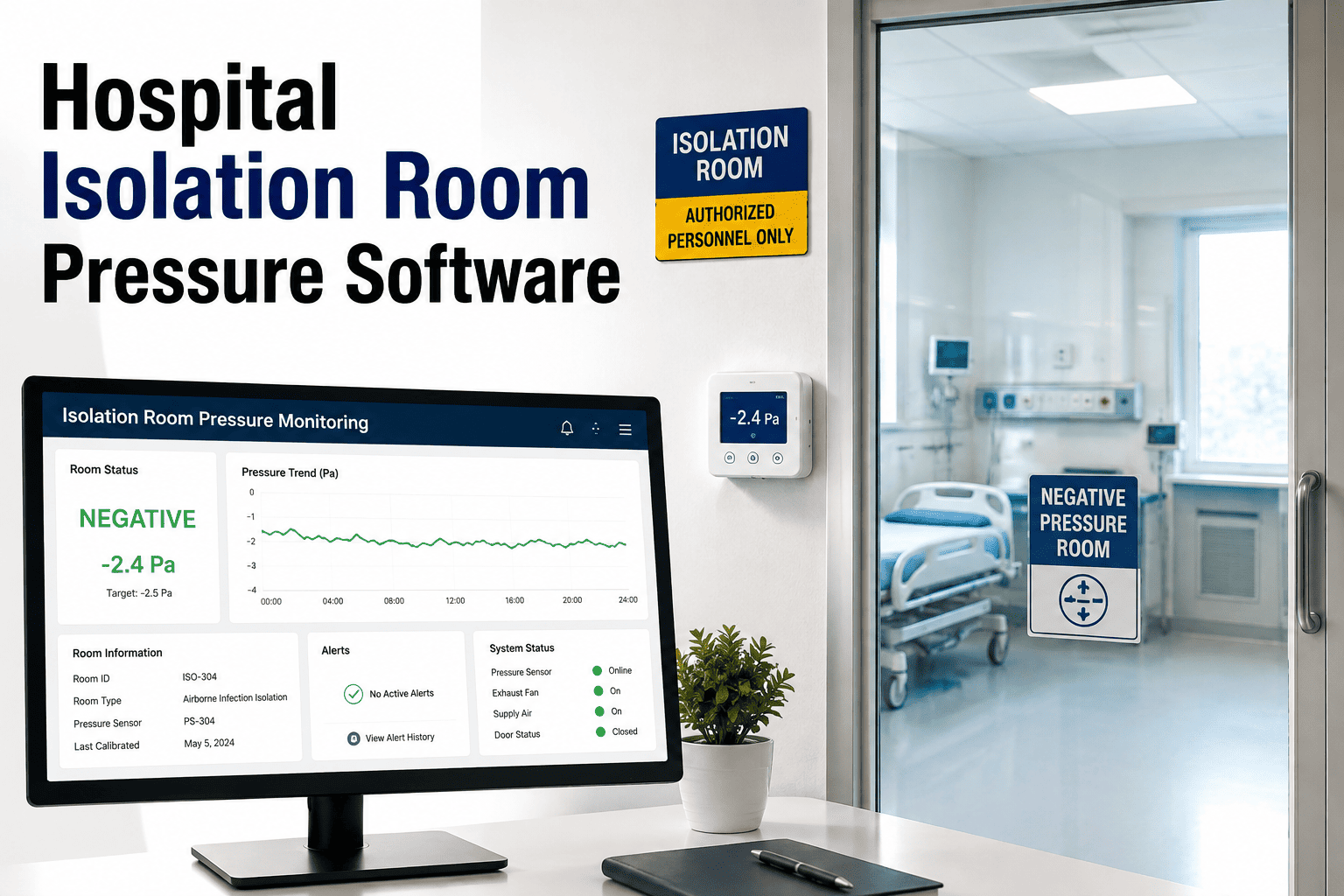
A hospital isolation room is only doing its job if the pressure differential behind that door stays exactly where it should. Airborne Infectious Isolation (AII) rooms must hold negative pressure so tuberculosis, measles, and other airborne pathogens never reach the corridor, while Protective Environment (PE) rooms need positive pressure to shield transplant and oncology patients from outside contaminants. ASHRAE Standard 170 requires continuous, permanently installed monitoring on every one of these rooms, and Joint Commission surveyors review those pressurization records under EC.02.05.01. Most facilities still rely on a paper log and a once-a-shift clipboard round, which is exactly the gap between a passing survey and a citation. Book a demo to see continuous isolation room pressure verification running in real time.
Infection Control
Facility Compliance
2026 Guide
Two Rooms, Two Opposite Pressures, One Monitoring Standard
AII Room
−0.01" WG
Negative pressure pulls air inward. Contains airborne pathogens like TB, measles, and flu-family viruses inside the room.
PE Room
+0.01" WG
Positive pressure pushes air outward. Keeps outside contaminants away from immunocompromised patients.
Minimum differential per ASHRAE 170 — most hospitals run 0.02–0.03" WG for margin against HVAC drift
Why This Fails Today
Clipboard Rounds Can't Catch a 3 AM Pressure Drop
Manual Monitoring
Staff glance at a wall gauge once per shift
Pressure loss between checks goes unnoticed
Paper logs are easy to backfill, hard to trust
Survey prep means chasing down binders
OxMaint Monitoring
Pressure logged continuously, every room, every minute
Instant alert the moment a room drifts off setpoint
Digital record time-stamped and tamper resistant
Audit-ready reports generated in one click
What Regulators Actually Check
Four Standards Every Isolation Room Answers To
ASHRAE 170
Sets the minimum pressure differential and mandates a permanently installed, continuously monitoring visual indicator for every AII and PE room.
Joint Commission
EC.02.05.01 surveys room pressurization records directly. Missing or inconsistent logs are a common citation during accreditation visits.
CDC Guidance
Recommends a minimum 2.5 Pa negative differential with 12 air changes per hour in new construction, 6 ACH in existing buildings.
FGI Guidelines
Defines over sixty room types across a hospital that require a documented positive or negative pressure relationship to adjacent spaces.
Stop Finding Out About Pressure Loss After the Fact
OxMaint pairs your existing pressure sensors with continuous CMMS logging, instant alerts, and audit-ready reports built for exactly the standards your surveyors check.
Room-By-Room Reference
Isolation Room Types and Their Pressure Requirements
When The Alarm Fires
The Four Steps Every Isolation Alarm Response Follows
01
Confirm the Alarm
Check the room's monitor reading before assuming a fault. A brief fluctuation during door use is normal.
02
Keep the Door Closed
Containment depends on a sealed room. Opening the door during a confirmed alarm defeats the pressure differential entirely.
03
Notify Facilities Engineering
A logged, time-stamped notification starts the correction clock and becomes part of the compliance record.
04
Evaluate Patient Relocation
If pressure cannot be restored quickly, written protocol determines whether the patient moves to a functioning AII room.
From The Field
What Facility Engineering Teams Say
Before we moved to continuous digital logging, our biggest fear was always the room that drifted off pressure overnight with nobody watching. Now every isolation room reports in every minute, and our survey binder builds itself.
Director of Facilities Engineering
Regional Acute Care Hospital, 340 Beds
Our last Joint Commission visit was the first time a surveyor pulled pressure records and found zero gaps. That alone justified moving off paper logs for every AII and PE room in the building.
Infection Prevention Manager
Academic Medical Center
Frequently Asked Questions
Hospital Isolation Room Pressure — Common Questions
What pressure differential does an isolation room actually need?
ASHRAE 170 sets a minimum of 0.01" WG (2.5 Pa), though most hospitals run closer to 0.02–0.03" WG to leave margin for normal HVAC variation.
Start a free trial to see your live differential trend by room.
How often does pressure need to be checked and documented?
Staff should visually confirm the monitor and log the reading at least once daily while a room is in isolation use, in addition to the continuous automated monitoring the standard requires.
What happens during a hospital's Joint Commission survey?
Surveyors review pressurization documentation directly under EC.02.05.01. Gaps, backfilled entries, or missing alarm records are common findings.
Book a demo to see audit-ready reporting built for this review.
Can a standard patient room be converted to negative pressure during a surge?
Yes. Portable HEPA exhaust units, filtered at 99.97 percent efficiency, can convert a standard room temporarily, exhausting through a sealed window panel until a dedicated AII room is available.
Does an anteroom need its own monitoring device?
Yes. ASHRAE 170 requires two separate monitoring devices for a combo AII/PE anteroom — one tracking the relationship to the isolation room and one tracking the relationship to the corridor.
Every Isolation Room, Verified, Every Minute
OxMaint turns scattered pressure gauges and paper rounds into one continuous, audit-ready compliance record across your entire facility.