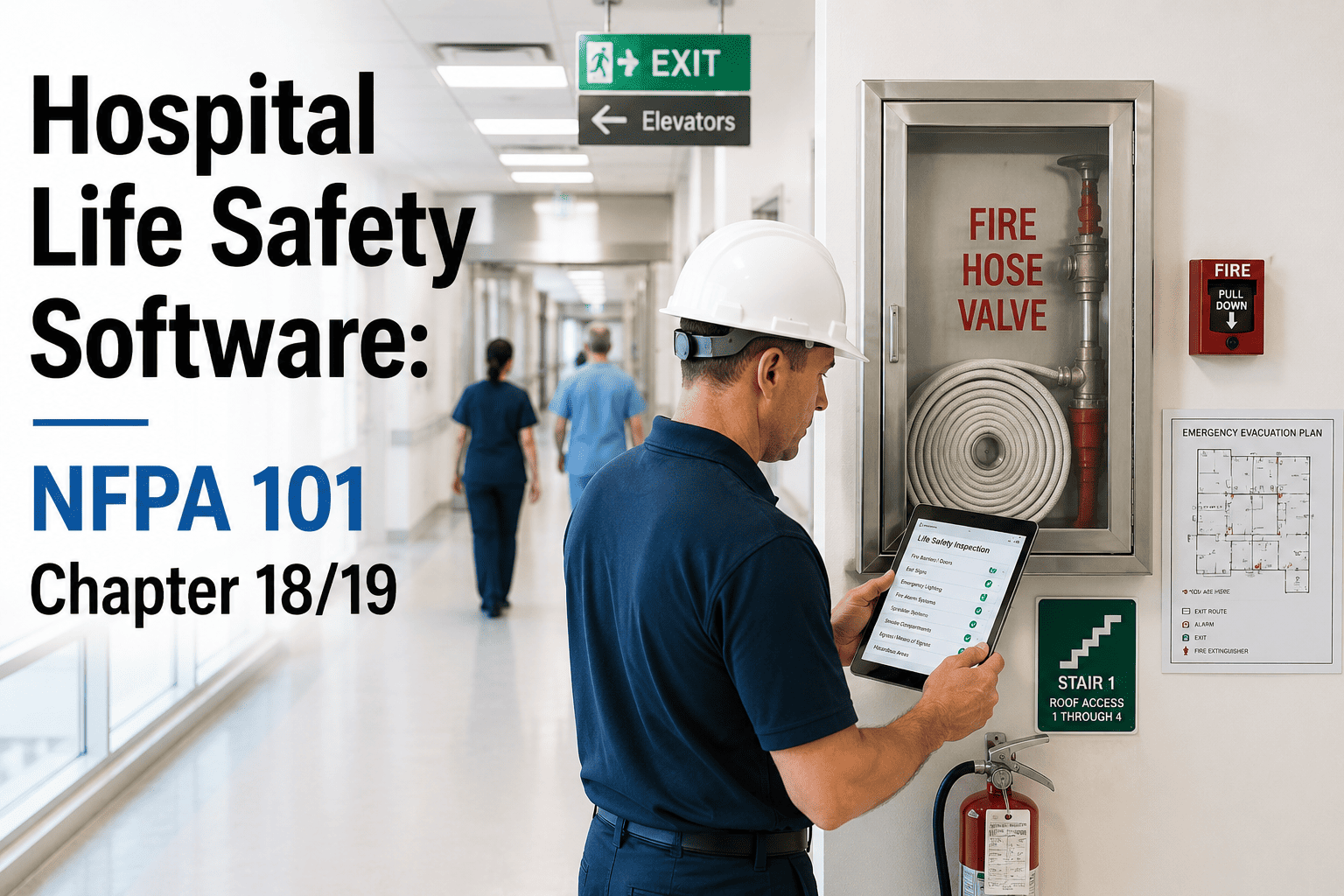
A hospital that fails a CMS life safety survey does not just receive a citation — it risks a mandatory plan of correction, repeat unannounced visits, and in the worst cases the threat of losing Medicare and Medicaid reimbursement altogether. NFPA 101 Chapters 18 and 19 govern every fire and smoke barrier, corridor door, means of egress, and interior finish inside a healthcare occupancy, and CMS surveyors still enforce the 2012 edition of the code down to the smallest paragraph reference. Facility teams juggling hundreds of fire doors, dozens of smoke compartments, and continuous interim life safety measures cannot rely on spreadsheets or paper binders when a surveyor asks for records going back years. This article looks at how hospital facility and life safety managers use structured CMMS work order management, like the platform at OxMaint, to keep every Chapter 18 and Chapter 19 requirement documented, current, and survey-ready.
Hospital Life Safety Software for NFPA 101 Chapter 18 and 19 Compliance
How hospital facility teams track fire barriers, means of egress, corridor doors, and interim life safety measures with a CMMS built for CMS survey readiness in 2026.
Core Life Safety Systems Every Hospital Must Document
Chapters 18 and 19 do not treat life safety as one system — they treat it as a set of interlocking systems that each need their own inspection interval, their own documentation trail, and their own accountable technician. A missing record for one smoke damper is treated the same as a missing record for the whole floor during a CMS survey, which is why facility teams increasingly move away from binders and toward a CMMS that timestamps every inspection automatically.
- 1-hour smoke barrier penetration seals — inspect annually
- Smoke compartment cross-corridor doors — verify latching monthly
- Fire-rated wall penetrations — log every new penetration seal
- Smoke damper actuation test — required every 4 years or 1 year for hospitals
- Suite boundary construction — verify against 40,000 sq ft limit
- Exit access corridor width — minimum 8 feet in new construction
- Corridor clutter and storage — documented rounds, twice per shift
- Emergency lighting and exit signage — monthly function test
- Stairwell door self-closing hardware — inspect quarterly
- Horizontal exit and refuge area access — annual verification
- Smoke detector sensitivity testing — annual per NFPA 72
- Fire alarm control panel supervisory test — weekly
- Pull station function check — semi-annual
- Notification appliance audibility — annual sound survey
- Fire drill documentation — quarterly, per shift, per building
Life Safety PM Schedule Hospitals Run on OxMaint
Every task below maps to a specific Chapter 18/19 provision that a CMS or state surveyor is trained to ask about. Building a preventive maintenance program directly around these intervals — rather than a generic annual walkthrough — is what separates a hospital that sails through survey week from one that spends months closing a plan of correction.
| System | PM Task | Frequency | NFPA Reference | OxMaint Automation |
|---|---|---|---|---|
| Fire Doors | Self-closing, latching, gap inspection | Annual, documented | NFPA 80 / Ch 19.3.6 | Auto-generated PM + photo checklist |
| Smoke Dampers | Actuation and drop test | 1 year (hospitals) | NFPA 105 | Calendar PM with runtime alert |
| Fire Alarm Panel | Supervisory signal verification | Weekly | NFPA 72 | Weekly recurring work order |
| Emergency Lighting | 30-second and 90-minute function test | Monthly / Annual | Ch 19.2.9 | Dual-interval PM tracking |
| Fire Drills | Simulated drill per shift, per building | Quarterly | Ch 19.7.1 | Auto-scheduled with digital sign-off |
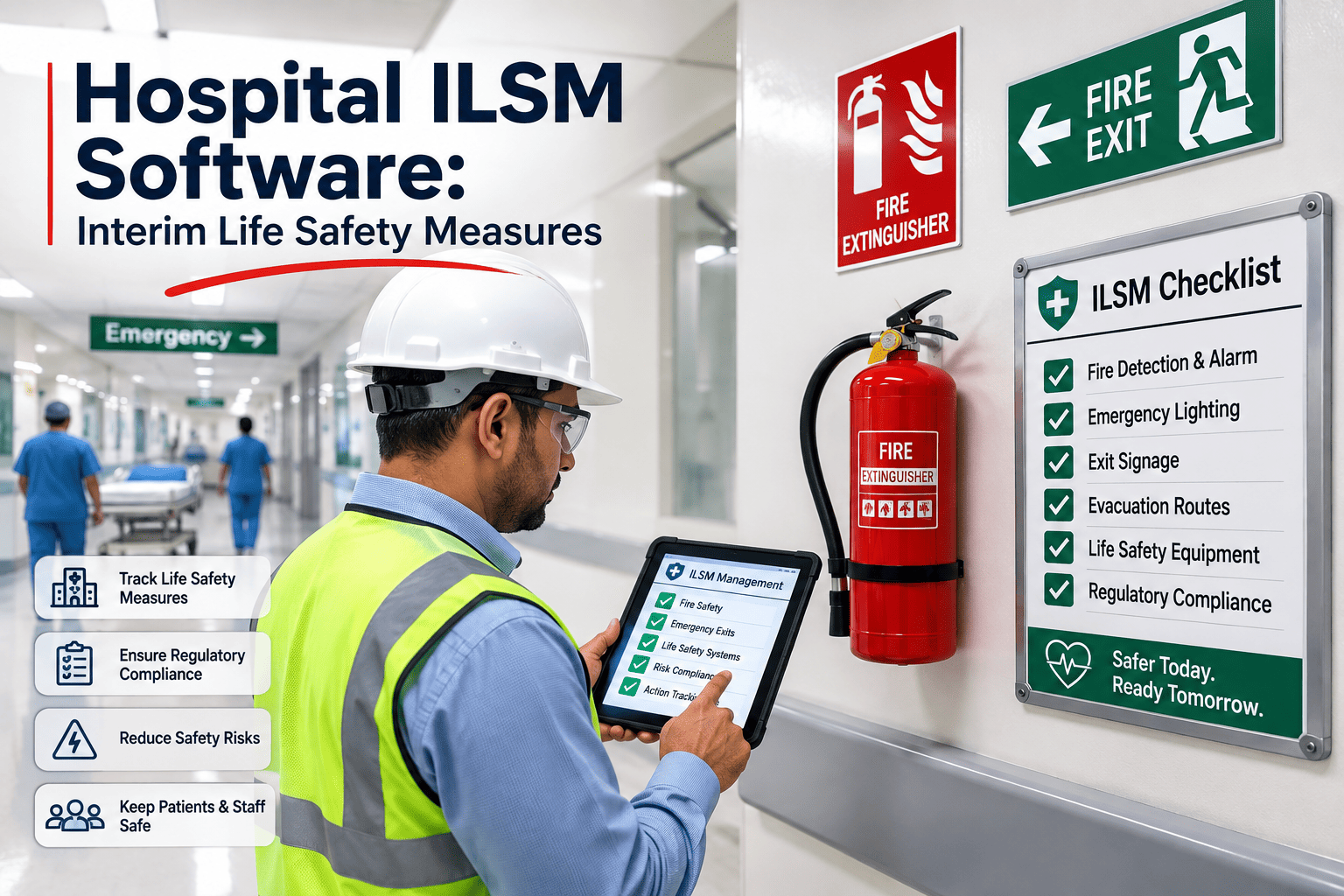
| ILSM Log | Interim life safety measure documentation | Continuous, event-based | Ch 4.6.10 | Triggered work order on deficiency |
OxMaint auto-generates fire door PMs, smoke damper test schedules, fire drill records, and interim life safety measure logs — so your facility team can pull a complete Chapter 18/19 compliance record in minutes, not days.
CMS Survey Readiness — What Documentation Surveyors Actually Pull
| Record Type | What Surveyors Ask For | Retention | Consequence if Missing |
|---|---|---|---|
| Fire Drill Reports | Date, shift, building, response time, deficiencies noted | 12 months minimum | Condition-level citation risk |
| ILSM Documentation | Trigger event, mitigation steps, closure date | Life of deficiency + audit trail | Plan of correction required |
| Fire Door Inspections | Annual test per door, technician signature | Current + prior cycle | Immediate deficiency tag |
| Smoke Damper Testing | Actuation confirmation per damper location | Current cycle records | Repeat survey visit likely |
Life safety compliance in a hospital is not an annual event, it is a daily operating discipline. The facilities that pass survey week without stress are the ones where every fire door test, every smoke damper actuation, and every interim life safety measure was already logged the moment it happened, not reconstructed the week before the surveyor arrives.
— VP of Facility Operations, 600-bed Regional Medical Center
Facilities that shifted from paper-based life safety logs to a CMMS-managed program report meaningfully faster deficiency closure and a sharp drop in repeat findings during follow-up surveys, according to industry benchmarking shared by healthcare facility associations tracking CMS survey outcomes.
Frequently Asked Questions
OxMaint gives hospital facility teams automated PM scheduling, digital fire door and smoke damper inspections, ILSM tracking, and one-click compliance exports — built specifically for the pace of Chapter 18 and Chapter 19 survey readiness. Book a demo to see the life safety dashboard configured live for your facility.