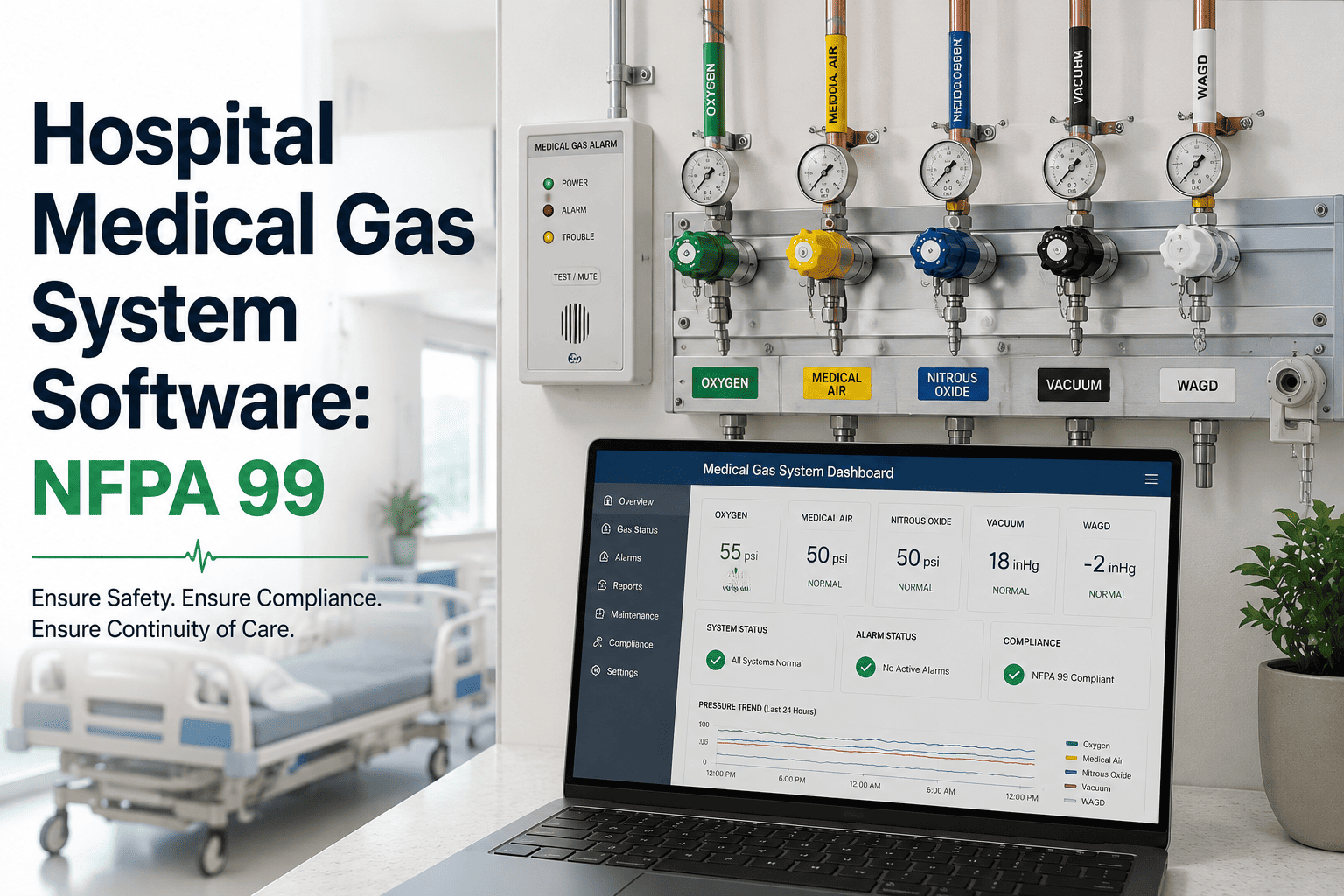
A piped oxygen line that alarms during a code blue, or a vacuum system that loses suction mid-surgery, is not treated by the Joint Commission as a maintenance lapse — it is treated as a sentinel event with mandatory root cause investigation. NFPA 99 requires documented inspection, testing, and alarm verification for every zone valve, master alarm panel, and source equipment cabinet across the oxygen, medical air, vacuum, and nitrous oxide systems that serve patient care areas. Joint Commission standard EC.02.05.09 backs this with an explicit requirement to inspect, test, and maintain every piped gas and vacuum system in the building. Facility engineers responsible for hundreds of zone valves across dozens of care areas cannot afford a documentation gap between the test that happened and the record that proves it happened, which is exactly the gap that CMMS platforms like OxMaint are built to close.
Hospital Medical Gas System Software for NFPA 99 Compliance
How hospital facility engineers track zone valves, master alarm panels, and source equipment across oxygen, medical air, vacuum, and nitrous oxide systems with a CMMS built for Joint Commission survey readiness.
The Components NFPA 99 Requires You to Test and Log
NFPA 99 does not leave inspection intervals entirely open — it expects a documented, risk-based schedule that a surveyor can trace from the plant room source equipment all the way to the bedside outlet. Every zone valve in the building has to be tested for isolation function, not sampled, and every alarm panel has to prove both its audible and visual indicators work before it can be signed off. The categories below cover where most facility teams build their PM library.
- Bulk oxygen tank pressure and level — daily log
- Medical air compressor duty cycle — weekly check
- Vacuum pump run-time and backup switchover — monthly test
- Manifold cylinder bank changeover — verify automatic function
- Reserve supply header pressure — daily verification
- Master alarm panel — confirm 24-hour staffed location
- Area alarm panel — activate low and high pressure simulation
- Alarm silence function — visual indicator must persist
- Panel labeling — gas type, zone, normal operating range
- High-pressure alarm — oxygen and nitrous oxide threshold test
- External leakage test — every valve, annually
- Isolation function test — 100% of valves, documented
- DISS outlet connection integrity — quarterly visual check
- Valve box labeling accuracy — verify against as-built drawings
- Gas contamination screening — moisture and particulate test
Medical Gas PM Schedule Built Around NFPA 99
The Joint Commission does not dictate a single interval for every task under EC.02.05.09 — it expects your facility to define a risk-based schedule and then prove you actually followed it. The intervals below reflect the intervals most hospital facility teams converge on when they align their utility management plan with NFPA 99 guidance and manufacturer recommendations.
| System | PM Task | Frequency | NFPA 99 Focus | OxMaint Automation |
|---|---|---|---|---|
| Master Alarm Panel | Audible and visual activation test | Annual, per panel | Chapter 5, Level 1 | Auto-scheduled with sign-off |
| Area Alarm Panel | Low/high pressure simulation test | Annual | Chapter 5.1.9 | Calendar PM per zone |
| Zone Valves | Isolation function and leak test | Annual, every valve | Chapter 5.1.12 | 100% coverage tracking |
| Bulk Oxygen Source | Level, pressure, changeover verification | Daily log | Chapter 5.1.3 | Auto-log with threshold alert |
| Vacuum Pumps | Backup switchover and run-time test | Monthly | Chapter 5.1.10 | Monthly recurring work order |
| Outlet Terminals | Connection integrity and flow test | Quarterly sample / Annual full | Chapter 5.1.12 | Digital checklist per outlet |
OxMaint centralizes every zone valve test, alarm panel verification, and source equipment log into one system — so Joint Commission surveyors get a complete, timestamped NFPA 99 compliance record instead of a search through binders and spreadsheets.
Joint Commission Survey — What EC.02.05.09 Documentation Looks Like
| Record Type | What Surveyors Ask For | Retention | Consequence if Missing |
|---|---|---|---|
| Zone Valve Test Log | Valve ID, zone, gas type, isolation result, signature | Current + prior cycle | RFI citation under EC.02.05.09 |
| Alarm Panel Verification | Panel ID, test date, audible/visual result | 12 months minimum | Corrective action plan required |
| Source Equipment Log | Daily pressure/level readings, changeover events | Rolling 12 months | Immediate deficiency tag |
| Contamination Test Records | Moisture, particulate, hydrocarbon test results | Current cycle records | Repeat survey follow-up |
A medical gas failure in a hospital is never just a maintenance ticket, it is a patient safety event the moment it happens near a bedside. The facilities that stay ahead of Joint Commission findings are the ones that test every single zone valve on schedule and can produce the record in seconds, not the ones that only discover a gap when a surveyor asks for it.
— Director of Plant Operations, Multi-Campus Health System
Industry reviews of NFPA 99 medical gas findings consistently point to inadequate inspection documentation and incorrect valve labeling as leading contributors to Joint Commission citations, reinforcing why a single, timestamped digital record matters as much as the inspection itself.
Frequently Asked Questions
OxMaint gives hospital facility engineers automated PM scheduling, digital zone valve and alarm panel testing, and one-click NFPA 99 compliance exports — built specifically for Joint Commission survey readiness. Book a demo to see the medical gas dashboard configured live for your facility.