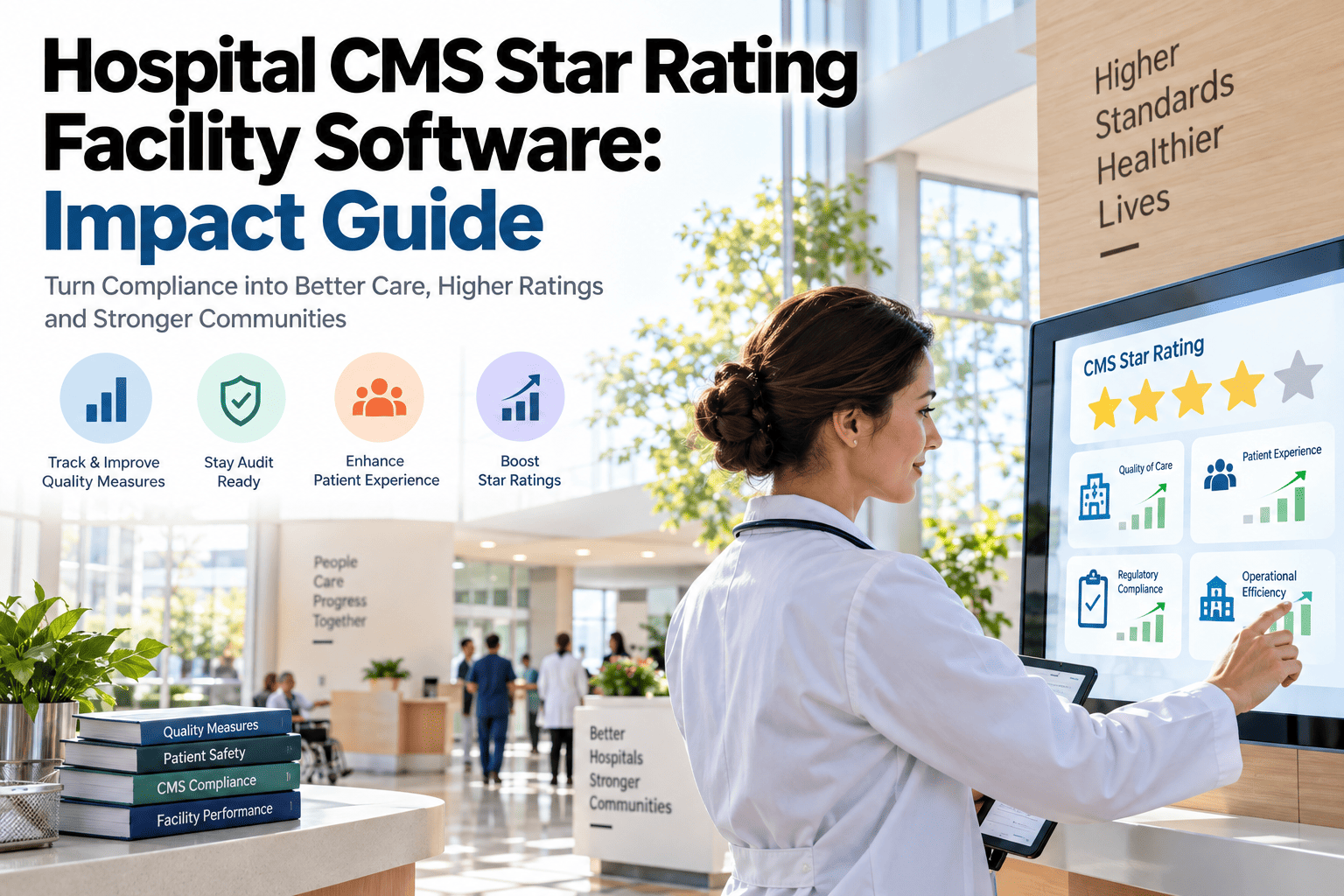
The CMS Overall Hospital Quality Star Rating is usually treated as a clinical scorecard, owned by quality and nursing leadership, with facilities management several rooms away from the conversation. That reading no longer survives contact with the 2026 methodology. Patient experience carries the same weight as mortality, safety and readmissions, and two of the survey items inside it — cleanliness of the hospital environment and quietness of the hospital environment — are now scored as separate measures rather than buried in a composite. Those two items describe the physical plant, the housekeeping programme and the mechanical systems that facilities engineering runs every day. Hospital teams that want to see how maintenance records feed those scores can book a walkthrough or open a free account.
Hospital CMS star rating facility software: the maintenance data behind your stars
Five measure groups decide a hospital's overall star. Facilities engineering has a direct, documented influence on two of them and an indirect influence on a third — yet almost no hospital reports facility performance to the star rating committee.
Mortality22%
Safety of care22%
Readmission22%
Patient experience22%
Timely and effective care12%
Patient experience and safety of care together carry 44% of the score. Both are shaped by the environment of care.
Where facilities engineering actually touches the score
The link between a maintenance backlog and a survey response is not abstract. Each row below traces a scored item back to a specific system, a specific failure mode and the maintenance control that prevents it.
| Scored item |
Patient-facing symptom |
Responsible system |
Maintenance control |
| Cleanliness of the hospital environment |
Dust on vents and sills, stained ceiling tiles, sticky floors, visible corrosion in bathrooms |
Terminal air devices, plumbing fixtures, finishes, drainage |
Scheduled diffuser and grille cleaning, ceiling tile replacement on inspection findings, fixture PM with photo evidence |
| Quietness of the hospital environment |
Night-time noise from equipment, doors, alarms and HVAC |
AHUs, fan coil units, door closers and hardware, nurse call, chillers |
Vibration and bearing checks, damper and actuator adjustment, door hardware PM, alarm and paging calibration |
| Responsiveness of hospital staff |
Call lights unanswered, delays caused by broken beds, lifts or equipment |
Nurse call system, patient lifts, beds, elevators |
Corrective work order routing with priority tiers and mobile acknowledgement |
| Safety of care measures |
Healthcare-associated infection, falls, pressure injury events |
Ventilation and pressure relationships, water systems, lighting, flooring |
Pressure differential logging, water management programme tasks, lighting level checks, floor condition inspections |
| Outpatient and ambulatory surgery experience |
Waiting area comfort, temperature, cleanliness, wayfinding |
Zone HVAC, outpatient suite finishes, signage, entrance systems |
Zone comfort rounds, seasonal changeover PM, outpatient-specific inspection routes |
| Overall rating and willingness to recommend |
Cumulative impression of an environment that feels cared for |
Every visible asset in the patient journey |
Backlog age control and visible-defect turnaround targets |
The reporting gap
Hospitals rarely lack maintenance activity; they lack the evidence chain that connects it to a scored item. When facilities can show that a unit's diffuser cleaning is current, that door closers on the ward were adjusted last month and that no comfort complaint is older than 48 hours, the cleanliness and quietness conversation stops being anecdotal.
What changed in the 2026 star rating methodology
The 2026 refresh made several structural changes at once, which is why many hospitals saw their star move without any obvious change in their own performance. Four of them matter to facilities leaders.
01
Cleanliness and quietness became separate measures
Previously combined as a single hospital environment item, the two now stand alone inside the patient experience group. That takes the HCAHPS measure count from eight to ten and gives each item its own standardised score — so a strong cleanliness result can no longer mask a weak quietness result.
02
HCAHPS now enters on linear mean scores
The patient experience group used published measure star values as inputs. It now uses the underlying linear mean scores on a hundred-point scale, which capture the full distribution of survey responses. Small, real improvements register instead of being rounded away at a star boundary.
03
Outpatient surgery experience joined the group
Five OAS CAHPS measures covering facilities and staff, communication about the procedure, preparation for discharge and recovery, facility rating and willingness to recommend now sit inside patient experience. Ambulatory surgery environments are in scope for the first time.
04
A four-star ceiling for the lowest safety quartile
Hospitals falling in the bottom quartile of the safety of care group, where at least three safety measures were captured, are capped at four stars regardless of performance elsewhere. A five-star rating can no longer be assembled around a weak safety position.
Why the movement was hard to explain
Because the changes landed together and scoring is relative to a peer group, a hospital can perform exactly as it did the year before and still see its star shift. That makes controllable inputs more valuable, and environment-of-care performance is among the most controllable inputs a hospital has.
Quietness: the measure facilities can move fastest
Quietness at night is consistently among the lowest-scoring HCAHPS items nationally. Much of the noise is mechanical, and mechanical noise responds to maintenance far more reliably than behavioural noise responds to signage.
Mechanical and building sources
Fan coil unit bearing wear producing a low rumble that staff stop noticing and patients do not
Damper actuators hunting against a poorly tuned control loop
Door closers out of adjustment, causing latch slam on every entry
Unbalanced supply air whistling through a partly closed terminal device
Loose ductwork or missing hanger isolation transmitting vibration into the ceiling plenum
Pneumatic tube station arrivals and compressor cycling near patient rooms
Ice machines, vacuum pumps and medical air compressors sited close to occupied space
The maintenance response
Vibration and sound-level rounds on unit equipment during night shift, logged against the asset
Control loop review and actuator PM scheduled with the seasonal changeover
Door hardware inspection route covering closers, latches, gaskets and hinges by ward
Air balance verification after any ceiling or partition work, recorded as a closeout task
Hanger and isolation inspection added to the plenum access checklist
Tube system and compressor PM timed to avoid overnight hours where possible
Complaint-triggered corrective orders with a defined response target and verification
Turning complaints into a tracked asset problem
A noise complaint that reaches a nurse manager and stops there produces nothing. The same complaint raised as a corrective work order against a named asset produces a repair, a record and a trend. Over a survey period, that difference is visible in the score.
Environment of care in OxMaint
Give your star rating committee facility evidence, not anecdotes
Inspection rounds by unit, corrective work orders with response targets, asset histories for every fan coil and door closer, and dashboards showing open environment-of-care items by ward. Everything the patient experience conversation has been missing.
The safety cap makes environment of care a board-level issue
With a four-star ceiling now attached to the lowest safety quartile, the systems that influence infection, falls and patient harm carry weight beyond their own group. Several of them are maintained, not clinical.
Ventilation and pressure relationships
Operating rooms, airborne infection isolation rooms, protective environment rooms and sterile processing all depend on held pressure differentials and air change rates. Continuous or per-shift logging with an escalation path is the difference between a documented control and an assumption.
Water management
Temperature checks, flushing of low-use outlets, dead-leg management and cooling tower treatment are scheduled maintenance tasks with infection consequences. They need the same record discipline as any regulated PM.
Patient handling equipment
Ceiling lifts, floor lifts, slings and bariatric equipment reduce fall and injury risk only while they are inspected, load-tested and available. An out-of-service lift with no tracked repair date is a fall risk with a paper trail.
Flooring, lighting and egress
Threshold transitions, worn non-slip surfaces, failed corridor lamps and blocked egress paths are inspection findings that map directly onto fall events. They belong on a rounding checklist with photo capture and a repair deadline.
Medical gas and vacuum
Source equipment, alarms and outlets require documented periodic verification. Missing records are both a safety exposure and an accreditation finding during survey.
Life safety systems
Fire alarm, suppression, smoke barriers and door assemblies carry prescriptive inspection frequencies. Their records are the first thing a surveyor asks for and the most common place a paper system fails.
From ward round to closed record
The workflow below is what a defensible environment-of-care programme looks like when it runs on a CMMS rather than on clipboards and email.
1
Scheduled round
A unit-specific inspection route opens on the technician's phone with the items that map to scored measures: air devices, door hardware, fixtures, finishes, lighting, noise.
2
Finding captured
A failed item is recorded with a photo, a location and a severity. No separate form, no transcription later, no findings lost between the ward and the office.
3
Work order raised
The finding becomes a corrective work order against the asset, with a priority tier and a response target appropriate to a patient-occupied area.
4
Assigned and acknowledged
Routing sends it to the right trade with a mobile notification. Acknowledgement time and start time are captured, which is where most response-target reporting falls apart.
5
Repaired and verified
Completion requires evidence: a closing photo, parts used, and where relevant a re-measured value such as a pressure differential or a sound reading.
6
Reported to the committee
Open items by unit, median closure time and repeat findings by asset feed the quality dashboard the same month, not a quarter later in a hand-built spreadsheet.
Facility measures worth reporting alongside the star rating
These are definitions, not benchmarks. Each one is directly controllable by the facilities department and each one has a plausible path to a scored item.
Environment-of-care backlog age by unit
Median and ninetieth percentile age of open corrective items in patient-occupied areas. Ageing backlog in a single ward is often the hidden explanation for a weak cleanliness score on that floor.
Visible-defect closure time
Time to close findings a patient can see: stained tiles, damaged finishes, failed lamps, dirty air devices. Track separately from plant work, because patients score only what is in the room.
Noise-related corrective volume
Count of noise complaints converted into work orders, and the share resolved with a mechanical root cause. A rising conversion rate is a healthy sign, not a problem.
Pressure relationship compliance
Share of required room pressure readings taken on schedule and within limits, by area. This is the single cleanest link between facilities data and the safety of care group.
PM completion in patient care areas
Completion rate for preventive tasks on assets located in or serving occupied clinical space, held separately from central plant PM compliance.
Repeat findings per asset
Assets generating multiple findings within a rolling quarter. These are replacement or modernisation candidates, and the data makes the capital case without argument.
What OxMaint contributes to a hospital facilities department
Hospital maintenance software has to work for a technician in a corridor at two in the morning and for a director presenting to the quality committee three weeks later. These capabilities serve both.
Mobile inspections and rounds
Unit-specific checklists with photo capture and required fields, usable on a phone, so environment-of-care rounds produce structured data rather than a signed sheet nobody reads.
Preventive maintenance scheduling
Calendar, runtime and meter-based triggers across HVAC, plumbing, life safety and clinical support assets, with automatic generation and assignment.
Work order management
Priority tiers, response targets, routing by trade and location, and acknowledgement timestamps that make response reporting real rather than reconstructed.
Asset management
Full history by asset and by room, including repeat findings, parts consumed and total maintenance cost, which is the evidence base for replacement decisions.
Compliance records
Dated, signed and attachment-backed records for inspection and testing programmes, retrievable by asset, by area or by date range during a survey.
Inventory control
Critical spares held against minimum levels so a patient-area repair is not delayed by a stock-out, with consumption tied to the work order.
Dashboards and reporting
Backlog, closure time and PM compliance by unit, exportable for the quality committee without a manual spreadsheet build each cycle.
Condition-based workflows
Sensor feeds for pressure, temperature and runtime that raise corrective work automatically when a monitored condition leaves its band.
Star rating and facilities: common questions
Does a CMMS directly change our CMS star rating?
No software changes a score by itself. It changes the speed and consistency of the maintenance work behind cleanliness, quietness and environmental safety, and it produces the evidence to manage that work. Book a demo to see the reporting a committee actually uses.
Which measures should facilities focus on first?
Quietness and cleanliness, because both are now scored individually and both have identifiable mechanical and housekeeping root causes. Start with the units showing the weakest results and build a noise and visible-defect route for those floors.
How does this fit alongside our accreditation compliance work?
It is the same dataset viewed differently. Inspection records, PM completion and life safety testing serve survey readiness and star rating reporting at once — you can set up both record sets free without duplicating entry.
Do we need sensors to report pressure relationship compliance?
Not to start. Scheduled manual readings recorded against the room and the asset are defensible and auditable. Continuous monitoring adds value in critical areas where a relationship can fail between rounds.
How long does it take to stand up environment-of-care rounds?
Most departments build their first unit checklist and asset register within a few days, then extend ward by ward. The limiting factor is usually agreeing the checklist content with nursing, not the configuration itself.
Put facilities in the star rating conversation
Cleanliness and quietness are scored separately now. Manage them that way.
OxMaint gives hospital facilities teams the rounds, work orders, asset histories and dashboards that turn environment-of-care performance into reportable data. Bring evidence to the next quality committee instead of a description of how busy the department has been.